
If you are asking “how many square feet does a concrete truck cover”, the answer depends on three important things:
- The size of the concrete truck
- The thickness of the concrete slab
- The total cubic yards of concrete delivered
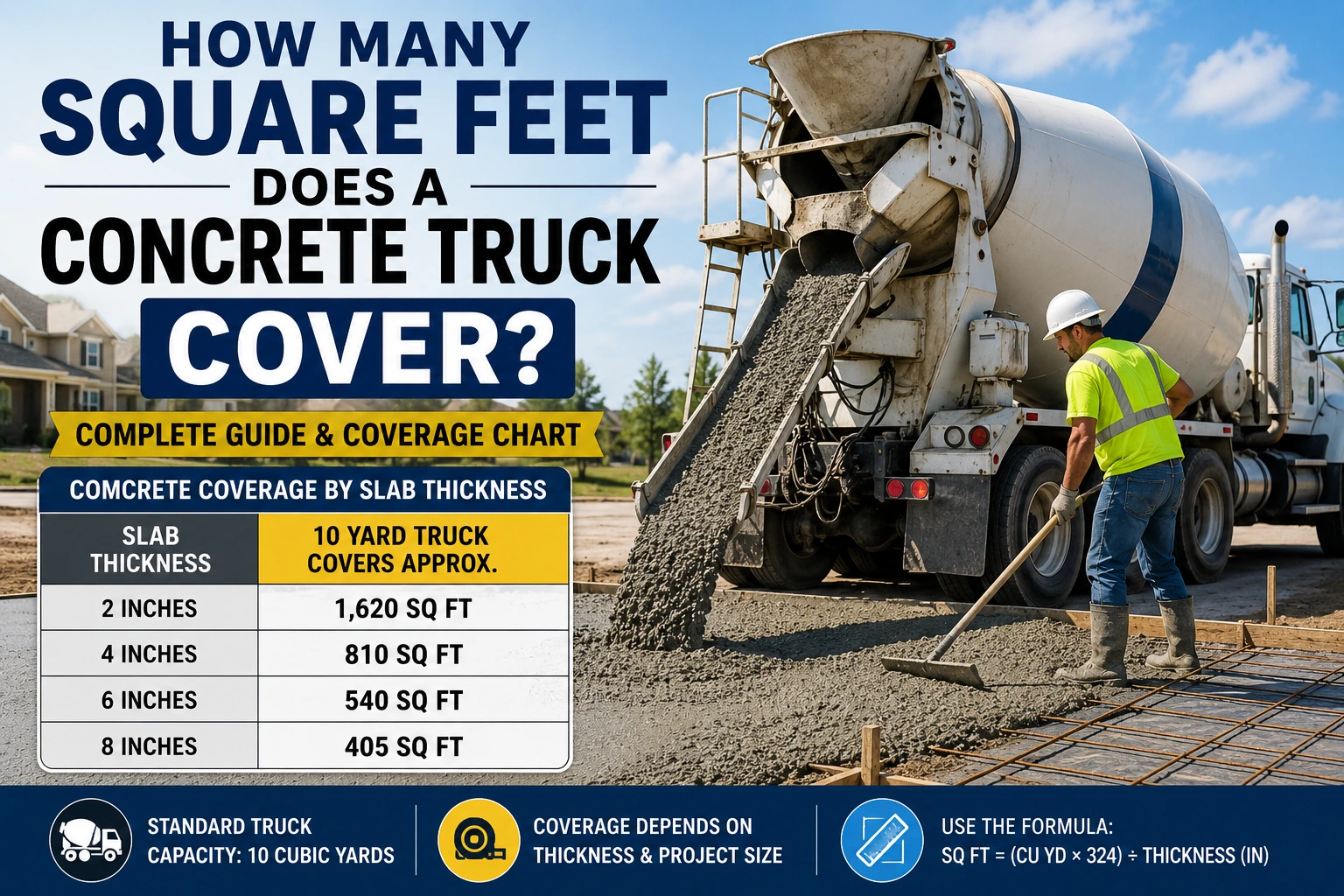
On average, a standard concrete truck carrying 10 cubic yards of concrete can cover:
- About 810 square feet at 4 inches thick
- About 540 square feet at 6 inches thick
- About 405 square feet at 8 inches thick
Concrete coverage changes because thicker slabs require more material. A driveway, patio, sidewalk, and foundation all use different slab depths.
This guide explains:
- Concrete truck coverage calculations
- Square footage charts
- Real-world examples
- Concrete formulas
- Ordering tips
- Common mistakes to avoid
By the end, you will know exactly how much area a concrete truck can cover for your project.
Quick Answer: Concrete Truck Coverage
Here is a quick overview of how much area a standard 10-yard concrete truck can cover.
| Slab Thickness | Square Feet Covered |
|---|---|
| 2 inches | 1,620 sq ft |
| 3 inches | 1,080 sq ft |
| 4 inches | 810 sq ft |
| 5 inches | 648 sq ft |
| 6 inches | 540 sq ft |
| 8 inches | 405 sq ft |
These numbers are approximate but widely used in construction planning.
The thicker the slab:
- The fewer square feet the truck covers
The thinner the slab:
- The more square footage you can pour
Understanding Concrete Truck Capacity
Before calculating coverage, it helps to understand how concrete trucks work.
What Is a Concrete Truck?
A concrete truck transports ready-mix concrete from a batching plant to a construction site.
The rotating drum keeps the concrete mixed during transport.
Concrete trucks are commonly used for:
- Driveways
- Sidewalks
- Foundations
- Garage floors
- Patios
- Commercial slabs
Average Concrete Truck Size
Most standard trucks carry:
- 8 to 10 cubic yards of concrete
Some larger trucks can carry:
- 12 cubic yards
However, 10 cubic yards is the most common estimate used for residential projects.
How Concrete Coverage Is Calculated
Concrete coverage is measured using:
- Cubic yards
- Slab thickness
- Square footage
The key idea is simple:
More thickness = less coverage.
For example:
- A thin patio slab covers a large area
- A thick foundation slab covers less area
Formula to Calculate Concrete Coverage
The formula for concrete coverage is:
\text{Square Feet} = \frac{\text{Cubic Yards} \times 324}{\text{Thickness in Inches}}
Why 324?
Because:
- 1 cubic yard = 27 cubic feet
- 27 × 12 = 324
This formula helps estimate square footage quickly.
Example Calculation
Let’s calculate how much area a 10-yard truck covers at 4 inches thick.
\frac{10 \times 324}{4} = 810\ \text{square feet}
So:
- A 10-yard concrete truck covers approximately 810 square feet at 4 inches deep.
Coverage Chart by Slab Thickness
This detailed chart shows approximate concrete coverage for different slab depths.
| Cubic Yards | 2 in Thick | 4 in Thick | 6 in Thick | 8 in Thick |
| 1 Yard | 162 sq ft | 81 sq ft | 54 sq ft | 40 sq ft |
| 5 Yards | 810 sq ft | 405 sq ft | 270 sq ft | 202 sq ft |
| 8 Yards | 1,296 sq ft | 648 sq ft | 432 sq ft | 324 sq ft |
| 10 Yards | 1,620 sq ft | 810 sq ft | 540 sq ft | 405 sq ft |
| 12 Yards | 1,944 sq ft | 972 sq ft | 648 sq ft | 486 sq ft |
This table is useful for:
- Contractors
- DIY projects
- Home renovations
- Concrete planning
Real-World Examples of Concrete Truck Coverage
Understanding real examples makes calculations easier.
Example 1: Concrete Driveway
A driveway measures:
- 20 feet wide
- 40 feet long
Total area:
- 800 square feet
At 4 inches thick:
- One 10-yard truck is usually enough
Example 2: Backyard Patio
Patio size:
- 15 × 20 feet
Area:
- 300 square feet
At 4 inches thick:
- About 4 cubic yards needed
A small concrete truck or partial load works well.
Example 3: Garage Floor
Garage dimensions:
- 24 × 24 feet
Area:
- 576 square feet
At 6 inches thick:
- Around 11 cubic yards needed
This may require:
- One large truck
- Or two smaller loads
Factors That Affect Concrete Coverage
Several factors can change how much area a concrete truck covers.
1. Slab Thickness
This is the biggest factor.
Common slab thickness:
- Sidewalks: 4 inches
- Driveways: 4–6 inches
- Foundations: 8 inches or more
Thicker slabs use more concrete.
2. Waste and Spillage
Concrete projects often lose material due to:
- Spills
- Uneven ground
- Overpouring
Most contractors order:
- 5% to 10% extra concrete
3. Ground Conditions
Uneven surfaces require:
- Additional concrete
- More leveling work
Poor site preparation increases material use.
4. Reinforcements and Forms
Rebar, mesh, and forms may affect:
- Final depth
- Pour consistency
- Concrete volume needs
5. Truck Capacity Limits
Road weight laws may reduce:
- Maximum concrete load
- Delivery size
Some trucks carry less than advertised depending on local regulations.
Common Concrete Truck Sizes
Concrete trucks come in several sizes.
| Truck Size | Cubic Yards | Typical Use |
| Small Truck | 3–5 yards | Sidewalks, patios |
| Medium Truck | 6–8 yards | Residential slabs |
| Standard Truck | 10 yards | Driveways, foundations |
| Large Truck | 12 yards | Commercial projects |
Choosing the right size helps:
- Reduce waste
- Save money
- Improve efficiency
How to Estimate Concrete for Your Project
Here is a simple step-by-step process.
Step 1: Measure Length and Width
Multiply:
- Length × width
Example:
- 20 × 30 = 600 square feet
Step 2: Choose Slab Thickness
Typical thickness:
- Patio: 4 inches
- Driveway: 6 inches
- Foundation: 8 inches
Step 3: Use the Formula
\text{Cubic Yards} = \frac{\text{Square Feet} \times \text{Thickness in Inches}}{324}
Example:
\frac{600 \times 4}{324} = 7.4\ \text{cubic yards}
So:
- You need about 7.5 cubic yards
Benefits of Accurate Concrete Estimation
Good estimates help you:
- Avoid running out of concrete
- Reduce wasted material
- Save money
- Finish pours smoothly
- Prevent project delays
Ordering too little concrete can ruin a pour.
Ordering too much increases costs.
Accurate planning matters.
Common Mistakes When Ordering Concrete
Many homeowners make avoidable mistakes.
1. Ignoring Thickness
A slab that is too thin may crack.
A slab that is too thick wastes money.
2. Forgetting Waste Factor
Always add:
- 5–10% extra concrete
This covers:
- Spills
- Uneven surfaces
- Last-minute adjustments
3. Incorrect Measurements
Small measuring errors create large volume problems.
Double-check:
- Length
- Width
- Depth
4. Not Considering Access
Concrete trucks need:
- Enough turning space
- Clear access paths
Difficult access may require:
- Pump trucks
- Wheelbarrows
- Extra labor
Expert Tips for Concrete Projects
Professionals use several tricks to improve efficiency.
Order Slightly More Than Needed
Extra concrete is safer than shortages.
Most experts recommend:
- 5% extra
Prepare the Site Properly
Before the truck arrives:
- Set forms
- Compact soil
- Install reinforcements
This prevents delays during pouring.
Schedule Carefully
Concrete begins hardening quickly.
Coordinate:
- Workers
- Tools
- Finishing equipment
Before delivery starts.
Use a Concrete Calculator
Online calculators simplify:
- Yard estimates
- Coverage calculations
- Slab planning
They reduce mistakes significantly.
Concrete Coverage for Popular Projects
Here is a quick guide.
| Project Type | Common Thickness | Approx Coverage From 10 Yards |
| Patio | 4 inches | 810 sq ft |
| Sidewalk | 4 inches | 810 sq ft |
| Driveway | 6 inches | 540 sq ft |
| Garage Floor | 6 inches | 540 sq ft |
| Foundation Slab | 8 inches | 405 sq ft |
This helps compare projects quickly.
Frequently Asked Questions
1. How many square feet does a 10-yard concrete truck cover?
A 10-yard truck covers:
- About 810 square feet at 4 inches thick
Coverage changes depending on slab depth.
2. How much area does 1 yard of concrete cover?
One cubic yard covers approximately:
- 81 square feet at 4 inches thick
3. How thick should a concrete driveway be?
Most residential driveways use:
- 4 to 6 inches of concrete
Heavy vehicles may require thicker slabs.
4. How do I calculate concrete needed?
Use this formula:
\text{Cubic Yards} = \frac{\text{Square Feet} \times \text{Thickness}}{324}
5. Should I order extra concrete?
Yes.
Most contractors recommend:
- 5% to 10% extra
To cover waste and unexpected needs.
Conclusion
If you were wondering “how many square feet does a concrete truck cover”, the answer depends mainly on slab thickness and truck capacity.
A standard 10-yard concrete truck typically covers:
- 810 square feet at 4 inches thick
- 540 square feet at 6 inches thick
- 405 square feet at 8 inches thick
Using proper calculations helps:
- Save money
- Prevent shortages
- Reduce waste
- Improve project planning
Whether you are pouring a driveway, patio, garage floor, or foundation, understanding concrete coverage makes your project smoother and more cost-effective.
Always measure carefully, include extra material for safety, and choose the right slab thickness for long-lasting results.
Discover More:
1How Many Cubic Feet in a Pickup Truck Bed?