
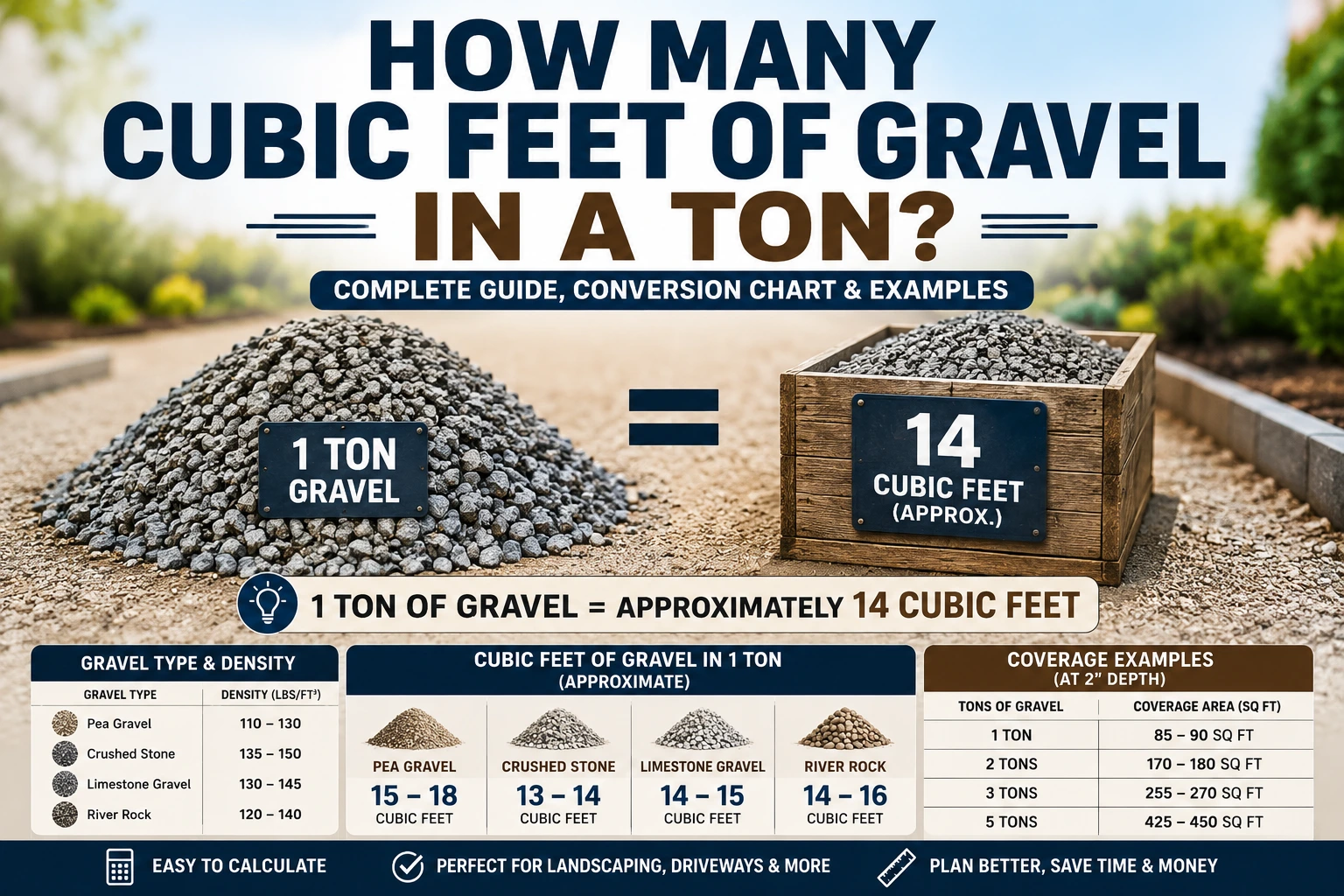
If you are wondering “how many cubic feet of gravel in a ton”, the short answer is:
- One ton of gravel typically equals 13 to 18 cubic feet
- On average, most gravel types contain about 14 cubic feet per ton
However, the exact amount depends on:
- Gravel type
- Stone size
- Moisture level
- Density
- Compaction
For example:
- Crushed stone may have fewer cubic feet per ton
- Lightweight pea gravel may have more cubic feet per ton
Understanding gravel volume is important for:
- Landscaping
- Driveways
- Walkways
- Drainage systems
- Construction projects
This guide explains everything you need to know, including formulas, charts, calculations, and practical examples.
Quick Answer: Cubic Feet in a Ton of Gravel
Here is a simple estimate for common gravel.
| Gravel Weight | Approx Cubic Feet |
|---|---|
| 1 ton gravel | 14 cubic feet |
| 2 tons gravel | 28 cubic feet |
| 5 tons gravel | 70 cubic feet |
| 10 tons gravel | 140 cubic feet |
This estimate works for standard crushed gravel with average density.
But remember:
- Gravel density varies
That means actual cubic feet can change slightly.
Understanding Gravel Weight and Volume
To understand gravel calculations, you need to know the difference between:
- Weight
- Volume
Weight
Weight is measured in:
- Tons
- Pounds
In the United States:
- 1 ton = 2,000 pounds
Volume
Volume measures space.
It is commonly measured in:
- Cubic feet
- Cubic yards
One cubic foot is:
- A space measuring 1 foot × 1 foot × 1 foot
Why Gravel Measurements Matter
Gravel is sold by:
- Weight
- Volume
Knowing both helps you:
- Estimate costs
- Prevent shortages
- Avoid overspending
- Plan landscaping accurately
Formula for Converting Tons to Cubic Feet
The general conversion formula is:
\text{Cubic Feet} = \frac{\text{Weight in Pounds}}{\text{Density}}
Since:
- 1 ton = 2,000 pounds
The formula becomes:
\text{Cubic Feet} = \frac{2000}{\text{Gravel Density}}
Typical gravel density:
- Around 100–150 pounds per cubic foot
Example:
\frac{2000}{140} \approx 14.3\ \text{cubic feet}
So:
- One ton of average gravel equals roughly 14 cubic feet
Gravel Coverage Chart
This chart helps estimate gravel volume quickly.
| Tons of Gravel | Approx Cubic Feet | Approx Cubic Yards |
| 1 ton | 14 cu ft | 0.52 cu yd |
| 2 tons | 28 cu ft | 1.04 cu yd |
| 3 tons | 42 cu ft | 1.56 cu yd |
| 5 tons | 70 cu ft | 2.59 cu yd |
| 10 tons | 140 cu ft | 5.18 cu yd |
Remember:
- 1 cubic yard = 27 cubic feet
Different Types of Gravel and Their Density
Not all gravel weighs the same.
Different stone types change the conversion.
1. Crushed Stone
Typical density:
- 140–150 lb/cu ft
Approximate volume:
- 13–14 cubic feet per ton
Used for:
- Driveways
- Foundations
- Roads
2. Pea Gravel
Typical density:
- 110–130 lb/cu ft
Approximate volume:
- 15–18 cubic feet per ton
Used for:
- Landscaping
- Walkways
- Decorative gardens
3. River Rock
Typical density:
- 120–140 lb/cu ft
Approximate volume:
- 14–16 cubic feet per ton
Used for:
- Drainage
- Water features
- Decorative landscaping
4. Limestone Gravel
Typical density:
- 130–145 lb/cu ft
Approximate volume:
- 14–15 cubic feet per ton
Used for:
- Driveways
- Base layers
- Construction projects
Real-Life Examples of Gravel Coverage
Here are practical examples to help visualize gravel volume.
Example 1: Gravel Driveway
Driveway dimensions:
- 10 feet wide
- 20 feet long
- 4 inches deep
Volume calculation:
10 \times 20 \times \frac{4}{12} = 66.7\ \text{cubic feet}
Since one ton equals about 14 cubic feet:
\frac{66.7}{14} \approx 4.8\ \text{tons}
You would need:
- About 5 tons of gravel
Example 2: Garden Path
Path dimensions:
- 3 feet wide
- 25 feet long
- 2 inches deep
Volume:
3 \times 25 \times \frac{2}{12} = 12.5\ \text{cubic feet}
Required gravel:
- About 1 ton
Example 3: Gravel Patio Base
Patio dimensions:
- 12 × 12 feet
- 3 inches deep
Volume:
12 \times 12 \times \frac{3}{12} = 36\ \text{cubic feet}
Gravel needed:
\frac{36}{14} \approx 2.6\ \text{tons}
You would need:
- Around 3 tons
How to Calculate Gravel for Your Project
Follow these simple steps.
Step 1: Measure Area
Multiply:
- Length × width
Example:
- 20 × 15 = 300 sq ft
Step 2: Choose Gravel Depth
Common depths:
- Walkways: 2 inches
- Driveways: 4 inches
- Drainage areas: 6 inches
Step 3: Convert Depth to Feet
Example:
- 4 inches ÷ 12 = 0.33 feet
Step 4: Calculate Volume
Use this formula:
\text{Volume} = \text{Length} \times \text{Width} \times \text{Depth}
Step 5: Convert Volume to Tons
Divide cubic feet by:
- Approximate cubic feet per ton
Example:
\frac{100\ \text{cubic feet}}{14} \approx 7.1\ \text{tons}
Factors That Affect Gravel Volume
Several things change how many cubic feet are in a ton.
1. Moisture Content
Wet gravel weighs more.
This reduces:
- Cubic feet per ton
2. Stone Shape
Angular gravel packs tightly.
Rounded gravel has:
- More air gaps
- Lower density
3. Gravel Size
Large stones leave more empty space.
Smaller gravel compacts better.
4. Compaction
Compacted gravel occupies less volume.
Fresh loose gravel takes more space.
Common Gravel Estimation Mistakes
Many homeowners underestimate gravel needs.
1. Ignoring Compaction
Gravel settles over time.
Always add extra material.
2. Using Incorrect Depth
Thin gravel layers may:
- Shift
- Wash away
- Expose soil underneath
3. Forgetting Waste Factor
Experts recommend ordering:
- 5–10% extra gravel
4. Mixing Weight and Volume
Tons and cubic feet are not the same.
Always convert correctly.
Expert Tips for Ordering Gravel
Professionals follow several best practices.
Order Slightly More
Extra gravel prevents project delays.
A shortage can increase delivery costs.
Match Gravel Type to Project
Different projects need different gravel.
| Project | Recommended Gravel |
| Driveway | Crushed stone |
| Garden path | Pea gravel |
| Drainage | River rock |
| Patio base | Limestone gravel |
Compact Gravel Properly
Use:
- Plate compactors
- Rollers
Proper compaction improves:
- Stability
- Drainage
- Longevity
Use Landscape Fabric
Landscape fabric:
- Reduces weeds
- Improves drainage
- Prevents sinking
Gravel Coverage by Depth
Here is a quick coverage guide for one ton of gravel.
| Gravel Depth | Approx Coverage |
| 1 inch | 170–180 sq ft |
| 2 inches | 85–90 sq ft |
| 3 inches | 55–60 sq ft |
| 4 inches | 40–45 sq ft |
Coverage depends on gravel type and compaction.
Why Accurate Gravel Calculations Matter
Correct estimates help:
- Reduce waste
- Save money
- Prevent shortages
- Improve project planning
- Avoid multiple deliveries
Good planning creates smoother landscaping and construction projects.
Frequently Asked Questions
1. How many cubic feet are in one ton of gravel?
Most gravel types contain:
- Around 14 cubic feet per ton
However, density can change the exact amount.
2. How many cubic yards is a ton of gravel?
One ton equals approximately:
- 0.5 cubic yards
Depending on gravel density.
3. How much area does 1 ton of gravel cover?
At 2 inches deep:
- About 85–90 square feet
Coverage changes based on depth.
4. Does wet gravel weigh more?
Yes.
Wet gravel is heavier because water increases density.
5. Should I order extra gravel?
Yes.
Most experts recommend:
- 5% to 10% extra
To account for compaction and waste.
Conclusion
If you were asking “how many cubic feet of gravel in a ton”, the average answer is:
1\ \text{ton of gravel} \approx 14\ \text{cubic feet}
However, the exact volume depends on:
- Gravel type
- Density
- Moisture
- Stone size
- Compaction
Understanding gravel conversions helps you:
- Estimate materials accurately
- Save money
- Avoid shortages
- Plan landscaping projects effectively
Whether you are building a driveway, patio, garden path, or drainage system, accurate gravel calculations make every project smoother and more successful.
Discover More:
1How Many Cubic Feet of Gravel Do I Need?