

If you’re shopping for an air conditioner, mini split, or cooling system, one of the most common questions is how many BTU for 600 square feet.
Choosing the correct BTU rating is important because an undersized air conditioner will struggle to cool the room, while an oversized unit may waste energy and create humidity problems.
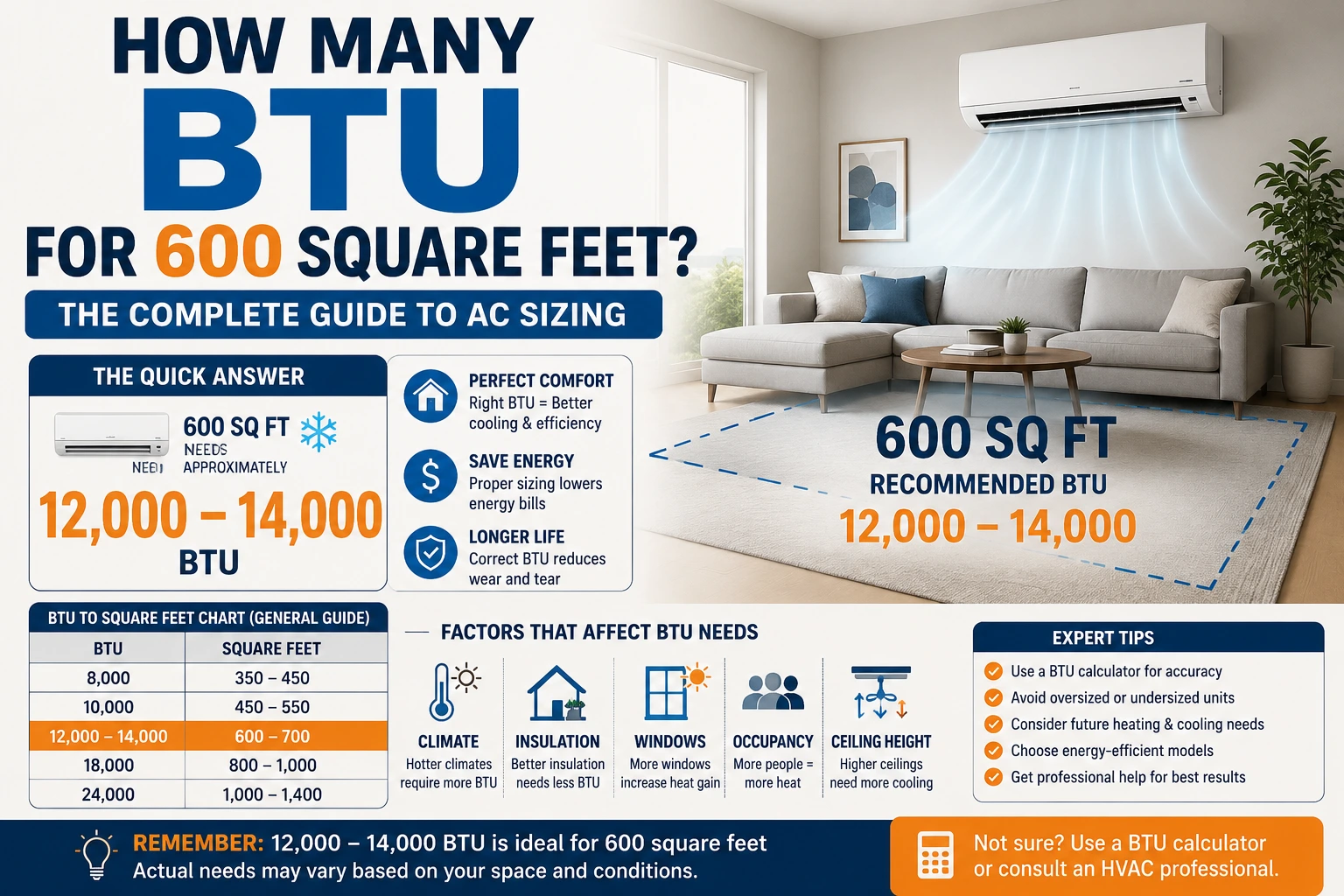
For most homes and apartments, a 600-square-foot room typically requires between 12,000 and 14,000 BTUs for effective cooling.
Many HVAC professionals use a general guideline of approximately 20 BTUs per square foot. However, several factors can increase or decrease your actual cooling requirements.
This guide explains the ideal BTU size for 600 square feet, how BTU ratings work, factors affecting cooling performance, and how to choose the right air conditioner for your space.
Quick Answer: How Many BTU for 600 Square Feet?
For standard residential conditions:
| Room Size | Recommended BTU |
|---|---|
| 600 Square Feet | 12,000–14,000 BTU |
A quick estimate can be calculated using:
600×20=12,000 BTU
This means a 12,000 BTU air conditioner is often the minimum recommendation for a 600-square-foot space.
If the room receives significant sunlight, has poor insulation, or is located in a hot climate, a 14,000 BTU unit may perform better.
Understanding BTU Ratings
Before choosing an air conditioner, it helps to understand what BTU means.
What Does BTU Mean?
BTU stands for British Thermal Unit.
It measures the amount of heat an air conditioner can remove from a room in one hour.
Higher BTU ratings indicate greater cooling capacity.
For example:
| BTU Rating | Cooling Power |
|---|---|
| 8,000 BTU | Small Rooms |
| 12,000 BTU | Medium Rooms |
| 18,000 BTU | Large Rooms |
| 24,000 BTU | Very Large Spaces |
The goal is to match the BTU rating with the room size.
Why Proper Sizing Matters
Many people assume bigger is always better.
That’s not true when it comes to air conditioners.
An Undersized Unit May:
- Run constantly
- Increase electricity bills
- Wear out faster
- Struggle during hot weather
An Oversized Unit May:
- Short cycle frequently
- Waste energy
- Remove less humidity
- Create uneven temperatures
Correct sizing provides the best comfort and efficiency.
How Many BTU for 600 Square Feet?
The ideal BTU range depends on room conditions.
Standard Recommendation
Most HVAC sizing charts recommend:
12,000–14,000 BTU for 600 square feet
This range works well for:
- Living rooms
- Apartments
- Studios
- Offices
- Open-concept spaces
Recommended Range Based on Conditions
| Room Condition | Suggested BTU |
|---|---|
| Excellent Insulation | 12,000 BTU |
| Average Home | 12,000–13,000 BTU |
| Hot Climate | 14,000 BTU |
| Large Windows | 14,000 BTU |
| High Ceilings | 14,000–15,000 BTU |
These estimates provide a better starting point than relying solely on square footage.
BTU to Square Feet Coverage Chart
Use this chart as a quick reference.
| BTU Rating | Coverage Area |
|---|---|
| 5,000 BTU | 100–250 sq ft |
| 8,000 BTU | 250–350 sq ft |
| 10,000 BTU | 350–450 sq ft |
| 12,000 BTU | 550–650 sq ft |
| 14,000 BTU | 600–700 sq ft |
| 18,000 BTU | 800–1,000 sq ft |
| 24,000 BTU | 1,200–1,500 sq ft |
| 36,000 BTU | 1,500–2,000 sq ft |
This chart helps compare cooling capacities across different room sizes.
Factors That Affect BTU Requirements
Square footage is only one part of the calculation.
Several factors influence how many BTUs are needed.
Climate
Homes in hotter regions require more cooling power.
For example:
- Arizona
- Texas
- Florida
- Nevada
often need higher BTU ratings than cooler climates.
Insulation
Good insulation keeps cool air inside.
A well-insulated home can often use a smaller air conditioner.
Poor insulation increases cooling demand.
Ceiling Height
Most BTU charts assume:
8-foot ceilings
Higher ceilings increase room volume and require additional cooling.
For example:
| Ceiling Height | Cooling Impact |
|---|---|
| 8 ft | Standard |
| 10 ft | Moderate Increase |
| 12 ft | Significant Increase |
Sun Exposure
Large windows and direct sunlight increase indoor temperatures.
Rooms facing:
- South
- Southwest
- West
typically require more cooling power.
Number of Occupants
People generate heat.
A room frequently occupied by several people may need additional BTUs.
Examples include:
- Family rooms
- Meeting rooms
- Shared offices
How to Calculate BTU Requirements for 600 Square Feet
Many HVAC professionals start with a simple formula:
BTU=Square Feet×20
For a 600-square-foot room:
600 × 20 = 12,000 BTU
Adjustments can then be made for:
- Sun exposure
- Climate
- Ceiling height
- Occupancy
- Insulation
This is why many experts recommend 12,000–14,000 BTU rather than a single fixed number.
Real-World Examples
Apartment Living Room
Size:
600 square feet
Conditions:
- Good insulation
- Average ceiling height
- Moderate sunlight
Recommended:
12,000 BTU
Open Floor Plan
Size:
600 square feet
Conditions:
- Open layout
- Large windows
- High occupancy
Recommended:
14,000 BTU
Office Space
Size:
600 square feet
Conditions:
- Computers generating heat
- Several occupants
Recommended:
13,000–14,000 BTU
Choosing Between Window AC, Portable AC, and Mini Split
Several cooling options can handle a 600-square-foot room.
| Type | Advantages | Disadvantages |
|---|---|---|
| Window AC | Affordable | Window required |
| Portable AC | Easy installation | Less efficient |
| Mini Split | Highly efficient | Higher upfront cost |
Mini splits often provide the best long-term efficiency for larger spaces.
Benefits of Correct AC Sizing
Choosing the right BTU rating provides several advantages.
Better Comfort
Rooms cool evenly and maintain consistent temperatures.
Lower Energy Bills
Proper sizing reduces wasted electricity.
Longer Equipment Life
The unit experiences less strain.
Improved Humidity Control
Correctly sized systems remove moisture effectively.
Quieter Operation
Efficient systems run more smoothly and quietly.
Common Mistakes When Choosing BTU Size
Choosing Based Only on Price
Cheaper units may not provide adequate cooling.
Ignoring Climate
Hotter locations require more cooling capacity.
Forgetting Ceiling Height
Tall ceilings increase cooling needs.
Overestimating Room Size
Measure carefully before purchasing.
Buying Too Large a Unit
Oversized systems often reduce efficiency.
Expert Tips for Maximum Cooling Efficiency
Seal Air Leaks
Prevent cool air from escaping.
Use Quality Insulation
Insulation improves efficiency dramatically.
Install Window Treatments
Blinds and curtains reduce solar heat gain.
Maintain the Unit
Clean filters regularly.
Choose Energy-Efficient Models
Look for high SEER ratings and ENERGY STAR certification.
Strong Summary: How Many BTU for 600 Square Feet?
If you’re asking how many BTU for 600 square feet, the ideal range is generally 12,000 to 14,000 BTU.
A well-insulated room with standard ceilings may cool effectively with 12,000 BTUs, while spaces with high ceilings, large windows, or hotter climates may benefit from 14,000 BTUs. Understanding room conditions is just as important as square footage when selecting an air conditioner.
Frequently Asked Questions
Is 12,000 BTU enough for 600 square feet?
Yes, in many homes with good insulation and standard ceiling heights, 12,000 BTU is sufficient.
Should I choose 12,000 or 14,000 BTU for 600 square feet?
If your room receives significant sunlight or has poor insulation, 14,000 BTU may be the better option.
Can a 10,000 BTU AC cool 600 square feet?
Generally, no. Most 10,000 BTU units are designed for spaces closer to 450 square feet.
Is a mini split better than a window AC for 600 square feet?
In many cases, yes. Mini splits are often more efficient, quieter, and provide better temperature control.
How do I calculate BTU requirements?
Multiply square footage by approximately 20 BTU per square foot and adjust for room conditions.
Conclusion
When determining how many BTU for 600 square feet, most experts recommend 12,000 to 14,000 BTU for comfortable and efficient cooling. While square footage provides a useful starting point, factors such as climate, insulation quality, ceiling height, sunlight exposure, and occupancy levels can significantly affect cooling needs.
Choosing the correct BTU size ensures better comfort, lower energy bills, improved humidity control, and a longer lifespan for your air conditioning system. By understanding these factors and evaluating your specific space, you can confidently select the right cooling solution for your 600-square-foot room.
Discover more