

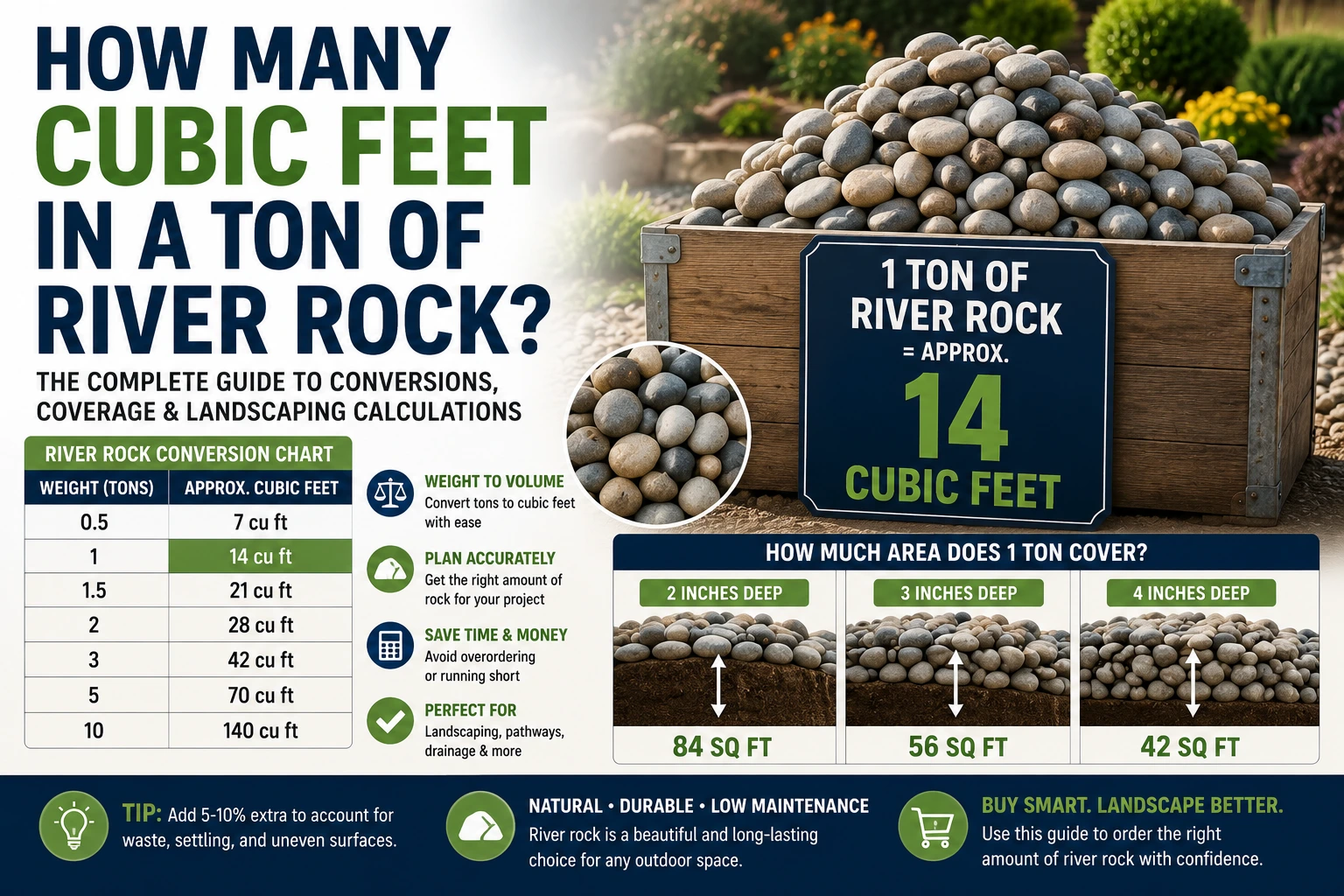
If you’re planning a landscaping project, one of the most common questions is how many cubic feet in a ton of river rock.
Whether you’re covering flower beds, building a decorative landscape feature, improving drainage, or creating a pathway, knowing how weight converts into volume helps you buy the correct amount of material and avoid costly overages.
The quick answer is:
One ton of river rock typically equals between 13 and 15 cubic feet.
However, the exact amount depends on the size, shape, moisture content, and density of the rock.
In this guide, you’ll learn how many cubic feet are in a ton of river rock, how to estimate coverage, conversion charts, practical examples, and expert tips to ensure your landscaping project stays on budget.
Quick Answer: How Many Cubic Feet in a Ton of River Rock?
Most landscaping suppliers estimate:
1 ton of river rock≈13−15 cubic feet
A commonly used average is:
1 ton of river rock = approximately 14 cubic feet
This figure works well for most landscaping calculations.
Depending on rock size, you may see estimates ranging from:
| River Rock Size | Cubic Feet Per Ton |
|---|---|
| Small River Rock | 13–14 cu ft |
| Medium River Rock | 14–15 cu ft |
| Large River Rock | 15–16 cu ft |
Always verify with your supplier because different rock types vary in density.
Understanding River Rock Measurements
Before calculating coverage, it helps to understand how river rock is measured.
What Is River Rock?
River rock is a naturally rounded stone that has been shaped by flowing water over time.
It is commonly used for:
- Garden beds
- Landscape borders
- Decorative ground cover
- Water features
- Drainage systems
- Walkways
River rock is sold by:
- Weight (tons)
- Volume (cubic feet)
- Volume (cubic yards)
Because suppliers may use different measurement methods, conversions become important.
Why Weight and Volume Differ
Many people assume one ton always equals the same volume.
In reality, volume depends on density.
For example:
- Dense stone occupies less space.
- Lightweight stone occupies more space.
This explains why different river rock suppliers may provide slightly different conversion values.
How Many Cubic Feet in a Ton of River Rock?
The industry average is:
Approximately 14 cubic feet per ton
This estimate is based on common landscape river rock weighing approximately:
2,700–3,000 pounds per cubic yard.
A useful approximation is:
| Measurement | Equivalent |
|---|---|
| 1 Ton | 13–15 Cubic Feet |
| 1.5 Tons | 20–22 Cubic Feet |
| 2 Tons | 26–30 Cubic Feet |
| 3 Tons | 39–45 Cubic Feet |
| 5 Tons | 65–75 Cubic Feet |
For most residential landscaping projects, using 14 cubic feet per ton provides reliable estimates.
Why the Number Can Vary
Several factors affect the exact volume.
Rock Size
Larger rocks create more air gaps between stones.
This increases apparent volume.
Moisture Content
Wet rock weighs more than dry rock.
Rock Density
Different geological materials have different weights.
Supplier Specifications
Each quarry may use slightly different conversion factors.
River Rock Weight to Volume Conversion Chart
Use this chart for quick estimates.
| Tons of River Rock | Approximate Cubic Feet |
|---|---|
| 0.5 Ton | 7 Cubic Feet |
| 1 Ton | 14 Cubic Feet |
| 1.5 Tons | 21 Cubic Feet |
| 2 Tons | 28 Cubic Feet |
| 3 Tons | 42 Cubic Feet |
| 4 Tons | 56 Cubic Feet |
| 5 Tons | 70 Cubic Feet |
| 10 Tons | 140 Cubic Feet |
This chart simplifies project planning when ordering bulk river rock.
How to Calculate River Rock Coverage
Knowing cubic feet is useful, but most homeowners want to know how much area a ton of river rock will cover.
The answer depends on depth.
Coverage at 2 Inches Deep
Two inches equals:
0.167 feet
Coverage formula:
Coverage Area=DepthCubic Feet
Using 14 cubic feet:
14 ÷ 0.167
≈ 84 square feet
One Ton Covers Approximately:
84 square feet at 2 inches deep
Coverage at 3 Inches Deep
Three inches equals:
0.25 feet
Calculation:
14 ÷ 0.25
= 56 square feet
One Ton Covers Approximately:
56 square feet at 3 inches deep
Coverage at 4 Inches Deep
Four inches equals:
0.333 feet
Calculation:
14 ÷ 0.333
≈ 42 square feet
One Ton Covers Approximately:
42 square feet at 4 inches deep
Real-World River Rock Examples
Garden Beds
Garden bed dimensions:
- 10 ft × 8 ft
Area:
80 square feet
At 2 inches deep:
One ton of river rock is usually sufficient.
Walkways
Walkway dimensions:
- 3 ft × 20 ft
Area:
60 square feet
At 3 inches deep:
Approximately one ton is required.
Drainage Areas
Drainage project:
- 40 square feet
- 4 inches deep
One ton generally provides adequate coverage.
Factors That Affect River Rock Volume
Several variables impact estimates.
Rock Diameter
Common sizes include:
- ¾ inch
- 1–2 inch
- 2–4 inch
- 3–5 inch
Larger stones create more void space.
Compaction
Some projects experience settling after installation.
This may require additional material.
Irregular Shapes
Curved landscape beds often require slightly more material than simple rectangular areas.
Waste Factor
Professionals typically order:
5–10% extra
to account for waste and settling.
River Rock vs Other Landscaping Materials
Understanding comparisons helps with project planning.
| Material | Cubic Feet Per Ton (Approx.) |
|---|---|
| River Rock | 13–15 |
| Pea Gravel | 12–14 |
| Crushed Stone | 12–14 |
| Lava Rock | 18–25 |
| Mulch | 70–100+ |
Notice that lightweight materials such as mulch and lava rock occupy significantly more space per ton.
Benefits of Using River Rock
Low Maintenance
Unlike mulch, river rock does not decompose.
Attractive Appearance
Provides a natural landscape look.
Excellent Drainage
Water flows easily through rock beds.
Long Lifespan
River rock can last for decades.
Weed Suppression
Works well with landscape fabric.
Common Mistakes When Ordering River Rock
Ordering by Weight Only
Always consider coverage depth.
Ignoring Rock Size
Large stones occupy more apparent volume.
Forgetting Waste Allowance
Most projects need extra material.
Miscalculating Area
Measure carefully before ordering.
Using Generic Estimates
Supplier-specific conversions are often more accurate.
Expert Tips for Accurate River Rock Estimates
Measure Twice
Confirm area dimensions before purchasing.
Determine Desired Depth
Decorative projects often use 2–3 inches.
Drainage projects may require 4 inches or more.
Use Supplier Conversion Charts
Local suppliers provide the most accurate estimates.
Add Extra Material
Order approximately 10% more than calculated.
Consider Future Expansion
Additional rock from the same batch helps maintain color consistency.
Strong Summary: How Many Cubic Feet in a Ton of River Rock?
When asking how many cubic feet in a ton of river rock, the industry-standard estimate is approximately 14 cubic feet per ton, with most products ranging between 13 and 15 cubic feet depending on size and density.
This conversion helps homeowners, landscapers, and contractors estimate coverage, determine project costs, and order the right amount of material. At typical landscaping depths, one ton can cover between 42 and 84 square feet depending on how thick the rock layer is installed.
Frequently Asked Questions
How many cubic feet are in one ton of river rock?
Most suppliers estimate approximately 14 cubic feet per ton.
How many square feet does a ton of river rock cover?
Coverage varies by depth:
- 84 sq ft at 2 inches
- 56 sq ft at 3 inches
- 42 sq ft at 4 inches
Is river rock sold by weight or volume?
River rock is commonly sold by both tons and cubic yards, depending on the supplier.
How many tons of river rock are in a cubic yard?
A cubic yard of river rock typically weighs around 1.3 to 1.5 tons.
Should I order extra river rock?
Yes. Most professionals recommend ordering 5–10% extra for waste, settling, and future touch-ups.
Conclusion
If you’re wondering how many cubic feet in a ton of river rock, a practical estimate is about 14 cubic feet per ton, although actual volume may range from 13 to 15 cubic feet depending on the rock’s size and density.
Understanding this conversion allows you to calculate coverage accurately, compare supplier pricing, and avoid underordering or overspending. Whether you’re creating decorative garden beds, installing drainage systems, or building walkways, knowing how many cubic feet are in a ton of river rock helps ensure a successful landscaping project from start to finish.
Discover more