

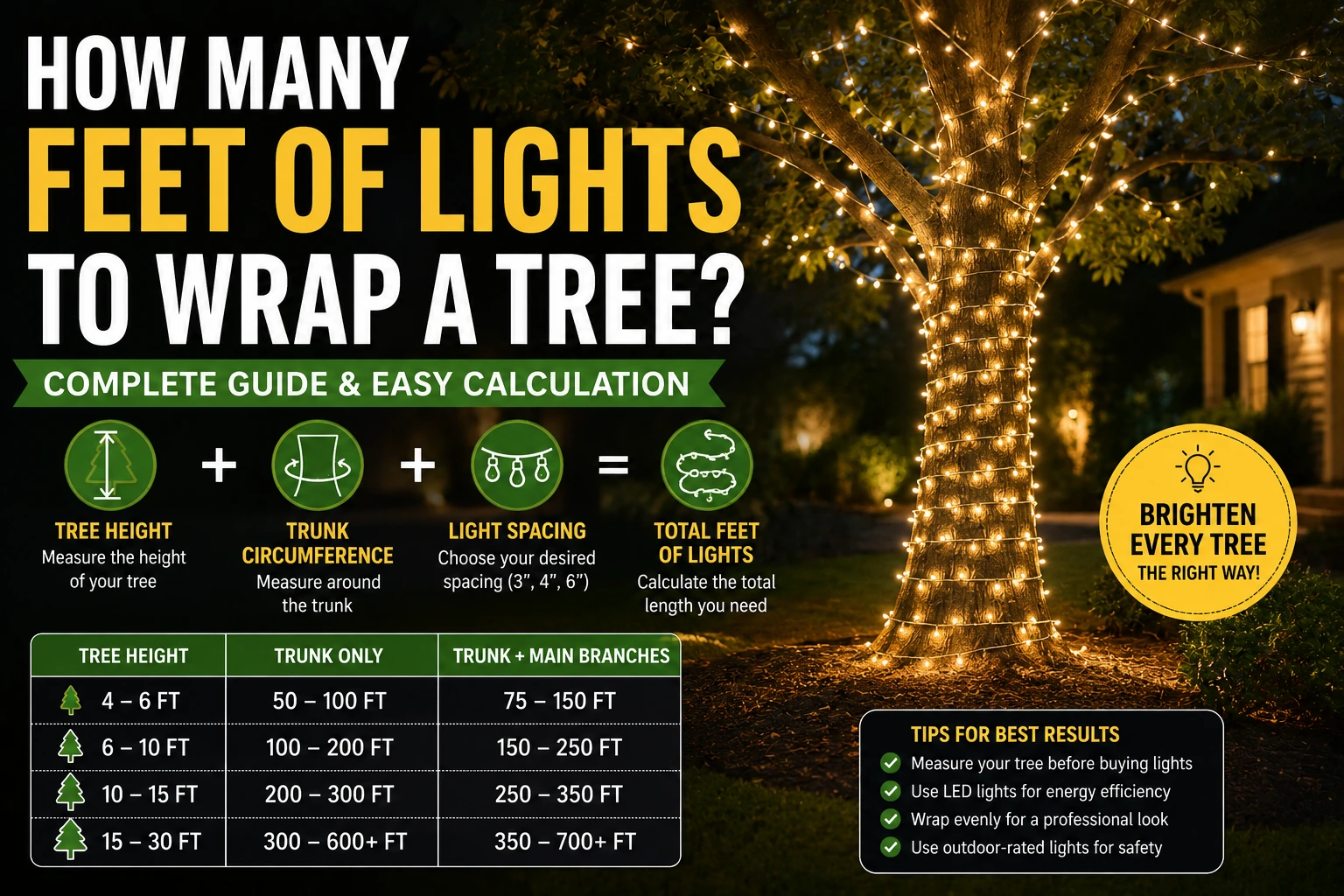
If you’re wondering how many feet of lights to wrap a tree, the answer depends on the tree’s height, trunk diameter, branch coverage, and how closely you want to wrap the lights.
As a general guideline:
- Small trees (6–8 ft): 100–150 feet of lights
- Medium trees (10–15 ft): 150–300 feet
- Large trees (20–30 ft): 300–600+ feet
Whether you’re decorating for Christmas, creating year-round landscape lighting, or preparing for a special event, choosing the correct length of lights ensures your tree looks bright without wasting money on extra strands.
This guide explains how to calculate the exact amount of lighting you need, provides helpful charts, and shares expert decorating tips.
Quick Answer
There isn’t a one-size-fits-all answer because every tree is different.
Here’s a quick reference:
| Tree Height | Suggested Light Length |
|---|---|
| 4–6 ft | 50–100 ft |
| 6–8 ft | 100–150 ft |
| 8–10 ft | 150–200 ft |
| 10–15 ft | 200–300 ft |
| 15–20 ft | 300–400 ft |
| 20–30 ft | 400–600+ ft |
If you’re wrapping both the trunk and major branches, you’ll need significantly more lights than wrapping the trunk alone.
How to Calculate the Right Amount of Lights
Instead of guessing, you can estimate your lighting needs using a simple process.
Step 1: Measure the Tree Height
Use a tape measure or estimate the height.
Example:
- 8 feet
- 12 feet
- 20 feet
Step 2: Measure the Trunk Circumference
Wrap a measuring tape around the trunk.
Example:
- 18 inches
- 24 inches
- 36 inches
Convert inches to feet if needed.
Step 3: Decide the Spacing
Most decorators leave:
- 3-inch spacing for a dense look
- 4-inch spacing for a standard look
- 6-inch spacing for a subtle look
Closer spacing requires more lights.
Step 4: Include Branches (Optional)
If wrapping:
- Primary branches
- Large limbs
- Entire canopy
Measure each section separately.
Factors That Affect Light Length
Several factors influence how many feet of lights you’ll need.
Tree Height
Taller trees naturally require longer strands.
Trunk Thickness
A thick trunk takes more lights per wrap than a narrow trunk.
Branch Coverage
Decorating only the trunk uses far fewer lights than wrapping every branch.
Desired Brightness
Dense lighting creates a professional appearance but uses more lights.
Light Spacing
The closer the wraps, the longer the string required.
Tree Light Length Chart
Use this chart as a starting point.
| Tree Height | Trunk Only | Trunk + Main Branches |
|---|---|---|
| 4 ft | 50 ft | 75 ft |
| 6 ft | 75 ft | 100 ft |
| 8 ft | 100 ft | 150 ft |
| 10 ft | 150 ft | 200 ft |
| 12 ft | 200 ft | 250 ft |
| 15 ft | 250 ft | 350 ft |
| 20 ft | 350 ft | 450 ft |
| 25 ft | 450 ft | 550 ft |
| 30 ft | 550 ft | 700+ ft |
These are estimates and may vary depending on tree shape.
Tree Height vs. Light Requirements
Let’s look at common scenarios.
Small Trees (4–8 Feet)
Perfect for:
- Entryways
- Patios
- Small gardens
Recommended lights:
50–150 feet
Medium Trees (10–15 Feet)
Ideal for:
- Front yards
- Driveways
- Landscape focal points
Recommended lights:
200–350 feet
Large Trees (20–30 Feet)
Large oak, maple, or pine trees require:
- 400–700+ feet
Professional installers often use multiple strings connected together.
Step-by-Step Guide to Wrapping Lights Around a Tree
Decorating a tree properly improves both safety and appearance.
Step 1
Test every light strand before installation.
Step 2
Begin at the base of the trunk.
Step 3
Wrap upward using even spacing.
Step 4
Secure loose sections without overtightening.
Step 5
Continue onto major branches if desired.
Step 6
Hide extension cord connections near the base.
Step 7
Plug into an outdoor-rated timer for convenience.
Best Types of Lights for Trees
Not all lights are equally suited for outdoor trees.
LED Lights
Advantages:
- Energy efficient
- Bright
- Long lifespan
- Cool to the touch
- Weather resistant
Best overall choice.
Mini String Lights
Perfect for:
- Small trees
- Decorative wrapping
- Indoor trees
Wide-Angle LED Lights
Provide:
- Better visibility
- Even brightness
- Professional appearance
Commercial-Grade Lights
Recommended for:
- Large properties
- Public displays
- Long-term installations
They are more durable and often weatherproof.
Indoor vs. Outdoor Tree Lighting
Choose lights designed for the environment.
| Feature | Indoor | Outdoor |
|---|---|---|
| Water Resistant | No | Yes |
| UV Protection | No | Yes |
| Heavy Duty Wire | Usually No | Yes |
| Safe in Rain | No | Yes |
Always check the packaging before installation.
Practical Examples
Example 1
Tree height:
8 feet
Desired spacing:
4 inches
Recommended lighting:
Approximately 150 feet.
Example 2
Tree height:
15 feet
Wrap trunk and five main branches.
Recommended lighting:
Around 350 feet.
Example 3
Large landscape tree:
25 feet
Dense professional wrap
Recommended lighting:
550–700 feet.
Benefits of Using the Correct Amount of Lights
Choosing the right length offers several advantages.
- Balanced appearance
- Fewer dark spots
- Easier installation
- Lower energy waste
- Better safety
- Reduced need for extension cords
- Professional-looking results
Common Mistakes to Avoid
Many homeowners make these decorating errors.
Guessing the Light Length
Always measure before purchasing.
Wrapping Too Tightly
Trees continue to grow.
Avoid restricting bark or branches.
Uneven Spacing
Inconsistent spacing creates noticeable gaps.
Using Indoor Lights Outdoors
Outdoor-rated lights are designed to withstand moisture and temperature changes.
Ignoring Power Limits
Don’t overload electrical outlets or extension cords.
Always follow manufacturer recommendations.
Expert Tips for Beautiful Tree Lighting
Professional decorators recommend the following:
- Use warm white LEDs for a classic look.
- Start at the bottom and work upward.
- Keep spacing consistent.
- Use timers to save energy.
- Hide connectors behind the trunk.
- Match light color across all trees.
- Secure cords to prevent tripping hazards.
- Measure first, buy second.
Frequently Asked Questions
How many feet of lights do I need to wrap a tree?
It depends on the tree’s size. Small trees may need 50–150 feet, while large outdoor trees can require 400 feet or more.
How do I calculate tree lights?
Measure the tree’s height, trunk circumference, and any branches you plan to wrap. The closer the spacing between wraps, the more lights you’ll need.
Can I use LED lights outdoors?
Yes. Outdoor-rated LED lights are the best choice because they are energy efficient, weather resistant, and long lasting.
Should I wrap only the trunk or the branches too?
For a simple look, wrap only the trunk. For a fuller and more dramatic effect, continue onto the main branches.
Is it better to have too many or too few lights?
It’s usually better to have a little extra. Additional lights provide flexibility if you decide to wrap more branches or reduce spacing for a brighter display.
Conclusion
Knowing how many feet of lights to wrap a tree helps you create a beautiful and balanced display without overspending or running short on supplies. While the exact amount depends on the tree’s height, trunk size, and desired spacing, a general guideline is 100–150 feet for small trees, 200–350 feet for medium trees, and 400–700+ feet for large outdoor trees.
Before buying lights, measure your tree carefully and decide whether you’ll decorate only the trunk or include the branches. By using the charts, formulas, and expert tips in this guide, you can confidently choose the right light length and create a stunning display for the holidays or year-round landscape lighting.
Discover more