

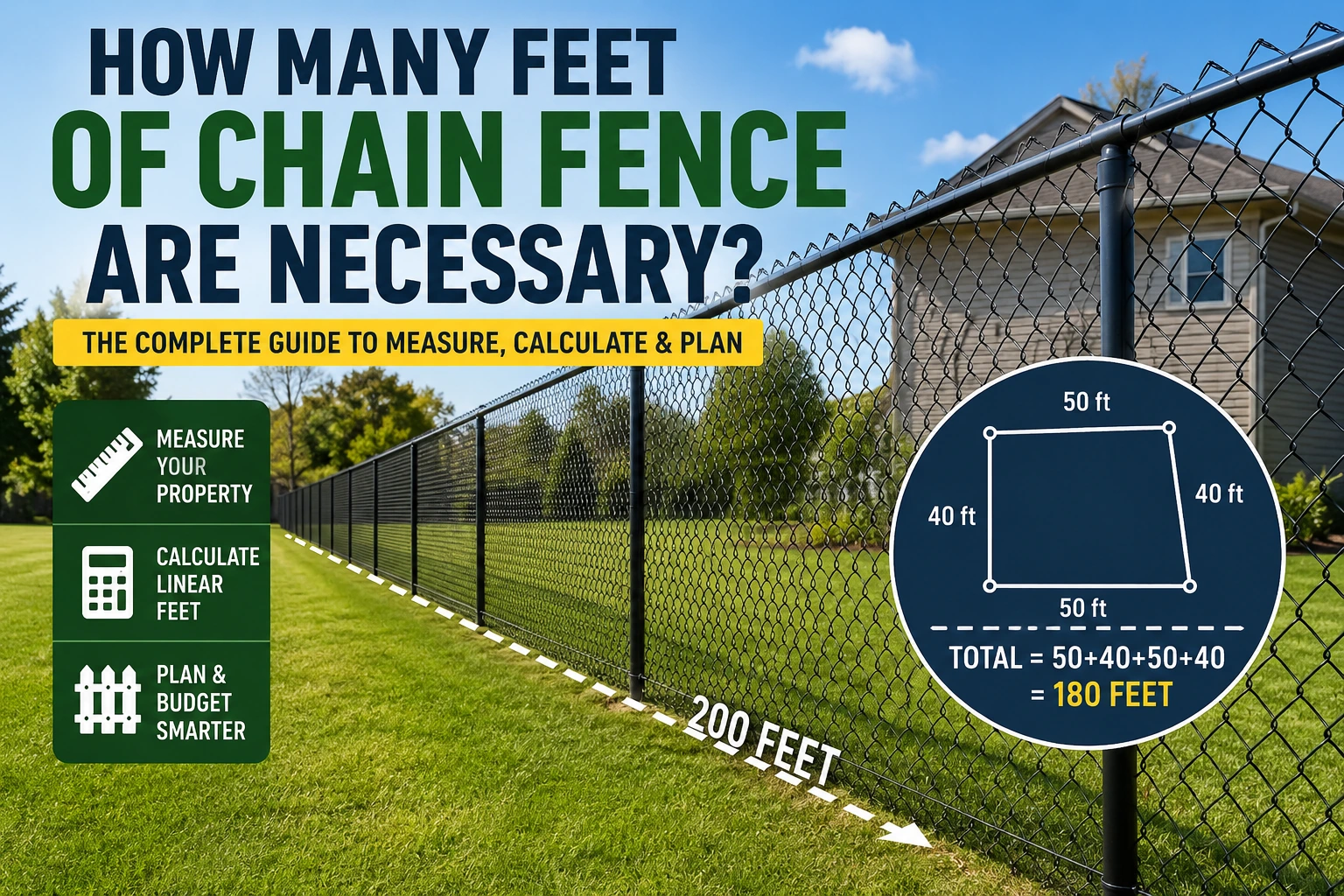
If you are planning to install a fence around your yard, business, garden, or property, one of the first questions you may ask is: how many feet of chain fence are necessary? Knowing the correct fence length is important because it affects your budget, material costs, labor, and overall project success.
Many people underestimate or overestimate their fencing needs. That can lead to wasted money, extra materials, or unfinished sections. The good news is that calculating chain fence footage is easier than most people think once you understand a few simple measurement methods.
In this guide, you will learn how to calculate fence footage accurately, understand perimeter measurements, estimate costs, and avoid common mistakes. Whether you are fencing a small backyard or a large property, this article will help you determine exactly how much chain fence you need.
Understanding Chain Fence Measurements
Before calculating fence footage, it helps to understand how fencing measurements work.
What Does Linear Feet Mean?
Chain fences are measured in linear feet, not square feet. Linear feet refer to the total length of the fence line.
For example:
- A fence that is 100 feet long equals 100 linear feet
- A property with four sides totaling 400 feet needs 400 linear feet of fencing
Fence height is measured separately. A 4-foot-high fence and a 6-foot-high fence may have the same linear footage but different material costs.
Why Accurate Measurements Matter
Accurate measurements help you:
- Buy the correct amount of fencing material
- Avoid overspending
- Reduce installation delays
- Estimate labor costs properly
- Plan gates and corners efficiently
Even a small measurement mistake can increase project costs significantly, especially on large properties.
How to Calculate How Many Feet of Chain Fence Are Necessary
The easiest way to calculate fencing needs is by measuring the perimeter of your property.
Measuring Square and Rectangle Yards
Most residential properties are square or rectangular. The formula is simple:
Perimeter = 2 × (Length + Width)
For example:
| Yard Size | Formula | Total Fence Needed |
|---|---|---|
| 50 ft × 100 ft | 2 × (50 + 100) | 300 ft |
| 80 ft × 120 ft | 2 × (80 + 120) | 400 ft |
| 100 ft × 150 ft | 2 × (100 + 150) | 500 ft |
If your yard measures 80 feet wide and 120 feet long, you need 400 linear feet of chain fence.
Measuring Irregular Shapes
Not every property is perfectly square. For irregular shapes:
- Measure each side separately
- Add all side lengths together
- Include curves or angled sections
Example:
- Side 1 = 90 ft
- Side 2 = 120 ft
- Side 3 = 80 ft
- Side 4 = 110 ft
Total fence required = 400 ft
Using a measuring wheel or property survey can improve accuracy.
Adding Gate Space
Many people forget to include gate measurements. Gates reduce the amount of fencing material needed but require separate hardware and posts.
Example:
- Total perimeter = 400 ft
- Gate width = 10 ft
Actual chain fence material needed = 390 ft
However, you still plan posts and layout for the full 400-foot perimeter.
Chain Fence Length Formula Explained
The simplest formula for determining how many feet of chain fence are necessary is:
P=2(L+W)
Where:
- P = perimeter
- L = length
- W = width
For irregular properties:
P=s1+s2+s3+⋯+sn
This means you add all side lengths together.
These formulas work for most residential and commercial fence projects.
Fence Footage Chart for Common Property Sizes
The table below helps estimate fence requirements quickly.
Small Residential Yards
| Yard Dimensions | Fence Needed |
|---|---|
| 40 × 60 ft | 200 ft |
| 50 × 80 ft | 260 ft |
| 60 × 90 ft | 300 ft |
Medium Lots
| Lot Dimensions | Fence Needed |
|---|---|
| 80 × 120 ft | 400 ft |
| 100 × 150 ft | 500 ft |
| 120 × 180 ft | 600 ft |
Large Properties and Acreage
| Property Size | Approximate Fence Needed |
|---|---|
| 1 acre square | 835 ft |
| 2 acres square | 1,208 ft |
| 5 acres square | 1,865 ft |
These numbers are estimates. Actual fence footage depends on property shape.
How Many Feet of Chain Fence Are Necessary for 1 Acre?
This is one of the most common fencing questions.
An acre equals 43,560 square feet, but the perimeter changes depending on shape.
Square Acre Example
If one acre is shaped like a square:
- Each side measures approximately 208.7 feet
Perimeter calculation:
P=4×208.7≈834.8
So, you need about 835 linear feet of chain fence.
Rectangular Acre Example
A rectangular acre may measure:
- 150 ft × 290.4 ft
Perimeter:
P=2(150+290.4)=880.8
In this case, you need around 881 feet of fencing.
This shows why property shape matters when calculating fence requirements.
Factors That Affect Fence Requirements
Several factors can change how many feet of chain fence are necessary for your project.
Terrain and Slopes
Flat land is easier to measure. Sloped or uneven terrain may require extra fencing material because the fence follows ground contours.
Steep areas can also increase:
- Post requirements
- Labor costs
- Material waste
Gates and Openings
Adding gates affects fence layout. Common gate sizes include:
| Gate Type | Average Width |
|---|---|
| Walk gate | 3–4 ft |
| Double gate | 10–14 ft |
| Driveway gate | 12–20 ft |
Large gates require stronger posts and extra hardware.
Local Regulations
Some cities and neighborhoods limit:
- Fence height
- Fence location
- Fence type
- Property setbacks
Always check local building codes before purchasing materials.
Common Mistakes When Measuring Chain Fence
Incorrect measurements are one of the biggest reasons fencing projects exceed budget.
Here are common mistakes to avoid:
Ignoring Property Lines
Never guess property boundaries. Use:
- Property surveys
- Plat maps
- Professional markers
Installing a fence on a neighbor’s land can create legal problems.
Forgetting Corners and Curves
Curved areas increase fence length slightly. Always measure carefully around landscaping or irregular boundaries.
Not Accounting for Gates
Gate openings affect fence layout and material quantities.
Estimating Instead of Measuring
Many homeowners try visual estimates. Even small errors can add dozens of unnecessary fence feet.
Use a tape measure, measuring wheel, or digital property map whenever possible.
Cost Estimation Based on Fence Length
After calculating fence footage, the next step is estimating costs.
Average chain link fence costs range from $10 to $30 per linear foot installed, depending on:
- Fence height
- Material quality
- Coating type
- Labor rates
- Terrain difficulty
Here is a basic estimate chart:
| Fence Length | Estimated Cost Range |
|---|---|
| 100 ft | $1,000–$3,000 |
| 200 ft | $2,000–$6,000 |
| 400 ft | $4,000–$12,000 |
| 800 ft | $8,000–$24,000 |
Black vinyl-coated chain fences usually cost more than standard galvanized fences.
DIY vs Professional Fence Installation
Many property owners wonder whether they should install chain fencing themselves.
DIY Installation
Pros:
- Lower labor costs
- Flexible schedule
- Good for small projects
Cons:
- Time-consuming
- Requires tools and skills
- Mistakes can be expensive
DIY installation works best for smaller, simple properties.
Professional Installation
Pros:
- Faster installation
- Accurate measurements
- Better durability
- Proper permits and compliance
Cons:
- Higher upfront cost
Professional installers are often worth the investment for large or uneven properties.
Expert Tips for Accurate Fence Planning
Professionals use several strategies to improve fence accuracy and reduce waste.
Measure Twice
Always verify measurements before ordering materials.
Add Extra Material
Order 5% to 10% extra fencing for:
- Mistakes
- Uneven terrain
- Repairs
- Future modifications
Mark Fence Corners
Use stakes and string lines to visualize the fence layout before digging posts.
Consider Future Needs
Think about pets, children, security, and landscaping changes before selecting fence height and layout.
Use Online Mapping Tools
Satellite maps and property apps can help estimate perimeter dimensions quickly.
9. FAQs
How do I calculate how many feet of chain fence are necessary?
Measure the perimeter of your property by adding all side lengths together. The total equals the linear feet of fencing required.
How many feet of chain fence are necessary for a quarter acre?
A square quarter-acre lot typically requires around 417 linear feet of fencing.
Does gate size reduce total fence footage?
Yes. Gate openings replace sections of fencing, so subtract gate widths from the total fence material needed.
How much extra fence material should I buy?
Most professionals recommend ordering 5% to 10% extra material to cover errors, slopes, and adjustments.
Is chain link fence sold by linear feet?
Yes. Chain link fencing is typically priced and sold by linear foot, while height affects the final cost.
10. Conclusion
Understanding how many feet of chain fence are necessary is the key to planning a successful fencing project. By measuring your property perimeter correctly, accounting for gates, and considering terrain, you can avoid costly mistakes and purchase the right amount of materials.
Whether you are fencing a small backyard or several acres of land, accurate calculations help save time, reduce waste, and keep your project within budget. Use perimeter formulas, measurement charts, and planning tips to determine the exact linear footage you need before starting installation.
With proper preparation, your chain fence project can be efficient, affordable, and built to last for years.
Discover more