
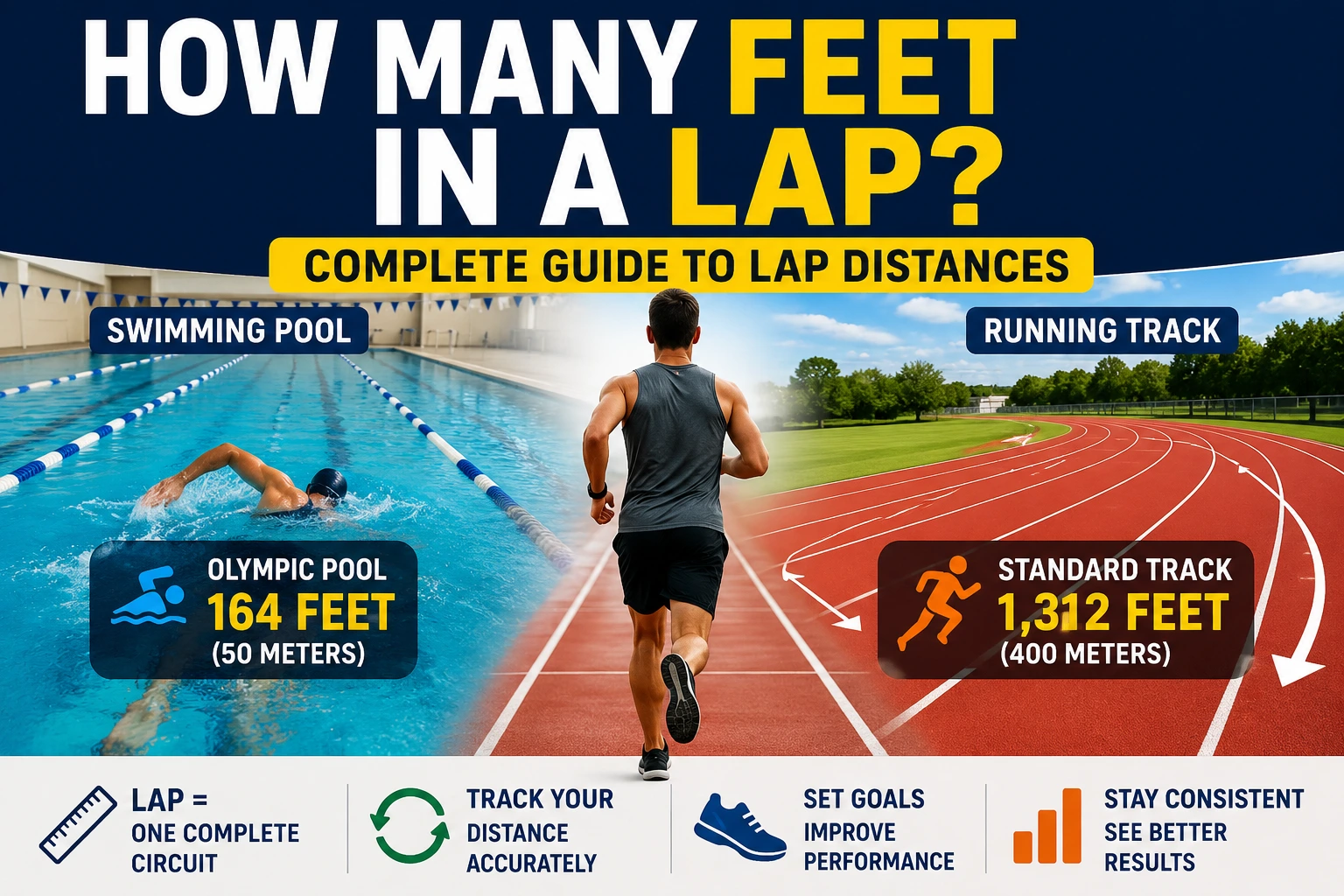
Many people ask the question, “how many feet in a lap?” when starting a fitness routine, joining a swim class, training for sports, or simply trying to track exercise distance. The answer depends on the type of lap you are talking about because swimming pools, running tracks, and fitness circuits all use different measurements.
A lap is generally one complete trip around a track, pool, or course. However, the exact distance can vary widely. A lap in an Olympic swimming pool is very different from a lap around a neighborhood track. That is why understanding lap measurements is important for accurate fitness tracking, goal setting, and workout planning.
In this guide, you will learn how many feet are in a lap for different activities, how lap distances are measured, common conversion charts, and practical examples that make understanding laps simple.
What Does a Lap Mean?
The word “lap” is used in many sports and fitness activities. It usually means one complete circuit around a designated area.
Lap in Swimming
In swimming, a lap often refers to swimming from one end of the pool to the other. However, some swimmers count a full round trip as one lap. This difference can sometimes create confusion.
For example:
- One-way across the pool = 1 lap for some people
- Down and back = 1 lap for others
Competitive swimmers usually follow official distance standards.
Lap in Running
For runners, a lap means one complete trip around a track. Standard outdoor tracks are built with official measurements, making it easier to calculate distances.
Lap in General Fitness
In fitness training, a lap can refer to:
- Walking around a gym
- Circling a field
- Completing one circuit in an obstacle course
The actual number of feet depends on the space being used.
How Many Feet in a Lap for Swimming Pools?
Swimming pool lap distances vary depending on pool size.
Standard Residential Pools
Many home pools are between 20 and 40 feet long.
Here are common examples:
| Pool Length | One Lap Distance |
|---|---|
| 20 ft pool | 20 ft |
| 25 ft pool | 25 ft |
| 30 ft pool | 30 ft |
| 40 ft pool | 40 ft |
If you swim down and back, double the distance.
Example:
40×2=80
A round trip in a 40-foot pool equals 80 feet.
Olympic Pools
Olympic swimming pools are 50 meters long.
To convert meters to feet:
50 meters≈164 feet
One lap in an Olympic pool is approximately 164 feet.
A complete round trip equals about 328 feet.
Short Course Pools
Many schools and gyms use short-course pools that measure 25 yards.
Since 1 yard equals 3 feet:
25×3=75
A 25-yard pool equals 75 feet per lap.
This is one of the most common competitive swim distances in the United States.
How Many Feet in a Lap Around a Running Track?
Running tracks follow more standardized measurements than swimming pools.
Standard Track Measurements
A standard outdoor running track measures 400 meters for one lap.
Converting to feet:
400 meters≈1312 feet
So, one lap around a standard track equals approximately 1,312 feet.
This is the measurement used in most schools, universities, and professional competitions.
Indoor Track Differences
Indoor tracks are often shorter because of limited space.
Common indoor track lengths include:
| Indoor Track Type | Lap Distance |
|---|---|
| 200 meters | 656 ft |
| 300 meters | 984 ft |
| Small gym track | 400–600 ft |
Always check the posted measurements before tracking workouts indoors.
Lap Distance Conversion Chart
Understanding conversions makes lap calculations much easier.
Feet to Meters
| Feet | Meters |
|---|---|
| 50 ft | 15.24 m |
| 75 ft | 22.86 m |
| 100 ft | 30.48 m |
| 164 ft | 50 m |
| 1,312 ft | 400 m |
Common Lap Examples
| Activity | Typical Lap Distance |
|---|---|
| Olympic pool | 164 ft |
| 25-yard pool | 75 ft |
| Home pool | 20–40 ft |
| Outdoor track | 1,312 ft |
| Indoor track | 656–984 ft |
These numbers help athletes track workouts more accurately.
Why Lap Length Matters in Fitness
Knowing how many feet in a lap is important for several reasons.
Tracking Progress
Distance tracking helps measure improvement over time.
For example:
- Faster lap times
- Longer workout distances
- Better endurance
- Improved calorie burn
Athletes often use lap counts to set weekly goals.
Workout Planning
Many training plans are built around lap distances.
Examples include:
- Swim 20 laps
- Run 4 laps
- Walk 10 laps indoors
Without knowing lap distance, workout totals may be inaccurate.
How to Measure a Lap Accurately
If you are unsure about your lap distance, measuring it yourself is a smart idea.
Step 1: Identify the Start and End Points
Determine where one lap begins and ends.
Step 2: Use a Measuring Tool
You can use:
- Tape measures
- Measuring wheels
- GPS watches
- Smartphone fitness apps
Step 3: Calculate Total Distance
For rectangular spaces:
P=2(L+W)
This formula helps calculate perimeter distance.
Step 4: Confirm with Multiple Measurements
Double-check distances for better accuracy.
Small measurement mistakes can add up during long workouts.
Common Mistakes When Calculating Lap Distance
Many people accidentally track the wrong workout distance because of simple misunderstandings.
Confusing One Length With One Lap
In swimming, some people count one pool length as one lap, while others count a round trip.
Always define your method clearly.
Forgetting Lane Position on Tracks
Outer track lanes are longer than inner lanes.
For example:
- Lane 1 = official 400 meters
- Outer lanes = slightly longer
This matters in competitive running.
Estimating Instead of Measuring
Guessing distances often leads to inaccurate workout tracking.
Use reliable measurement tools whenever possible.
Ignoring Conversion Differences
Feet, yards, and meters are often mixed up in sports settings.
Remember:
- 1 yard = 3 feet
- 1 meter ≈ 3.28 feet
Swimming vs Running Lap Comparison
Swimming and running laps differ greatly in length and workout intensity.
| Activity | Typical Lap Distance | Main Focus |
|—|—|
| Swimming | 75–164 ft | Full-body cardio |
| Running | 1,312 ft | Endurance and speed |
| Walking track | 400–1,312 ft | Low-impact exercise |
Swimming laps are shorter but require constant body resistance in water, while running laps cover greater distances.
Expert Tips for Lap Training
Fitness professionals use several strategies to improve lap-based workouts.
Set Distance Goals
Instead of focusing only on time, aim for total distance.
Example goals:
- Swim 1,000 feet
- Run 2 miles
- Walk 20 laps
Track Lap Times
Monitoring lap speed helps improve performance gradually.
Use Fitness Devices
Smartwatches and fitness trackers make lap counting easier and more accurate.
Warm Up Properly
Always warm up before intense lap workouts to reduce injury risk.
Increase Distance Slowly
Gradual progression prevents burnout and overtraining.
9. FAQs
How many feet in a lap around a standard track?
One lap around a standard outdoor running track is approximately 1,312 feet.
How many feet is one lap in an Olympic pool?
One lap in an Olympic swimming pool is about 164 feet long.
Is one lap the same in every swimming pool?
No. Pool sizes vary, so lap distances can range from 20 feet to over 160 feet.
How many feet are in a 25-yard pool lap?
A 25-yard swimming pool lap equals 75 feet.
Why do lap distances matter in workouts?
Lap distances help track exercise progress, measure endurance, and create accurate fitness plans.
10. Conclusion
Understanding how many feet in a lap is important for swimmers, runners, walkers, and fitness enthusiasts. The exact distance depends on the activity and location, whether it is a swimming pool, running track, or indoor fitness area.
A standard outdoor track lap measures about 1,312 feet, while swimming laps can range from 20 feet in small pools to 164 feet in Olympic pools. Knowing these measurements helps improve workout accuracy, track progress, and build better training routines.
By using proper measurements, conversion charts, and fitness tracking methods, you can plan smarter workouts and achieve your fitness goals more effectively.
Discover More
how many square feet does a 5 gallon bucket cover