

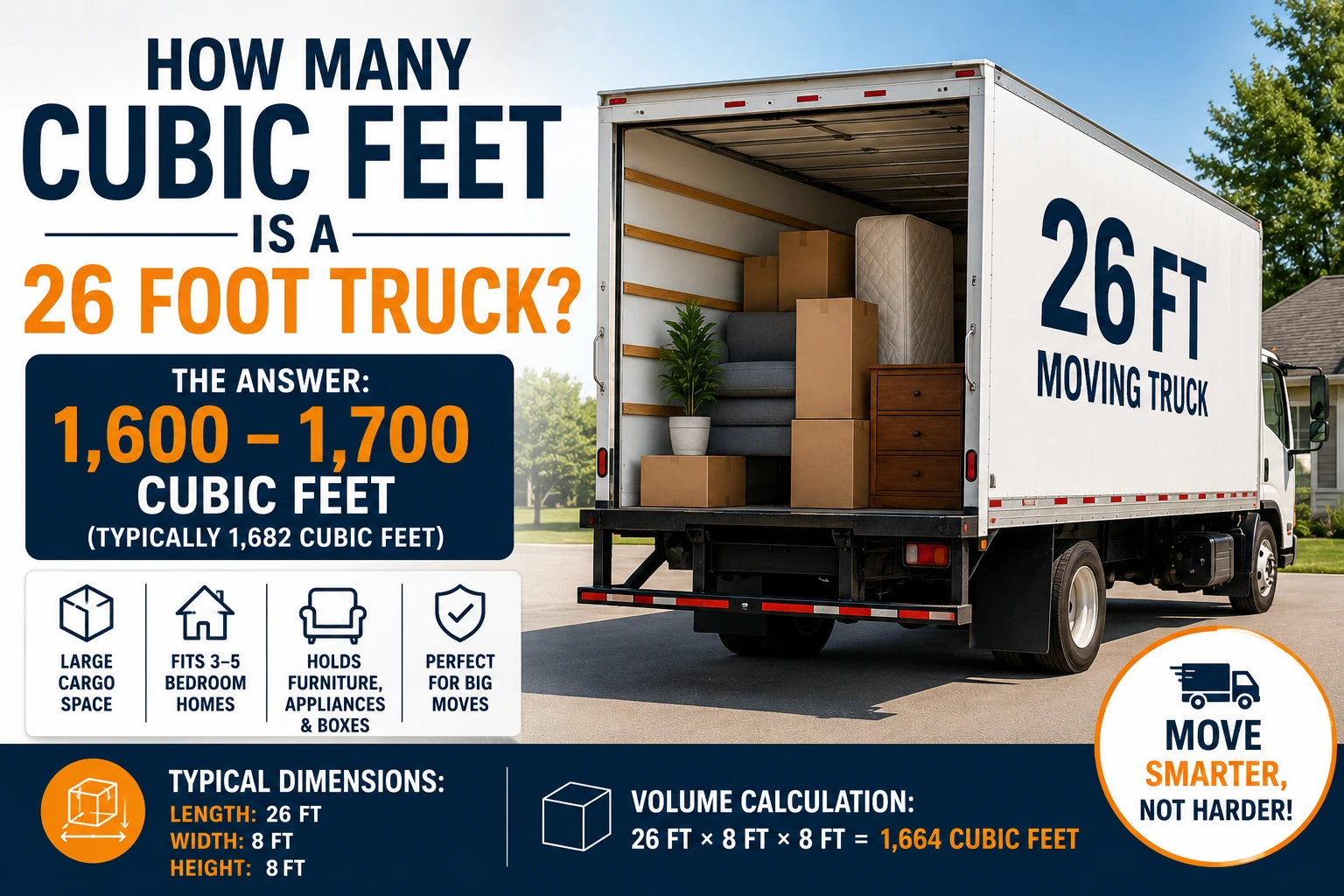
If you’re preparing for a move, one of the first questions you’ll likely ask is how many cubic feet is a 26 foot truck. Knowing the cargo volume helps determine whether the truck can hold your furniture, appliances, boxes, and other belongings.
A typical 26-foot moving truck offers approximately 1,600 to 1,700 cubic feet of cargo space, depending on the manufacturer and rental company. Most major rental companies advertise capacities around 1,682 cubic feet, making this the largest truck commonly available for residential moves.
Understanding truck volume can help you avoid renting a truck that’s too small—or paying extra for one that’s too large.
In this guide, we’ll cover truck dimensions, cubic-foot calculations, capacity comparisons, packing strategies, and real-world moving examples.
Quick Answer
Most 26-foot moving trucks provide:
- Approximately 1,600–1,700 cubic feet
- Around 1,682 cubic feet for many rental models
- Space for a 3 to 5-bedroom home
- Capacity for up to 12,000 pounds or more (varies by company)
The commonly advertised figure is:
26-Foot Truck ≈ 1,682 Cubic Feet
Understanding Cubic Feet in Moving Trucks
Before discussing truck capacity, it’s important to understand what cubic feet actually means.
What Is a Cubic Foot?
A cubic foot measures volume.
One cubic foot represents a cube measuring:
- 1 foot long
- 1 foot wide
- 1 foot high
Volume is calculated using:
Volume=Length×Width×Height
Unlike square feet, which measure area, cubic feet measure the total amount of three-dimensional space available.
Why Truck Volume Matters
Truck volume determines:
- How many boxes fit
- How much furniture can be loaded
- Whether appliances can be transported
- The number of trips required
For movers, cubic feet often matters more than truck length alone.
How Many Cubic Feet Is a 26 Foot Truck?
The exact answer depends on the truck’s interior dimensions.
Most 26-foot moving trucks have cargo areas approximately:
- Length: 26 feet
- Width: 8 feet
- Height: 8 feet
Using these dimensions:
26×8×8=1664
Result:
1,664 cubic feet
Many rental companies list capacities between:
- 1,600 cubic feet
- 1,650 cubic feet
- 1,682 cubic feet
- 1,700 cubic feet
Therefore, the commonly accepted answer is:
A 26-foot truck typically holds about 1,600–1,700 cubic feet of cargo.
How Truck Rental Companies Measure Capacity
Truck rental companies calculate capacity using interior cargo dimensions rather than exterior measurements.
Several factors affect volume:
- Wall thickness
- Wheel wells
- Interior roof shape
- Loading ramps
- Storage compartments
This explains why two different 26-foot trucks may have slightly different cubic-foot ratings.
Typical Dimensions of a 26-Foot Moving Truck
While dimensions vary by manufacturer, most trucks fall within these ranges.
Length
Cargo length:
- 25–26 feet
Width
Cargo width:
- 8 feet
Height
Interior cargo height:
- 7.5–8 feet
These measurements combine to create approximately 1,600–1,700 cubic feet of usable space.
What Can Fit Inside a 26 Foot Truck?
One reason people search for how many cubic feet is a 26 foot truck is to determine what can realistically fit inside.
Number of Rooms
A 26-foot truck typically accommodates:
| Home Size | Typical Fit |
|---|---|
| 1 Bedroom | Easily |
| 2 Bedroom | Easily |
| 3 Bedroom | Yes |
| 4 Bedroom | Usually |
| 5 Bedroom | Often, depending on contents |
Furniture Examples
A fully loaded truck may hold:
- Multiple sofas
- Dining room sets
- Bedroom furniture
- Office desks
- Bookshelves
- Entertainment centers
Appliance Capacity
Large appliances typically fit, including:
- Refrigerators
- Washers
- Dryers
- Freezers
- Dishwashers
Proper packing remains essential to maximize space.
26 Foot Truck Capacity Comparison Chart
Here’s how a 26-foot truck compares to smaller rental trucks.
| Truck Size | Approx. Cubic Feet |
|---|---|
| 10 Foot | 400–500 |
| 12 Foot | 450–600 |
| 15 Foot | 750–850 |
| 17 Foot | 850–1,000 |
| 20 Foot | 1,000–1,200 |
| 22 Foot | 1,200–1,400 |
| 26 Foot | 1,600–1,700 |
The 26-foot truck provides significantly more cargo volume than smaller options.
Real-World Moving Examples
Understanding volume becomes easier through practical examples.
Example 1: Three-Bedroom Home
Typical contents:
- 40–60 boxes
- 3 beds
- Living room furniture
- Dining room furniture
- Appliances
Most of these belongings fit comfortably within a 26-foot truck.
Example 2: Four-Bedroom Family Move
Contents may include:
- Children’s furniture
- Office equipment
- Garage items
- Outdoor furniture
A 26-foot truck is often recommended for this type of move.
Example 3: Small Business Relocation
Businesses frequently use 26-foot trucks to transport:
- Office furniture
- Inventory
- Filing cabinets
- Equipment
The large cubic-foot capacity makes commercial moves more efficient.
Advantages of Renting a 26-Foot Truck
There are several benefits.
Fewer Trips
More volume means:
- Reduced fuel costs
- Less driving
- Faster moves
Better Efficiency
A single trip often replaces multiple smaller-truck trips.
Suitable for Large Households
Large families benefit from the extra cargo space.
Better Value
In many cases, renting one large truck is cheaper than renting multiple smaller vehicles.
Potential Drawbacks
A larger truck isn’t always the perfect solution.
Harder to Drive
New drivers may find:
- Parking difficult
- Turning more challenging
- Narrow streets stressful
Higher Fuel Consumption
Larger trucks typically use more fuel.
Unused Space
If moving from a small apartment, you may pay for capacity you don’t need.
Expert Packing Tips to Maximize Cubic Feet
Even a large truck can fill up quickly.
Load Heavy Items First
Start with:
- Appliances
- Dressers
- Sofas
This creates a stable base.
Use Vertical Space
Stack boxes safely to maximize height.
Disassemble Furniture
Removing:
- Table legs
- Bed frames
- Shelves
can save considerable space.
Fill Empty Areas
Place smaller items inside:
- Dressers
- Cabinets
- Appliances when safe
Use Moving Blankets
Protect furniture while reducing wasted gaps.
Common Mistakes When Estimating Truck Space
Many people underestimate how much space they need.
Counting Rooms Instead of Volume
Two homes with the same number of rooms can require very different truck sizes.
Forgetting Garage Items
Commonly overlooked items include:
- Tools
- Bikes
- Lawn equipment
- Storage bins
Ignoring Appliance Size
Large appliances consume significant cubic footage.
Poor Packing
Inefficient loading can waste hundreds of cubic feet.
Why Cubic Feet Matter More Than Truck Length
Many renters focus only on truck length.
However, cargo volume gives a much clearer picture of capacity.
For example:
- A longer truck with lower ceilings may offer less volume.
- A shorter truck with greater height may provide more usable storage.
That’s why moving companies often recommend choosing a truck based on cubic feet rather than overall length.
Summary: How Many Cubic Feet Is a 26 Foot Truck?
Here’s the key takeaway:
- Most 26-foot trucks provide between 1,600 and 1,700 cubic feet.
- A common industry figure is approximately 1,682 cubic feet.
- These trucks are designed for large residential moves.
- They can typically handle 3–5-bedroom homes.
- Proper packing helps maximize available space.
Understanding cubic footage helps ensure you rent the right truck and avoid unnecessary moving expenses.
9. FAQs
How many cubic feet is a standard 26-foot moving truck?
Most standard 26-foot moving trucks offer approximately 1,600–1,700 cubic feet, with many models providing around 1,682 cubic feet.
Is a 26-foot truck big enough for a four-bedroom house?
Yes. In most cases, a 26-foot truck can accommodate the contents of a typical four-bedroom home.
How many boxes fit in a 26-foot truck?
Depending on box size and furniture volume, a 26-foot truck can hold well over 100 moving boxes.
What is the weight capacity of a 26-foot truck?
Most rental trucks in this category can carry approximately 10,000–13,000 pounds, depending on the model.
Can a 26-foot truck hold a three-bedroom house?
Yes. A 26-foot truck is commonly recommended for three-bedroom homes and often has additional space available.
10. Conclusion
If you’re asking how many cubic feet is a 26 foot truck, the typical answer is between 1,600 and 1,700 cubic feet, with many rental companies advertising around 1,682 cubic feet of cargo space. This makes a 26-foot truck one of the best options for moving large households, transporting furniture, or relocating a business.
By understanding cubic-foot capacity, truck dimensions, and packing techniques, you can choose the right vehicle, maximize available space, and complete your move more efficiently. Whether you’re relocating a family home or handling a commercial move, a 26-foot truck provides substantial storage volume and flexibility for large-scale transportation needs.
Discover more