
If you’re buying an air conditioner, one of the first questions you’ll ask is how many BTUs for 100 square feet. Choosing the correct BTU rating is essential because an undersized air conditioner won’t cool your room effectively, while an oversized unit can waste electricity and create uncomfortable humidity levels.
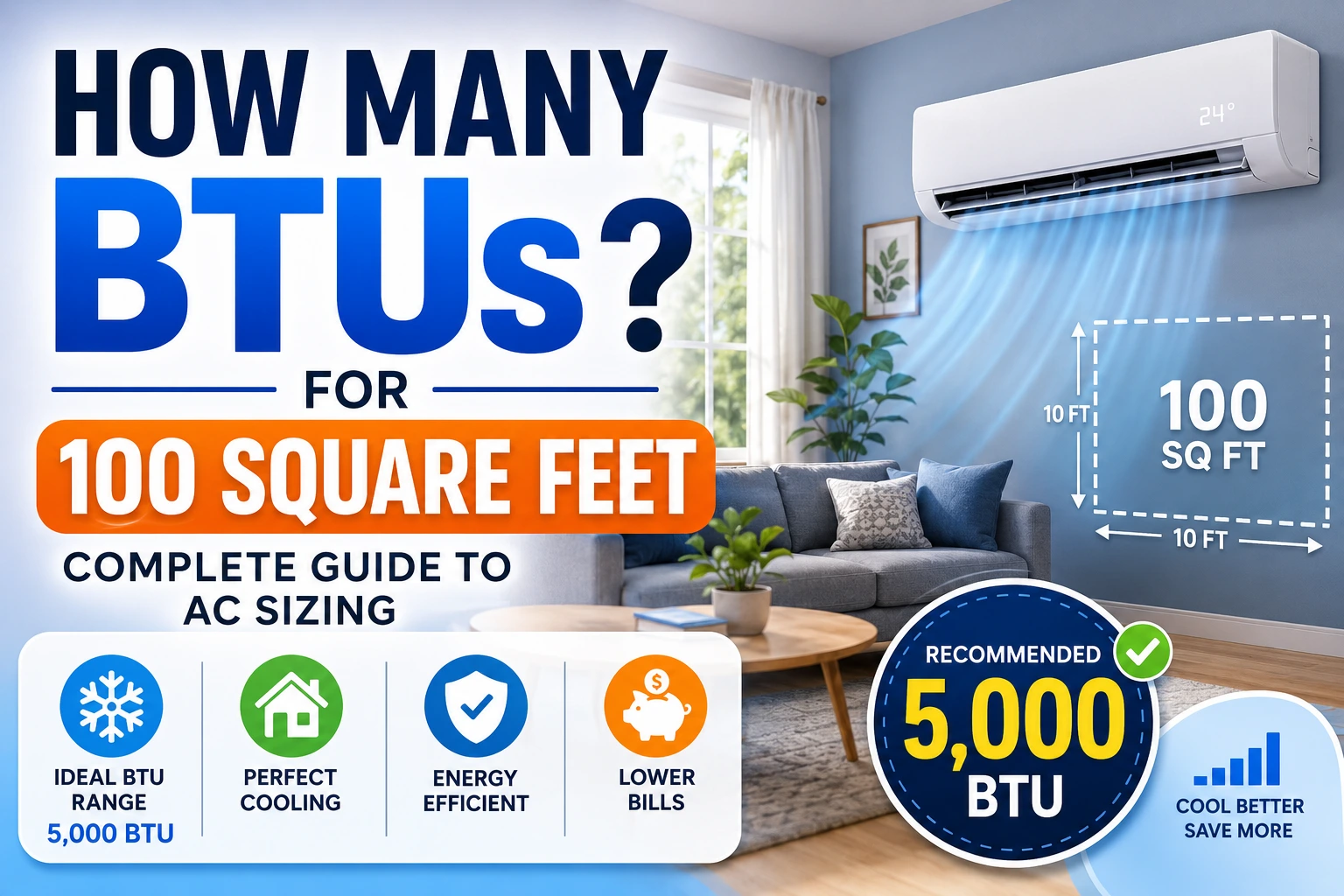
For most rooms measuring 100 square feet, the recommended cooling capacity is around 5,000 BTUs. However, several factors—including ceiling height, insulation, sunlight, climate, and occupancy—can change the ideal BTU requirement.
This complete guide explains everything you need to know, including BTU calculations, room-size charts, practical examples, and expert recommendations so you can choose the right air conditioner with confidence.
Quick Answer
The standard recommendation is:
100 square feet = approximately 5,000 BTUs
This recommendation works for most bedrooms, home offices, dorm rooms, and small living spaces with average insulation and an 8-foot ceiling.
Quick Formula
A common rule of thumb is:
Square Feet × 20 BTUs = Estimated Cooling Capacity
Example:
100 × 20 = 2,000 BTUs
However, HVAC manufacturers and ENERGY STAR recommendations use a practical minimum of 5,000 BTUs for rooms up to about 150 square feet because smaller air conditioners are rarely manufactured below this capacity and real-world conditions require additional cooling power.
What Is a BTU?
BTU stands for British Thermal Unit.
In air conditioning, BTUs measure how much heat an air conditioner can remove from a room every hour.
Simply put:
- Higher BTUs = more cooling power
- Lower BTUs = less cooling power
The correct BTU rating ensures your room cools quickly while using electricity efficiently.
How Many BTUs for 100 Square Feet?
For a standard room:
| Room Size | Recommended BTUs |
|---|---|
| 100 sq ft | 5,000 BTUs |
| 120 sq ft | 5,000 BTUs |
| 150 sq ft | 5,000–6,000 BTUs |
| 200 sq ft | 6,000–8,000 BTUs |
| 250 sq ft | 8,000 BTUs |
Although mathematical formulas sometimes produce smaller numbers, HVAC sizing guidelines recommend 5,000 BTUs as the smallest practical cooling unit for a room around 100 square feet.
BTU Calculation Formula
A quick estimate uses this equation:
BTUs = Room Area × 20
For a room measuring:
- Width = 10 feet
- Length = 10 feet
Area:
10 × 10 = 100 square feet
Estimated BTUs:
100 × 20 = 2,000 BTUs
However, because cooling needs vary throughout the day and manufacturers generally start at 5,000 BTUs, choosing a 5,000-BTU unit provides better real-world performance.
Factors That Affect BTU Requirements
Room size is only one factor when selecting an air conditioner.
Ceiling Height
Most BTU charts assume an 8-foot ceiling.
If your ceiling is higher:
- 9-foot ceiling: add about 10%
- 10-foot ceiling: add about 20%
More air volume requires more cooling.
Sunlight Exposure
Rooms with large south- or west-facing windows receive more heat.
Increase BTUs by approximately 10% if the room receives direct sunlight most of the day.
Shaded rooms may need slightly less cooling.
Climate
Outdoor temperatures matter.
If you live in very hot climates where summer temperatures regularly exceed 95°F (35°C), choosing a slightly larger unit helps maintain comfortable indoor temperatures.
Number of Occupants
People generate body heat.
If more than two people regularly occupy the room, add roughly 600 BTUs per additional person.
Kitchen Appliances
Rooms with ovens, refrigerators, or cooking appliances produce extra heat.
Kitchen spaces generally require an additional 4,000 BTUs beyond standard recommendations.
Insulation Quality
Well-insulated homes hold cool air longer.
Poor insulation increases cooling requirements because cold air escapes while warm outdoor air enters.
BTU Chart by Room Size
Use this quick sizing chart when shopping for an air conditioner.
| Room Size (sq ft) | Recommended BTUs |
| 100 | 5,000 |
| 150 | 5,000–6,000 |
| 200 | 6,000–8,000 |
| 250 | 8,000 |
| 300 | 8,000–10,000 |
| 350 | 10,000 |
| 400 | 10,000–12,000 |
| 450 | 12,000 |
| 500 | 12,000–14,000 |
This chart assumes average insulation, moderate climate, and standard ceiling height.
Real-World Examples
Example 1: Small Bedroom
Room Size:
10 × 10 feet
Area:
100 square feet
Conditions:
- Average insulation
- One person
- Moderate climate
Recommended AC:
5,000 BTUs
Example 2: Home Office
Room Size:
100 square feet
Equipment:
- Desktop computer
- Two monitors
- Printer
Since electronics generate heat, a 5,000 to 6,000 BTU air conditioner may perform better.
Example 3: Sunny Guest Room
Room Size:
100 square feet
Features:
- Large windows
- Afternoon sunlight
Recommendation:
Increase cooling capacity by about 10%.
Ideal range:
5,500–6,000 BTUs
Is It Better to Oversize or Undersize an AC?
Many buyers think bigger is always better.
That isn’t always true.
Oversized AC
Pros
- Faster cooling
- Better performance during heat waves
Cons
- Higher purchase cost
- More electricity use
- Short cycling
- Poor humidity removal
Undersized AC
Pros
- Lower initial price
Cons
- Runs constantly
- Higher electricity bills
- Uneven cooling
- Shorter lifespan
- Reduced comfort
Choosing the correct BTU size provides the best balance between comfort and efficiency.
Best Types of Air Conditioners for 100 Square Feet
Several AC styles work well for small rooms.
Window Air Conditioner
Ideal for:
- Bedrooms
- Dorm rooms
- Offices
Recommended capacity:
5,000 BTUs
Portable Air Conditioner
Best for:
- Rental properties
- Rooms without window installation options
Recommended size:
5,000–6,000 BTUs
Mini Split System
Ideal if:
- You want quiet operation
- High energy efficiency
- Permanent installation
Although more expensive initially, mini splits often save energy over time.
Energy Efficiency Tips
Even the correctly sized air conditioner performs better when your room is energy efficient.
Here are some simple improvements:
- Close curtains during hot afternoons.
- Seal air leaks around windows.
- Use ceiling fans to circulate cool air.
- Clean AC filters monthly.
- Keep doors closed while cooling.
- Avoid placing heat-producing appliances near the thermostat.
These habits reduce electricity costs while improving cooling performance.
Common BTU Sizing Mistakes
Avoid these frequent errors.
Buying Based Only on Price
Cheaper isn’t always better.
An undersized AC often costs more to operate over time.
Ignoring Ceiling Height
Large ceilings increase room volume significantly.
Forgetting About Sunlight
Direct sunlight can dramatically increase indoor temperatures.
Ignoring Insulation
Poor insulation causes constant heat gain.
Using Only Online Calculators
Online calculators provide estimates, but room conditions should always influence your final decision.
Expert Tips
HVAC professionals often recommend these best practices:
- Measure room dimensions carefully.
- Consider future room usage.
- Check the manufacturer’s recommended coverage area.
- Choose ENERGY STAR-certified units when possible.
- Clean filters regularly.
- Schedule annual maintenance.
- Avoid blocking air vents with furniture.
- Leave space around the indoor unit for proper airflow.
Following these recommendations helps maximize comfort and extend your air conditioner’s lifespan.
Why Proper BTU Sizing Matters
Correct sizing improves nearly every aspect of cooling.
Benefits include:
- Lower energy bills
- Faster cooling
- Better humidity control
- Longer equipment life
- Quieter operation
- More consistent temperatures
- Improved indoor comfort
An appropriately sized air conditioner works efficiently without unnecessary strain.
Practical Buying Checklist
Before purchasing an AC for a 100-square-foot room, confirm:
- Room dimensions
- Ceiling height
- Window direction
- Number of occupants
- Insulation quality
- Climate conditions
- AC installation type
- Energy efficiency rating
- Warranty coverage
Checking these details helps ensure you select the right unit the first time.
Frequently Asked Questions
How many BTUs for 100 square feet?
For most standard rooms measuring 100 square feet, a 5,000-BTU air conditioner provides effective cooling under normal conditions.
Can a 5,000 BTU air conditioner cool 100 square feet?
Yes. A 5,000-BTU AC is designed to cool rooms up to approximately 150 square feet, making it an excellent choice for a 100-square-foot space.
What happens if my AC has too many BTUs?
An oversized unit cools the room quickly but may cycle on and off frequently, reducing humidity removal and increasing energy consumption.
Does ceiling height affect BTU requirements?
Yes. Rooms with ceilings higher than 8 feet contain more air volume and typically require additional cooling capacity.
Is a portable AC or window AC better for 100 square feet?
Both work well. Window units are generally more energy-efficient, while portable air conditioners offer greater flexibility if permanent installation isn’t possible.
Conclusion
Choosing how many BTUs for 100 square feet doesn’t have to be complicated. For most standard rooms, a 5,000-BTU air conditioner offers the ideal balance of cooling performance, comfort, and energy efficiency. However, factors such as ceiling height, insulation, sunlight, climate, and the number of occupants can increase your cooling needs.
Before making a purchase, measure your room accurately and consider all environmental factors rather than relying solely on square footage. Selecting the correct BTU capacity will help your air conditioner cool efficiently, reduce electricity costs, improve humidity control, and provide years of reliable performance.
Discover more