
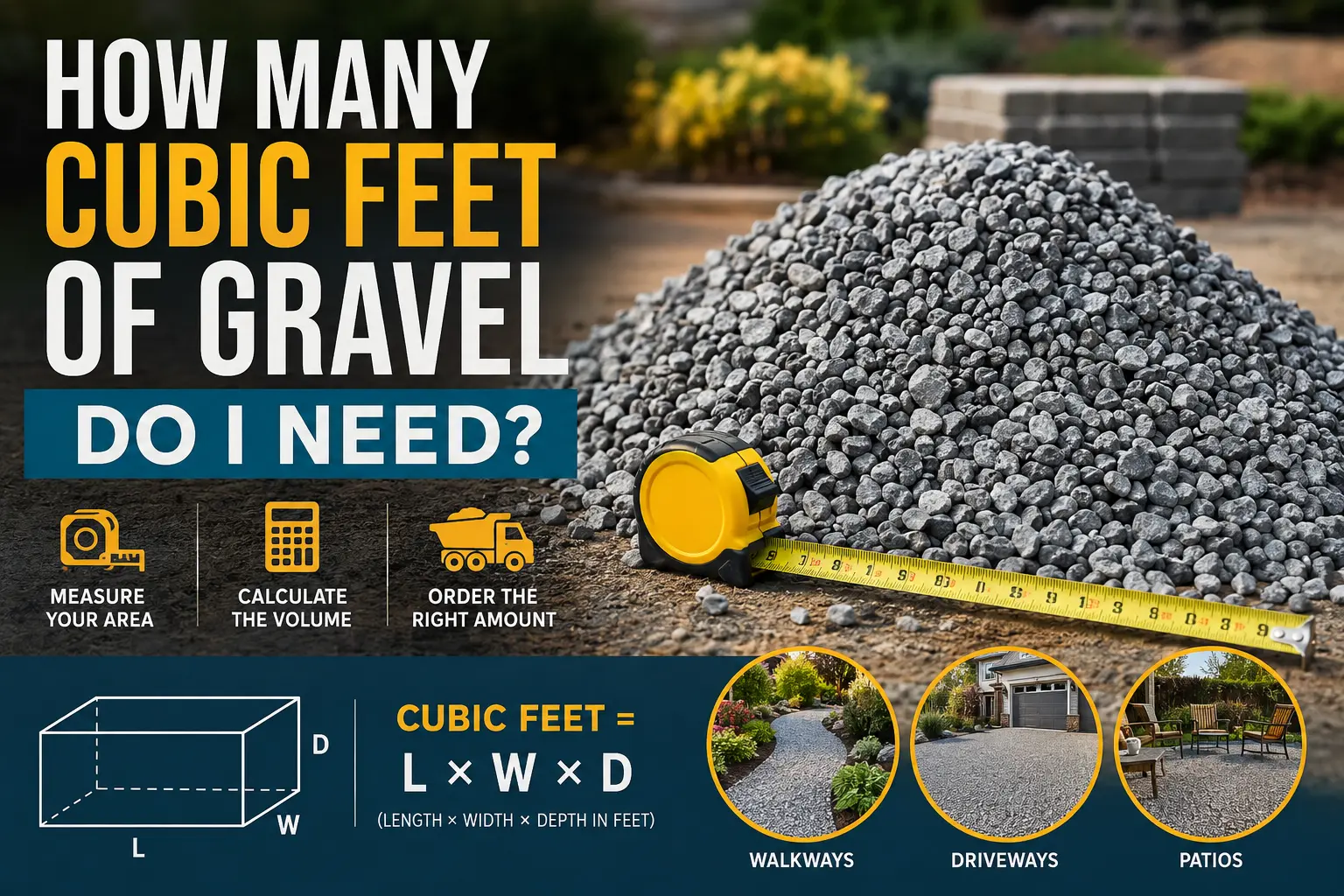
If you are planning a driveway, patio, walkway, garden bed, or drainage project, one of the first questions you may ask is: “how many cubic feet of gravel do I need?”
Getting the right amount matters more than many people think. Too little gravel can leave uneven coverage and delay your project. Too much gravel means wasted money and extra cleanup. The good news is that calculating gravel is easier than it sounds.
In this guide, you will learn how to calculate gravel volume step by step, understand cubic feet, use simple formulas, and avoid common mistakes. You will also see practical examples and gravel coverage charts to help you estimate accurately.
Why Calculating Gravel Correctly Matters
Gravel projects often look simple, but accurate measurements make a huge difference.
Here’s why proper gravel calculations are important:
- Prevent overspending on extra material
- Avoid running short during installation
- Ensure even surface coverage
- Improve drainage performance
- Reduce labor and transportation costs
Whether you are installing a small garden path or a large driveway, knowing the correct amount of gravel saves time and money.
Understanding Cubic Feet for Gravel Projects
Before calculating gravel, it helps to understand how cubic feet work.
What Is a Cubic Foot?
A cubic foot is a measurement of volume. It describes a space that is:
- 1 foot long
- 1 foot wide
- 1 foot deep
Mathematically, it looks like this:
1 ft×1 ft×1 ft=1 cubic foot
Gravel suppliers often sell materials in cubic feet or cubic yards because gravel fills three-dimensional space.
Why Gravel Is Measured by Volume
Unlike flooring or paint, gravel has depth. You are not just covering length and width. You are filling an area with material thickness.
For example:
- A driveway may need 4 inches of gravel
- A walkway may need 2 inches
- Drainage systems may require deeper layers
That depth changes how much gravel you need.
How to Calculate How Many Cubic Feet of Gravel You Need
The process is simple if you follow these steps carefully.
Step 1: Measure Length
Measure the total length of the project area in feet.
Example:
- Driveway length = 20 feet
Step 2: Measure Width
Measure the width in feet.
Example:
- Driveway width = 10 feet
Step 3: Determine Depth
Decide how deep the gravel layer should be.
Typical gravel depths:
| Project Type | Recommended Depth |
|---|---|
| Walkways | 2–3 inches |
| Patios | 3–4 inches |
| Driveways | 4–6 inches |
| Drainage Areas | 6–12 inches |
Convert inches into feet before calculating.
For example:
- 4 inches ÷ 12 = 0.33 feet
Step 4: Use the Formula
Use this basic gravel formula:
Cubic Feet=Length×Width×Depth
Example calculation:
20×10×0.33=66 cubic feet
You would need approximately 66 cubic feet of gravel.
Gravel Calculation Formula
Here is the full process in simple terms:
- Measure the area in feet
- Convert depth from inches to feet
- Multiply length × width × depth
If your project area is circular, use this formula:V=πr2h
Where:
- r = radius
- h = depth
- V = volume
This works well for fire pits, circular patios, or round garden beds.
Common Gravel Depth Recommendations
Different projects need different gravel depths.
| Project | Depth |
|---|---|
| Decorative landscaping | 1–2 inches |
| Garden paths | 2–3 inches |
| Patios | 3–4 inches |
| Driveways | 4–6 inches |
| Heavy vehicle driveways | 8–12 inches |
Always consider traffic load and drainage needs before choosing depth.
Gravel Coverage Chart
This quick chart helps estimate coverage.
| Gravel Amount | Coverage at 2 Inches Deep | Coverage at 4 Inches Deep |
|---|---|---|
| 1 cubic foot | 6 sq ft | 3 sq ft |
| 10 cubic feet | 60 sq ft | 30 sq ft |
| 25 cubic feet | 150 sq ft | 75 sq ft |
| 50 cubic feet | 300 sq ft | 150 sq ft |
These are approximate values because gravel compacts slightly over time.
Real-World Gravel Calculation Examples
Let’s look at practical examples to make calculations easier.
Driveway Example
Suppose your driveway measures:
- Length = 40 feet
- Width = 12 feet
- Depth = 5 inches
Convert depth:
5÷12=0.42 feet
Now calculate:
40×12×0.42=201.6 cubic feet
You need approximately 202 cubic feet of gravel.
Patio Example
Patio dimensions:
- 15 feet × 15 feet
- Depth = 3 inches
Convert depth:
3÷12=0.25 feet
Formula:
15×15×0.25=56.25 cubic feet
You need about 56 cubic feet.
Garden Path Example
Path dimensions:
- Length = 25 feet
- Width = 3 feet
- Depth = 2 inches
Convert depth:
2÷12=0.167 feet
Calculation:
25×3×0.167≈12.5 cubic feet
You need around 13 cubic feet of gravel.
Converting Cubic Feet to Cubic Yards
Many suppliers sell gravel by cubic yard instead of cubic foot.
Since:
1 cubic yard=27 cubic feet
Use this formula:
Cubic Yards=27Cubic Feet
Example:
66÷27≈2.44 cubic yards
You would order about 2.5 cubic yards.
Most contractors recommend adding 5–10% extra for waste and settling.
Types of Gravel and Their Uses
Choosing the right gravel is just as important as calculating the amount.
Pea Gravel
Pea gravel is small, smooth, and decorative.
Best for:
- Walkways
- Patios
- Landscaping
Pros:
- Attractive appearance
- Comfortable to walk on
Cons:
- Shifts easily under heavy traffic
Crushed Stone
Crushed stone has rough edges that compact tightly.
Best for:
- Driveways
- Base layers
- Drainage
Pros:
- Excellent stability
- Strong support
Cons:
- Less comfortable for bare feet
River Rock
River rock consists of rounded natural stones.
Best for:
- Decorative landscaping
- Water features
Pros:
- Beautiful appearance
- Natural look
Cons:
- More expensive
- Poor compaction
Common Mistakes When Calculating Gravel
Many DIY projects fail because of small calculation errors.
Avoid these common mistakes:
Forgetting to Convert Inches to Feet
This is the biggest mistake.
Always divide inches by 12 before calculating volume.
Ignoring Compaction
Gravel settles over time. Ordering exact amounts may leave gaps later.
Not Measuring Correctly
Uneven shapes and curves can affect calculations. Measure carefully.
Choosing the Wrong Depth
Thin gravel layers may wash away or develop holes quickly.
Not Adding Extra Material
Most professionals recommend ordering 5–10% more gravel than calculated.
Expert Tips to Save Money on Gravel
Want to reduce costs without hurting quality? These tips help.
Buy in Bulk
Bulk gravel deliveries usually cost less than bagged gravel.
Use Landscape Fabric
Landscape fabric prevents weeds and reduces gravel loss.
Compact the Base
A compacted base prevents sinking and movement.
Combine Gravel Sizes
Larger stones underneath with smaller gravel on top improves stability.
Compare Supplier Prices
Delivery fees can vary widely between suppliers.
When to Use a Gravel Calculator
Online gravel calculators make large projects easier.
They are especially useful for:
- Irregular shapes
- Multiple project sections
- Large driveways
- Commercial landscaping
However, understanding the math yourself helps you double-check estimates and avoid ordering mistakes.
FAQs
How do I calculate how many cubic feet of gravel I need?
Measure the length, width, and depth of the area in feet, then multiply them together using the formula:
Length × Width × Depth = Cubic Feet
How much area does 1 cubic foot of gravel cover?
At 2 inches deep, 1 cubic foot covers about 6 square feet. Coverage decreases with deeper layers.
How many cubic feet are in a cubic yard of gravel?
There are 27 cubic feet in 1 cubic yard.
Should I order extra gravel?
Yes. Most experts recommend ordering 5–10% extra to account for settling, waste, and uneven surfaces.
What depth of gravel is best for a driveway?
Most residential driveways need 4–6 inches of gravel, while heavy vehicle areas may require deeper layers.
Conclusion
If you have been asking, “how many cubic feet of gravel do I need,” the answer depends on your project size and gravel depth. Fortunately, the calculation process is straightforward once you know the formula.
Measure your area carefully, convert the depth into feet, and multiply the dimensions to find the total cubic feet needed. For larger projects, convert cubic feet into cubic yards before ordering.
Whether you are building a driveway, patio, garden path, or drainage area, accurate gravel calculations help you save money, avoid delays, and create a more durable finished project.
discover more
how many feet apart for ladder ball