
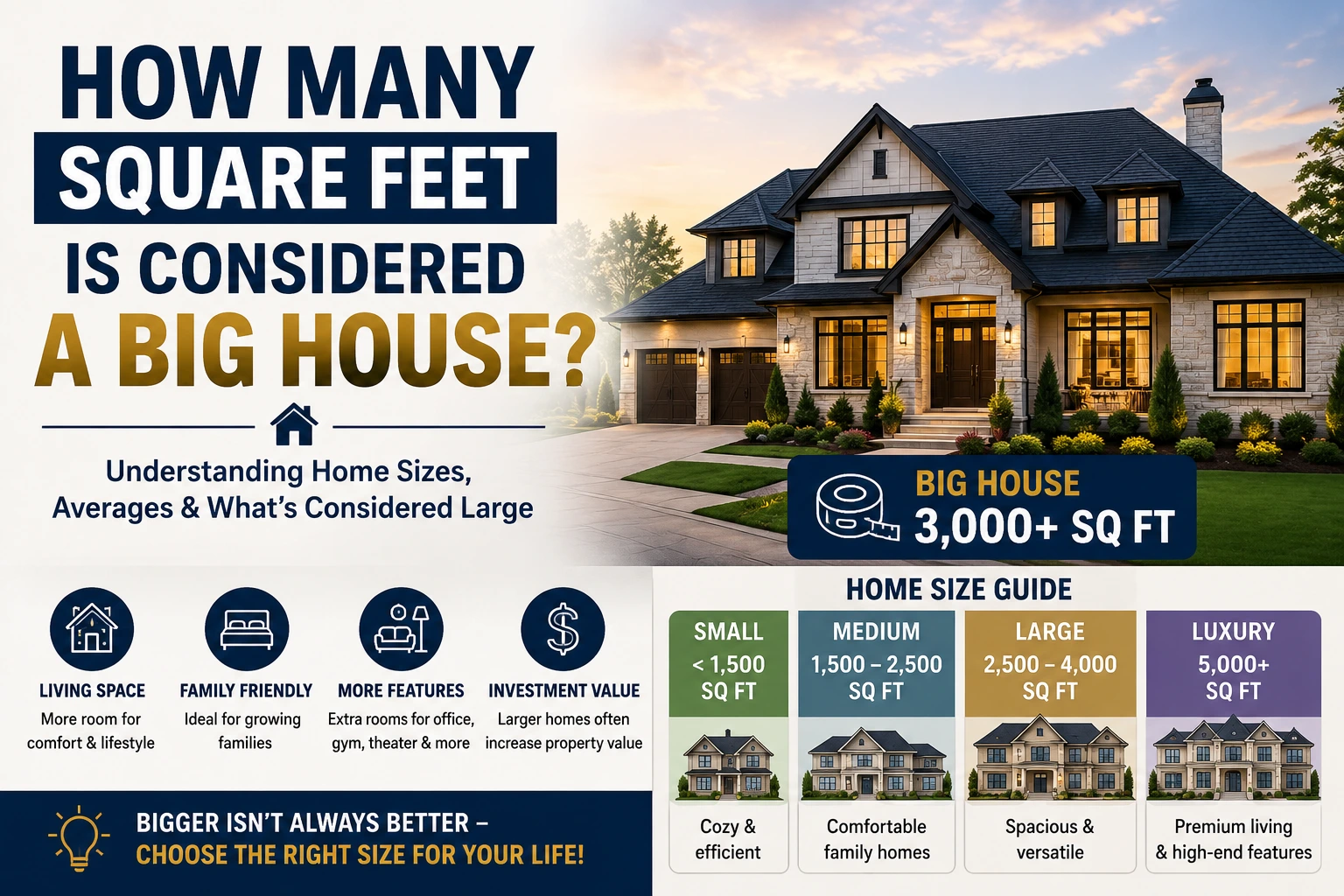
Many people wonder how many square feet is considered a big house, especially when comparing homes online or planning to buy a property. The answer depends on location, lifestyle, family size, and local housing trends. However, in general, most experts consider a home over 3,000 square feet to be a large house.
In some cities, a 2,500-square-foot home may already feel spacious. In luxury neighborhoods, homes often exceed 5,000 square feet and include extra features like home theaters, gyms, offices, and multiple garages.
Understanding house size helps buyers make smarter decisions about comfort, maintenance costs, and long-term living needs. It also helps you compare homes more realistically instead of focusing only on appearance.
Understanding House Size Measurements
Before deciding what counts as a big house, it helps to understand how square footage works.
What Does Square Footage Mean?
Square footage measures the total living space inside a home.
It includes:
- Bedrooms
- Bathrooms
- Living rooms
- Kitchens
- Hallways
- Finished basements
It usually does not include:
- Garages
- Open patios
- Unfinished attics
- Outdoor spaces
Square footage is calculated by multiplying the length and width of each room.
For example:
Area=Length×Width
If a room is:
- 20 feet long
- 15 feet wide
Then:
20×15=300 square feet
How Square Feet Are Calculated
To calculate an entire house:
- Measure every finished room.
- Find each room’s area.
- Add all areas together.
Example:
| Room | Size | Square Feet |
|---|---|---|
| Living Room | 20 x 15 | 300 |
| Kitchen | 12 x 15 | 180 |
| Bedroom | 14 x 14 | 196 |
The total home size equals the sum of all finished spaces.
How Many Square Feet Is Considered a Big House?
Most housing experts use general size ranges to classify homes.
Here is a simple breakdown:
| House Size | Square Footage |
|---|---|
| Small House | Under 1,500 sq ft |
| Medium House | 1,500–2,500 sq ft |
| Big House | 3,000–4,000 sq ft |
| Luxury Home | 5,000+ sq ft |
| Mansion | 8,000+ sq ft |
So, if you are asking how many square feet is considered a big house, the answer is usually around 3,000 square feet or more.
Average House Size in the United States
The average American single-family home is generally around:
- 2,200 to 2,500 square feet
That means homes above this range are often considered larger than average.
In some countries or urban areas, even a 1,800-square-foot home may feel very large due to limited land availability.
When a House Becomes “Big”
A house starts feeling big when it has:
- Multiple living areas
- Extra bedrooms
- Dedicated office spaces
- Large kitchens
- Storage rooms
- Wide hallways
- Open floor plans
Many families consider a home large when every family member has personal space plus extra rooms for entertainment or work.
House Size Categories Explained
Different home sizes serve different lifestyles.
Small Houses
Small homes are usually:
- Under 1,500 square feet
These homes work well for:
- Singles
- Couples
- Minimalist lifestyles
- First-time buyers
Benefits include:
- Lower maintenance
- Lower utility bills
- Easier cleaning
Medium-Sized Homes
Medium homes range from:
- 1,500 to 2,500 square feet
This is the most common range for family homes.
Typical features:
- 3–4 bedrooms
- Multiple bathrooms
- Standard garage
- Dining room
Large Houses
Large homes generally start around:
- 3,000 square feet
These homes may include:
- Guest rooms
- Home offices
- Playrooms
- Formal dining areas
- Large outdoor spaces
A 3,500-square-foot home often feels very spacious for an average family.
Luxury Homes and Mansions
Luxury properties usually exceed:
- 5,000 square feet
Mansions often surpass:
- 8,000 square feet
These homes may contain:
- Indoor theaters
- Wine cellars
- Gyms
- Libraries
- Swimming pools
- Multiple kitchens
Square Foot Comparison Chart
This chart helps visualize home sizes.
| Square Feet | Typical Description |
|---|---|
| 800 sq ft | Small apartment |
| 1,200 sq ft | Starter home |
| 2,000 sq ft | Average family home |
| 3,000 sq ft | Large house |
| 5,000 sq ft | Luxury property |
| 8,000+ sq ft | Mansion |
Real-Life Examples of Big Houses
Seeing real-world examples makes square footage easier to understand.
2,500 Square Foot Home
A 2,500-square-foot home may include:
- 4 bedrooms
- 3 bathrooms
- Large kitchen
- Family room
- Garage
For many families, this already feels spacious.
4,000 Square Foot Home
A 4,000-square-foot home often contains:
- Large master suite
- Home office
- Theater room
- Walk-in closets
- Large backyard access
This size is clearly considered a big house in most neighborhoods.
6,000+ Square Foot Luxury Homes
Homes above 6,000 square feet may include:
- Elevator
- Gym
- Guest wing
- Indoor pool
- Multi-car garage
These homes require significant maintenance and higher operating costs.
Factors That Make a House Feel Big
Square footage matters, but layout also affects how spacious a home feels.
Ceiling Height
High ceilings create a more open atmosphere.
A 2,500-square-foot home with:
- 12-foot ceilings
May feel larger than:
- A 3,000-square-foot home with low ceilings
Open Floor Plans
Modern homes often combine:
- Kitchen
- Dining area
- Living room
This creates a larger visual space.
Storage and Layout
Poor layouts waste space.
A well-designed home feels bigger when it includes:
- Smart storage
- Wide hallways
- Functional rooms
- Natural lighting
Benefits of Owning a Big House
Large homes provide several advantages.
More Personal Space
Family members can enjoy:
- Privacy
- Quiet work areas
- Personal hobbies
Better for Entertaining
Large houses are ideal for:
- Hosting guests
- Holiday gatherings
- Family events
Flexible Rooms
Extra rooms can become:
- Home gyms
- Offices
- Gaming rooms
- Libraries
Higher Resale Appeal in Some Areas
In upscale neighborhoods, large homes often attract premium buyers.
Drawbacks of Large Homes
Bigger homes are not always better.
Higher Costs
Large homes usually mean:
- Bigger mortgages
- Higher taxes
- Expensive insurance
Increased Utility Bills
Heating and cooling larger homes costs more.
More Maintenance
Cleaning large homes takes:
- More time
- More money
- More effort
Unused Space
Some homeowners rarely use:
- Formal dining rooms
- Guest suites
- Large basements
Unused space can become wasted money.
Is Bigger Always Better?
Not necessarily.
The best house size depends on:
- Family size
- Lifestyle
- Budget
- Location
For some people:
- 1,800 square feet feels perfect.
For others:
- 4,000 square feet still feels small.
A well-designed smaller home can feel more comfortable than a poorly designed large house.
Common Mistakes When Choosing House Size
Homebuyers often focus only on square footage.
Avoid these common mistakes.
Ignoring Future Costs
Large homes require ongoing expenses such as:
- Repairs
- Landscaping
- Furniture
- Utilities
Buying More Space Than Needed
Extra rooms may sit unused for years.
Overlooking Lot Size
A big house on a tiny lot may feel crowded.
Forgetting Storage Needs
Some homes have large rooms but limited storage.
Expert Tips Before Buying a Large House
Professionals recommend thinking carefully before purchasing a big property.
Think About Daily Life
Ask yourself:
- Will you use every room?
- How often will guests visit?
- Do you work from home?
Consider Long-Term Maintenance
Larger homes may require:
- Roof repairs
- More paint
- Larger HVAC systems
Focus on Layout Over Size
Smart layouts matter more than raw square footage.
Visit Homes in Person
Online listings can make homes appear larger or smaller than reality.
Walking through the property gives a better sense of space.
Big House Size by Lifestyle
Different lifestyles require different amounts of space.
| Lifestyle | Suggested Home Size |
|---|---|
| Single Person | 800–1,500 sq ft |
| Couple | 1,200–2,000 sq ft |
| Small Family | 1,800–2,500 sq ft |
| Large Family | 3,000+ sq ft |
| Luxury Lifestyle | 5,000+ sq ft |
FAQs
How many square feet is considered a big house?
Most experts consider homes over 3,000 square feet to be large houses.
Is 2,500 square feet a big house?
Yes, for many families, 2,500 square feet feels spacious and above average.
Is 4,000 square feet considered huge?
Yes. A 4,000-square-foot home is considered very large in most neighborhoods.
What size is considered a mansion?
Homes over 8,000 square feet are commonly classified as mansions.
Does a bigger house increase property value?
Usually yes, but location, condition, and neighborhood demand also strongly affect value.
Conclusion
Understanding how many square feet is considered a big house helps buyers compare homes more realistically and choose a property that fits their lifestyle. In general, homes over 3,000 square feet are considered large, while luxury homes often exceed 5,000 square feet.
However, the ideal house size depends on more than numbers alone. Layout, ceiling height, storage, and room design all affect how spacious a home feels. A smartly designed medium-sized house may feel more comfortable than an oversized home with wasted space.
Before buying a large property, consider your budget, maintenance responsibilities, long-term plans, and daily living needs. Choosing the right amount of space can improve comfort, reduce stress, and create a better overall living experience.
Discover more
how many feet are in a half acre