

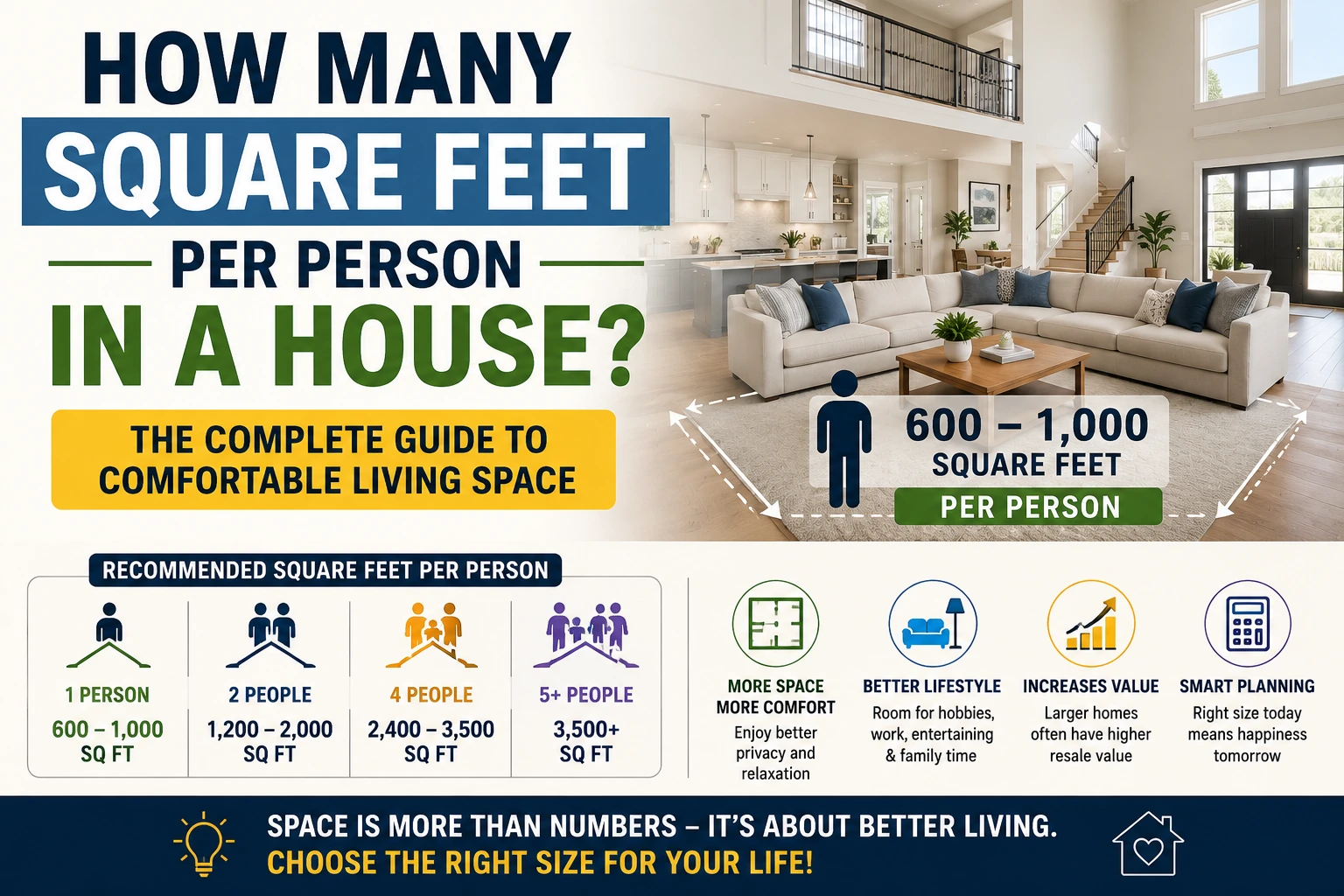
Many people ask how many square feet per person in a house is ideal for comfortable living. The answer depends on lifestyle, family size, budget, and personal preferences. However, most housing experts suggest that around 600 to 1,000 square feet per person provides a comfortable amount of living space in a modern home.
Some people are happy in smaller homes with efficient layouts, while others prefer large open spaces with extra rooms. A family with children, pets, or work-from-home needs will usually require more square footage than a single person or couple.
Understanding how much space each person truly needs can help you choose the right home, avoid overspending, and create a more comfortable lifestyle.
Understanding Square Feet Per Person
Before deciding how much space is enough, it is important to understand how square footage works.
What Does Square Footage Mean?
Square footage measures the total indoor living area of a house.
It generally includes:
- Bedrooms
- Bathrooms
- Kitchens
- Living rooms
- Dining areas
- Finished basements
It usually does not include:
- Garages
- Open patios
- Unfinished attics
- Outdoor decks
Square footage is calculated using room dimensions.
For example:
Area=Length×Width
If a room is:
- 12 feet wide
- 15 feet long
Then:
12×15=180 square feet
Why Space Per Person Matters
The amount of space per person affects:
- Comfort
- Privacy
- Organization
- Mental well-being
- Storage capacity
Too little space may feel crowded, while too much space can increase maintenance costs and utility bills.
How Many Square Feet Per Person in a House Is Ideal?
There is no universal rule, but most experts agree on general comfort ranges.
| Living Style | Square Feet Per Person |
|---|---|
| Minimal Living | 200–400 sq ft |
| Comfortable Living | 600–1,000 sq ft |
| Spacious Living | 1,000+ sq ft |
In many modern households:
- 600 to 800 square feet per person feels comfortable.
- 1,000 square feet per person feels luxurious.
Average Space Per Person
In the United States, the average home is approximately:
- 2,200 to 2,500 square feet
The average household contains about:
- 2.5 people
That means many Americans have roughly:
2.52400=960 square feet per person
This is considered spacious compared to many other countries.
Recommended Square Footage by Lifestyle
Different lifestyles require different amounts of space.
Minimalist Lifestyle
People who prefer simplicity may need:
- 200–500 square feet per person
Tiny homes often fall into this category.
Standard Family Lifestyle
Families usually prefer:
- 600–900 square feet per person
This allows:
- Bedrooms
- Shared living spaces
- Storage
- Functional kitchens
Luxury Lifestyle
Luxury homes may provide:
- 1,000–2,000+ square feet per person
These homes often include:
- Home theaters
- Gyms
- Offices
- Guest rooms
Square Feet Per Person Chart
This chart provides quick comparisons.
| Household Size | Recommended House Size |
|---|---|
| 1 Person | 600–1,000 sq ft |
| 2 People | 1,200–1,800 sq ft |
| 3 People | 1,800–2,400 sq ft |
| 4 People | 2,400–3,000 sq ft |
| 5+ People | 3,000+ sq ft |
These are flexible guidelines, not strict rules.
How to Calculate Square Feet Per Person
Calculating square footage per person is simple.
Simple Formula
Use this formula:
Square Feet Per Person=Number of PeopleTotal House Size
Example Calculation 1
A house is:
- 2,000 square feet
- 4 people live there
Calculation:
42000=500 square feet per person
Example Calculation 2
A home is:
- 3,600 square feet
- 3 people live there
Calculation:
33600=1200 square feet per person
This would be considered very spacious living.
Recommended House Sizes for Different Family Sizes
Different households have different space needs.
One Person
A single person may feel comfortable in:
- 600 to 1,200 square feet
This typically includes:
- Bedroom
- Kitchen
- Living room
- Bathroom
- Workspace
Couples
Couples usually prefer:
- 1,200 to 2,000 square feet
Extra space may be used for:
- Guests
- Home office
- Storage
- Future children
Families With Children
Families often need:
- 2,000 to 3,500 square feet
This supports:
- Multiple bedrooms
- Play areas
- Shared living spaces
- Storage
Multi-Generational Families
Homes with grandparents or extended family may require:
- 3,000+ square feet
These homes may include:
- Separate suites
- Additional bathrooms
- Large kitchens
Factors That Affect Space Needs
Square footage needs vary widely between households.
Privacy Requirements
People who value privacy usually want:
- Separate bedrooms
- Personal workspaces
- Quiet areas
Larger families often need more individual rooms.
Work From Home Lifestyle
Remote workers may require:
- Dedicated office space
- Meeting rooms
- Quiet zones
This increases square footage needs.
Storage Needs
Families with many belongings require:
- Closets
- Garages
- Basement storage
- Utility rooms
Pets and Hobbies
Pets and hobbies also increase space requirements.
Examples:
- Home gyms
- Music studios
- Craft rooms
- Indoor pet areas
Small House vs Large House Living
Both small and large homes have advantages.
| Small House | Large House |
|---|---|
| Lower costs | More privacy |
| Easier cleaning | Extra rooms |
| Lower utilities | Better entertaining |
| Simpler lifestyle | More storage |
Choosing the right size depends on your priorities.
Benefits of More Space Per Person
Having more space often improves comfort.
Better Privacy
Extra rooms provide:
- Quiet work areas
- Personal relaxation space
- Reduced stress
Improved Organization
More storage reduces clutter.
Easier Entertaining
Larger homes are better for:
- Guests
- Family gatherings
- Parties
Flexible Lifestyle
Extra rooms can become:
- Offices
- Gyms
- Guest suites
- Playrooms
Drawbacks of Too Much Space
More space is not always better.
Higher Costs
Large homes often mean:
- Higher mortgage payments
- Increased taxes
- Expensive utilities
More Maintenance
Cleaning and repairs take more:
- Time
- Money
- Energy
Unused Rooms
Some homeowners rarely use:
- Formal dining rooms
- Guest bedrooms
- Large basements
Unused space can become wasteful.
Expert Tips for Choosing the Right House Size
Professionals recommend focusing on practical needs.
Think About Daily Activities
Consider:
- Cooking habits
- Remote work
- Entertaining guests
- Children’s activities
Plan for the Future
Your needs may change because of:
- Marriage
- Children
- Aging parents
- Career changes
Focus on Layout, Not Just Size
A well-designed 2,000-square-foot home may feel larger than a poorly designed 3,000-square-foot home.
Visit Homes in Person
Photos can be misleading.
Walking through a property helps you understand:
- Room flow
- Ceiling height
- Storage space
Common Mistakes When Estimating Space Needs
Many people misjudge how much space they truly need.
Buying Too Much House
Large homes can create:
- Financial pressure
- Maintenance stress
- Empty unused rooms
Ignoring Storage
A home may appear spacious but lack functional storage.
Forgetting Future Needs
Some buyers fail to consider:
- Growing families
- Remote work changes
- Lifestyle upgrades
Prioritizing Size Over Functionality
Smart layouts matter more than raw square footage.
Real-Life Space Examples
Here are practical examples of how square footage feels.
| House Size | Number of People | Space Per Person |
|---|---|---|
| 1,200 sq ft | 2 people | 600 sq ft each |
| 2,400 sq ft | 4 people | 600 sq ft each |
| 3,500 sq ft | 3 people | 1,166 sq ft each |
| 5,000 sq ft | 4 people | 1,250 sq ft each |
These examples show how lifestyle and family size affect comfort levels.
FAQs
How many square feet per person in a house is comfortable?
Most experts consider 600 to 1,000 square feet per person comfortable for modern living.
Is 500 square feet per person enough?
Yes, 500 square feet per person is comfortable for many people, especially with a smart floor plan.
How much space does a family of four need?
A family of four often feels comfortable in a home between 2,000 and 3,000 square feet.
What is considered crowded living space?
Less than 200 square feet per person may feel crowded for long-term living.
Does a bigger house improve quality of life?
Not always. Smart layouts and functional design often matter more than overall size.
Conclusion
Understanding how many square feet per person in a house is ideal can help you choose a home that balances comfort, functionality, and budget. While many people feel comfortable with 600 to 1,000 square feet per person, the right amount depends on lifestyle, family size, privacy needs, and future plans.
Some households thrive in smaller, efficient homes, while others prefer spacious properties with extra rooms and storage. The key is finding a balance between usable space and practical living costs.
By calculating square footage per person carefully and considering real-life needs, you can choose a home that supports both comfort and long-term happiness.
discover more
how many square feet is considered a big house