

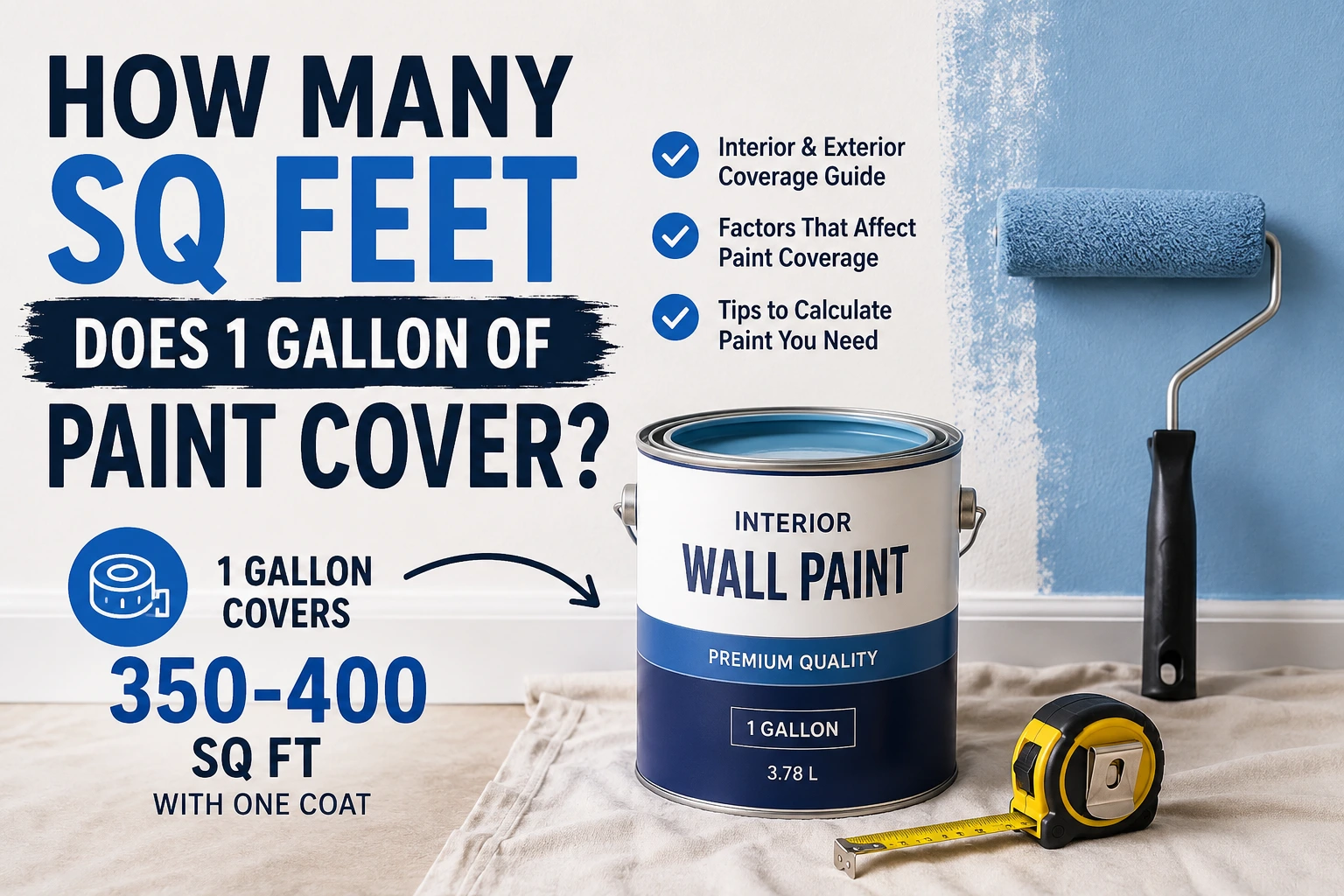
If you are planning to paint a room, office, ceiling, or exterior wall, one of the first questions you will ask is: how many sq feet 1 gallon paint covers?
Knowing the answer helps you:
- Buy the correct amount of paint
- Avoid wasting money
- Prevent running out of paint mid-project
- Estimate renovation costs more accurately
In most cases, 1 gallon of paint covers around 350 to 400 square feet with one coat. However, the actual coverage depends on several factors such as wall texture, paint quality, number of coats, and application method.
Whether you are repainting a bedroom or painting a new house from scratch, this guide explains everything you need to know about paint coverage in simple language.
Average Coverage of 1 Gallon of Paint
Most paint manufacturers state that:
| Paint Type | Average Coverage Per Gallon |
|---|---|
| Interior wall paint | 350–400 sq ft |
| Exterior paint | 250–350 sq ft |
| Primer | 200–300 sq ft |
| Textured surfaces | 150–250 sq ft |
So if your wall area is about 400 square feet, one gallon may be enough for a single coat on smooth walls.
For example:
- A small bedroom may need 1 gallon
- A living room may require 2–3 gallons
- Exterior siding usually needs more paint
Paint labels often include estimated coverage information. Still, real-world results vary.
Factors That Affect Paint Coverage
Even though manufacturers provide estimates, several factors influence how many square feet 1 gallon paint can actually cover.
Surface Texture
Smooth walls require less paint.
Rough or textured surfaces absorb more paint because they have more surface area.
Examples of high-absorption surfaces:
- Brick
- Stucco
- Concrete
- Popcorn ceilings
- Textured drywall
A textured wall may reduce paint coverage by 20–40%.
Type of Paint
Different paint formulas have different spreading abilities.
Flat Paint
- Covers imperfections well
- Usually spreads evenly
- Good coverage
Satin or Semi-Gloss
- More durable
- Slightly lower coverage
- Reflective finish
High-Quality Paint
Premium paints often cover better and may need fewer coats.
Cheap paint can require multiple coats, increasing total paint usage.
Number of Coats
One coat rarely gives perfect coverage.
Most walls need:
- 2 coats for best appearance
- Extra coats when changing colors dramatically
For example:
- Painting dark walls white usually requires more paint
- Fresh drywall absorbs paint quickly
If one gallon covers 400 sq ft with one coat, it may only cover 200 sq ft for two coats.
Application Method
How you apply paint also changes coverage.
| Method | Coverage Efficiency |
|---|---|
| Roller | High |
| Brush | Moderate |
| Paint sprayer | Lower due to overspray |
Paint sprayers waste more paint because fine mist spreads beyond the target surface.
Primer Usage
Primer helps paint stick better and improves coverage.
Using primer can:
- Reduce the number of paint coats
- Improve color consistency
- Save paint overall
Without primer, porous walls may absorb excessive paint.
How to Calculate Paint Needed
Learning how to calculate paint properly prevents overspending and shortages.
Follow these simple steps.
Step 1: Measure Wall Dimensions
Measure:
- Wall height
- Wall width
Then multiply them.
Formula:
Wall Area=Height×Width
Example:
A wall that is:
- 10 feet high
- 12 feet wide
Calculation:
10×12=120 sq ft
That wall equals 120 square feet.
Step 2: Subtract Doors and Windows
Doors and windows do not need paint.
Average sizes:
- Standard door: 20 sq ft
- Window: 15 sq ft
Subtract these from total wall area.
Example:
120 sq ft wall
Minus 20 sq ft door
Equals 100 sq ft paintable area.
Step 3: Multiply by Number of Coats
If you need 2 coats:
100×2=200 sq ft
You now need enough paint for 200 square feet.
Since 1 gallon covers around 350–400 sq ft, one gallon is enough in this example.
Paint Coverage Chart by Room Size
Here is a simple paint estimation chart.
| Room Size | Wall Area Approx. | Paint Needed |
|---|---|---|
| Small bathroom | 200 sq ft | 1 gallon |
| Small bedroom | 350 sq ft | 1 gallon |
| Medium bedroom | 500 sq ft | 2 gallons |
| Living room | 700–900 sq ft | 2–3 gallons |
| Large open area | 1200+ sq ft | 4+ gallons |
These estimates assume:
- Smooth walls
- Two coats
- Standard paint quality
Interior vs Exterior Paint Coverage
Interior and exterior paints behave differently.
| Feature | Interior Paint | Exterior Paint |
|---|---|---|
| Coverage | Better | Lower |
| Thickness | Moderate | Thicker |
| Weather resistance | Low | High |
| Surface absorption | Lower | Higher |
Exterior walls face:
- Rain
- Sunlight
- Dust
- Temperature changes
Because of this, exterior paint is usually thicker and covers fewer square feet.
How Many Sq Feet 1 Gallon Paint Covers for Ceilings
Ceilings often absorb more paint than walls.
Typical ceiling coverage:
- 250–350 sq ft per gallon
Textured ceilings may reduce this further.
Using ceiling-specific paint can improve results.
Paint Coverage for Different Surfaces
| Surface Type | Estimated Coverage |
|---|---|
| Smooth drywall | 400 sq ft |
| Textured drywall | 300 sq ft |
| Brick wall | 200–300 sq ft |
| Concrete | 250–300 sq ft |
| Wood siding | 250–350 sq ft |
Always buy slightly more paint when dealing with porous materials.
Common Paint Coverage Mistakes to Avoid
Many people underestimate how much paint they need.
Avoid these common mistakes.
Ignoring Second Coats
One coat often looks uneven.
Always plan for at least two coats.
Not Using Primer
Skipping primer can cause:
- Uneven color
- More paint usage
- Poor durability
Forgetting Surface Texture
Textured walls consume much more paint.
Never rely only on manufacturer estimates.
Buying Cheap Paint
Low-quality paint may seem cheaper initially but often requires:
- More coats
- More labor
- More gallons
High-quality paint usually saves money over time.
Poor Measurements
Small measuring mistakes can lead to buying too little paint.
Measure carefully before shopping.
Expert Tips to Save Paint and Money
Professional painters use several tricks to improve paint efficiency.
Use Quality Rollers
Good rollers distribute paint evenly and reduce waste.
Mix Paint Properly
Stir paint thoroughly before use to maintain consistent coverage.
Paint in Good Lighting
Proper lighting helps you spot missed areas early.
Buy Extra Paint
It is smart to buy about 10% extra paint for:
- Touch-ups
- Mistakes
- Future repairs
Use Paint Calculators
Online paint calculators help estimate gallons more accurately.
Most paint brands offer free tools on their websites.
Best Tools for Measuring Paint Coverage
These tools help improve paint planning.
| Tool | Purpose |
|---|---|
| Tape measure | Measure walls |
| Laser distance measurer | Faster room measurements |
| Paint calculator | Estimate gallons |
| Notebook or app | Record dimensions |
| Painter’s tape | Mark sections |
Professional contractors often use laser tools for accuracy.
Understanding Paint Label Information
Paint cans usually list:
- Coverage range
- Drying time
- Recommended coats
- Surface compatibility
Always read the label before starting.
Coverage estimates on labels assume:
- Smooth walls
- Proper preparation
- Normal application thickness
Real-life coverage may differ.
When You Need More Than 1 Gallon
You may need additional paint if:
- The wall is textured
- You use dark colors
- You switch from dark to light paint
- The surface is new drywall
- You paint exterior surfaces
It is better to slightly overestimate than underestimate.
Matching paint later can sometimes be difficult.
Is One Coat Enough?
Sometimes yes, but usually no.
One coat may work when:
- Repainting similar colors
- Using high-quality paint
- Painting smooth walls
Two coats are recommended for:
- Better durability
- Richer color
- Professional appearance
Eco-Friendly Paint Considerations
Low-VOC and eco-friendly paints are becoming more popular.
Benefits include:
- Less odor
- Better indoor air quality
- Safer for families
Some eco-friendly paints may have slightly different coverage rates, so always check manufacturer guidelines.
FAQs
How many square feet does 1 gallon of paint cover?
Most paints cover around 350–400 square feet per gallon with one coat on smooth surfaces.
Does textured wall use more paint?
Yes. Textured walls absorb more paint and usually reduce coverage significantly.
How much paint do I need for a 12×12 room?
A standard 12×12 room usually needs about 1–2 gallons depending on ceiling height and number of coats.
Can 1 gallon paint two coats?
Yes, if the paintable area is around 175–200 square feet or less.
Does primer count as paint coverage?
No. Primer and paint are separate products with different coverage rates.
Conclusion
Understanding how many sq feet 1 gallon paint covers helps you plan painting projects with confidence. In general, one gallon covers about 350–400 square feet on smooth interior walls with one coat. However, factors like wall texture, paint quality, primer use, and application method can change actual coverage.
Before buying paint:
- Measure carefully
- Consider multiple coats
- Account for texture and waste
- Use a paint calculator when possible
A little planning saves time, money, and frustration. Whether you are painting a small bedroom or an entire house, accurate paint estimation leads to smoother and more professional results.
Discover more