
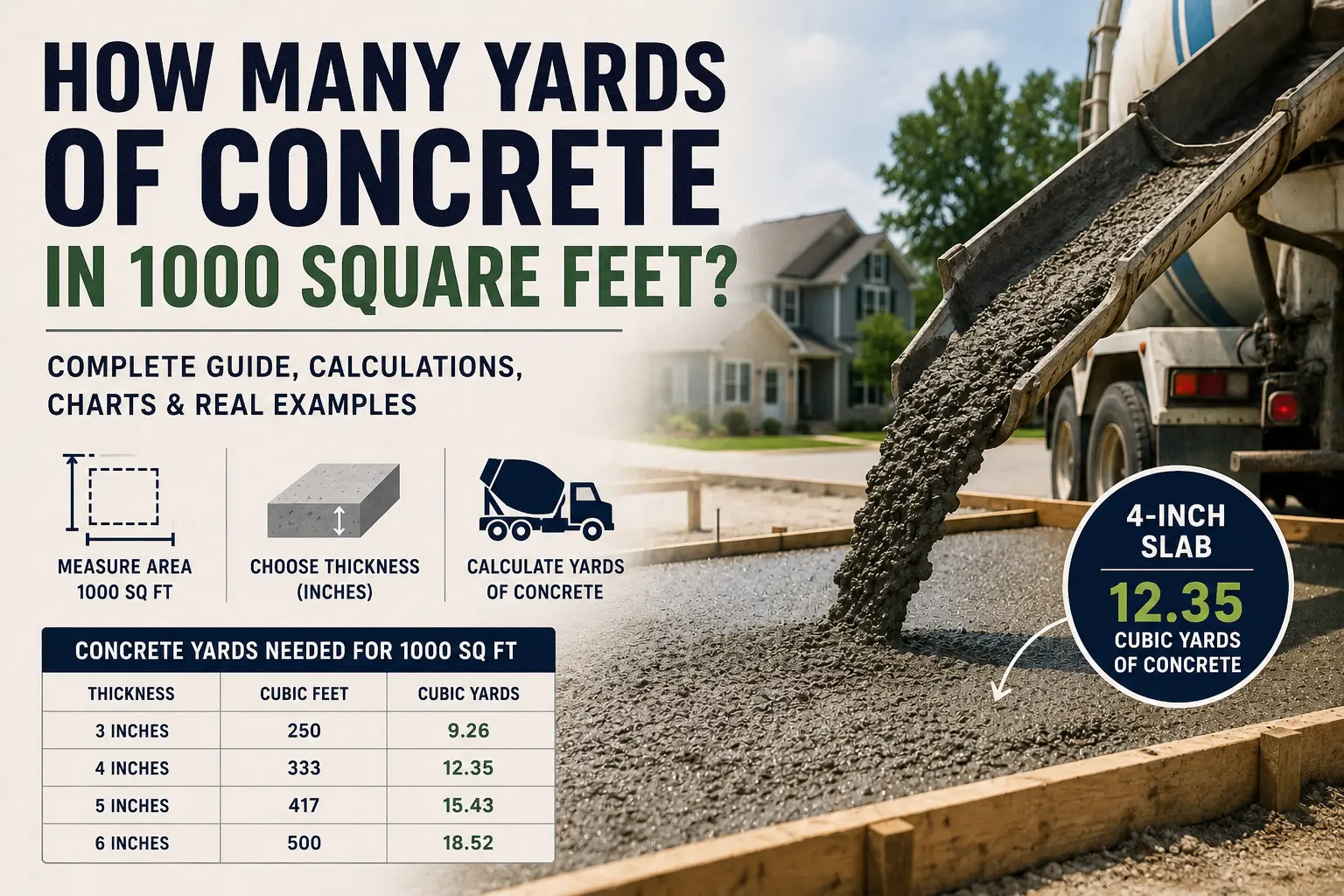
If you are planning a driveway, patio, garage floor, or foundation, one of the most important questions is: how many yards of concrete in 1000 square feet? The answer depends mainly on the thickness of the concrete slab.
For a standard 4-inch concrete slab, 1000 square feet typically requires about 12.35 cubic yards of concrete. However, thicker slabs need more concrete, and extra material is usually added for waste and uneven surfaces.
Understanding how to calculate concrete volume correctly helps you:
- Avoid expensive shortages
- Prevent overordering
- Stay within budget
- Reduce project delays
Whether you are a homeowner handling a DIY project or a contractor preparing estimates, this guide explains concrete yard calculations in simple language with practical examples and charts.
Understanding Concrete Measurements
Before calculating how many yards of concrete in 1000 square feet, it is important to understand how concrete is measured.
What Is a Cubic Yard?
Concrete is sold in cubic yards because it measures volume rather than area.
One cubic yard equals:
1 cubic yard=27 cubic feet
A cubic yard is:
- 3 feet wide
- 3 feet long
- 3 feet high
Concrete projects combine:
- Length
- Width
- Thickness
This creates a three-dimensional volume measurement.
Why Concrete Is Measured in Cubic Yards
Concrete slabs are not flat sheets. They have depth, which is why thickness matters.
For example:
- A thin patio uses less concrete
- A thick driveway uses more concrete
Even if both areas are 1000 square feet, slab thickness changes the amount of concrete needed.
How Many Yards of Concrete in 1000 Square Feet?
The amount of concrete required depends on slab thickness.
Here are common estimates for 1000 square feet:
| Slab Thickness | Cubic Yards Needed |
|---|---|
| 3 Inches | 9.26 yards |
| 4 Inches | 12.35 yards |
| 5 Inches | 15.43 yards |
| 6 Inches | 18.52 yards |
A 4-inch slab is the most common choice for:
- Patios
- Sidewalks
- Residential floors
Driveways and heavy-use surfaces often require thicker concrete.
Standard Thickness Calculations
Here are typical concrete slab thickness recommendations:
| Project Type | Recommended Thickness |
|---|---|
| Sidewalk | 4 inches |
| Patio | 4 inches |
| Shed Base | 4–5 inches |
| Driveway | 5–6 inches |
| Garage Floor | 5–6 inches |
| Commercial Slab | 6+ inches |
The thicker the slab, the more cubic yards of concrete are needed.
Formula to Calculate Concrete Yards
Learning the concrete formula helps you estimate projects accurately.
Step-by-Step Formula
Use this formula:
Concrete Yards=27Length×Width×Depth
All measurements must be converted into feet.
Converting Inches to Feet
Since slab thickness is usually measured in inches, convert inches into feet first.
Examples:
- 4 inches = 0.333 feet
- 5 inches = 0.417 feet
- 6 inches = 0.5 feet
Example Calculation for 1000 Square Feet
Suppose:
- Area = 1000 square feet
- Thickness = 4 inches
Calculation:
271000×0.333≈12.35
Result:
- About 12.35 cubic yards of concrete
Most contractors round up slightly to account for waste.
Concrete Thickness and Yard Requirements
Thickness plays the biggest role in determining concrete quantity.
4-Inch Slab
A 4-inch slab is ideal for:
- Patios
- Walkways
- Residential floors
Concrete required for 1000 square feet:
- Approximately 12.35 cubic yards
This is the most common residential slab thickness.
5-Inch Slab
A 5-inch slab provides more strength and durability.
Best for:
- Light vehicle traffic
- Garage floors
- Stronger foundations
Concrete required:
- Approximately 15.43 cubic yards
6-Inch Slab
A 6-inch slab is used for heavy loads.
Common uses:
- Driveways
- RV parking
- Commercial areas
Concrete required:
- Approximately 18.52 cubic yards
Concrete Yard Calculation Examples
Real-world examples make concrete calculations easier to understand.
Patio Example
Suppose you are building a patio:
- 20 ft × 50 ft
- Thickness = 4 inches
Area:
- 1000 square feet
Concrete needed:
- Around 12.35 cubic yards
Add 5–10% extra for waste:
- Final order = 13–14 yards
Driveway Example
Driveway dimensions:
- 25 ft × 40 ft
- Thickness = 6 inches
Calculation:
- 1000 sq ft total
Concrete required:
- About 18.52 cubic yards
Recommended order:
- 19–20 yards
Driveways often need thicker slabs because vehicles create pressure.
Garage Slab Example
Garage dimensions:
- 24 ft × 42 ft
- Thickness = 5 inches
Area:
- 1008 square feet
Concrete needed:
- Approximately 15.5 cubic yards
Most contractors would order:
- Around 16 yards
Concrete Coverage Chart by Thickness
| Thickness | Cubic Feet Needed | Cubic Yards Needed |
|---|---|---|
| 3 Inches | 250 cu ft | 9.26 yards |
| 4 Inches | 333 cu ft | 12.35 yards |
| 5 Inches | 417 cu ft | 15.43 yards |
| 6 Inches | 500 cu ft | 18.52 yards |
This chart helps estimate concrete quickly without repeating calculations.
Factors That Affect Concrete Quantity
Several factors can increase the amount of concrete needed.
Waste and Spillage
Concrete projects almost always involve some waste.
Causes include:
- Spills
- Uneven pouring
- Overexcavation
- Form movement
Experts usually recommend adding:
- 5–10% extra concrete
Uneven Ground
Uneven surfaces require deeper concrete in some areas.
Poor ground preparation may increase concrete usage significantly.
Reinforcement Needs
Reinforcement materials such as:
- Rebar
- Wire mesh
- Gravel base
do not directly change cubic yard calculations, but they may influence slab thickness requirements.
Ready-Mix Concrete vs Bagged Concrete
Choosing the right concrete type matters for large projects.
| Type | Best For | Advantages |
|---|---|---|
| Ready-Mix Concrete | Large projects | Fast and convenient |
| Bagged Concrete | Small DIY jobs | Easier for repairs |
For 1000 square feet, ready-mix concrete is almost always the better choice.
Bagged concrete would require hundreds of bags and much more labor.
Common Concrete Calculation Mistakes
Many people underestimate their concrete needs.
Forgetting Thickness
Square footage alone is not enough. Thickness must always be included.
Not Adding Extra Material
Ordering the exact calculated amount may cause shortages.
Always order slightly more than the minimum estimate.
Incorrect Unit Conversion
Mixing inches, feet, and yards can create inaccurate estimates.
Double-check all conversions before ordering.
Ignoring Ground Conditions
Soft or uneven ground may increase slab depth requirements.
Tips for Ordering Concrete Accurately
Use these expert tips for better concrete estimates.
Measure Carefully
Check:
- Length
- Width
- Thickness
Measure multiple times before ordering.
Use Standard Thickness
Following standard slab thickness recommendations reduces risk and ensures durability.
Order Extra Concrete
Most contractors recommend:
- 5–10% extra
This protects against waste and unexpected changes.
Talk to Local Suppliers
Concrete suppliers often help estimate quantities based on project type and local conditions.
Concrete Cost Considerations
Concrete costs vary depending on:
- Location
- Thickness
- Delivery fees
- Reinforcement
- Labor
Average ready-mix concrete prices range from:
- $125–$175 per cubic yard in many areas
Estimated material cost for 1000 square feet:
| Thickness | Approximate Concrete Cost |
|---|---|
| 4 Inches | $1,500–$2,200 |
| 5 Inches | $1,900–$2,700 |
| 6 Inches | $2,300–$3,300 |
Labor and finishing costs are separate.
Why Accurate Concrete Estimates Matter
Correct calculations help:
- Prevent project delays
- Reduce waste
- Avoid extra delivery fees
- Improve budgeting
- Ensure structural strength
Concrete cannot easily be returned once mixed, so planning ahead is essential.
9. FAQs
How many yards of concrete do I need for 1000 square feet at 4 inches thick?
You need approximately 12.35 cubic yards of concrete for a 4-inch slab covering 1000 square feet.
How much concrete is needed for a 1000 sq ft driveway?
A driveway usually needs a 5–6 inch slab, requiring about 15.43 to 18.52 cubic yards of concrete.
Should I order extra concrete?
Yes. Experts recommend ordering 5–10% extra to account for waste, uneven ground, and spillage.
How do I convert concrete thickness into feet?
Divide inches by 12. For example:
- 4 inches ÷ 12 = 0.333 feet
Is ready-mix concrete better for large slabs?
Yes. Ready-mix concrete is faster, more consistent, and more practical for projects around 1000 square feet.
10. Conclusion
Understanding how many yards of concrete in 1000 square feet is essential for planning successful construction projects. The exact amount depends mainly on slab thickness, with a standard 4-inch slab requiring about 12.35 cubic yards of concrete. Thicker slabs for driveways, garages, or commercial use may require significantly more material.
By using accurate measurements, proper formulas, and extra allowance for waste, you can avoid costly mistakes and ensure your project runs smoothly. Whether you are pouring a patio, driveway, or foundation slab, careful concrete calculations help save time, money, and frustration while delivering stronger and longer-lasting results.
Discover