

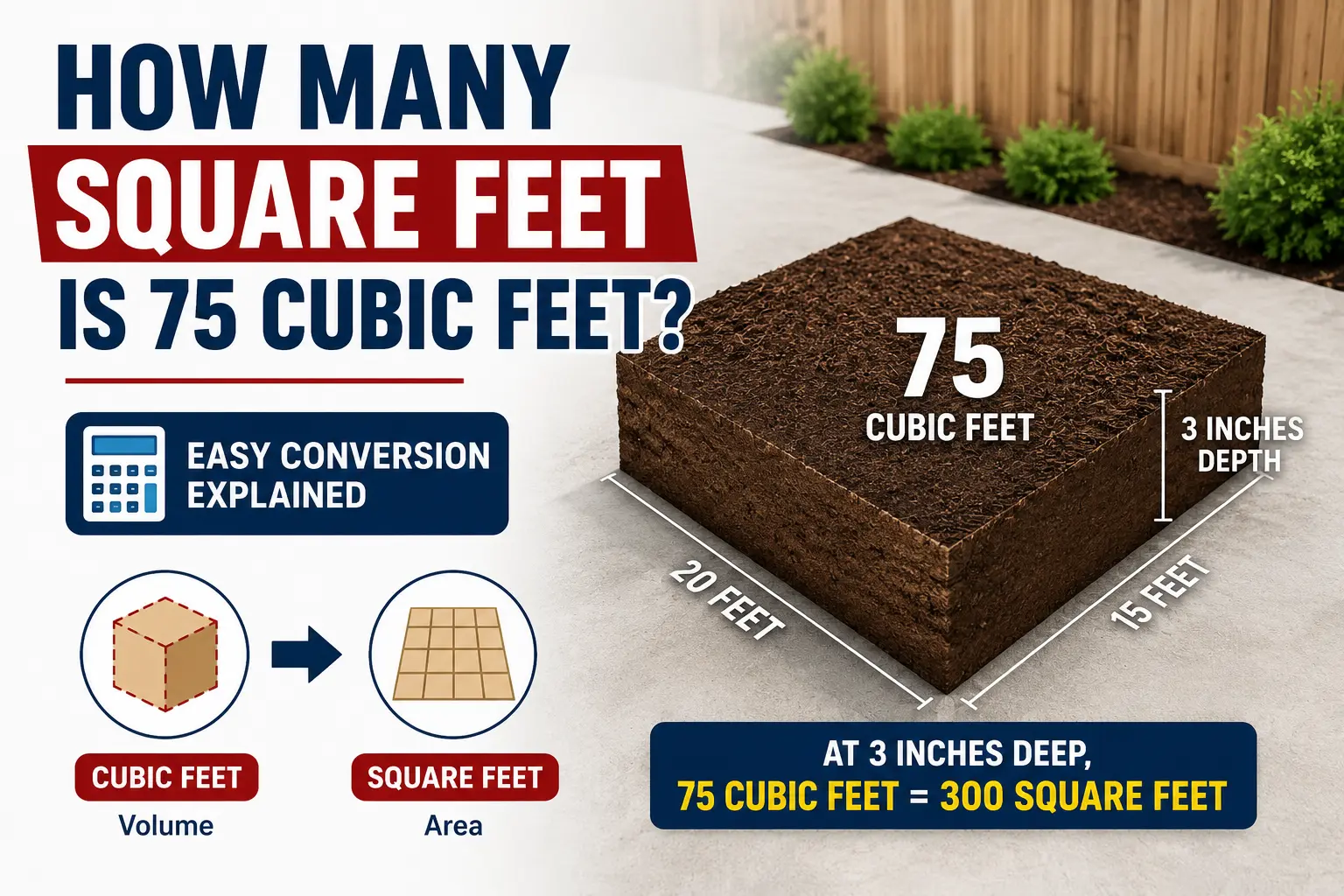
When people ask “how many square feet is 75 cubic feet,” they are usually trying to figure out how much space a material or object will cover. However, cubic feet and square feet measure two different things, so you cannot directly convert one into the other without knowing one extra measurement: the depth or height.
This is one of the most common measurement questions in home improvement, gardening, flooring, construction, and storage planning. Understanding the relationship between cubic feet and square feet can help you avoid expensive mistakes and make accurate calculations for your project.
In simple terms:
- Cubic feet measures volume
- Square feet measures area
To convert 75 cubic feet into square feet, you must know how deep the material will be spread or how tall the space is.
Understanding the Difference Between Cubic Feet and Square Feet
Before doing any calculations, it is important to understand what each measurement means.
What Is Cubic Feet?
Cubic feet is a unit of volume. It measures three-dimensional space using:
- Length
- Width
- Height
For example, a box that is:
- 5 feet long
- 3 feet wide
- 5 feet high
Has a volume of:
5×3×5=75 cubic feet
This means the box can hold 75 cubic feet of material or air.
What Is Square Feet?
Square feet measures area. It only uses:
- Length
- Width
For example, a floor that is:
- 15 feet long
- 5 feet wide
Has an area of:
15×5=75 square feet
This tells you how much surface space exists.
Why People Confuse Them
People often confuse cubic feet and square feet because both involve feet and measurements. However:
| Measurement | What It Measures | Dimensions Used |
|---|---|---|
| Square Feet | Area | Length × Width |
| Cubic Feet | Volume | Length × Width × Height |
That extra dimension makes a huge difference.
Can You Directly Convert 75 Cubic Feet to Square Feet?
No, you cannot directly convert 75 cubic feet into square feet without knowing the depth or height.
Here is why:
If you spread 75 cubic feet of material very thinly, it will cover a large area. If you spread it thickly, it will cover a smaller area.
The Missing Measurement: Depth or Height
The missing measurement is usually:
- Depth for soil, mulch, gravel, or concrete
- Height for rooms, storage, or containers
Once you know the depth, the calculation becomes easy.
Why Depth Matters
Imagine pouring 75 cubic feet of soil:
- At 1 inch deep, it covers a large area
- At 12 inches deep, it covers a much smaller area
The deeper the material, the fewer square feet it covers.
Formula to Convert Cubic Feet to Square Feet
The basic formula is:
Square Feet=Depth in FeetCubic Feet
Real-Life Explanation
Suppose you have 75 cubic feet of mulch and want to spread it 3 inches deep.
First, convert inches to feet:
3 inches=0.25 feet
Then apply the formula:
0.2575=300 square feet
So, 75 cubic feet covers 300 square feet at 3 inches deep.
How Many Square Feet Is 75 Cubic Feet at Different Depths?
The answer changes depending on depth.
1 Inch Deep
1 inch equals:
121=0.0833 feet
Now calculate:
0.083375≈900 square feet
At 1 inch deep, 75 cubic feet covers about 900 square feet.
2 Inches Deep
2 inches equals:
122=0.1667 feet
Calculation:
0.166775≈450 square feet
At 2 inches deep, 75 cubic feet covers about 450 square feet.
3 Inches Deep
At 3 inches deep:
0.2575=300 square feet
6 Inches Deep
6 inches equals 0.5 feet.
Calculation:
0.575=150 square feet
12 Inches Deep
12 inches equals 1 foot.
Calculation:
175=75 square feet
Conversion Table for 75 Cubic Feet
| Depth | Square Feet Covered |
|---|---|
| 1 inch | 900 sq ft |
| 2 inches | 450 sq ft |
| 3 inches | 300 sq ft |
| 4 inches | 225 sq ft |
| 6 inches | 150 sq ft |
| 12 inches | 75 sq ft |
This table helps homeowners and contractors estimate material coverage quickly.
Real-World Examples
Understanding how many square feet is 75 cubic feet becomes easier with practical examples.
Soil and Mulch
Gardeners often buy soil or mulch in cubic feet.
If you spread:
- 75 cubic feet of mulch
- At 3 inches deep
You can cover about 300 square feet.
This is useful for:
- Flower beds
- Landscaping
- Vegetable gardens
Concrete Projects
Concrete is often measured in cubic feet or cubic yards.
For a patio requiring:
- 6 inches thickness
75 cubic feet of concrete would cover:
- About 150 square feet
Storage Units
Storage companies measure volume in cubic feet.
A storage space with 75 cubic feet may fit:
- Small furniture
- Moving boxes
- Seasonal items
But the floor area depends on ceiling height.
Room Measurements
Suppose a room contains 75 cubic feet of air and has an 8-foot ceiling.
You can find the floor area:
875=9.375 square feet
So the room floor area would be about 9.4 square feet.
Step-by-Step Calculation Examples
Here are easy examples anyone can follow.
Example 1: Mulch Coverage
You have:
- 75 cubic feet of mulch
- Desired depth: 2 inches
Convert inches to feet:
122=0.1667
Apply formula:
0.166775≈450
Answer:
- 450 square feet
Example 2: Concrete Slab
You have:
- 75 cubic feet of concrete
- Thickness: 6 inches
Convert thickness:
6 inches=0.5 feet
Calculate:
0.575=150
Answer:
- 150 square feet
Example 3: Room Space
You have:
- Volume: 75 cubic feet
- Ceiling height: 10 feet
Calculate floor area:
1075=7.5
Answer:
- 7.5 square feet
Common Mistakes When Converting Cubic Feet to Square Feet
Many people make avoidable calculation errors.
Forgetting to Convert Inches to Feet
This is the most common mistake.
Always convert inches into feet before using formulas.
Examples:
- 3 inches = 0.25 feet
- 6 inches = 0.5 feet
Mixing Area and Volume
Remember:
- Square feet = area
- Cubic feet = volume
They are not interchangeable.
Using the Wrong Depth
Even a small depth mistake can create huge coverage errors.
For example:
- 2 inches deep covers 450 sq ft
- 4 inches deep covers only 225 sq ft
That is a massive difference.
Rounding Too Early
Round numbers only at the final step to keep calculations accurate.
Practical Uses of Cubic Feet to Square Feet Conversion
This conversion is useful in many industries and home projects.
Landscaping
Calculate:
- Mulch coverage
- Soil coverage
- Gravel spread
Flooring
Estimate:
- Concrete requirements
- Self-leveling compounds
- Underlayment materials
Construction
Builders use these calculations for:
- Foundations
- Fill dirt
- Cement pours
Home Storage
Estimate:
- Storage room capacity
- Box placement
- Moving truck space
Real Estate
Property professionals use volume and area calculations for:
- Room planning
- Space utilization
- Interior layouts
Expert Tips for Accurate Measurements
Professionals follow a few important rules for accurate conversions.
Measure Twice
Always double-check dimensions before purchasing materials.
Use Consistent Units
Keep everything in:
- Feet
- Inches
- Meters
Do not mix units.
Add Extra Material
For landscaping or concrete projects, add 5–10% extra for waste and settling.
Use Online Calculators
Online cubic feet to square feet calculators can speed up large projects.
However, understanding the formula helps you verify the results.
Write Down Measurements
Create a simple chart before shopping for materials.
This avoids expensive overbuying or underbuying.
FAQs
Can you convert 75 cubic feet directly into square feet?
No. You need to know the depth or height before converting cubic feet into square feet.
How many square feet does 75 cubic feet cover at 3 inches deep?
At 3 inches deep, 75 cubic feet covers approximately 300 square feet.
What is the formula for converting cubic feet to square feet?
The formula is:
Square Feet=Depth in FeetCubic Feet
Why are cubic feet and square feet different?
Cubic feet measures volume, while square feet measures surface area.
How much area will 75 cubic feet cover at 6 inches deep?
At 6 inches deep, 75 cubic feet covers around 150 square feet.
Conclusion
If you are wondering how many square feet is 75 cubic feet, the answer depends entirely on the depth or height involved. Since cubic feet measures volume and square feet measures area, you must know one additional dimension to convert accurately.
For quick reference:
- 75 cubic feet at 1 inch deep covers about 900 sq ft
- At 3 inches deep, it covers about 300 sq ft
- At 6 inches deep, it covers about 150 sq ft
Understanding this conversion is extremely useful for landscaping, construction, storage, flooring, and home improvement projects. Once you learn the simple formula, converting cubic feet to square feet becomes fast and easy.
Discover more