

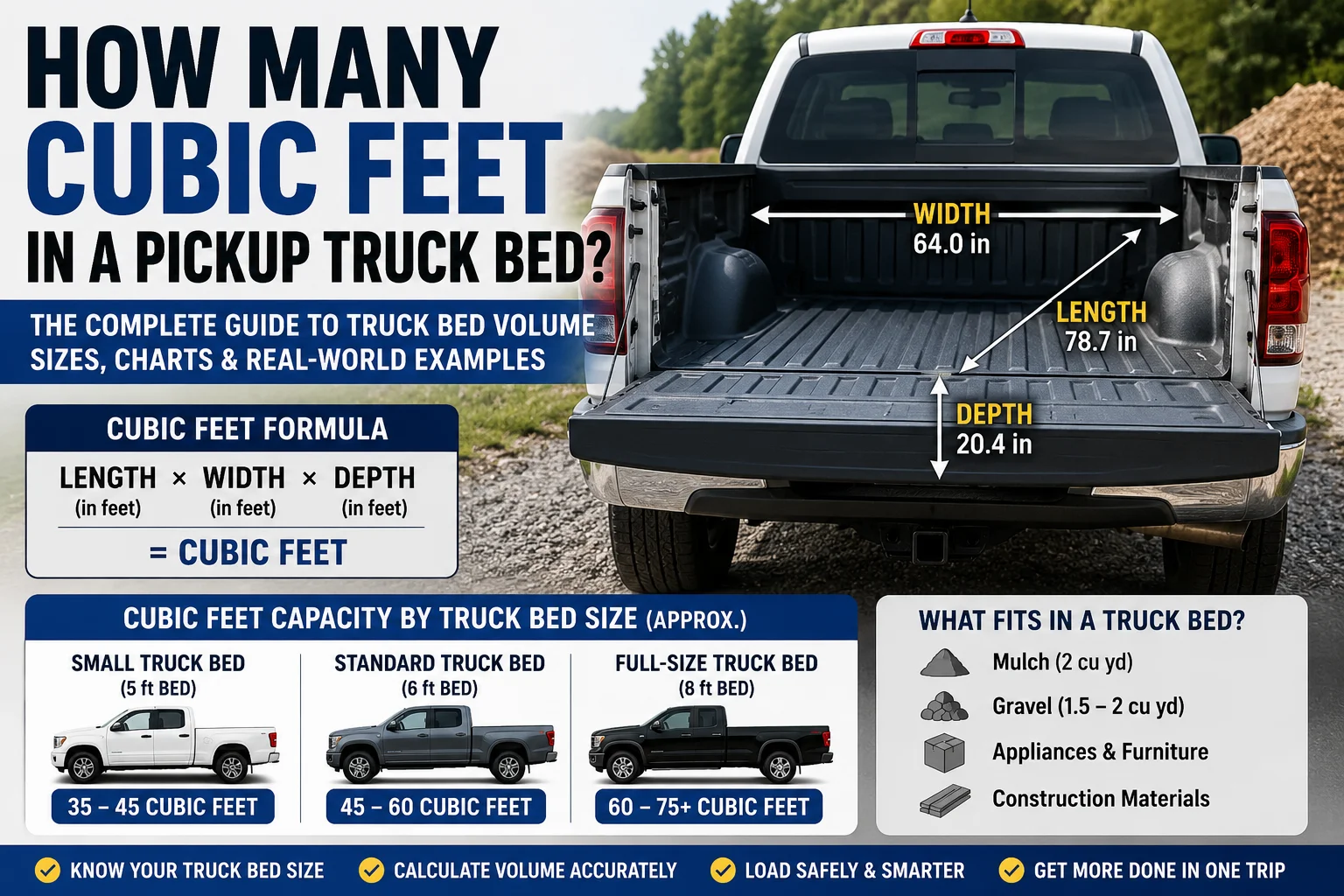
How Many Cubic Feet in a Pickup Truck Bed?
If you are planning to haul mulch, gravel, furniture, soil, or construction materials, you may wonder: how many cubic feet in a pickup truck bed? Knowing the cubic feet capacity of your truck helps you load materials safely, avoid overloading, and estimate how much cargo you can transport in one trip.
The average pickup truck bed holds between 35 and 75 cubic feet, depending on the truck’s size and bed dimensions. Compact trucks usually have smaller beds, while full-size trucks offer much larger hauling capacity.
Understanding truck bed volume is important for:
- Landscaping projects
- Moving furniture
- Construction work
- DIY home improvement
- Transporting bulk materials
This guide explains how truck bed cubic feet are calculated, how different truck sizes compare, and how to estimate cargo volume accurately.
Understanding Pickup Truck Bed Volume
Before calculating capacity, it helps to understand what cubic feet means and why it matters.
What Is Cubic Feet?
Cubic feet measure volume, which is the amount of three-dimensional space inside an object.
The formula for cubic feet is:
Cubic Feet=Length×Width×Height
For pickup trucks, this formula measures the usable cargo space inside the truck bed.
Why Truck Bed Volume Matters
Truck bed volume helps determine:
- How much mulch or gravel you can haul
- Whether furniture will fit
- How many boxes you can carry
- Safe loading limits
Without accurate volume estimates, you may overload the truck or require extra trips.
Common Truck Bed Sizes
Pickup truck beds generally come in:
- Short beds
- Standard beds
- Long beds
Each type has different cargo capacity.
How Many Cubic Feet in a Pickup Truck Bed?
Truck bed capacity varies by truck size and manufacturer.
Small Pickup Trucks
Compact pickup trucks usually hold:
35−45 cubic feet approximately
Examples include:
- Ford Maverick
- Toyota Tacoma short bed
- Chevrolet Colorado
These trucks are ideal for:
- Light hauling
- Small landscaping jobs
- Everyday use
Standard Pickup Trucks
Mid-size and standard pickups often hold:
45−60 cubic feet approximately
These trucks balance:
- Passenger comfort
- Cargo space
- Fuel efficiency
Full-Size Pickup Trucks
Large trucks with long beds may hold:
60−75 cubic feet or more
Examples include:
- Ford F-150 long bed
- RAM 1500
- Chevrolet Silverado
These are popular for:
- Construction
- Heavy hauling
- Large equipment transport
Average Truck Bed Capacity Chart
| Truck Type | Approximate Cubic Feet |
|---|---|
| Compact truck | 35–45 cu ft |
| Mid-size truck | 45–55 cu ft |
| Full-size short bed | 52–65 cu ft |
| Full-size long bed | 65–75 cu ft |
This chart provides a general estimate for most pickup trucks.
How to Calculate Cubic Feet in a Pickup Truck Bed
You can calculate your truck bed volume using simple measurements.
Basic Formula
The formula is:
Length×Width×Height=Cubic Feet
All measurements should be converted into feet before multiplying.
Step-by-Step Example
Suppose your truck bed measures:
- Length = 6 feet
- Width = 5 feet
- Height = 2 feet
Calculation:
6×5×2=60 cubic feet
So the truck bed holds approximately 60 cubic feet.
Measuring Bed Dimensions
To measure accurately:
- Measure bed length from cab to tailgate
- Measure width between sidewalls
- Measure interior bed depth
Always use interior measurements instead of exterior dimensions.
Pickup Truck Bed Size Comparison
Truck beds vary significantly between models.
Short Bed vs Long Bed
Short beds:
- Easier to park
- Better for city driving
- Less cargo space
Long beds:
- More hauling capacity
- Better for contractors
- Harder to maneuver
Compact vs Full-Size Trucks
Compact trucks:
- Better fuel economy
- Lower hauling capacity
Full-size trucks:
- Higher payload
- Larger cargo space
- Better towing ability
Popular Truck Models
| Truck Model | Approximate Bed Volume |
|---|---|
| Ford Maverick | 33–40 cu ft |
| Toyota Tacoma | 40–50 cu ft |
| Ford F-150 | 52–77 cu ft |
| RAM 1500 | 53–74 cu ft |
| Chevrolet Silverado | 62–89 cu ft |
Actual capacity depends on bed configuration.
Real-Life Uses for Truck Bed Cubic Feet Calculations
Knowing truck bed volume helps in many everyday situations.
Mulch and Soil
Landscaping suppliers often sell mulch by cubic feet or cubic yards.
For example:
- 1 cubic yard = 27 cubic feet
A 54-cubic-foot truck bed can hold about:
2754=2 cubic yards
Gravel and Sand
Heavy materials like gravel may fit by volume but exceed payload weight limits.
Always check:
- Payload rating
- Suspension capacity
- Tire limits
Furniture and Appliances
Truck bed measurements help determine whether:
- Sofas fit
- Refrigerators fit
- Mattresses fit
Construction Materials
Contractors often transport:
- Lumber
- Concrete bags
- Drywall
- Roofing materials
Volume calculations help organize loads safely.
Factors That Affect Truck Bed Capacity
Truck beds are not perfectly shaped boxes.
Wheel Wells
Wheel wells reduce usable cargo space.
This affects:
- Flat storage area
- Box placement
- Material stacking
Bed Liners
Plastic liners slightly reduce interior dimensions.
Payload Limits
Cubic feet only measure space, not weight.
A truck may have enough space for gravel but still exceed safe weight limits.
Stacking Height
Cargo can sometimes be stacked above bed rails, but this increases:
- Safety risks
- Wind resistance
- Load instability
Secure all cargo properly.
Common Mistakes When Estimating Truck Bed Volume
Many truck owners make simple calculation mistakes.
Ignoring Bed Shape
Truck beds are rarely perfect rectangles.
Measure carefully for accurate estimates.
Overloading the Truck
Overloading may damage:
- Suspension
- Tires
- Brakes
- Axles
Forgetting Payload Ratings
Payload ratings matter just as much as volume capacity.
Check your vehicle manual before hauling heavy materials.
Expert Tips for Loading a Pickup Truck Bed
Safe loading protects both your truck and cargo.
Distribute Weight Evenly
Place heavy items:
- Near the cab
- Centered over the axle
This improves stability.
Secure Loose Materials
Use:
- Ratchet straps
- Tarps
- Cargo nets
to prevent shifting during driving.
Know Your Truck Limits
Never exceed:
- Payload limits
- Tire ratings
- Axle ratings
Safety always comes first.
Pickup Truck Bed Cubic Feet Chart
| Bed Length | Approximate Cubic Feet |
|---|---|
| 5-foot bed | 35–45 cu ft |
| 6-foot bed | 50–60 cu ft |
| 8-foot bed | 65–75 cu ft |
These are average estimates and vary by truck model.
Benefits of Understanding Truck Bed Volume
Knowing truck bed cubic feet provides several advantages.
Better Project Planning
You can estimate:
- Number of trips
- Material quantities
- Loading efficiency
Improved Safety
Proper loading reduces accident risks.
Saves Time and Money
Accurate calculations reduce fuel costs and wasted trips.
Prevents Truck Damage
Understanding payload limits helps protect your vehicle.
FAQs
1. How many cubic feet are in a standard pickup truck bed?
Most standard pickup truck beds hold between 45 and 60 cubic feet.
2. How do you calculate cubic feet in a truck bed?
Multiply the interior length, width, and height measurements in feet.
3. How many cubic yards fit in a pickup truck bed?
Most full-size pickup trucks can carry about 2 cubic yards of material by volume, depending on payload limits.
4. Does payload limit matter more than cubic feet?
Yes. A truck may have enough space but still exceed safe weight capacity.
5. Can a pickup truck carry one cubic yard of gravel?
Yes, many pickup trucks can carry one cubic yard of gravel, but heavy loads may exceed smaller truck payload ratings.
Conclusion
Understanding how many cubic feet in a pickup truck bed helps you plan hauling projects more efficiently and safely. Most pickup truck beds hold between 35 and 75 cubic feet depending on bed size, truck model, and configuration.
By measuring your truck bed correctly and using the cubic feet formula, you can estimate cargo space for mulch, gravel, furniture, construction materials, and more. However, it is equally important to consider payload ratings and safe loading practices to avoid damaging your truck or creating unsafe driving conditions.
Whether you use your pickup for landscaping, moving, DIY projects, or construction work, knowing your truck bed’s cubic feet capacity helps save time, reduce costs, and improve hauling accuracy.
Discover more