

If you’ve been reading the Bible, studying ancient history, or researching historical measurements, you may have wondered: how many feet is 5 cubits?
The answer seems simple at first, but there’s an important detail to understand. Ancient civilizations used different versions of the cubit, which means the exact conversion can vary slightly depending on the historical source.
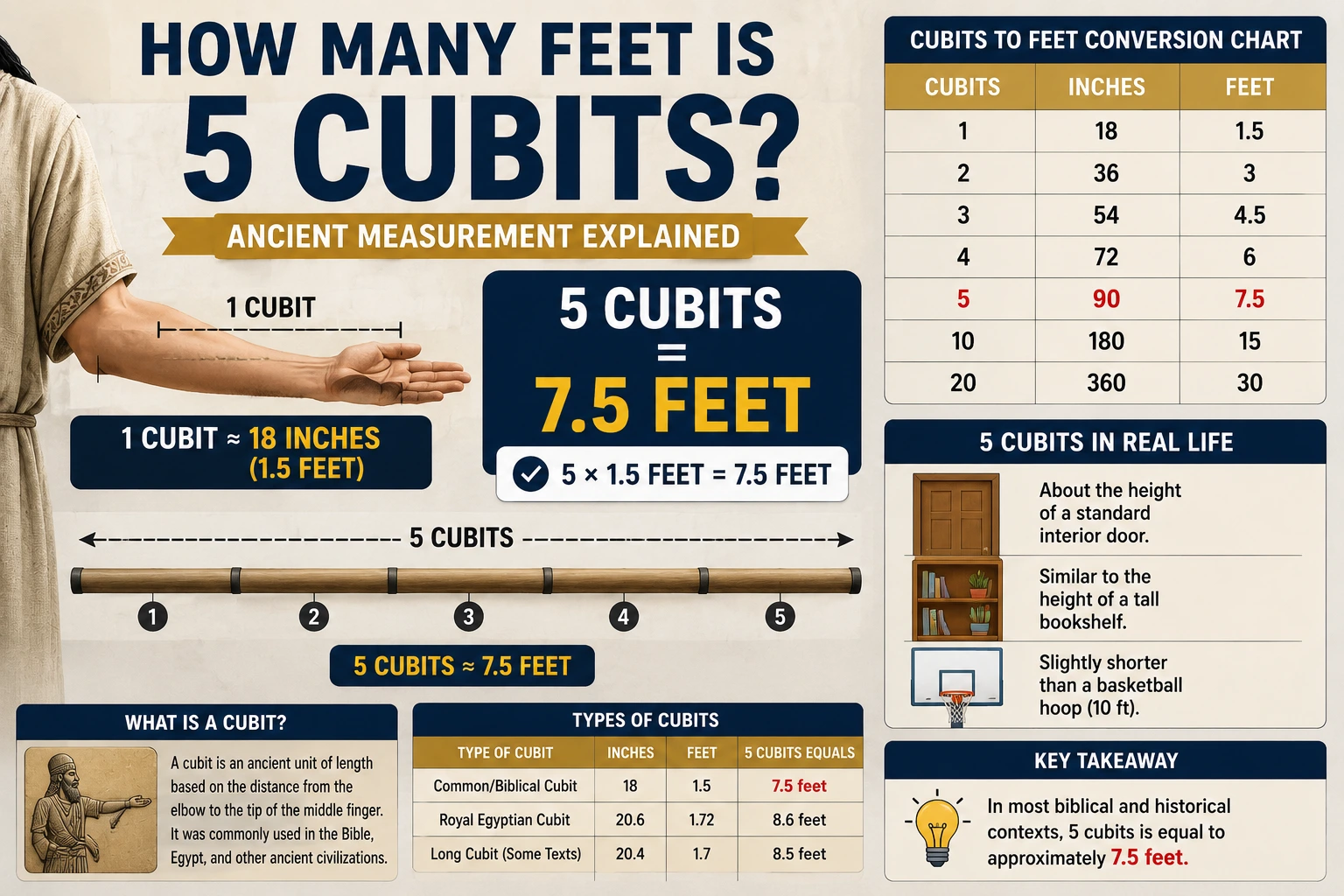
In most biblical and historical references, 5 cubits equals approximately 7.5 feet. This calculation is based on the commonly accepted cubit length of 18 inches, or 1.5 feet.
Understanding cubits helps bring ancient texts and historical structures to life. Whether you’re reading about Noah’s Ark, Solomon’s Temple, or ancient Egyptian architecture, converting cubits into modern measurements makes these descriptions much easier to visualize.
This guide explains exactly how many feet is 5 cubits, explores the history of the cubit, compares different cubit standards, and provides practical examples to help you understand the measurement.
Quick Answer: How Many Feet Is 5 Cubits?
The standard biblical cubit is generally considered to be:
- 1 cubit = 18 inches
- 1 cubit = 1.5 feet
Using that conversion:
5 cubits × 1.5 feet = 7.5 feet
Quick Conversion Table
| Cubits | Feet |
|---|---|
| 1 Cubit | 1.5 Feet |
| 2 Cubits | 3 Feet |
| 3 Cubits | 4.5 Feet |
| 4 Cubits | 6 Feet |
| 5 Cubits | 7.5 Feet |
Therefore, the most widely accepted answer to how many feet is 5 cubits is:
7.5 feet
What Is a Cubit?
Before modern measuring tools existed, people often used parts of the human body as measuring standards.
The cubit was one of the oldest units of length ever used.
Origin of the Cubit
The word “cubit” comes from the Latin word cubitum, meaning elbow.
Traditionally, a cubit represented the distance from:
- The elbow
- To the tip of the middle finger
Because arm lengths differ from person to person, cubits were not perfectly standardized.
Over time, civilizations established official cubit measurements for construction and trade.
Why Ancient Civilizations Used Cubits
Cubits were practical because everyone carried the measuring tool with them—their own arm.
Ancient cultures using cubits included:
- Egyptians
- Hebrews
- Babylonians
- Assyrians
- Greeks
Many famous ancient structures were designed using cubit measurements.
How Many Feet Is 5 Cubits Based on Different Standards?
One reason people get different answers is that several types of cubits existed.
Standard Hebrew Cubit
Most biblical scholars use:
- 18 inches
- 1.5 feet
Calculation:
5 × 1.5 = 7.5 feet
Egyptian Royal Cubit
The Egyptian royal cubit measured approximately:
- 20.6 inches
- 1.72 feet
Calculation:
5 × 1.72 = 8.6 feet
Longer Biblical Cubit
Some researchers believe certain biblical passages used a longer cubit of roughly:
- 20.4 inches
- 1.7 feet
Calculation:
5 × 1.7 = 8.5 feet
Comparison Table
| Cubit Type | Length of 1 Cubit | 5 Cubits |
| Common Cubit | 18 inches | 7.5 feet |
| Hebrew Cubit | 18 inches | 7.5 feet |
| Royal Cubit | 20.6 inches | 8.6 feet |
| Long Cubit | 20.4 inches | 8.5 feet |
For most purposes, especially biblical interpretation, 5 cubits equals approximately 7.5 feet.
Cubits to Feet Conversion Chart
The following chart helps convert common cubit measurements into feet.
| Cubits | Feet |
| 1 | 1.5 |
| 2 | 3 |
| 3 | 4.5 |
| 4 | 6 |
| 5 | 7.5 |
| 10 | 15 |
| 20 | 30 |
| 30 | 45 |
| 50 | 75 |
| 100 | 150 |
This chart is useful when reading historical or biblical descriptions.
Why Cubit Measurements Can Vary
Many people assume there was only one cubit. In reality, several standards existed.
Common Cubit
The common cubit measured:
- Approximately 18 inches
- Based on the average forearm
This is the measurement most often used in biblical studies.
Royal Cubit
Kings and builders needed more consistent measurements.
As a result, some cultures created official cubits.
The Egyptian royal cubit was:
- About 20.6 inches long
Builders used rods marked with precise units.
Biblical Cubit
The Bible occasionally refers to measurements that may have used either:
- The common cubit
- A longer sacred or royal cubit
This explains why scholars sometimes disagree about exact dimensions.
Biblical Examples of Cubit Measurements
Understanding cubits becomes much easier when examining famous biblical structures.
Noah’s Ark
According to Genesis, Noah’s Ark measured:
- 300 cubits long
- 50 cubits wide
- 30 cubits high
Using the common cubit:
| Measurement | Feet |
| Length | 450 ft |
| Width | 75 ft |
| Height | 45 ft |
This reveals how enormous the Ark would have been.
The Ark of the Covenant
The Ark of the Covenant measured:
- 2.5 cubits long
- 1.5 cubits wide
- 1.5 cubits high
Converted into feet:
- Length: 3.75 feet
- Width: 2.25 feet
- Height: 2.25 feet
Solomon’s Temple
The Bible records numerous temple dimensions using cubits.
Modern conversions help historians estimate:
- Building size
- Room dimensions
- Construction methods
What Does 5 Cubits Look Like in Real Life?
Numbers can be hard to visualize.
Let’s compare 5 cubits, or roughly 7.5 feet, to familiar objects.
Everyday Comparisons
5 cubits is approximately:
- The height of a standard basketball hoop rim (10 feet) minus 2.5 feet
- The height of many interior room ceilings
- The length of a large sofa
- The height of a tall bookshelf
Human Comparison
An average adult stands:
- About 5.5 to 6 feet tall
Therefore, 5 cubits is noticeably taller than most people.
Vehicle Comparison
A midsize SUV is often:
- Around 6 to 7 feet wide
So 5 cubits is close to the width of many vehicles.
How to Convert Cubits to Feet
Converting cubits is simple when using the standard cubit.
Step 1: Determine Cubit Length
Most biblical conversions use:
1 cubit = 1.5 feet
Step 2: Multiply
Formula:
Feet = Cubits × 1.5
Example
5 cubits:
5 × 1.5 = 7.5 feet
Additional Examples
| Cubits | Feet |
| 6 | 9 |
| 8 | 12 |
| 12 | 18 |
| 25 | 37.5 |
Common Mistakes When Converting Cubits
Assuming Every Cubit Is Identical
Different cultures used different cubits.
Always consider historical context.
Ignoring Biblical Scholarship
Some passages may use longer cubits.
Check the source before converting.
Confusing Feet and Inches
Remember:
- 18 inches = 1.5 feet
- Not 1.8 feet
Overlooking Ancient Variations
Ancient measurements were not always standardized.
Small differences can produce large discrepancies in major structures.
Expert Tips for Understanding Ancient Measurements
Use Standard Biblical Conversions
For most Bible studies:
1 cubit = 18 inches
This provides consistency.
Focus on Scale
Ancient measurements help us understand:
- Building sizes
- Engineering achievements
- Historical lifestyles
Use Comparison Charts
Converting cubits into feet makes ancient texts easier to visualize.
Remember Historical Context
The cubit was a practical measurement long before rulers and measuring tapes existed.
Understanding that context improves interpretation.
Summary: How Many Feet Is 5 Cubits?
The most accepted conversion is straightforward:
5 cubits = 7.5 feet
This calculation uses the common biblical cubit of 18 inches or 1.5 feet.
Although some historical cubits were longer, most biblical scholars and conversion references use the standard cubit. Whether you’re studying Scripture, exploring ancient history, or simply curious about historical measurements, knowing how many feet is 5 cubits helps make ancient dimensions easier to understand and visualize.
9. FAQs
How many feet is 5 cubits in the Bible?
Using the common biblical cubit of 18 inches, 5 cubits equals 7.5 feet.
What is one cubit in feet?
One cubit is generally accepted as 1.5 feet.
Why are there different cubit measurements?
Ancient civilizations used different standards, including common cubits and royal cubits, resulting in slight variations.
How many inches is 5 cubits?
Using the standard cubit:
5 cubits = 90 inches.
Was the cubit used outside the Bible?
Yes. Egyptians, Babylonians, Hebrews, Greeks, and many other ancient civilizations used cubits for construction and trade.
10. Conclusion
If you’ve been wondering how many feet is 5 cubits, the most widely accepted answer is 7.5 feet. This conversion is based on the standard biblical cubit of 18 inches, making it easy to translate ancient measurements into modern terms.
Understanding cubits provides valuable insight into biblical passages, historical architecture, and ancient engineering achievements. Whether you’re studying Scripture, researching history, or simply converting measurements, knowing that 5 cubits equals approximately 7.5 feet offers a practical and accurate reference point.