

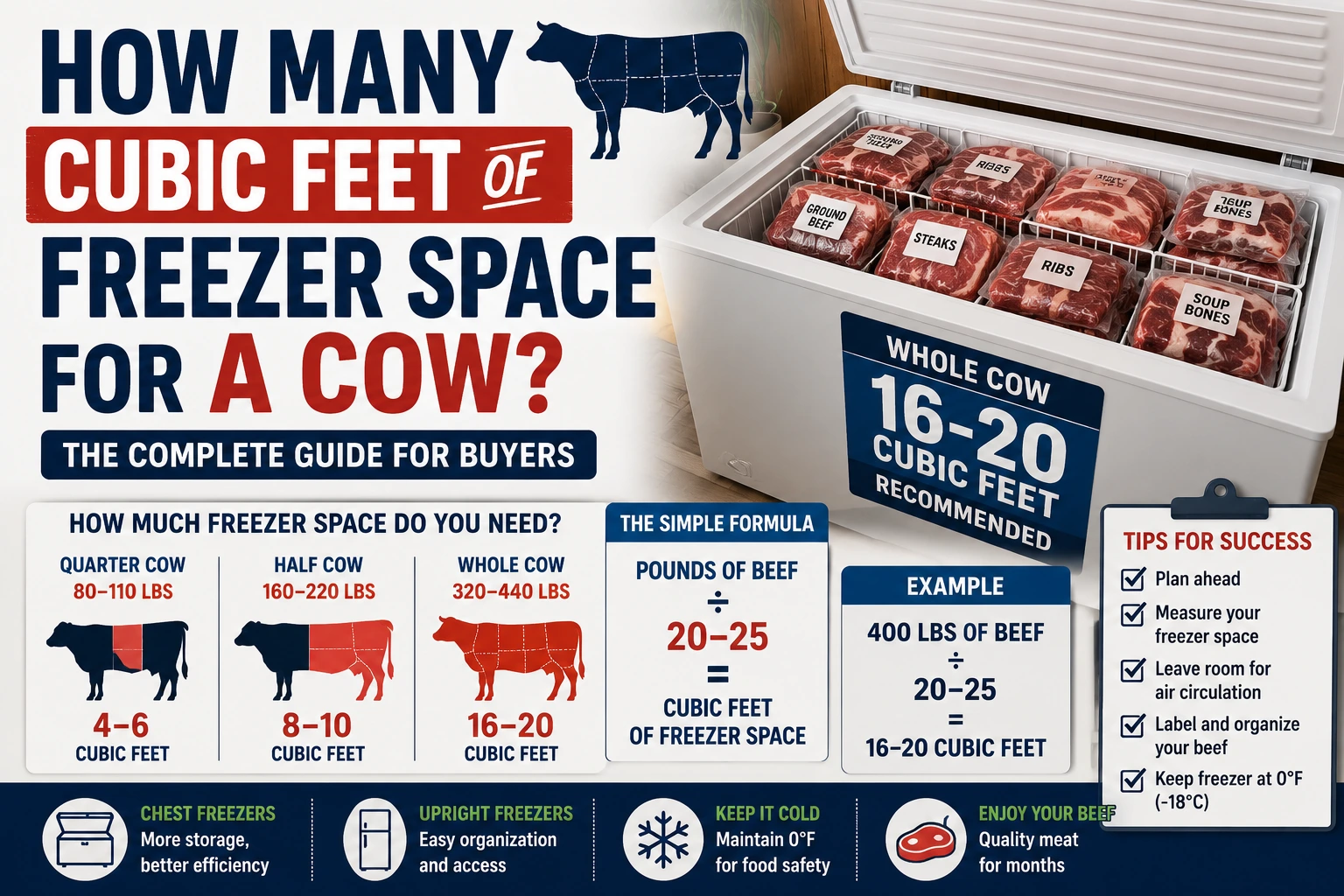
If you are buying beef in bulk, one of the first questions to answer is: how many cubic feet of freezer space for a cow do you need?
For a whole cow, plan for about 16 to 20 cubic feet of dedicated freezer space. In some cases, a very well-packed whole beef order may fit into 12 to 18 cubic feet. However, choosing a larger freezer gives you room to organize cuts, keep airflow moving, and store other frozen food.
The amount of space depends on the final packaged beef weight, not simply the size of the live animal. A whole cow may provide roughly 320 to 440 pounds of take-home beef, depending on the animal, butcher instructions, trimming, aging, and whether you choose bones and organ meats. A practical planning rule is to allow about 20 to 25 pounds of packaged beef per cubic foot of freezer space.
This guide explains how much space you need for a whole, half, or quarter cow and how to choose the right freezer before your beef arrives.
Quick Answer: How Many Cubic Feet of Freezer Space for a Cow?
The simple answer is:
A whole cow usually needs about 16 to 20 cubic feet of freezer space.
If you want a safer estimate, especially when buying bone-in cuts, soup bones, organ meats, or extra ground beef, choose a 20-cubic-foot or larger freezer.
Here is a quick guide:
| Beef Share | Typical Packaged Beef Weight | Suggested Freezer Space |
|---|---|---|
| Quarter cow | 80–110 pounds | 4–6 cubic feet |
| Half cow | 160–220 pounds | 8–10 cubic feet |
| Whole cow | 320–440 pounds | 16–20 cubic feet |
Freezer-space estimates vary because beef cuts are not all neat, identical boxes. Roasts, bones, briskets, and oddly shaped packages use more room than tightly stacked ground beef. Sources commonly suggest roughly 12 to 18 cubic feet for a whole cow, while others recommend 16 to 20 cubic feet for more comfortable storage.
Whole Cow Freezer Space Estimate
A whole cow can require more room than many people expect. Even if the final packaged beef weight is around 350 pounds, you should not choose a freezer that holds exactly 350 pounds with no room left.
A freezer that is packed too tightly can make it hard to:
- Find specific cuts
- Keep packages organized
- Rotate older beef forward
- Store bones or organ meats
- Add ice packs during an outage
- Keep a little space for other frozen food
For most households, a 20-cubic-foot chest freezer is a practical choice for a whole cow. A larger freezer may be better if you also freeze chicken, fish, vegetables, prepared meals, or seasonal produce.
The 25-Pounds-Per-Cubic-Foot Rule
A common bulk-beef guideline is:
[
1 \text{ cubic foot of freezer space} \approx 20\text{–}25 \text{ pounds of packaged beef}
]
Using 25 pounds per cubic foot gives a compact estimate:
[
400 \text{ pounds} ÷ 25 = 16 \text{ cubic feet}
]
Using 20 pounds per cubic foot gives a safer estimate:
[
400 \text{ pounds} ÷ 20 = 20 \text{ cubic feet}
]
That is why a 16- to 20-cubic-foot freezer is usually recommended for a whole cow.
How Many Cubic Feet of Freezer Space for a Cow by Share Size?
Not every buyer needs a whole cow. A quarter or half cow can be easier to manage, especially for smaller households.
Quarter Cow Freezer Space
A quarter cow often provides about 80 to 110 pounds of packaged beef.
Most buyers should plan for:
4 to 6 cubic feet of freezer space
A small chest freezer may work well if it is mostly empty. A refrigerator freezer can sometimes hold a quarter cow, but it may leave little room for everyday frozen food.
A quarter cow is a good option if you want a mix of steaks, roasts, ground beef, and slow-cooking cuts without committing to a large freezer.
Half Cow Freezer Space
A half cow often provides around 160 to 220 pounds of packaged beef.
Most buyers should plan for:
8 to 10 cubic feet of freezer space
A 10-cubic-foot chest freezer is often a comfortable fit for a half cow. If you choose many bone-in cuts or keep other food frozen, consider 12 cubic feet or more.
Whole Cow Freezer Space
A whole cow may provide around 320 to 440 pounds of packaged beef.
Most buyers should plan for:
16 to 20 cubic feet of freezer space
A 20-cubic-foot chest freezer gives better flexibility than trying to force the beef into a smaller unit. If you are splitting the order with family or friends, each person can calculate their own share based on expected pounds.
Whole Cow Freezer Space Chart
Use this chart to estimate your needs.
| Packaged Beef Weight | Minimum Space at 25 lbs per Cu. Ft. | Safer Space at 20 lbs per Cu. Ft. |
| 100 pounds | 4 cu. ft. | 5 cu. ft. |
| 150 pounds | 6 cu. ft. | 7.5 cu. ft. |
| 200 pounds | 8 cu. ft. | 10 cu. ft. |
| 300 pounds | 12 cu. ft. | 15 cu. ft. |
| 350 pounds | 14 cu. ft. | 17.5 cu. ft. |
| 400 pounds | 16 cu. ft. | 20 cu. ft. |
| 450 pounds | 18 cu. ft. | 22.5 cu. ft. |
The safer estimate is usually better for a first-time buyer because it allows room for awkward packages and easier organization.
Why Whole-Cow Freezer Space Can Vary
Two whole-cow orders can take up different amounts of space. The final freezer requirement depends on more than the animal’s size.
Live Weight, Hanging Weight, and Take-Home Weight
These terms are easy to confuse.
- Live weight: The animal’s weight before processing.
- Hanging weight: Weight after the hide, head, and internal organs are removed.
- Take-home weight: The packaged beef you receive after trimming, aging, cutting, and wrapping.
Your freezer holds take-home weight, not live weight or hanging weight. Ask the farm or butcher for an estimated packaged weight before buying a freezer.
Cut Choices and Bone-In Meat
Your butcher instructions can change how much room the order uses.
Bone-in cuts often take more space than boneless cuts. Items that may require extra room include:
- Soup bones
- Marrow bones
- Short ribs
- Bone-in roasts
- Brisket
- Organ meats
- Large roasts
- Fat or suet packages
Ground beef stacks easily. Large roasts and bones do not. If you want every usable part of the animal, choose a larger freezer.
Packaging Style
Vacuum-sealed beef is usually easier to stack than butcher-paper packages. Flat packages of ground beef also use space more efficiently than bulky packages.
However, packaging is not the only factor. Even vacuum-sealed brisket, ribs, and bone-in roasts can take up a lot of room.
Existing Food in the Freezer
Do not count the full listed capacity of your freezer if it already contains food.
For example, if you own a 15-cubic-foot freezer that is half full of vegetables, chicken, bread, and prepared meals, you may have only 7 or 8 cubic feet available. That is not enough for a whole cow.
How to Calculate Freezer Space for a Cow
Use this simple process before ordering bulk beef.
Step 1: Confirm Your Expected Take-Home Beef Weight
Ask the rancher, farmer, or butcher:
- What is the expected packaged weight?
- Are bones and organ meats included?
- Is the estimate for a quarter, half, or whole cow?
- Is the beef vacuum sealed or paper wrapped?
A realistic weight estimate is more useful than guessing based on the animal’s live weight.
Step 2: Divide Pounds by 20 to 25
Use this formula:
[
\text{Freezer cubic feet} = \frac{\text{Packaged beef pounds}}{20\text{ to }25}
]
For example, if you expect 375 pounds of beef:
[
375 ÷ 25 = 15 \text{ cubic feet}
]
For easier storage:
[
375 ÷ 20 = 18.75 \text{ cubic feet}
]
A 20-cubic-foot freezer would be the better choice.
Step 3: Add Extra Working Space
Add extra capacity if you plan to store:
- Other frozen food
- Bones and organ meats
- Ice packs
- Homemade meals
- Seasonal produce
- A second meat order
A good rule is to avoid buying a freezer that will be packed completely full on day one.
Step 4: Choose a Freezer Size
For a whole cow, look for a freezer with at least 16 cubic feet of usable capacity. For most buyers, 20 cubic feet gives a more comfortable result.
Example: What Size Freezer for a 400-Pound Whole Cow?
Imagine you expect 400 pounds of packaged beef.
Minimum Space Estimate
Using 25 pounds per cubic foot:
[
400 ÷ 25 = 16
]
The minimum estimate is 16 cubic feet.
Recommended Freezer Capacity
Using 20 pounds per cubic foot:
[
400 ÷ 20 = 20
]
The recommended capacity is 20 cubic feet.
A 16-cubic-foot freezer may work if it is empty and you pack it carefully. A 20-cubic-foot freezer gives you more practical room for sorting and access.
Chest Freezer vs. Upright Freezer for a Cow
Both styles can store bulk beef, but they work differently.
Benefits and Drawbacks of Chest Freezers
Benefits
- Usually hold more usable meat for the same rated size
- Often use less energy
- Better temperature retention during power outages
- Good for long-term bulk storage
- Often cost less per cubic foot
Drawbacks
- Harder to reach food at the bottom
- Can become disorganized without baskets or bins
- Large models need more floor space
Chest freezers are often the best choice for a whole cow because they maximize storage space.
Benefits and Drawbacks of Upright Freezers
Benefits
- Easier to organize by shelves
- Easier to see and access cuts
- Good for rotating food
- Useful for smaller beef shares
Drawbacks
- Shelves and door storage can reduce usable space
- Large roasts may not fit neatly
- May hold less bulk meat than a chest freezer with the same listed capacity
An upright freezer can work well for a quarter or half cow. For a whole cow, many people prefer a large chest freezer or two organized upright freezers.
How to Organize a Freezer Full of Beef
A full freezer is useful only if you can find what you need.
Sort Cuts by Type
Group beef into categories:
- Ground beef
- Steaks
- Roasts
- Ribs
- Slow-cooking cuts
- Bones
- Organ meats
Keep frequently used items near the top or front.
Use Bins and Labels
Use freezer-safe bins, baskets, or reusable bags to separate cuts. Label each package with:
- Cut name
- Weight
- Date frozen
- Quantity
A simple inventory list on the freezer lid can help you track what you have.
Follow First In, First Out
Use older packages first. When you add new beef, place it behind or below older packages.
This reduces waste and helps maintain quality.
Food Safety Tips for Storing Bulk Beef
Keep the Freezer at 0°F
Set your freezer to 0°F (-18°C) or below. This helps keep beef safely frozen and protects quality over time.
Avoid Overpacking
A freezer should be full enough to stay efficient, but not so crowded that you cannot organize packages. Leave enough room to close the lid properly and allow cold air to circulate around the storage area.
Protect Beef From Freezer Burn
Freezer burn affects quality, texture, and flavor. To reduce it:
- Keep packages tightly sealed
- Use vacuum-sealed packaging when possible
- Do not leave meat exposed to air
- Keep the freezer temperature steady
- Avoid opening the freezer door too often
Common Mistakes When Planning Freezer Space for a Cow
Buying a Freezer Based on the House Footprint
Your house size does not tell you how much freezer space you need. The final packaged beef weight does.
Ignoring Existing Frozen Food
A freezer that is already full of chicken, vegetables, and meals cannot hold a whole cow, even if its total capacity sounds large enough.
Choosing the Exact Minimum Size
A 16-cubic-foot freezer may technically hold a whole cow, but it can be difficult to organize. Choose extra capacity when possible.
Forgetting Bones, Organs, and Ground Beef
Bones, fat, organs, and specialty cuts can add volume. Include them in your plan if you want the full order.
Frequently Asked Questions
How many cubic feet of freezer space for a cow?
A whole cow usually needs about 16 to 20 cubic feet of freezer space. Smaller whole-beef orders may fit in 12 to 18 cubic feet, but 20 cubic feet gives more room for organization.
Can a whole cow fit in a 15-cubic-foot freezer?
It may fit if the packaged beef weight is low, the freezer is empty, and the beef is packed tightly. However, a 15-cubic-foot freezer can be tight for a whole cow. A 16- to 20-cubic-foot freezer is safer.
What size freezer do I need for half a cow?
A half cow usually needs about 8 to 10 cubic feet of freezer space. Choose more space if you want bones, organ meats, or room for other frozen food.
How much beef do you get from a whole cow?
A whole cow commonly provides around 320 to 440 pounds of packaged beef, but the amount varies by animal size, trimming, aging, cut choices, and processing method.
Is a chest freezer or upright freezer better for bulk beef?
A chest freezer is often better for storing a whole cow because it offers efficient bulk storage and good temperature retention. An upright freezer is easier to organize and access, especially for smaller beef shares.
Conclusion: How Many Cubic Feet of Freezer Space for a Cow?
So, how many cubic feet of freezer space for a cow should you plan for? For a whole cow, the best target is usually 16 to 20 cubic feet of dedicated freezer capacity.
Use the expected packaged beef weight, not the live weight, to make your estimate. A helpful rule is to allow around 20 to 25 pounds of beef per cubic foot. If you expect 400 pounds of packaged beef, a 20-cubic-foot freezer is a comfortable choice.
Before buying a freezer, ask your supplier for the expected take-home weight, consider your preferred cuts and packaging, and leave room for organization. Planning a little extra space makes storing bulk beef easier, safer, and far less stressful.
Discover more