
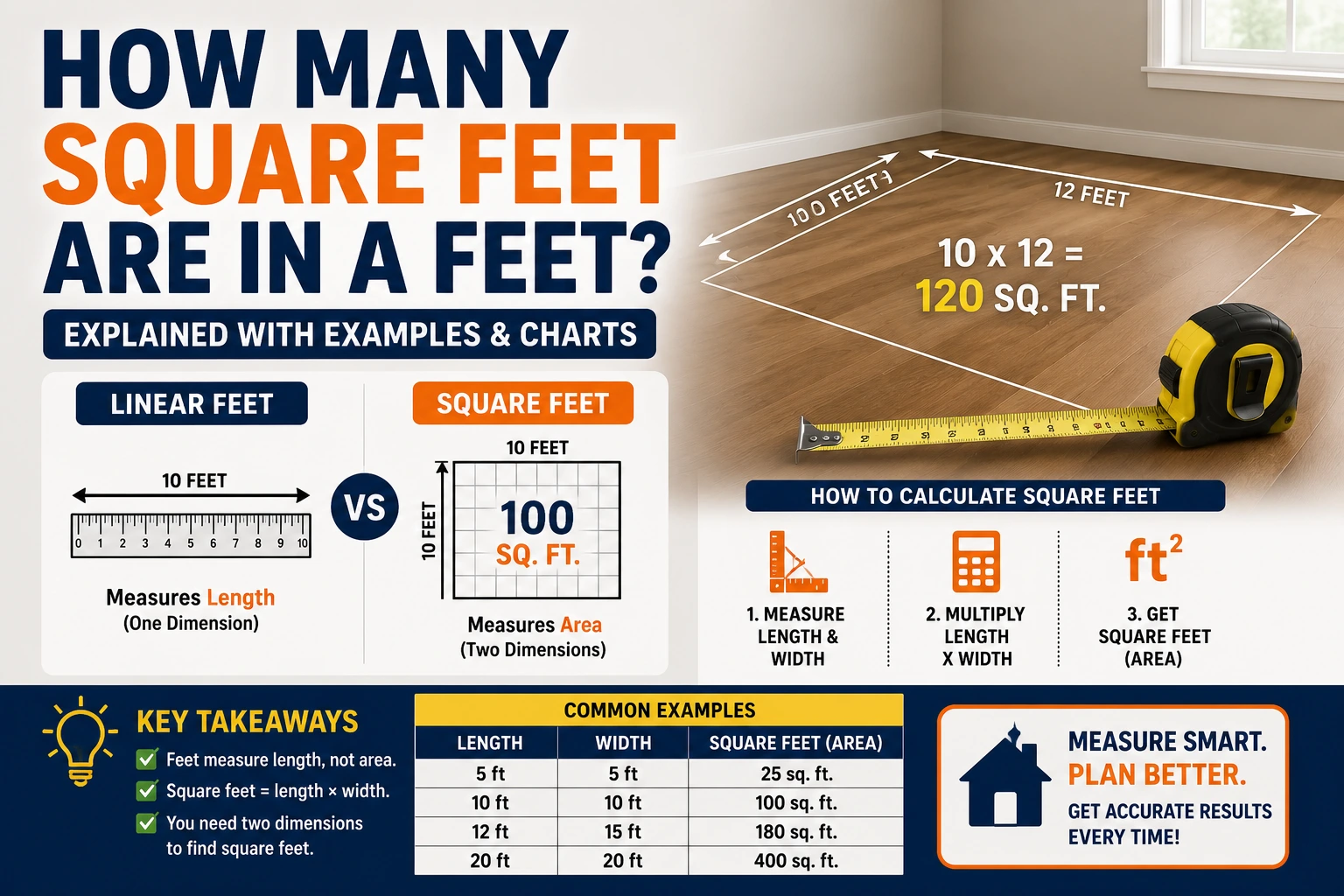
If you are searching for how many square feet are in a feet, the important answer is that there is no fixed number. A foot measures length, while a square foot measures area.
To calculate square feet, you need at least two measurements: length and width.
For example, a space that is 1 foot long and 1 foot wide equals 1 square foot. But a space that is 10 feet long can have many different square-foot totals depending on its width.
- 10 feet long × 1 foot wide = 10 square feet
- 10 feet long × 5 feet wide = 50 square feet
- 10 feet long × 12 feet wide = 120 square feet
This guide explains the difference between feet and square feet, shows the correct formula, and gives practical examples for rooms, flooring, paint, gardens, walls, and more.
Quick Answer: How Many Square Feet Are in a Feet?
The short answer is:
You cannot directly convert one foot into square feet without knowing the width.
A foot is a linear measurement. It tells you how long something is.
A square foot is an area measurement. It tells you how much flat space something covers.
Why There Is No Single Conversion
Think of a foot as a straight line. It has length only.
Square feet describe a flat surface. A square foot has both length and width.
For example:
| Length | Width | Total Square Feet |
|---|---|---|
| 1 foot | 1 foot | 1 sq. ft. |
| 1 foot | 2 feet | 2 sq. ft. |
| 1 foot | 5 feet | 5 sq. ft. |
| 1 foot | 10 feet | 10 sq. ft. |
| 10 feet | 10 feet | 100 sq. ft. |
This is why the phrase “how many square feet are in a feet” needs another measurement before you can calculate the answer.
When One Foot Can Equal One Square Foot
One foot equals one square foot only when the area is:
[
1 \text{ foot} × 1 \text{ foot}
]
That creates a square that is one foot long and one foot wide.
So:
[
1 \text{ ft} × 1 \text{ ft} = 1 \text{ sq. ft.}
]
However, this does not mean every linear foot equals one square foot. The width always matters.
Feet vs. Square Feet: What Is the Difference?
Feet and square feet may sound similar, but they measure different things.
What Is a Linear Foot?
A linear foot is simply one foot of length.
It can describe:
- The length of a board
- A curtain rod
- A piece of trim
- A fence line
- A countertop edge
- A cable or wire
- A roll of material
For example, a 12-foot board is 12 linear feet long.
What Is a Square Foot?
A square foot is a unit of area. It measures a flat surface that is 1 foot long and 1 foot wide.
[
1 \text{ square foot} = 1 \text{ foot} × 1 \text{ foot}
]
Square feet are commonly used for:
- Room size
- House size
- Flooring
- Carpet
- Tile
- Walls
- Decks
- Patios
- Gardens
- Roofs
Why Area Needs Two Measurements
To calculate area, you need length and width.
The formula is:
[
\text{Square Feet} = \text{Length in Feet} × \text{Width in Feet}
]
For example:
[
15 \text{ ft} × 12 \text{ ft} = 180 \text{ sq. ft.}
]
A 15-by-12-foot room has 180 square feet of floor area.
How Many Square Feet Are in a Feet for Common Sizes?
The following examples show why width changes the answer.
One Foot by One Foot
[
1 × 1 = 1 \text{ square foot}
]
A 1-foot-by-1-foot tile, board, or mat covers 1 square foot.
One Foot by Two Feet
[
1 × 2 = 2 \text{ square feet}
]
A strip that is 1 foot wide and 2 feet long covers 2 square feet.
One Foot by Ten Feet
[
1 × 10 = 10 \text{ square feet}
]
A narrow runner that is 1 foot wide and 10 feet long covers 10 square feet.
This is common when calculating material such as:
- Roofing underlayment
- Wall panels
- Carpet runners
- Vinyl flooring
- Fabric
- Insulation
- Landscaping fabric
How to Convert Feet to Square Feet
You cannot convert feet to square feet with only one number. Instead, multiply the length by the width.
The Square Feet Formula
Use this formula:
[
\text{Square Feet} = \text{Length} × \text{Width}
]
Both measurements must be in feet.
Step-by-Step Example
Imagine a room is 14 feet long and 11 feet wide.
Step 1: Write the measurements
- Length = 14 feet
- Width = 11 feet
Step 2: Multiply them
[
14 × 11 = 154
]
Step 3: Add the correct unit
The room is:
154 square feet
Calculating Irregular Areas
Not every room, garden, or patio is a perfect rectangle.
For L-shaped or irregular spaces:
- Divide the space into smaller rectangles.
- Measure each rectangle.
- Calculate the square feet of each section.
- Add the totals together.
For example:
- Main section: 12 feet × 10 feet = 120 sq. ft.
- Small section: 5 feet × 4 feet = 20 sq. ft.
[
120 + 20 = 140 \text{ sq. ft.}
]
The full area is 140 square feet.
Feet to Square Feet Conversion Chart
This chart shows common length-and-width combinations.
| Length | Width | Square Feet |
| 1 ft | 1 ft | 1 sq. ft. |
| 2 ft | 2 ft | 4 sq. ft. |
| 3 ft | 3 ft | 9 sq. ft. |
| 4 ft | 4 ft | 16 sq. ft. |
| 5 ft | 5 ft | 25 sq. ft. |
| 6 ft | 6 ft | 36 sq. ft. |
| 8 ft | 8 ft | 64 sq. ft. |
| 10 ft | 10 ft | 100 sq. ft. |
| 12 ft | 12 ft | 144 sq. ft. |
| 15 ft | 15 ft | 225 sq. ft. |
| 20 ft | 20 ft | 400 sq. ft. |
Use this chart as a quick reference. Remember that it works only when you know both dimensions.
Real-Life Examples of Square Foot Calculations
Square-foot measurements are useful in many everyday projects.
Measuring a Room
Suppose your bedroom is 12 feet long and 10 feet wide.
[
12 × 10 = 120 \text{ sq. ft.}
]
The room is 120 square feet.
This helps when buying flooring, rugs, paint, or furniture.
Calculating Flooring
If your living room is 18 feet by 14 feet:
[
18 × 14 = 252 \text{ sq. ft.}
]
You need flooring for 252 square feet.
However, you should add extra material for cuts and waste. A common allowance is 5% to 10%.
For 10% waste:
[
252 × 0.10 = 25.2
]
[
252 + 25.2 = 277.2
]
You should buy flooring for about 278 square feet.
Estimating Wall Paint
To find the area of a wall, multiply its width by its height.
For a wall that is 15 feet wide and 8 feet high:
[
15 × 8 = 120 \text{ sq. ft.}
]
That wall has 120 square feet of paintable area before subtracting windows or doors.
Measuring a Garden or Patio
If a patio is 16 feet long and 12 feet wide:
[
16 × 12 = 192 \text{ sq. ft.}
]
You may use this number when buying pavers, outdoor tiles, artificial grass, or landscape fabric.
How Many Square Feet Are in a Feet When Buying Materials?
When buying materials, sellers may use linear feet, square feet, or both. Understanding the difference helps you order the right amount.
Flooring and Carpet
Flooring is usually sold by square feet because it covers a flat area.
For example, if your room is 200 square feet, you need at least 200 square feet of flooring. Add extra for waste.
Carpet may be sold by square yards or square feet. Always check the unit before comparing prices.
Tile and Wall Panels
Tiles and wall panels are also sold by area. A box may cover 15, 20, or 30 square feet.
Measure the full surface area, then add 10% extra for cuts, breakage, and future repairs.
Roofing and Landscaping
Roofing materials are often measured in square feet or roofing squares. One roofing square equals 100 square feet.
Landscaping materials may be sold by square feet for coverage or cubic yards for volume. Mulch, gravel, and soil need depth as well as area, so square footage alone is not enough.
Common Mistakes When Converting Feet to Square Feet
Treating Linear Feet as Square Feet
A 10-foot board is not automatically 10 square feet. You need its width.
For example:
- 10 feet long × 1 foot wide = 10 sq. ft.
- 10 feet long × 6 inches wide = 5 sq. ft.
The second example has the same length but a smaller area.
Forgetting to Measure Width
You cannot calculate area from length alone.
Always measure:
- Length
- Width
- Height, if you are measuring a wall
Mixing Feet and Inches
If one measurement includes inches, convert it to feet before multiplying.
For example, 6 feet 6 inches equals 6.5 feet.
[
6 \text{ inches} ÷ 12 = 0.5 \text{ feet}
]
Then:
[
6.5 × 10 = 65 \text{ sq. ft.}
]
Not Adding Waste Allowance
When ordering materials, exact square footage is not always enough.
Add waste for:
- Cuts
- Broken pieces
- Pattern matching
- Corners
- Repairs
- Irregular room shapes
A 5% to 10% waste allowance is common for many flooring and tile projects.
Expert Tips for Accurate Square Footage
Measure Twice
Measure each area twice, especially before ordering expensive materials.
A small measuring error can lead to too little flooring, carpet, paint, or tile.
Use Decimal Feet for Inches
Convert inches into decimal feet before calculating.
| Inches | Decimal Feet |
| 3 inches | 0.25 ft |
| 6 inches | 0.50 ft |
| 9 inches | 0.75 ft |
| 12 inches | 1.00 ft |
For example, 8 feet 6 inches becomes 8.5 feet.
Break Large Areas Into Smaller Shapes
Large or irregular areas are easier to calculate when divided into rectangles.
This method works well for:
- L-shaped rooms
- Decks
- Hallways
- Gardens
- Roof sections
- Basements
Add every section together for the final total.
Frequently Asked Questions
How many square feet are in one foot?
There is no direct conversion because one foot measures length and square feet measure area. One foot equals one square foot only when the area is 1 foot by 1 foot.
Is 10 feet the same as 10 square feet?
No. Ten feet is a length. Ten square feet is an area. You need both length and width to calculate square footage.
How do I calculate square feet from feet?
Multiply the length by the width.
For example:
[
10 \text{ ft} × 8 \text{ ft} = 80 \text{ sq. ft.}
]
How many square feet is a 12 by 12 room?
A 12-by-12-foot room is:
[
12 × 12 = 144 \text{ square feet}
]
Can I convert linear feet directly to square feet?
No, not without knowing the width. Linear feet measure length only, while square feet measure area.
Conclusion: How Many Square Feet Are in a Feet?
So, how many square feet are in a feet? There is no fixed answer because feet measure length and square feet measure area.
To calculate square feet, multiply length by width:
[
\text{Square Feet} = \text{Length} × \text{Width}
]
A 1-foot-by-1-foot area equals 1 square foot. But a 10-foot length can equal 10, 50, 100, or more square feet depending on the width.
Whether you are measuring a room, buying flooring, estimating paint, planning a garden, or calculating a patio, always measure both dimensions. This simple step helps you get accurate results and avoid ordering too much or too little material.
Discover more