
If you are shopping for an air conditioner, one of the most important questions is how many BTU do I need for 750 square feet. Choosing the correct cooling capacity helps your air conditioner keep your home comfortable while using energy efficiently. A unit that is too small may struggle to cool the space, while one that is too large can cycle on and off too frequently, leading to uneven temperatures and higher energy costs.
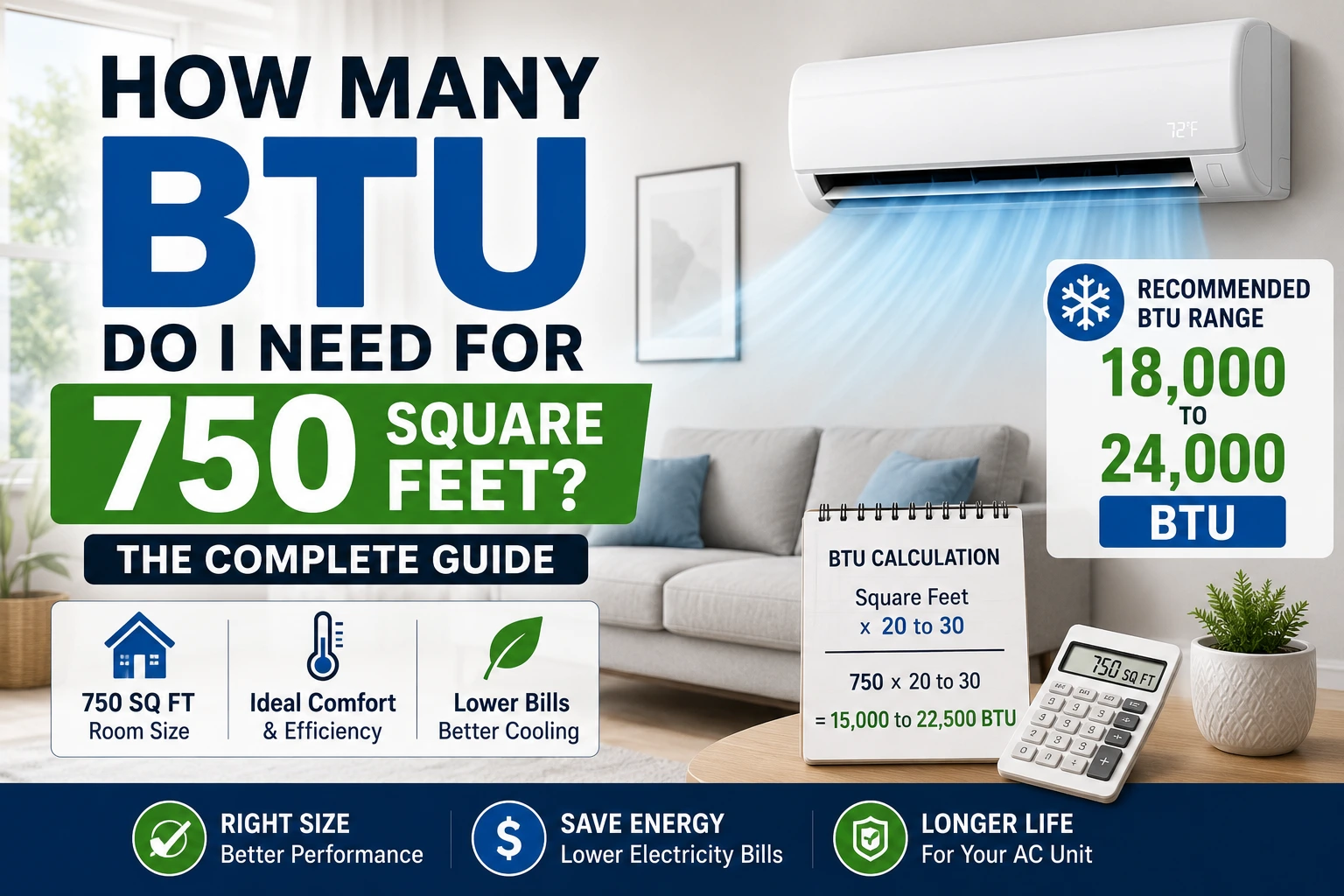
For most homes with average insulation and an 8 foot ceiling, a 750 square foot area typically requires between 18,000 and 24,000 BTU. However, the ideal size depends on several factors, including climate, ceiling height, sun exposure, insulation quality, and the number of people using the space.
This guide explains how BTU ratings work, how to calculate the right cooling capacity, and what factors you should consider before buying an air conditioner.
What Is BTU
BTU stands for British Thermal Unit.
It is the standard measurement used to describe the cooling or heating capacity of an HVAC system.
One BTU is the amount of heat required to raise the temperature of one pound of water by one degree Fahrenheit.
When shopping for air conditioners, a higher BTU rating means the unit can remove more heat from the room every hour.
Common BTU ratings include:
- 5,000 BTU
- 8,000 BTU
- 10,000 BTU
- 12,000 BTU
- 18,000 BTU
- 24,000 BTU
- 36,000 BTU
Choosing the correct BTU ensures the system performs efficiently without wasting energy.
How Many BTU Do I Need for 750 Square Feet
For an average home, the recommended cooling capacity is:
18,000 to 24,000 BTU
This recommendation assumes:
- Standard ceiling height
- Average insulation
- Moderate climate
- Typical household occupancy
The exact requirement varies depending on the building’s conditions.
Standard BTU Recommendation
The table below provides general recommendations.
| Room Size | Recommended BTU |
|---|---|
| 500 square feet | 12,000 BTU |
| 600 square feet | 14,000 BTU |
| 700 square feet | 18,000 BTU |
| 750 square feet | 18,000 to 24,000 BTU |
| 800 square feet | 22,000 BTU |
| 1,000 square feet | 24,000 BTU |
These values are suitable for most residential applications.
Why Room Conditions Matter
Square footage alone does not determine the correct AC size.
Several factors influence the cooling load.
These include:
- Ceiling height
- Sunlight exposure
- Insulation quality
- Window size
- Climate
- Number of occupants
- Heat producing appliances
Ignoring these factors may result in choosing the wrong air conditioner.
How BTU Requirements Are Calculated
Professionals use cooling load calculations rather than relying only on square footage.
A simple estimation uses:
20 to 30 BTU per square foot
For a 750 square foot space:
750 × 20 = 15,000 BTU
750 × 25 = 18,750 BTU
750 × 30 = 22,500 BTU
This explains why most experts recommend a system between 18,000 and 24,000 BTU.
BTU Chart by Room Size
The following chart offers a quick reference.
| Area | Suggested BTU |
|---|---|
| 150 square feet | 5,000 BTU |
| 250 square feet | 6,000 BTU |
| 350 square feet | 8,000 BTU |
| 450 square feet | 10,000 BTU |
| 550 square feet | 12,000 BTU |
| 700 square feet | 18,000 BTU |
| 750 square feet | 18,000 to 24,000 BTU |
| 1,000 square feet | 24,000 BTU |
| 1,200 square feet | 30,000 BTU |
These estimates assume average home conditions.
How to Calculate BTU Requirements
Calculating the correct cooling capacity involves more than measuring the floor.
Follow these steps.
Measure the Room
Measure the room’s length and width.
Multiply them together.
Example:
Length:
30 feet
Width:
25 feet
30 × 25
Total:
750 square feet
Consider Ceiling Height
Most BTU charts assume an 8 foot ceiling.
If your ceiling is higher, the room contains more air that must be cooled.
Homes with:
- 9 foot ceilings
- 10 foot ceilings
- Vaulted ceilings
may require additional cooling capacity.
Evaluate Sun Exposure
Rooms receiving direct sunlight throughout the day absorb more heat.
South facing and west facing rooms usually require more BTU than shaded spaces.
If the room has large windows, consider increasing the recommended BTU.
Count the Number of Occupants
Each person adds body heat to the room.
Larger families or busy office spaces may require additional cooling capacity.
Many HVAC professionals add approximately 600 BTU for each additional regular occupant beyond two people.
Factors That Affect Cooling Capacity
Every home is different.
Several conditions can increase or decrease the amount of cooling required.
Insulation
Well insulated homes stay cooler during summer.
Older homes with poor insulation lose cooled air more quickly.
Better insulation can reduce energy costs while improving comfort.
Windows
Large windows allow solar heat to enter the room.
Single pane windows transfer more heat than modern energy efficient windows.
Curtains and blinds can reduce heat gain during the hottest part of the day.
Climate
Outdoor temperatures play an important role.
Homes located in hot regions require larger air conditioners than similar homes in cooler climates.
For example:
- Desert climates
- Tropical regions
- Southern states
often require additional BTU.
Heat Producing Appliances
Appliances release heat into the room.
Examples include:
- Ovens
- Refrigerators
- Computers
- Televisions
- Dryers
Kitchens often need larger cooling systems because of cooking appliances.
Choosing the Right Type of Air Conditioner
Several types of air conditioners can cool a 750 square foot area.
Window Air Conditioner
Large window units may cool smaller open spaces but are generally best for individual rooms.
Some high capacity window units reach 18,000 BTU.
Portable Air Conditioner
Portable units are easy to install but are generally less efficient than other options.
They work best in temporary situations.
Mini Split System
Mini split air conditioners provide excellent energy efficiency.
Many homeowners choose an 18,000 or 24,000 BTU mini split for spaces around 750 square feet.
Central Air Conditioning
For homes with multiple connected rooms, central air conditioning provides consistent cooling throughout the house.
A licensed HVAC contractor can determine the proper system size.
Real World Example
Imagine a homeowner wants to cool a 750 square foot apartment.
The apartment has:
- Eight foot ceilings
- Average insulation
- Four occupants
- Large west facing windows
Although the standard recommendation begins around 18,000 BTU, the additional heat from sunlight and occupancy may justify selecting a 24,000 BTU system for better comfort during peak summer temperatures.
Real World BTU Calculation Examples
Understanding BTU requirements becomes easier when you look at real life examples.
Example One
A homeowner has a 750 square foot living room with:
- Eight foot ceilings
- Average insulation
- Two occupants
- Moderate sunlight
Recommended cooling capacity:
18,000 BTU
This size provides efficient cooling under normal conditions.
Example Two
A 750 square foot apartment has:
- Large south facing windows
- Poor insulation
- Four occupants
- Hot summer climate
Recommended cooling capacity:
24,000 BTU
The extra cooling capacity helps offset the additional heat entering the space.
Example Three
A home office measures 750 square feet and includes:
- Modern insulation
- Energy efficient windows
- Limited direct sunlight
- Two occupants
Recommended cooling capacity:
18,000 BTU
Since the room gains less heat throughout the day, a smaller unit within the recommended range is usually sufficient.
BTU Sizing Comparison Table
Choosing the right air conditioner depends on more than square footage. The table below shows when each BTU size is most appropriate.
| BTU Rating | Ideal Room Size | Best For |
|---|---|---|
| 12,000 BTU | Up to 550 square feet | Bedrooms and small living rooms |
| 18,000 BTU | 700 to 900 square feet | Apartments, offices, and open living spaces |
| 24,000 BTU | 900 to 1,200 square feet or hot 750 square foot spaces | Homes with high heat gain |
| 30,000 BTU | 1,200 to 1,500 square feet | Large open floor plans |
| 36,000 BTU | 1,500 square feet and above | Large homes and commercial spaces |
Always compare the manufacturer’s specifications before making a purchase.
Benefits of Choosing the Right BTU
Selecting the correct cooling capacity provides several important advantages.
- Better indoor comfort.
- Lower electricity bills.
- More even room temperatures.
- Longer equipment lifespan.
- Reduced humidity.
- Improved energy efficiency.
- Less wear on the compressor.
- Quieter operation.
An appropriately sized air conditioner performs better while reducing long term operating costs.
Problems with an Air Conditioner That Is Too Small
Many homeowners believe a smaller unit saves money, but it often creates more problems.
Common issues include:
- Constant operation without reaching the desired temperature.
- Higher electricity consumption.
- Faster equipment wear.
- Poor humidity control.
- Uneven cooling.
- Shorter system lifespan.
A unit that is too small must work harder every day, increasing maintenance costs over time.
Problems with an Air Conditioner That Is Too Large
Buying the largest available air conditioner is not always the best solution.
Oversized units can:
- Cool the room too quickly.
- Cycle on and off frequently.
- Leave excess humidity indoors.
- Increase energy consumption.
- Create uncomfortable temperature swings.
- Wear out components faster due to frequent starts.
Proper sizing is more important than simply choosing a higher BTU rating.
Energy Saving Tips for Cooling a 750 Square Foot Space
Even the best air conditioner performs better when combined with smart energy saving habits.
Try these practical tips.
- Keep doors and windows closed while the AC is running.
- Use ceiling fans to improve air circulation.
- Close curtains during the hottest part of the day.
- Replace air filters regularly.
- Seal air leaks around doors and windows.
- Schedule annual HVAC maintenance.
- Keep outdoor condenser units free of debris.
- Set the thermostat to a comfortable, energy efficient temperature.
These simple habits can reduce cooling costs while improving indoor comfort.
Common Mistakes When Choosing an AC Size
Avoid these common errors when selecting an air conditioner.
Choosing Based Only on Square Footage
Square footage is only one part of the calculation.
Factors such as insulation, ceiling height, and climate also affect cooling requirements.
Ignoring Sun Exposure
Rooms with large windows or direct afternoon sunlight often require additional BTU.
Ignoring solar heat gain can lead to an undersized system.
Forgetting Ceiling Height
Higher ceilings increase the volume of air that must be cooled.
A room with a vaulted ceiling may need a larger unit than a room with standard ceilings.
Not Considering Occupancy
Each additional person contributes body heat.
Homes with larger families usually require more cooling capacity.
Overlooking Appliances
Kitchen appliances, computers, televisions, and other electronics generate heat that increases the cooling load.
Expert Tips for Selecting the Right Air Conditioner
HVAC professionals recommend the following best practices.
- Measure your room carefully before shopping.
- Use a BTU calculator as a starting point.
- Consider insulation and window quality.
- Buy an ENERGY STAR certified unit when possible.
- Choose an inverter air conditioner for improved efficiency.
- Consult an HVAC professional for large or complex spaces.
- Compare warranty coverage before purchasing.
- Read the manufacturer’s sizing guide.
Following these recommendations helps ensure reliable cooling and lower operating costs.
Frequently Asked Questions
How many BTU do I need for 750 square feet?
Most 750 square foot spaces require 18,000 to 24,000 BTU, depending on insulation, ceiling height, climate, and sunlight exposure.
Is 18,000 BTU enough for 750 square feet?
Yes. An 18,000 BTU air conditioner is often suitable for a well insulated 750 square foot space with average ceiling height and moderate sun exposure.
Should I choose a 24,000 BTU unit instead?
A 24,000 BTU unit may be a better choice if the space has high ceilings, poor insulation, large windows, strong sunlight, or is located in a hot climate.
What happens if my air conditioner is too small?
An undersized air conditioner may run continuously, struggle to cool the room, increase electricity usage, and wear out more quickly.
Does insulation affect BTU requirements?
Yes. Good insulation reduces heat transfer, allowing a smaller air conditioner to cool the space efficiently. Poor insulation often requires a higher BTU rating.
Conclusion
Choosing the correct cooling capacity is essential when deciding how many BTU do I need for 750 square feet. For most homes, the ideal range is 18,000 to 24,000 BTU, but the exact requirement depends on factors such as insulation, ceiling height, climate, window placement, occupancy, and heat producing appliances.
Rather than relying only on square footage, evaluate your home’s overall cooling needs before purchasing an air conditioner. A properly sized unit delivers better comfort, improved humidity control, lower energy bills, and a longer equipment lifespan. By using the BTU charts, calculation methods, and expert recommendations in this guide, you can confidently select an air conditioner that keeps your 750 square foot space comfortable throughout the cooling season.
Discover more