
When planning a landscaping project, one of the most common questions people ask is: how many square feet will a ton of rock cover?
Whether you’re installing decorative stone, gravel pathways, river rock, or crushed stone, knowing the coverage area helps you estimate costs accurately and avoid ordering too much or too little material.
The answer depends primarily on the depth of the rock layer. In general, one ton of rock covers approximately 80 to 240 square feet, depending on how thick you spread it.
This guide explains coverage calculations, depth charts, formulas, and real-world examples so you can confidently estimate your landscaping needs.
Quick Answer
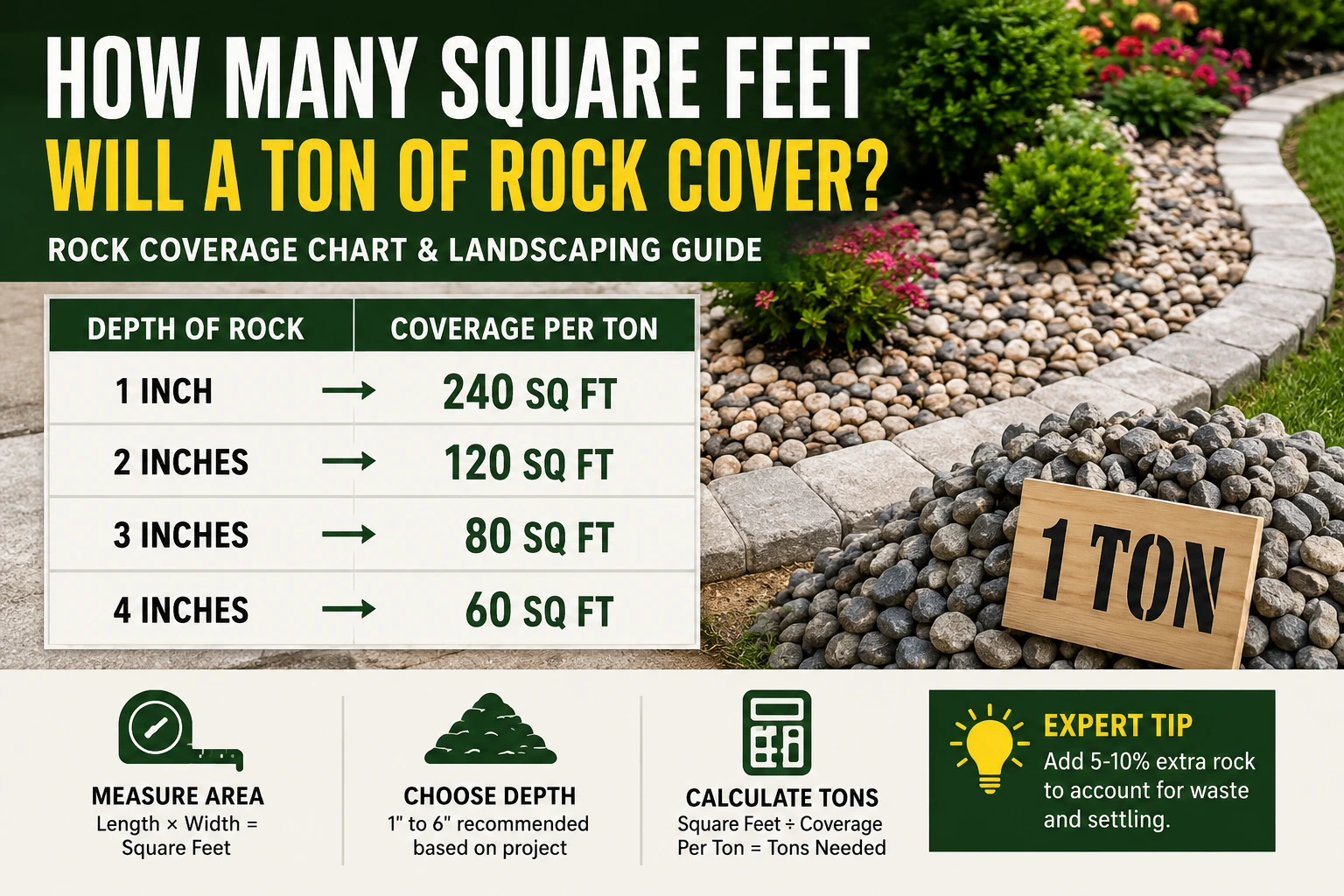
The average coverage of one ton of landscaping rock is:
| Rock Depth | Coverage Per Ton |
|---|---|
| 1 inch | 240 sq ft |
| 2 inches | 120 sq ft |
| 3 inches | 80 sq ft |
| 4 inches | 60 sq ft |
For most landscaping beds, homeowners use a depth of 2 inches, meaning one ton of rock typically covers about 120 square feet.
Why Rock Coverage Depends on Depth
The deeper you spread rock, the fewer square feet it will cover.
Think of it like spreading butter on bread:
- A thin layer covers more area.
- A thick layer covers less area.
The same principle applies to landscaping rock.
1 Inch Depth
A one-inch layer is suitable for:
- Decorative stone accents
- Areas with existing ground cover
- Light landscaping projects
Coverage:
1 ton ≈ 240 square feet
2 Inch Depth
Two inches is considered the standard depth for most landscaping applications.
Ideal for:
- Flower beds
- Around trees
- Decorative landscaping
Coverage:
1 ton ≈ 120 square feet
3 Inch Depth
A thicker layer provides:
- Better weed suppression
- Improved durability
- Enhanced moisture retention
Coverage:
1 ton ≈ 80 square feet
Rock Coverage Chart by Depth
Use this quick-reference chart when estimating your project.
| Depth | Coverage Per Ton |
|---|---|
| 1 inch | 240 sq ft |
| 1.5 inches | 160 sq ft |
| 2 inches | 120 sq ft |
| 2.5 inches | 96 sq ft |
| 3 inches | 80 sq ft |
| 4 inches | 60 sq ft |
| 5 inches | 48 sq ft |
| 6 inches | 40 sq ft |
This chart works for most decorative stone, gravel, crushed rock, and similar landscaping materials.
How to Calculate Rock Coverage Yourself
If your project is unique, you may want to calculate coverage manually.
Step 1: Measure the Area
Measure:
- Length
- Width
Formula:
Square Feet = Length × Width
Example:
20 feet × 15 feet = 300 square feet
Step 2: Determine Desired Depth
Typical depths:
| Application | Recommended Depth |
|---|---|
| Decorative Stone | 1–2 inches |
| Flower Beds | 2–3 inches |
| Walkways | 2–3 inches |
| Driveways | 4–6 inches |
Step 3: Calculate Tons Needed
Formula:
Tons Needed = Total Square Feet ÷ Coverage Per Ton
Example:
300 sq ft area at 2-inch depth
300 ÷ 120 = 2.5 tons
You would need approximately 2.5 tons of rock.
Coverage Examples for Common Projects
Garden Beds
Project size:
10 ft × 12 ft
Area:
120 sq ft
At a 2-inch depth:
You need about 1 ton of rock.
Walkways
Walkway dimensions:
4 ft × 25 ft
Area:
100 sq ft
At a 2-inch depth:
Approximately 1 ton is enough.
Driveways
Driveway dimensions:
20 ft × 20 ft
Area:
400 sq ft
At a 4-inch depth:
Coverage per ton = 60 sq ft
400 ÷ 60 = 6.7 tons
You’ll need approximately 7 tons.
Factors That Affect Rock Coverage
Not all rock materials cover exactly the same area.
Several factors influence the final coverage.
Rock Type
Different stones have different densities.
Examples:
- River rock
- Pea gravel
- Crushed granite
- Limestone
- Lava rock
Heavier rocks generally cover slightly less area per ton.
Rock Size
Large rocks leave more air gaps between pieces.
Because of this:
- Larger decorative stones may cover more surface area visually.
- Smaller gravel packs more tightly.
Coverage estimates can vary.
Compaction
Walkways and driveways often experience compaction.
As rocks settle:
- Depth decreases
- Additional material may be required
Waste and Settling
Some rock is inevitably lost during:
- Transport
- Installation
- Raking
- Settling
Professionals often order 5–10% extra material.
Coverage Comparison Table
Here is a practical comparison of how coverage changes with depth.
| Tons of Rock | 1 Inch | 2 Inches | 3 Inches |
|---|---|---|---|
| 1 Ton | 240 sq ft | 120 sq ft | 80 sq ft |
| 2 Tons | 480 sq ft | 240 sq ft | 160 sq ft |
| 3 Tons | 720 sq ft | 360 sq ft | 240 sq ft |
| 5 Tons | 1,200 sq ft | 600 sq ft | 400 sq ft |
| 10 Tons | 2,400 sq ft | 1,200 sq ft | 800 sq ft |
This table helps estimate larger projects quickly.
Common Mistakes When Ordering Rock
Many homeowners make costly mistakes when buying landscaping stone.
Ignoring Depth Requirements
Ordering based only on square footage can lead to shortages.
Always calculate using both:
- Area
- Desired depth
Not Accounting for Settling
Rock naturally shifts and compacts.
Failing to order extra material often results in visible low spots.
Choosing the Wrong Rock Size
Large decorative stones may appear sufficient initially but can leave exposed ground beneath.
Select the right size for your application.
Forgetting Irregular Shapes
Curved flower beds and winding pathways can be difficult to estimate.
Break complex shapes into:
- Rectangles
- Squares
- Triangles
Then calculate each section separately.
Expert Tips for Accurate Coverage Estimates
Professional landscapers use several techniques to improve accuracy.
Measure Twice
Double-check all dimensions before ordering.
Even small measurement errors can affect tonnage significantly.
Add Extra Material
A 5–10% buffer prevents shortages.
Example:
Need 4 tons?
Order 4.2–4.4 tons.
Use Landscape Fabric
Installing weed barrier fabric underneath rock:
- Reduces weed growth
- Improves appearance
- Helps maintain coverage depth
Match Depth to Purpose
Not every project requires thick rock layers.
For decorative beds:
2 inches is usually enough.
For driveways:
4–6 inches is often recommended.
How Many Tons of Rock Do You Need?
Use this simple guide.
| Area | Depth | Rock Needed |
|---|---|---|
| 120 sq ft | 2 inches | 1 ton |
| 240 sq ft | 2 inches | 2 tons |
| 360 sq ft | 2 inches | 3 tons |
| 480 sq ft | 2 inches | 4 tons |
| 600 sq ft | 2 inches | 5 tons |
This estimate works for most standard landscaping projects.
Frequently Asked Questions
1. How many square feet will a ton of rock cover at 2 inches deep?
A ton of rock typically covers about 120 square feet at a depth of 2 inches.
2. How many square feet does a ton of gravel cover?
Most gravel covers between 80 and 240 square feet, depending on installation depth.
3. Is one ton of rock enough for a flower bed?
For a flower bed around 120 square feet at 2 inches deep, one ton is generally sufficient.
4. How many tons of rock do I need for 500 square feet?
At a 2-inch depth:
500 ÷ 120 = 4.17 tons
You would need approximately 4.5 tons after allowing for waste.
5. What depth should landscaping rock be?
Most landscape professionals recommend:
- 2 inches for decorative beds
- 3 inches for weed control
- 4–6 inches for driveways
Conclusion
So, how many square feet will a ton of rock cover? The answer depends largely on the depth of the material. As a general rule, one ton of rock covers approximately 240 square feet at 1 inch, 120 square feet at 2 inches, and 80 square feet at 3 inches.
For most landscaping projects, a 2-inch depth provides the ideal balance between appearance, durability, and cost. By measuring your area carefully, selecting the appropriate depth, and ordering a little extra material, you can complete your project efficiently while avoiding unnecessary expenses. Whether you’re installing decorative stone, gravel pathways, or crushed rock, understanding rock coverage calculations ensures accurate planning and better results.
Discover more
how many square feet is 1000 bricks