

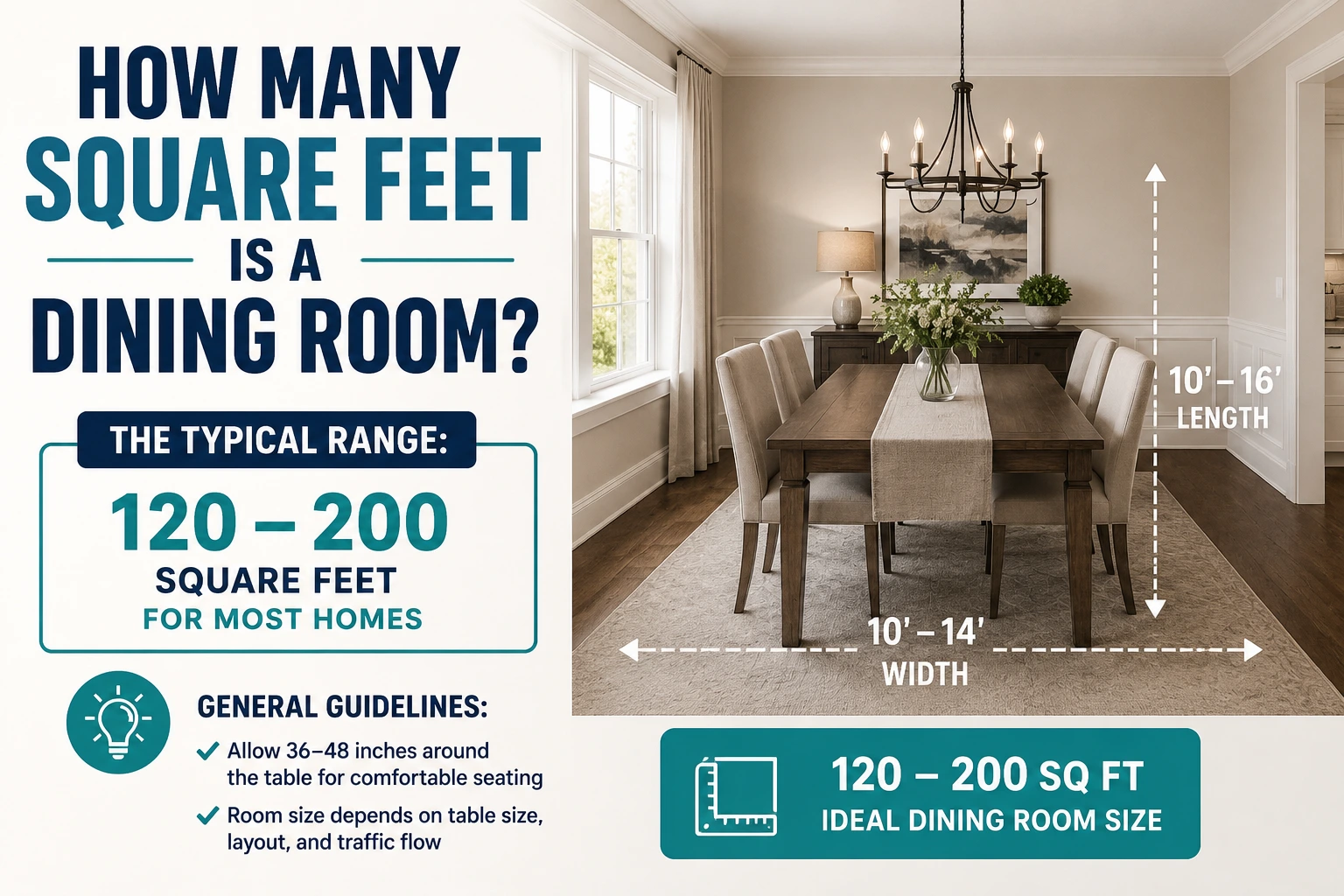
When planning a home, remodeling a space, or shopping for furniture, one common question is: how many square feet is a dining room?
The answer depends on several factors, including the number of people you want to seat, the size of your dining table, and whether the room is part of an open floor plan or a separate space.
In most homes, a dining room ranges from 100 to 300 square feet, with the average dining room measuring around 150 to 200 square feet. However, some compact homes may have dining areas under 100 square feet, while luxury homes often feature dining rooms larger than 300 square feet.
This guide explains standard dining room dimensions, seating requirements, layout recommendations, and practical planning tips so you can determine the ideal dining room size for your needs.
Understanding Dining Room Size
Before discussing specific measurements, it is important to understand what square footage means.
Square footage is calculated by multiplying a room’s length by its width.
For example:
- 10 ft × 10 ft = 100 sq ft
- 12 ft × 12 ft = 144 sq ft
- 12 ft × 16 ft = 192 sq ft
- 15 ft × 20 ft = 300 sq ft
The size of a dining room affects:
- Comfort
- Furniture placement
- Walking space
- Seating capacity
- Overall home value
A room that is too small may feel cramped, while an oversized dining room can feel empty and inefficient.
How Many Square Feet Is a Dining Room on Average?
The average dining room in modern homes typically falls between 150 and 200 square feet.
Here is a general breakdown:
| Dining Room Type | Typical Size |
|---|---|
| Small | 80–120 sq ft |
| Medium | 120–200 sq ft |
| Large | 200–300 sq ft |
| Luxury | 300+ sq ft |
Many new homes use open-concept designs where the dining area shares space with the kitchen or living room. In these layouts, the dining area itself may occupy only 80–150 square feet.
Standard Dining Room Dimensions
Small Dining Room
Small dining rooms are common in apartments, condos, and compact homes.
Typical dimensions:
| Length | Width | Square Feet |
|---|---|---|
| 8 ft | 10 ft | 80 sq ft |
| 10 ft | 10 ft | 100 sq ft |
| 10 ft | 12 ft | 120 sq ft |
These rooms typically accommodate:
- Round tables
- Small rectangular tables
- 4-person seating
Small dining rooms work best when furniture is scaled appropriately.
Medium Dining Room
A medium dining room is the most common size found in family homes.
Typical dimensions:
| Length | Width | Square Feet |
|---|---|---|
| 12 ft | 12 ft | 144 sq ft |
| 12 ft | 14 ft | 168 sq ft |
| 12 ft | 16 ft | 192 sq ft |
These spaces comfortably support:
- 6-person dining tables
- Buffets and sideboards
- Comfortable movement around furniture
For many families, this is considered the ideal dining room size.
Large Dining Room
Large dining rooms provide flexibility for entertaining and hosting guests.
Common dimensions:
| Length | Width | Square Feet |
|---|---|---|
| 14 ft | 16 ft | 224 sq ft |
| 15 ft | 18 ft | 270 sq ft |
| 15 ft | 20 ft | 300 sq ft |
Benefits include:
- Seating for 8–12 people
- Formal dining layouts
- Additional furniture pieces
- Decorative storage units
These rooms are often found in custom and luxury homes.
Dining Room Size Based on Seating Capacity
The number of people you want to seat significantly impacts the amount of square footage required.
4-Person Dining Room
Recommended size:
- 80–120 square feet
Common room dimensions:
- 8 × 10 ft
- 10 × 10 ft
- 10 × 12 ft
This size works well for couples and small families.
6-Person Dining Room
Recommended size:
- 120–180 square feet
Common dimensions:
- 12 × 12 ft
- 12 × 14 ft
This arrangement offers sufficient space around the table without feeling crowded.
8-Person Dining Room
Recommended size:
- 180–250 square feet
Common dimensions:
- 12 × 16 ft
- 14 × 16 ft
These rooms support larger tables and easier movement.
10-Person Dining Room
Recommended size:
- 250–350 square feet
Common dimensions:
- 15 × 18 ft
- 15 × 20 ft
Ideal for:
- Frequent entertaining
- Holiday gatherings
- Large families
Recommended Space Around a Dining Table
One of the biggest mistakes homeowners make is focusing only on the table size.
You also need clearance around the table.
Design professionals recommend:
| Area | Recommended Space |
|---|---|
| Chair pull-out space | 36 inches |
| Comfortable walkway | 42–48 inches |
| Main traffic path | 48 inches minimum |
For example:
A table measuring 42 inches by 72 inches should have at least 36 inches of clearance on all sides.
This additional space significantly affects the total room size required.
Dining Room Size Chart
The following chart provides quick estimates.
| Seating Capacity | Suggested Room Size | Approx. Square Feet |
|---|---|---|
| 4 people | 10 × 10 ft | 100 sq ft |
| 4–6 people | 10 × 12 ft | 120 sq ft |
| 6 people | 12 × 12 ft | 144 sq ft |
| 6–8 people | 12 × 14 ft | 168 sq ft |
| 8 people | 12 × 16 ft | 192 sq ft |
| 8–10 people | 14 × 16 ft | 224 sq ft |
| 10–12 people | 15 × 20 ft | 300 sq ft |
This chart serves as a practical reference when designing or remodeling a dining space.
Open Concept vs Separate Dining Rooms
Modern homes increasingly feature open floor plans.
In these layouts, dining areas are often smaller because they share space with:
- Kitchens
- Family rooms
- Living rooms
Typical open-concept dining areas:
- 80–150 square feet
Traditional separate dining rooms are usually larger:
- 150–300 square feet
Advantages of open-concept dining:
- Better traffic flow
- More natural light
- Flexible furniture placement
Advantages of separate dining rooms:
- Greater privacy
- Formal entertaining
- Better noise control
- Defined function
The best choice depends on your lifestyle and household needs.
How to Calculate Dining Room Square Footage
If you already have a room and want to know its size, use this simple formula:
Square Footage = Length × Width
Examples:
| Length | Width | Square Feet |
|---|---|---|
| 10 ft | 12 ft | 120 sq ft |
| 12 ft | 12 ft | 144 sq ft |
| 12 ft | 16 ft | 192 sq ft |
| 15 ft | 20 ft | 300 sq ft |
Step-by-Step
- Measure room length.
- Measure room width.
- Multiply the two numbers.
- The result is your square footage.
This calculation works for square and rectangular rooms.
Common Dining Room Planning Mistakes
Many homeowners underestimate space requirements.
Avoid these common mistakes:
Choosing a Table That’s Too Large
A large table may leave little room for chairs and movement.
Ignoring Chair Clearance
Guests should be able to sit and stand comfortably.
Forgetting Additional Furniture
Buffets, cabinets, and sideboards require extra space.
Blocking Walkways
Maintain clear traffic paths through the room.
Focusing Only on Square Footage
Room shape is equally important.
A 150-square-foot square room may function differently than a 150-square-foot rectangular room.
Expert Tips for Choosing the Right Dining Room Size
Consider Future Needs
Think beyond your current household.
Will you host guests frequently?
Do you expect your family to grow?
Match Room Size to Table Size
Always start with the dining table dimensions and work outward.
Leave Extra Circulation Space
A slightly larger room often feels more comfortable.
Think About Room Shape
Rectangular rooms typically work best for larger dining tables.
Plan for Storage
Built-in storage, buffets, and serving stations may require additional square footage.
Frequently Asked Questions
1. How many square feet is a typical dining room?
Most dining rooms range between 120 and 200 square feet, with 150–200 square feet being the average.
2. Is a 10×10 dining room large enough?
Yes. A 10×10 dining room provides 100 square feet and can comfortably seat four people.
3. What is the standard dining room size for six people?
A room measuring approximately 12×12 feet (144 square feet) is generally ideal for six people.
4. How much space should be left around a dining table?
Leave at least 36 inches around all sides of the table, with 42–48 inches preferred for comfortable movement.
5. Is 200 square feet a large dining room?
Yes. A 200-square-foot dining room is considered spacious and can typically accommodate six to eight people comfortably.
Conclusion
So, how many square feet is a dining room? In most homes, dining rooms range from 100 to 300 square feet, with the average dining room measuring around 150 to 200 square feet. The ideal size depends on your table dimensions, seating needs, and desired comfort level.
For smaller households, 100–120 square feet may be enough. Families that regularly entertain guests often benefit from 180–300 square feet or more. By considering seating capacity, table clearance, and room layout, you can choose a dining room size that is both functional and comfortable for years to come.
discover more
how many square feet will a ton of rock cover