
If you’ve ever purchased mulch, gravel, concrete, or topsoil, you’ve probably encountered the question: cubic yard equals how many cubic feet?
The answer is simple:
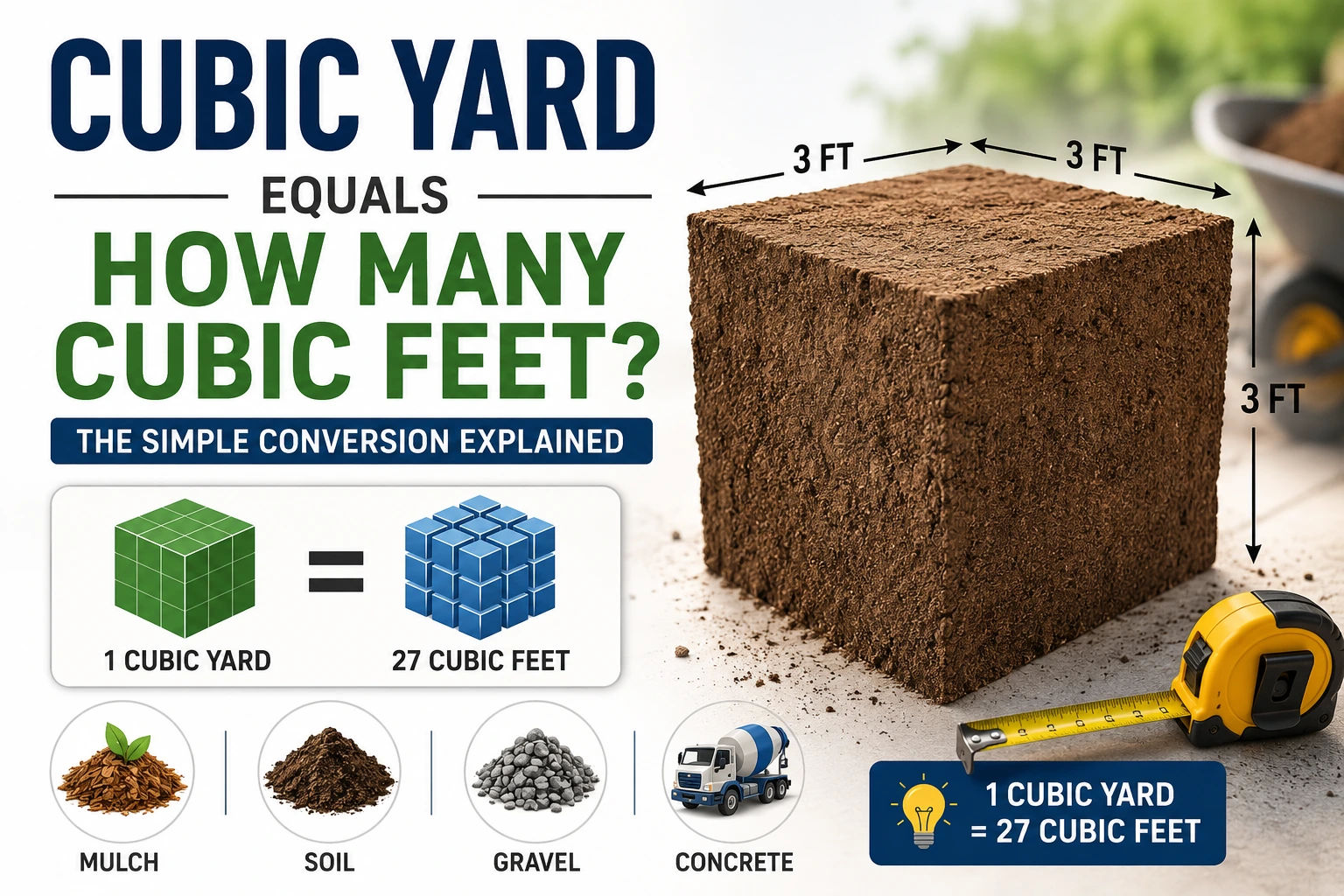
1 cubic yard = 27 cubic feet.
While the answer itself is straightforward, understanding why this conversion works can help you accurately estimate materials, avoid costly mistakes, and plan projects more efficiently.
Whether you’re a homeowner starting a landscaping project or a contractor ordering bulk materials, this guide explains everything you need to know about converting cubic yards to cubic feet.
Understanding Cubic Measurements
Before learning the conversion, it’s important to understand what cubic measurements represent.
Unlike square measurements that calculate area, cubic measurements calculate volume, meaning the amount of space an object or material occupies.
Volume measurements are commonly used for:
- Soil
- Sand
- Gravel
- Mulch
- Concrete
- Compost
- Debris removal
- Storage containers
What Is a Cubic Foot?
A cubic foot is a cube that measures:
- 1 foot long
- 1 foot wide
- 1 foot high
The volume is:
1 × 1 × 1 = 1 cubic foot
A cubic foot is often used for smaller volume calculations.
What Is a Cubic Yard?
A cubic yard is a larger unit of volume.
A cube measuring:
- 3 feet long
- 3 feet wide
- 3 feet high
equals one cubic yard.
Since each dimension is three times larger than a foot, the volume increases significantly.
Cubic Yard Equals How Many Cubic Feet?
The exact conversion is:
1 cubic yard=27 cubic feet
This means every cubic yard contains 27 cubic feet of volume.
The Simple Conversion Formula
To convert cubic yards into cubic feet:
Cubic Feet=Cubic Yards×27
For example:
- 1 cubic yard = 27 cubic feet
- 2 cubic yards = 54 cubic feet
- 3 cubic yards = 81 cubic feet
- 5 cubic yards = 135 cubic feet
Why the Answer Is 27 Cubic Feet
Many people wonder where the number 27 comes from.
Since:
- 1 yard = 3 feet
A cubic yard is:
3 feet × 3 feet × 3 feet
The calculation becomes:
3×3×3=27
That’s why one cubic yard contains exactly 27 cubic feet.
Cubic Yards to Cubic Feet Conversion Chart
| Cubic Yards | Cubic Feet |
|---|---|
| 1 | 27 |
| 2 | 54 |
| 3 | 81 |
| 4 | 108 |
| 5 | 135 |
| 6 | 162 |
| 7 | 189 |
| 8 | 216 |
| 9 | 243 |
| 10 | 270 |
| 15 | 405 |
| 20 | 540 |
| 25 | 675 |
| 30 | 810 |
This chart is useful when ordering landscaping or construction materials.
How to Convert Cubic Yards to Cubic Feet
Converting cubic yards to cubic feet requires only one step.
Step 1: Identify the Number of Cubic Yards
Suppose you need:
- 4 cubic yards of mulch
Step 2: Multiply by 27
4 × 27 = 108
Step 3: Get the Result
4 cubic yards equals 108 cubic feet.
This method works for any volume measurement.
How to Convert Cubic Feet to Cubic Yards
Sometimes suppliers provide measurements in cubic feet instead.
To convert cubic feet into cubic yards:
Cubic Yards=27Cubic Feet
Example:
81 cubic feet ÷ 27 = 3 cubic yards
Result:
81 cubic feet = 3 cubic yards
Real-World Examples of Cubic Yard Conversions
Understanding practical applications makes the conversion easier.
Mulch Example
You need enough mulch for flower beds.
A supplier recommends:
- 4 cubic yards
Convert:
4 × 27 = 108 cubic feet
Therefore, 4 cubic yards of mulch equals 108 cubic feet.
Soil Example
A garden project requires:
- 6 cubic yards of topsoil
Calculation:
6 × 27 = 162 cubic feet
You’ll receive 162 cubic feet of soil.
Concrete Example
A concrete contractor estimates:
- 8 cubic yards
Conversion:
8 × 27 = 216 cubic feet
This equals 216 cubic feet of concrete.
Gravel Example
Suppose a driveway needs:
- 12 cubic yards of gravel
Calculation:
12 × 27 = 324 cubic feet
You would need 324 cubic feet of gravel.
Why Contractors Use Cubic Yards
Most construction and landscaping industries use cubic yards because materials are often sold in large quantities.
Benefits include:
- Easier ordering
- Simpler truckload calculations
- Industry-standard measurements
- Reduced estimating errors
- Better project planning
For example, a dump truck may carry 10–15 cubic yards of material. Using cubic feet would create much larger numbers that are harder to manage.
Common Mistakes When Converting Cubic Yards and Cubic Feet
Many people make conversion errors that lead to ordering too much or too little material.
Forgetting the Volume Difference
A yard measures length, while a cubic yard measures volume.
These are completely different units.
Multiplying by 3 Instead of 27
A common mistake is assuming:
1 yard = 3 feet
Therefore:
1 cubic yard = 3 cubic feet
This is incorrect.
Because volume has three dimensions, you must multiply:
3 × 3 × 3 = 27
Ignoring Material Depth
Landscaping calculations require depth measurements.
Even a small change in depth can significantly affect total volume.
Rounding Too Early
Always complete calculations before rounding.
This improves accuracy and reduces waste.
Practical Applications in Construction and Landscaping
The cubic yard-to-cubic-foot conversion appears in many industries.
Landscaping
Used for:
- Mulch
- Decorative stone
- Topsoil
- Compost
Construction
Used for:
- Concrete
- Sand
- Backfill
- Excavation projects
Waste Removal
Dumpster and hauling companies often estimate debris volume using cubic yards.
Agriculture
Farmers calculate soil amendments, compost, and storage capacity using cubic volume measurements.
Quick Reference Table
| Measurement | Equivalent |
|---|---|
| 1 Cubic Yard | 27 Cubic Feet |
| 2 Cubic Yards | 54 Cubic Feet |
| 5 Cubic Yards | 135 Cubic Feet |
| 10 Cubic Yards | 270 Cubic Feet |
| 20 Cubic Yards | 540 Cubic Feet |
| 50 Cubic Yards | 1,350 Cubic Feet |
Keep this table handy when estimating materials.
Expert Tips for Accurate Volume Calculations
Professionals use several techniques to improve accuracy.
Measure Carefully
Double-check:
- Length
- Width
- Depth
Even small errors can affect material estimates.
Add a Small Buffer
For most projects, order about 5–10% extra material.
This helps compensate for:
- Settling
- Spillage
- Uneven surfaces
Use Consistent Units
Convert all measurements into feet before calculating volume.
Mixing inches, yards, and feet often causes mistakes.
Verify Supplier Units
Some suppliers list materials in:
- Cubic feet
- Cubic yards
- Tons
Always confirm the unit before ordering.
FAQs
1. Cubic yard equals how many cubic feet exactly?
One cubic yard equals exactly 27 cubic feet.
2. Why is one cubic yard equal to 27 cubic feet?
Because one yard equals three feet, and volume requires multiplying three dimensions:
3 × 3 × 3 = 27.
3. How many cubic feet are in 2 cubic yards?
Multiply 2 by 27:
2 × 27 = 54 cubic feet.
4. How do I convert cubic feet back to cubic yards?
Divide cubic feet by 27.
For example:
108 ÷ 27 = 4 cubic yards.
5. What materials are commonly measured in cubic yards?
Common materials include:
- Mulch
- Gravel
- Sand
- Topsoil
- Concrete
- Compost
- Debris
Conclusion
If you’ve been wondering cubic yard equals how many cubic feet, the answer is simple: 1 cubic yard equals 27 cubic feet. Understanding this conversion helps when ordering landscaping materials, estimating concrete needs, calculating soil volume, or managing construction projects.
Remember the key formula:
Cubic Feet = Cubic Yards × 27
By mastering this basic conversion, you can estimate material quantities more accurately, avoid costly mistakes, and complete projects with greater confidence. Whether you’re a homeowner, landscaper, or contractor, knowing how many cubic feet are in a cubic yard is an essential measurement skill.
discover more
how many square feet to tile a shower