

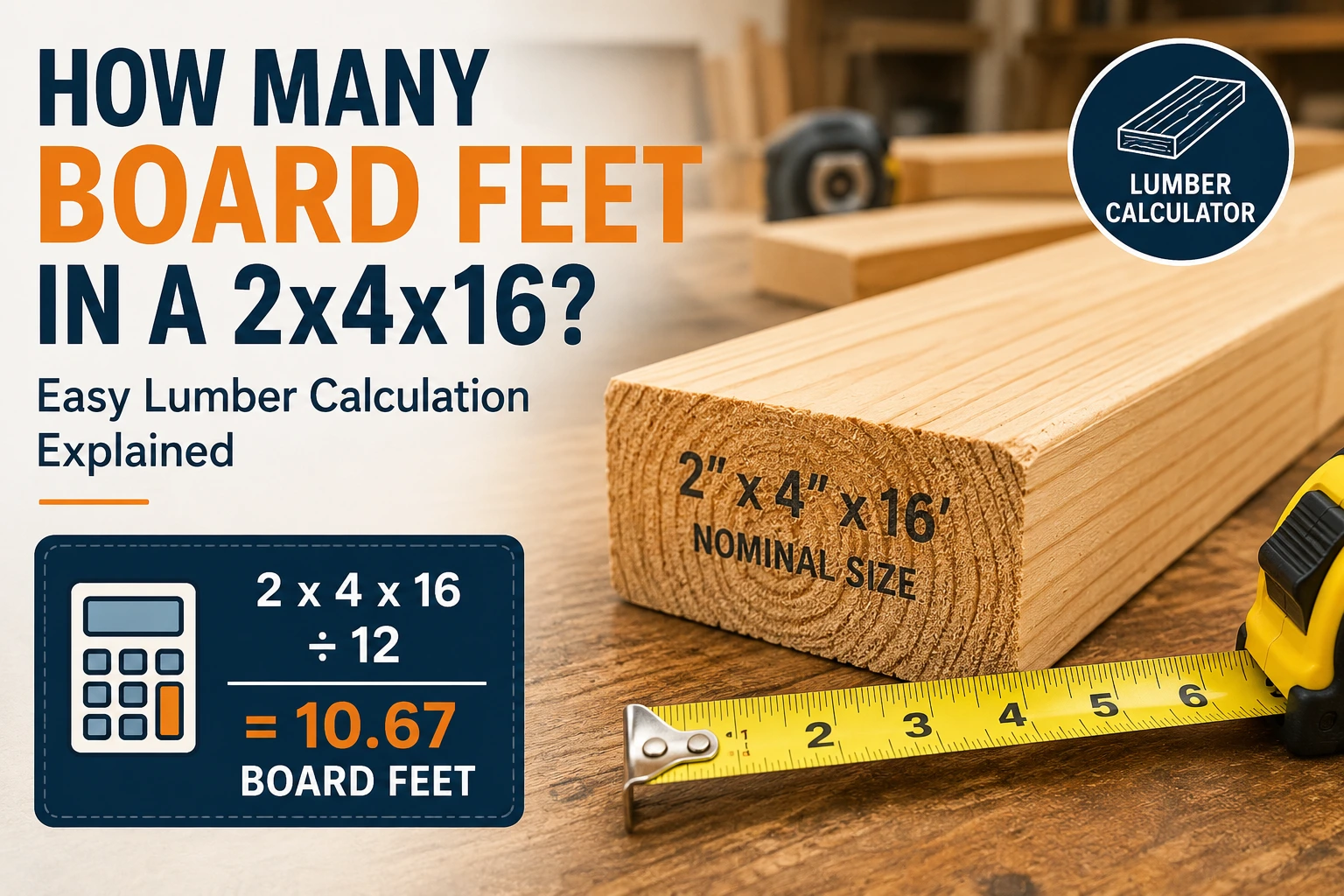
If you’re wondering how many board feet in a 2x4x16, the quick answer is:
A nominal 2×4×16 board contains approximately 10.67 board feet.
This is one of the most common lumber calculations used by carpenters, woodworkers, contractors, and DIY homeowners. Knowing how to calculate board feet helps you estimate lumber costs, compare wood prices, reduce waste, and purchase the right amount of material for your project.
In this guide, you’ll learn exactly what a board foot is, how the formula works, why actual lumber dimensions matter, and how to calculate board feet confidently for any size board.
Quick Answer
Here’s the calculation using the standard board foot formula.
| Lumber Size | Length | Board Feet |
|---|---|---|
| 2×4×16 | 16 feet | 10.67 board feet |
Formula:
Board Feet = (Thickness × Width × Length in Feet) ÷ 12
So:
(2 × 4 × 16) ÷ 12
= 128 ÷ 12
= 10.67 board feet
This calculation uses the lumber’s nominal dimensions, which is the industry standard.
What Is a Board Foot?
A board foot is a unit of volume used to measure lumber.
One board foot equals:
- 12 inches long
- 12 inches wide
- 1 inch thick
Or:
1 ft × 1 ft × 1 inch
Instead of measuring cubic feet, the lumber industry uses board feet because it provides an easy way to price and estimate wood.
Board Foot Definition
One board foot contains:
144 cubic inches
because
12 × 12 × 1 = 144 cubic inches.
Every piece of lumber can be converted into board feet using this standard measurement.
Why Lumber Uses Board Feet
Board feet make it easier to:
- Compare lumber prices
- Estimate project costs
- Order hardwood
- Calculate material requirements
- Reduce waste
- Prepare construction estimates
How Many Board Feet in a 2x4x16?
The answer depends on whether you’re using nominal or actual dimensions.
Using Nominal Dimensions
Construction lumber is sold using nominal sizes.
For a nominal 2×4×16:
Thickness = 2 inches
Width = 4 inches
Length = 16 feet
Calculation:
(2 × 4 × 16) ÷ 12
= 10.67 board feet
This is the number most lumber suppliers use.
Using Actual Dimensions
A modern 2×4 actually measures approximately:
- 1.5 inches thick
- 3.5 inches wide
If calculating actual wood volume:
Length:
16 feet = 192 inches
Volume:
1.5 × 3.5 × 192
= 1,008 cubic inches
Board feet:
1,008 ÷ 144
= 7 board feet
So:
| Measurement Type | Board Feet |
|---|---|
| Nominal Dimensions | 10.67 |
| Actual Dimensions | 7.00 |
This difference often surprises beginners.
Board Foot Formula Explained
The standard formula is simple.
Standard Formula
When length is in feet:
Board Feet = (Thickness × Width × Length) ÷ 12
When length is in inches:
Board Feet = (Thickness × Width × Length in Inches) ÷ 144
Both formulas produce the same result.
Step-by-Step Example
Suppose you have a 2×4×16.
Step 1:
Thickness = 2
Step 2:
Width = 4
Step 3:
Length = 16 feet
Step 4:
Multiply
2 × 4 × 16 = 128
Step 5:
Divide by 12
128 ÷ 12
= 10.67 board feet
That’s it.
Board Foot Conversion Table
Here are several common framing boards.
| Lumber Size | Length | Board Feet |
|---|---|---|
| 2×4×8 | 5.33 | |
| 2×4×10 | 6.67 | |
| 2×4×12 | 8.00 | |
| 2×4×14 | 9.33 | |
| 2×4×16 | 10.67 | |
| 2×6×8 | 8.00 | |
| 2×6×12 | 12.00 | |
| 2×8×16 | 21.33 | |
| 4×4×8 | 10.67 | |
| 4×6×12 | 24.00 |
These estimates are widely used for pricing and project planning.
Nominal vs Actual Lumber Dimensions
One of the biggest sources of confusion is the difference between nominal and actual sizes.
| Nominal Size | Actual Size |
|---|---|
| 2×4 | 1.5 × 3.5 |
| 2×6 | 1.5 × 5.5 |
| 2×8 | 1.5 × 7.25 |
| 4×4 | 3.5 × 3.5 |
| 1×6 | 0.75 × 5.5 |
Why the difference?
Lumber is cut rough, then dried and planed smooth. This process reduces the final dimensions.
When buying framing lumber, stores still label boards using nominal sizes because that’s the long-standing industry convention.
Common Examples of Board Feet
Once you understand the board foot formula, calculating the volume of different lumber sizes becomes much easier. The table below shows the board feet for several common board sizes using their nominal dimensions.
| Lumber Size | Length | Board Feet |
|---|---|---|
| 1×4 | 8 ft | 2.67 |
| 1×6 | 10 ft | 5.00 |
| 2×4 | 8 ft | 5.33 |
| 2×4 | 10 ft | 6.67 |
| 2×4 | 12 ft | 8.00 |
| 2×4 | 16 ft | 10.67 |
| 2×6 | 12 ft | 12.00 |
| 2×8 | 16 ft | 21.33 |
| 4×4 | 8 ft | 10.67 |
| 4×6 | 12 ft | 24.00 |
This chart is useful when estimating lumber for framing, woodworking, or renovation projects.
Practical Uses of Board Foot Calculations
Knowing how many board feet in a 2x4x16 is valuable for much more than solving a simple math problem. Whether you’re building a deck, framing a wall, or making custom furniture, board foot calculations help you estimate materials accurately and avoid overspending.
Buying Lumber
Hardwood suppliers typically sell lumber by the board foot rather than by individual boards. Understanding the board foot formula allows you to compare prices between suppliers and determine the true cost of the wood you need.
For example, if hardwood costs $8 per board foot, a nominal 2×4×16 containing 10.67 board feet would cost approximately:
10.67 × $8 = $85.36
Calculating this before purchasing helps you create a realistic project budget.
Estimating Project Costs
Board foot calculations make project planning much easier. Instead of guessing how much lumber you’ll need, you can estimate the exact quantity required.
Suppose your project requires 15 pieces of 2×4×16 lumber.
- Board feet per board: 10.67
- Number of boards: 15
- Total board feet: 160.05
If lumber costs $6 per board foot, your estimated lumber cost would be:
160.05 × $6 = $960.30
This approach is commonly used by contractors when preparing quotes.
Woodworking Projects
Board foot calculations are especially important when working with hardwood because it’s usually sold by volume instead of by piece.
Common woodworking projects include:
- Dining tables
- Cabinets
- Bookshelves
- Coffee tables
- Desks
- Bed frames
- Floating shelves
- Cutting boards
Calculating board feet before purchasing ensures you buy enough material while minimizing waste.
Home Construction
Construction professionals frequently use 2×4×16 boards for:
- Wall framing
- Interior partitions
- Garage construction
- Basement finishing
- Roof framing
- Pole barns
- Workshop buildings
Although framing lumber is often purchased by the piece, understanding board feet makes comparing lumber quantities much easier.
Common Mistakes When Calculating Board Feet
Even experienced DIYers occasionally make mistakes when measuring lumber. Avoid these common errors to improve accuracy.
Using Actual Dimensions Instead of Nominal Dimensions
One of the biggest sources of confusion is that a modern 2×4 does not actually measure 2 inches by 4 inches.
Its finished dimensions are approximately:
- 1.5 inches thick
- 3.5 inches wide
Most board foot calculations for construction lumber use nominal dimensions, so always check which measurement is required.
Forgetting to Divide by 12
When using the standard formula with length measured in feet, remember to divide by 12.
For a 2×4×16:
2 × 4 × 16 = 128
128 ÷ 12 = 10.67 board feet
Missing the final division results in an incorrect answer.
Mixing Measurement Units
Always keep your measurements consistent.
Use:
- Thickness in inches
- Width in inches
- Length in feet
Or convert everything into inches and divide by 144.
Mixing feet and inches without converting them correctly can lead to significant calculation errors.
Not Accounting for Waste
Most projects generate waste because of:
- Cutting
- Knots
- Warped boards
- Trimming
- Measurement errors
Professionals typically order 10% to 15% more lumber than their calculations indicate.
Rounding Too Soon
Keep decimal values throughout your calculations and round only at the end. This is especially important for large projects where small rounding errors can add up.
Expert Tips for Accurate Lumber Estimates
Professionals use a few simple practices to improve the accuracy of their lumber estimates.
- Measure every board individually when purchasing hardwood.
- Create a detailed cut list before buying lumber.
- Purchase an additional 10–15% to cover waste.
- Compare prices based on board feet instead of the number of boards.
- Double-check measurements before placing large orders.
- Use a board foot calculator to verify manual calculations.
- Store lumber properly to reduce warping and damage before use.
These habits help reduce waste, save money, and keep projects on schedule.
FAQs
1. How many board feet are in a 2×4×16?
A nominal 2×4×16 contains 10.67 board feet, which is calculated using the standard board foot formula.
2. Why does a 2×4 measure only 1.5 × 3.5 inches?
After rough-cut lumber is dried and planed smooth, its final dimensions become smaller. However, lumber is still sold using its original nominal size.
3. Is a board foot the same as a square foot?
No. A board foot measures volume, while a square foot measures area. They serve different purposes and cannot be used interchangeably.
4. Can I use the same formula for hardwood and softwood?
Yes. The board foot formula works for all types of lumber. The difference is that hardwood is commonly sold by the board foot, while framing lumber is often sold by individual boards.
5. What is the easiest way to calculate board feet?
Use this simple formula:
Board Feet = (Thickness × Width × Length in Feet) ÷ 12
This formula works for most standard lumber sizes and provides quick, accurate results.
Conclusion
If you’ve been asking how many board feet in a 2x4x16, the standard answer is 10.67 board feet when using nominal lumber dimensions. This measurement is widely accepted throughout the construction and woodworking industries for estimating lumber quantities and pricing materials.
Understanding how board feet are calculated can help you buy the right amount of lumber, compare prices accurately, and plan projects with greater confidence. Whether you’re framing a house, building furniture, or tackling a DIY renovation, mastering the board foot formula is a practical skill that saves both time and money.
Discover more