
Have you ever wondered how many steps in 300 feet? Whether you’re measuring walking distance for exercise, estimating movement on a job site, or simply satisfying your curiosity, converting feet into steps is easier than you might think.
The exact number of steps depends on your stride length. Taller people generally take fewer steps because their strides are longer, while shorter individuals usually take more. Walking speed, terrain, age, and even footwear can also affect your total step count.
In this guide, you’ll learn how to estimate the number of steps in 300 feet using simple formulas, conversion charts, and real-world examples. By the end, you’ll know how to calculate your own step count with confidence.
How Many Steps in 300 Feet?
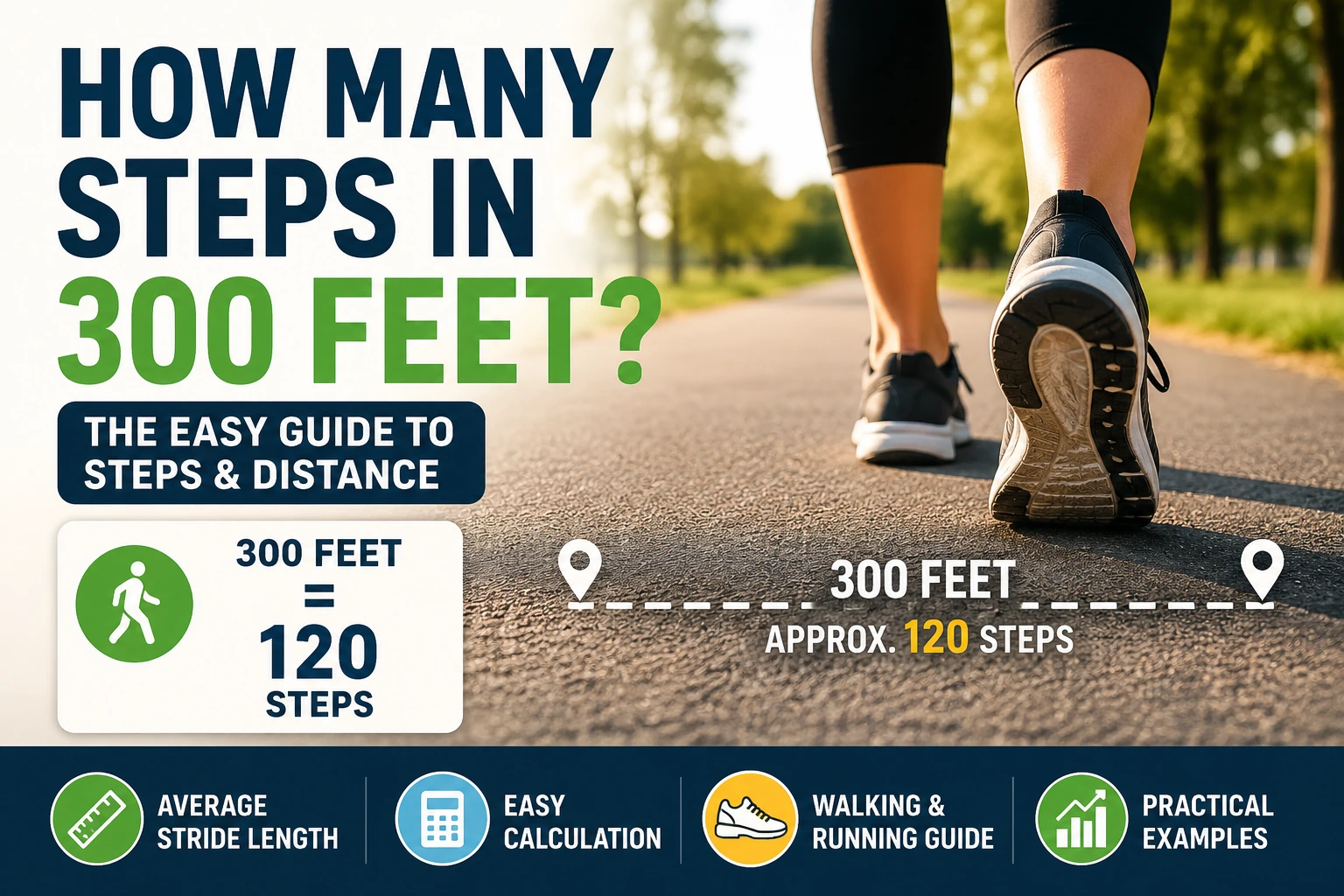
For most adults, 300 feet equals approximately 120 steps while walking.
However, the actual number varies based on stride length.
| Stride Length | Approximate Steps in 300 Feet |
|---|---|
| 2.0 feet | 150 steps |
| 2.2 feet | 136 steps |
| 2.5 feet | 120 steps |
| 2.7 feet | 111 steps |
| 3.0 feet | 100 steps |
For an average adult:
- Women: approximately 125–135 steps
- Men: approximately 110–125 steps
- Overall average: around 120 steps
This estimate works well for everyday walking.
Why Does the Number of Steps Vary?
There isn’t a single correct answer because everyone’s walking style is different.
Several factors influence stride length.
Height
Taller individuals usually have longer legs, allowing them to cover more ground with each step.
For example:
- A person who is 6’2″ may take about 105 steps.
- A person who is 5’0″ may need around 145 steps.
Walking Speed
Walking slowly produces shorter steps.
Brisk walking naturally increases stride length, reducing the number of steps required.
Running
When running, strides become significantly longer.
A runner may cover 300 feet in only 90–100 steps.
Age
Children have much shorter strides than adults, so they typically require many more steps.
Older adults may also have shorter strides depending on mobility.
Terrain
Walking uphill, through sand, snow, or rough trails shortens stride length and increases step count.
How to Calculate Steps from Feet
The calculation is simple.
Formula
Steps = Distance (feet) ÷ Stride Length (feet)
Let’s use an average stride length of 2.5 feet.
300 ÷ 2.5 = 120 steps
That’s why many fitness experts estimate that 300 feet equals about 120 steps.
What Is Average Stride Length?
Stride length refers to the distance covered in one step.
Average values include:
| Person | Average Step Length |
|---|---|
| Adult female | 2.2 feet |
| Adult male | 2.5 feet |
| Fast walker | 2.6–2.8 feet |
| Runner | 3.0–4.0 feet |
Knowing your own stride gives much more accurate results.
How to Measure Your Personal Stride Length
Instead of relying on averages, measure your own stride.
Follow these steps:
- Measure a straight distance of 20 feet.
- Walk naturally.
- Count every step.
- Divide the total distance by the number of steps.
Example:
- Distance = 20 feet
- Steps = 8
Stride length = 20 ÷ 8 = 2.5 feet
Now you can accurately estimate any walking distance.
Conversion Chart for Feet to Steps
Using an average stride of 2.5 feet:
| Distance | Approximate Steps |
|---|---|
| 25 feet | 10 |
| 50 feet | 20 |
| 75 feet | 30 |
| 100 feet | 40 |
| 150 feet | 60 |
| 200 feet | 80 |
| 250 feet | 100 |
| 300 feet | 120 |
| 400 feet | 160 |
| 500 feet | 200 |
| 1,000 feet | 400 |
This chart provides quick estimates for common distances.
Walking vs Running: Step Differences
Many people assume the number of steps remains the same regardless of speed.
That’s not true.
| Activity | Average Steps in 300 Feet |
|---|---|
| Slow walk | 130–145 |
| Normal walk | 120 |
| Brisk walk | 110–115 |
| Jogging | 100–110 |
| Running | 90–100 |
Longer strides during faster movement reduce the number of steps.
Practical Examples of 300 Feet
Understanding the distance helps put the numbers into perspective.
Approximately 300 feet is:
- About the length of a football field without end zones
- Around the length of a city block in some neighborhoods
- Roughly the distance from a parking lot entrance to a shopping center
- Similar to walking down a long office hallway several times
- About 91.44 meters
Knowing these comparisons makes it easier to estimate your daily movement.
How Fitness Trackers Estimate Steps
Devices such as smartwatches and fitness bands don’t actually measure distance directly.
Instead, they use:
- Motion sensors
- Accelerometers
- GPS (for outdoor walks)
- Personal height settings
- Estimated stride length
That’s why two people walking together may record different step counts.
In many devices, entering your height improves accuracy because the watch estimates a more realistic stride length.
Why Knowing Steps in 300 Feet Is Useful
Converting feet into steps has many practical applications.
It helps with:
- Walking workouts
- School track activities
- Physical therapy exercises
- Construction site measurements
- Home improvement projects
- Daily fitness goals
- Hiking distance estimates
- Step challenges
Rather than measuring with a tape every time, you can estimate distances simply by counting your steps.
Common Mistakes When Estimating Steps
Many people overestimate or underestimate their walking distance.
Avoid these common mistakes:
Assuming Everyone Has the Same Stride
People differ in height and walking style.
Ignoring Terrain
Walking uphill requires shorter steps.
Using Running Estimates While Walking
Running and walking produce different stride lengths.
Forgetting About Pace
Your stride changes depending on how quickly you move.
Never Measuring Your Own Stride
Personal measurements are always more accurate than averages.
Expert Tips for More Accurate Step Counts
If you frequently calculate walking distances, these tips will help.
- Measure your personal stride every few months.
- Walk naturally during measurement.
- Wear your usual walking shoes.
- Use a fitness tracker as a reference.
- Count several walking sessions and average the results.
- Adjust estimates for hills or uneven terrain.
These small adjustments greatly improve accuracy.
Real-World Examples of Walking 300 Feet
Understanding how many steps in 300 feet becomes easier when you apply it to everyday situations.
Example 1: Walking Across a Parking Lot
Imagine you park at the far end of a shopping center. The entrance is approximately 300 feet away.
- Average adult stride: 2.5 feet
- Distance: 300 feet
- Estimated steps: 120
This quick estimate helps you understand how much walking you’re doing throughout the day.
Example 2: Walking at School
Many school hallways range between 250 and 350 feet in length.
Walking from one end of a 300-foot hallway to the other usually takes around 120 steps for an average adult and slightly more for younger students.
Example 3: Fitness Challenge
Suppose your fitness coach asks you to complete 600 feet.
If 300 feet equals about 120 steps, then:
- 600 feet ≈ 240 steps
- 900 feet ≈ 360 steps
- 1,200 feet ≈ 480 steps
You can estimate your workout without needing a measuring wheel.
How Long Does It Take to Walk 300 Feet?
Besides step count, many people wonder how much time this distance requires.
| Walking Speed | Estimated Time |
|---|---|
| Slow walk | 1.5–2 minutes |
| Average walk | 1–1.5 minutes |
| Brisk walk | About 1 minute |
| Jogging | 40–50 seconds |
| Running | 20–35 seconds |
Most healthy adults can comfortably walk 300 feet in about one minute.
300 Feet Compared to Other Common Distances
Here are a few familiar comparisons that help visualize 300 feet.
| Distance | Approximate Steps |
|---|---|
| 50 feet | 20 |
| 100 feet | 40 |
| 150 feet | 60 |
| 200 feet | 80 |
| 250 feet | 100 |
| 300 feet | 120 |
| 500 feet | 200 |
| 1,000 feet | 400 |
| 1 mile (5,280 feet) | About 2,100–2,500 |
These figures are estimates based on an average walking stride.
Can Children and Seniors Have Different Step Counts?
Absolutely.
Age has a noticeable impact on stride length.
Children
Young children have much shorter legs, so they generally take more steps over the same distance.
For 300 feet:
- Young child: 150–180 steps
Teenagers
Teenagers often have stride lengths close to adults.
Estimated steps:
- 115–130 steps
Older Adults
Some seniors naturally shorten their stride for balance and comfort.
Estimated steps:
- 125–145 steps
These numbers vary depending on height, mobility, and walking speed.
How Accurate Are Online Feet-to-Steps Calculators?
Most online calculators provide a good estimate, but they rely on average stride lengths unless you enter your own measurements.
For the best accuracy:
- Enter your height if requested.
- Use your measured stride length when possible.
- Remember that walking and running require different stride lengths.
- Recalculate if your walking style changes due to fitness, injury, or age.
Personal measurements always produce the most reliable results.
Benefits of Knowing Your Step Count
Understanding the relationship between distance and steps offers several advantages.
Better Fitness Tracking
You can estimate your daily movement even when GPS isn’t available.
Easier Distance Estimation
Whether you’re indoors or outdoors, counting steps helps estimate how far you’ve traveled.
Improved Workout Planning
Walking programs often use distance goals. Converting those distances into steps makes workouts easier to follow.
Helpful for Weight Management
Many people use step goals to increase physical activity. Knowing that 300 feet equals roughly 120 steps helps break larger goals into smaller milestones.
Useful for Home and Workplace Measurements
Instead of carrying measuring tools, you can estimate short distances using your natural stride.
Tips to Increase Walking Efficiency
If you’re trying to improve your walking performance, consider these simple habits:
- Maintain an upright posture.
- Look forward instead of down.
- Swing your arms naturally.
- Wear supportive walking shoes.
- Keep a comfortable pace.
- Take consistent, even steps.
- Track your progress with a fitness app or pedometer.
These practices help make your stride more efficient and your distance estimates more reliable.
FAQs
How many steps are in 300 feet for the average adult?
Most adults take approximately 120 steps to walk 300 feet. The exact number depends on individual stride length, height, and walking pace.
Does height affect how many steps are in 300 feet?
Yes. Taller people usually have longer strides and therefore take fewer steps, while shorter individuals generally need more steps to cover the same distance.
How many running steps are in 300 feet?
Running increases stride length, so most runners cover 300 feet in about 90 to 100 steps, depending on speed and running style.
How can I calculate my own steps for 300 feet?
Measure your average stride length in feet and divide 300 by that number. For example, if your stride is 2.5 feet, then 300 ÷ 2.5 = 120 steps.
Are smartwatch step counts accurate for 300 feet?
Most modern fitness trackers provide a close estimate. Accuracy improves when you enter your height or customize your stride length in the device settings.
Conclusion
If you’ve been wondering how many steps in 300 feet, the answer for most adults is about 120 steps. However, your exact step count depends on factors such as stride length, height, walking speed, terrain, and age.
Using the simple formula—distance divided by stride length—allows you to estimate steps for virtually any distance. Measuring your personal stride provides the most accurate results and can improve fitness tracking, walking workouts, and everyday distance estimates.
Whether you’re counting steps for exercise, planning a walking route, or simply satisfying your curiosity, understanding the connection between feet and steps makes it much easier to monitor your movement and stay active.
Discover more
how many square feet do you need per chicken