
If you’re planning a new pool, comparing pool sizes, or simply curious, you may be wondering how many feet across a swimming pool really is. The answer depends on the type of pool, its purpose, and whether it’s designed for recreation, exercise, or competition.
Unlike pool length, which often gets more attention, the width (or distance across the pool) plays a major role in determining how comfortable the swimming experience will be. A wider pool offers more room for games, multiple swimmers, and family fun, while a narrower pool may be ideal for exercise or small backyards.
In this guide, you’ll learn the standard widths for different swimming pools, compare common pool sizes, understand what affects pool dimensions, and discover how to choose the right width for your needs.
How Many Feet Across a Swimming Pool?
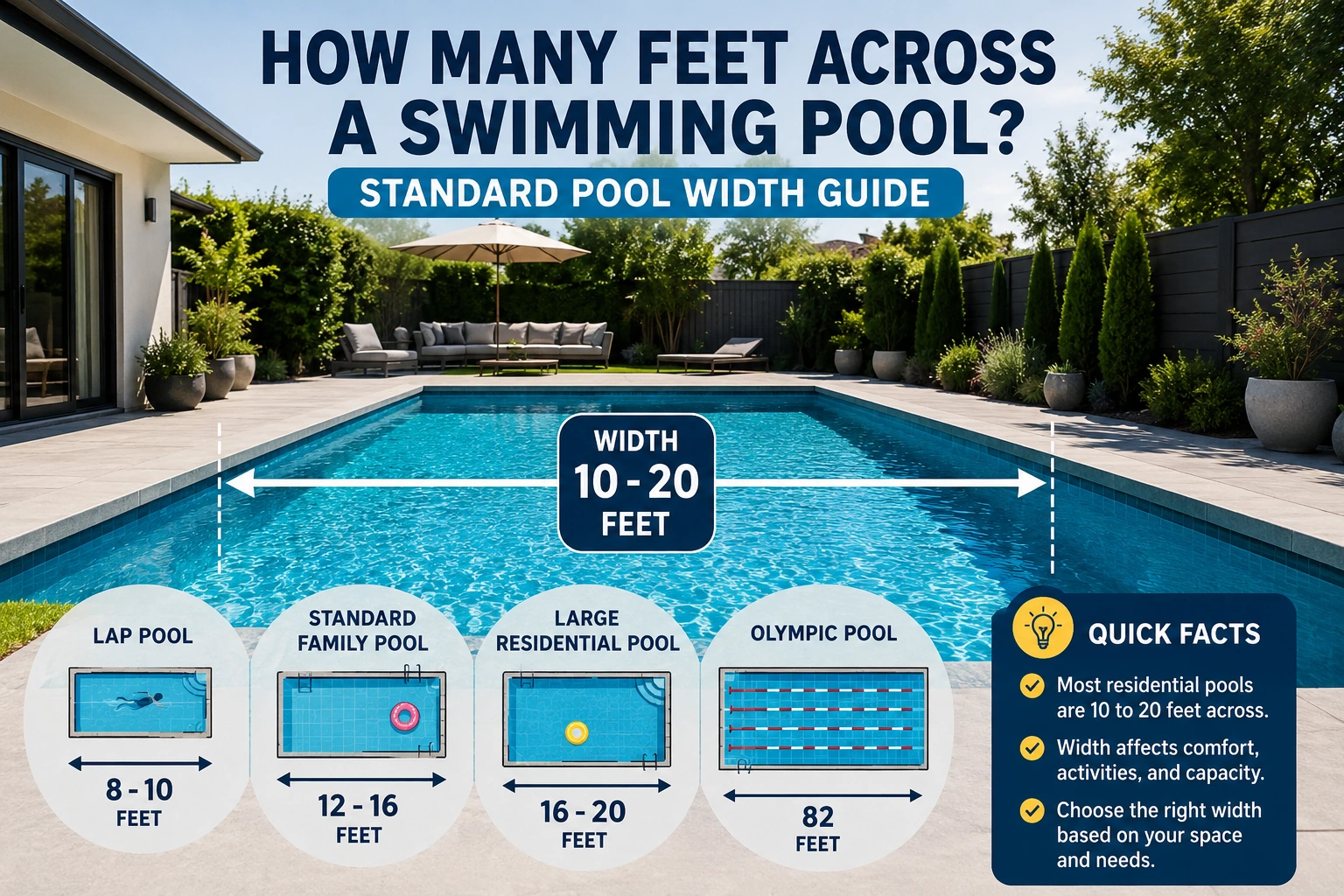
Most residential swimming pools are between 10 and 20 feet across.
Here are the most common widths:
| Pool Type | Typical Width |
|---|---|
| Small plunge pool | 6–10 feet |
| Compact backyard pool | 10–12 feet |
| Standard family pool | 12–16 feet |
| Large residential pool | 16–20 feet |
| Lap pool | 8–10 feet |
| Olympic swimming pool | 82 feet |
For most homeowners, a width of 12 to 16 feet provides enough room for swimming, floating, and family activities without requiring excessive backyard space.
Why Pool Width Matters
When people ask how many feet across a swimming pool, they’re usually trying to understand how much usable space the pool provides.
Pool width affects:
- Swimming comfort
- Number of swimmers
- Pool games
- Installation cost
- Water volume
- Backyard layout
- Maintenance expenses
A pool that’s too narrow may feel crowded, while one that’s excessively wide requires more water, chemicals, and maintenance.
Standard Swimming Pool Widths by Pool Type
Different pools serve different purposes, so their widths vary significantly.
Residential Family Pools
Family pools are designed for relaxation and recreation.
Typical width:
- 12 feet
- 14 feet
- 16 feet
- 18 feet
These sizes comfortably fit multiple swimmers while leaving room for seating areas or shallow play zones.
Lap Pools
Lap pools focus on fitness rather than recreation.
Typical width:
- 8 feet
- 9 feet
- 10 feet
Their narrow design allows efficient swimming while saving backyard space.
Plunge Pools
Plunge pools are becoming increasingly popular for small homes.
Typical width:
- 6 feet
- 8 feet
- 10 feet
Although compact, they’re perfect for cooling off rather than swimming laps.
Olympic Swimming Pools
Olympic pools are dramatically larger than residential pools.
Standard dimensions:
- Length: 164 feet (50 meters)
- Width: 82 feet (25 meters)
These pools contain eight to ten swimming lanes and are designed for international competitions.
Common Residential Pool Sizes
The following table shows popular backyard pool dimensions.
| Length | Width | Common Use |
|---|---|---|
| 20 ft | 10 ft | Small yard |
| 24 ft | 12 ft | Small family pool |
| 28 ft | 14 ft | Medium backyard |
| 30 ft | 15 ft | Recreation |
| 32 ft | 16 ft | Large family |
| 36 ft | 18 ft | Spacious backyard |
| 40 ft | 20 ft | Luxury residential |
These sizes are commonly installed because they balance usability with construction costs.
How Pool Shape Affects the Distance Across
Not every swimming pool is perfectly rectangular.
Some popular shapes include:
- Kidney-shaped
- Oval
- Circular
- Freeform
- L-shaped
For these pools, the measurement “across” usually refers to the widest point.
For example:
A kidney-shaped pool might measure:
- Length: 30 feet
- Widest point: 15 feet
Even though some sections are narrower, its official width remains 15 feet.
Above-Ground Pool Widths
Above-ground pools usually come in standard factory sizes.
Common round pool diameters include:
- 12 feet
- 15 feet
- 18 feet
- 21 feet
- 24 feet
- 27 feet
- 30 feet
For round pools, the distance across is simply the diameter.
For example:
| Pool Diameter | Feet Across |
|---|---|
| 12 ft | 12 feet |
| 18 ft | 18 feet |
| 24 ft | 24 feet |
| 30 ft | 30 feet |
In-Ground Pool Widths
In-ground pools offer much more flexibility.
Typical widths include:
- 10 feet
- 12 feet
- 14 feet
- 16 feet
- 18 feet
- 20 feet
Custom luxury pools may exceed 25 feet across depending on available land.
Choosing the Right Pool Width
The ideal pool width depends on several factors.
Consider the following before building a pool.
Backyard Size
A smaller yard naturally limits pool width.
Leave enough room for:
- Decking
- Seating
- Landscaping
- Walkways
- Safety fencing
Avoid designing a pool that occupies the entire yard.
Number of Swimmers
Think about how many people will use the pool regularly.
| Number of Users | Suggested Width |
|---|---|
| 1–2 people | 8–10 feet |
| 2–4 people | 12–14 feet |
| 4–6 people | 15–16 feet |
| Large families | 18–20 feet |
Wider pools reduce crowding during parties and family gatherings.
Pool Activities
Different activities require different widths.
Swimming laps:
- 8–10 feet
Family fun:
- 12–16 feet
Volleyball:
- 16–20 feet
Water basketball:
- 18–20 feet
Floating and relaxing:
- 12–15 feet
Choosing the correct width ensures the pool supports your favorite activities.
Budget
Larger pools cost more because they require:
- More excavation
- Additional concrete
- Larger liners
- More plumbing
- Bigger filtration systems
- Increased water usage
Even adding just a few extra feet can noticeably increase construction costs.
Width vs. Length: What’s More Important?
Both measurements matter, but they serve different purposes.
| Measurement | Importance |
|---|---|
| Width | Comfort and usable space |
| Length | Swimming distance |
| Depth | Diving and safety |
| Surface area | Capacity |
| Volume | Maintenance costs |
For families, width is often more important than length because it determines how many people can comfortably use the pool at once.
How Pool Width Affects Water Capacity
When asking how many feet across a swimming pool, it’s also helpful to understand how width influences the amount of water the pool holds. As the pool becomes wider, its total volume increases significantly, which affects installation costs and ongoing maintenance.
Here’s a general comparison for rectangular pools with an average depth of 5 feet.
| Pool Dimensions | Approximate Water Capacity |
|---|---|
| 20 × 10 ft | 7,500 gallons |
| 24 × 12 ft | 10,800 gallons |
| 30 × 15 ft | 16,800 gallons |
| 32 × 16 ft | 19,000 gallons |
| 40 × 20 ft | 30,000 gallons |
These figures are estimates and may vary depending on the pool’s shape, depth profile, and features such as tanning ledges or built-in spas.
Typical Swimming Pool Dimensions Around the World
Pool sizes vary depending on local building standards, available land, and intended use.
| Pool Type | Length | Width |
|---|---|---|
| Small plunge pool | 10–16 ft | 6–10 ft |
| Compact backyard pool | 20–24 ft | 10–12 ft |
| Standard family pool | 28–32 ft | 12–16 ft |
| Large residential pool | 36–40 ft | 16–20 ft |
| Lap pool | 40–75 ft | 8–10 ft |
| Olympic pool | 164 ft | 82 ft |
This comparison shows that while pool lengths differ greatly, most residential pools remain between 10 and 20 feet across.
Pool Width Recommendations Based on Backyard Size
Choosing the right width starts with understanding how much outdoor space you have.
Small Backyards
If your yard is limited, a pool that’s 10 to 12 feet across is usually the most practical option. It leaves enough room for decks, landscaping, and outdoor seating while still providing plenty of space for cooling off.
Medium Backyards
A width of 12 to 16 feet works well for most families. This size balances recreation, swimming, and available yard space.
Large Backyards
If space isn’t a concern, pools 16 to 20 feet across create a luxurious feel and allow multiple people to swim comfortably at the same time.
How to Measure the Width of a Swimming Pool
Whether you’re buying a home, planning renovations, or installing a new pool, measuring the width is straightforward.
Follow these steps:
- Stand at one side of the pool.
- Stretch a tape measure to the opposite side.
- Measure from the inside edge to the inside edge.
- For curved or freeform pools, measure the widest point.
- Record the measurement in feet.
If your pool dimensions are listed in meters, multiply the width by 3.281 to convert it into feet.
Residential Pool Width vs. Commercial Pool Width
The intended use of the pool has a major impact on its size.
| Feature | Residential Pool | Commercial Pool |
|---|---|---|
| Typical width | 10–20 ft | 25–82 ft |
| Purpose | Recreation | Public swimming and sports |
| Capacity | Small groups | Large crowds |
| Installation cost | Lower | Much higher |
| Maintenance | Easier | More demanding |
Commercial pools are designed for heavy use and competitive events, while residential pools focus on comfort and family enjoyment.
Expert Tips for Choosing the Best Pool Width
If you’re still deciding how wide your pool should be, keep these practical recommendations in mind:
- Plan for future family needs, not just your current lifestyle.
- Leave enough space around the pool for walking paths and furniture.
- Consider maintenance costs before choosing a larger pool.
- Think about the activities you’ll enjoy most, such as laps, games, or relaxing.
- Consult a pool designer to ensure your chosen size fits local building codes and your property’s layout.
Selecting the right width from the beginning can save money and prevent expensive renovations later.
Common Mistakes When Choosing Pool Width
Many homeowners focus on appearance without considering how they’ll actually use the pool.
Avoid these common mistakes:
- Choosing a pool that’s too narrow for family activities.
- Building an oversized pool that exceeds the available yard space.
- Ignoring maintenance and utility costs.
- Forgetting to account for decking and safety clearances.
- Assuming all “standard” pools have identical dimensions.
A well-planned pool should complement both your property and your lifestyle.
FAQs
How many feet across is a standard swimming pool?
A standard residential swimming pool is typically 12 to 16 feet across, although widths between 10 and 20 feet are common depending on the design and available space.
How wide is an Olympic swimming pool?
An Olympic swimming pool is 82 feet (25 meters) wide and 164 feet (50 meters) long, providing space for multiple competition lanes.
Is 12 feet wide enough for a backyard pool?
Yes. A pool that is 12 feet across is suitable for many families. It provides enough room for casual swimming, floating, and recreational activities while fitting comfortably in many residential backyards.
What is the best width for a lap pool?
Most lap pools are 8 to 10 feet across. This width offers enough space for swimming laps while keeping construction and maintenance costs lower than wider pools.
Can a swimming pool be wider than 20 feet?
Absolutely. Luxury residential pools and custom-built designs can exceed 20 feet across, while commercial and Olympic pools are much wider.
Conclusion
Understanding how many feet across a swimming pool helps you choose a size that matches your space, budget, and lifestyle. While residential pools generally range from 10 to 20 feet across, the most common width for family use is 12 to 16 feet. Smaller plunge pools may be as narrow as 6 feet, while lap pools are usually 8 to 10 feet wide. On the opposite end of the scale, Olympic swimming pools measure an impressive 82 feet across.
Before selecting a pool, think about who will use it, the activities you enjoy, and the amount of maintenance you’re comfortable with. By balancing width, length, and depth, you can create a pool that offers years of enjoyment while fitting perfectly into your outdoor space.
Discover more