

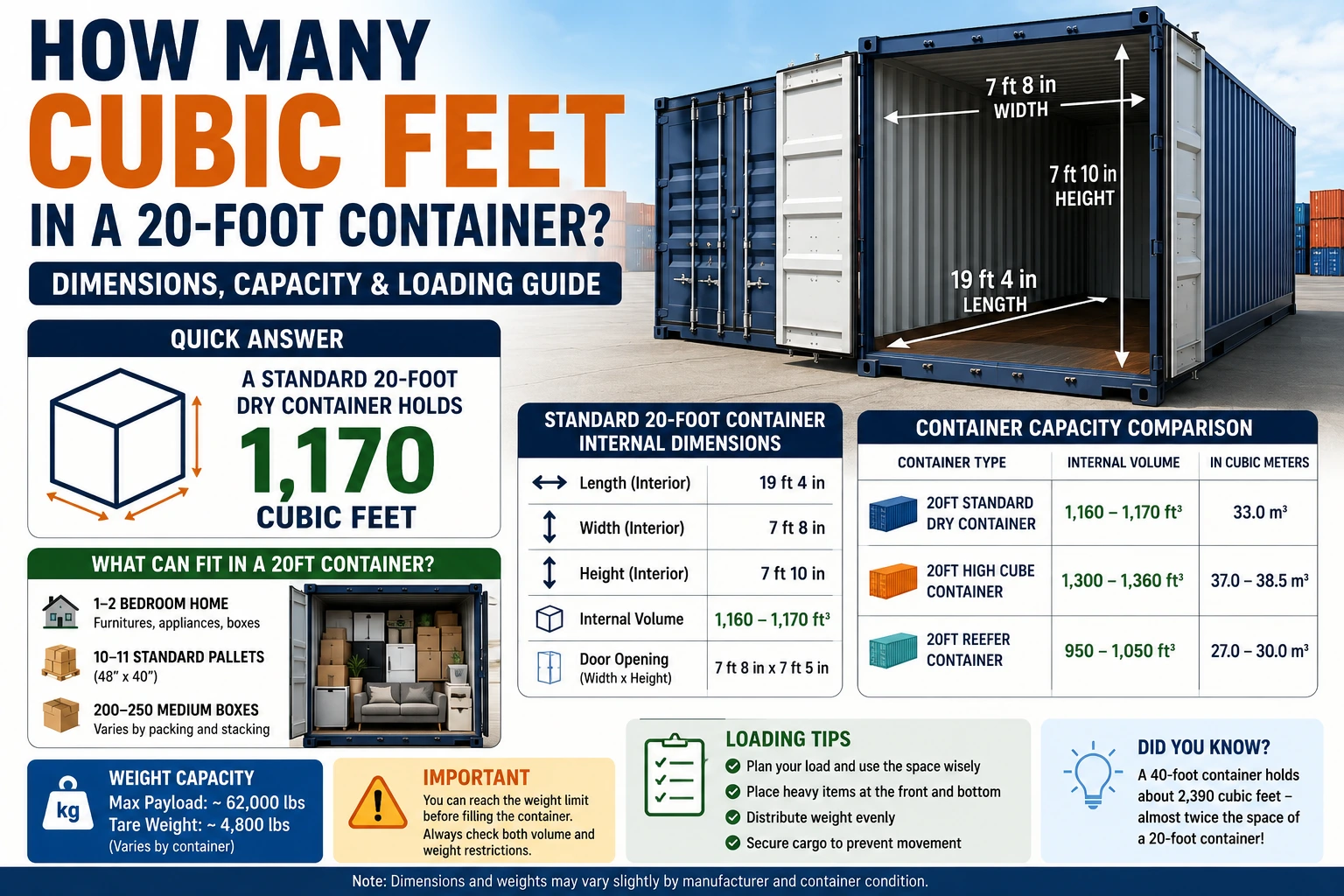
If you are planning a shipment, move, storage project, or import order, you may be asking how many cubic feet in a 20 foot container. A standard 20-foot shipping container holds approximately:
1,170 cubic feet
This number is based on the inside dimensions of a standard 20-foot dry container. Although the container is called “20 feet,” its usable interior length is slightly shorter because of the steel walls, doors, and frame.
Most standard 20-foot containers have an internal volume between:
1,160 and 1,175 cubic feet
The exact capacity can vary by manufacturer, container age, wall design, flooring thickness, and whether you are using a dry container, refrigerated container, or high-cube model.
For everyday planning, use this simple estimate:
A 20-foot shipping container holds about 1,170 cubic feet.
This guide explains container dimensions, volume calculations, weight limits, loading examples, and practical tips for using a 20-foot container efficiently.
Quick Answer: How Many Cubic Feet in a 20-Foot Container?
A standard 20-foot dry shipping container usually has:
| Measurement | Typical Size |
|---|---|
| Internal length | 19 ft 4 in |
| Internal width | 7 ft 8 in |
| Internal height | 7 ft 10 in |
| Approximate internal volume | 1,170 cubic feet |
| Maximum payload | Around 62,000 lb |
| Tare weight | Around 4,800 lb |
Therefore:
A 20-foot container has about 1,170 cubic feet of internal space.
This is the space inside the container. It does not include the exterior steel structure.
Standard 20-Foot Container Capacity
A standard 20-foot container is often called a:
- 20ft dry container
- 20ft GP container
- 20-foot general-purpose container
- 20-foot ISO container
It is one of the most common container sizes used for ocean freight, rail freight, road transport, temporary storage, and moving.
The usable volume is usually close to:
33 cubic meters
When converted to cubic feet:
33 cubic meters × 35.315 = about 1,165 cubic feet
That is why many shipping companies list the capacity as approximately 1,170 cubic feet.
Why Capacity Can Vary
Not every 20-foot container has identical internal measurements.
Capacity may vary because of:
- Container manufacturer
- Steel wall thickness
- Floor construction
- Door design
- Interior lining
- Refrigeration equipment
- High-cube design
- Damage or repairs inside the container
For example, a refrigerated container has insulation and cooling equipment inside. This reduces usable space compared with a standard dry container.
Always check the container specification sheet before planning a tight shipment.
Standard 20-Foot Container Internal Dimensions
The external length is close to 20 feet, but the inside is smaller.
| Container Area | Typical Internal Dimension |
|---|---|
| Length | 19 ft 4 in |
| Width | 7 ft 8 in |
| Height | 7 ft 10 in |
| Door width | 7 ft 8 in |
| Door height | 7 ft 5 in |
| Internal volume | About 1,170 cu ft |
These measurements are typical, not guaranteed. A specific container may differ by a few inches.
Length
The inside length is usually around:
19 feet 4 inches
This is shorter than 20 feet because the end walls and doors take up space.
Width
The internal width is usually:
7 feet 8 inches
This is important when loading pallets, furniture, machinery, or wide cartons.
Height
A standard dry container is usually:
7 feet 10 inches high inside
That is enough for many household items, boxes, furniture pieces, and standard cargo pallets.
Door Opening Size
The door opening is smaller than the internal space.
Typical door opening:
- Width: around 7 feet 8 inches
- Height: around 7 feet 5 inches
A large item may fit inside the container but still not fit through the doors. Always measure the item and the door opening.
How to Calculate How Many Cubic Feet in a 20-Foot Container
You can calculate volume using a simple formula.
Cubic Feet Formula
Length × Width × Height = Cubic Feet
Use feet for all measurements.
For a typical 20-foot container:
- Length: 19.33 feet
- Width: 7.67 feet
- Height: 7.83 feet
Calculation:
19.33 × 7.67 × 7.83 = approximately 1,160 cubic feet
The result may differ slightly from published specifications because manufacturers round dimensions differently.
For planning, use:
1,170 cubic feet
Step-by-Step Calculation
Step 1: Convert Inches to Feet
For example:
4 inches = 4 ÷ 12 = 0.33 feet
So:
19 feet 4 inches = 19.33 feet
Step 2: Multiply Length by Width
19.33 × 7.67 = 148.25 square feet
Step 3: Multiply by Height
148.25 × 7.83 = about 1,161 cubic feet
This is why the accepted estimate is around 1,160 to 1,170 cubic feet.
20-Foot Container Capacity Chart
| Container Type | Approx. Cubic Feet | Approx. Cubic Meters | Best Use |
|---|---|---|---|
| 20ft standard dry container | 1,160–1,170 cu ft | 33 cu m | General cargo and storage |
| 20ft high-cube container | 1,300–1,360 cu ft | 37–38.5 cu m | Taller, lighter cargo |
| 20ft refrigerated container | 950–1,050 cu ft | 27–30 cu m | Temperature-controlled goods |
| 20ft open-top container | Varies | Varies | Oversized cargo |
| 20ft flat rack | Open platform | N/A | Heavy or wide equipment |
A standard dry container is the most common choice for general shipping and storage.
How Much Can Fit in a 20-Foot Shipping Container?
Knowing the cubic feet is useful, but many people want to know what actually fits.
A 20-foot container can hold a large amount of cargo when packed properly.
Household Moving Examples
A 20-foot container may fit the contents of a small home or apartment.
It can often hold:
- A one- to two-bedroom household move
- Furniture from a small apartment
- Around 200 to 250 medium moving boxes
- Beds, sofas, tables, and appliances
- Office furniture and equipment
The actual amount depends on item size, packing method, and whether furniture can be stacked or disassembled.
Pallet Capacity
A standard 20-foot container can usually hold:
| Pallet Type | Typical Quantity |
|---|---|
| Standard U.S. pallets, 48 × 40 in | 10–11 pallets |
| Euro pallets, 120 × 80 cm | 11 pallets |
| Small pallets | More than 11, depending on layout |
Pallet height and cargo weight also matter. You may have enough floor space but not enough vertical space for tall pallets.
Furniture and Boxes
A 20-foot container works well for:
- Sofas
- Dining tables
- Chairs
- Mattresses
- Washing machines
- Refrigerators
- Packed boxes
- Business inventory
- Retail stock
However, awkward furniture can create empty spaces. Good loading technique can make a major difference.
Cubic Feet vs Weight Capacity
Volume is only one limit. Every container also has a maximum weight rating.
Maximum Payload
A typical 20-foot dry container may have a maximum payload of around:
62,000 pounds
However, actual legal road limits may be lower depending on:
- Country regulations
- Truck axle limits
- Port restrictions
- Cargo type
- Container chassis weight
Always confirm the permitted gross weight with your freight provider.
Why You Can Run Out of Weight Before Space
Heavy goods may reach the weight limit before filling the container.
Examples include:
- Tiles
- Stone
- Metal parts
- Machinery
- Books
- Cement products
- Bottled liquids
Light goods, such as clothing, pillows, plastic products, or furniture, may fill the cubic space before reaching the weight limit.
20-Foot Container vs 40-Foot Container
| Feature | 20-Foot Container | 40-Foot Container |
|---|---|---|
| Approx. volume | 1,170 cu ft | 2,390 cu ft |
| Internal length | About 19 ft 4 in | About 39 ft 5 in |
| Internal width | About 7 ft 8 in | About 7 ft 8 in |
| Internal height | About 7 ft 10 in | About 7 ft 10 in |
| Best for | Dense or smaller shipments | Larger-volume shipments |
| Common cargo | Machinery, boxes, pallets | Furniture, retail stock, light cargo |
A 40-foot container has roughly twice the volume of a 20-foot container. However, it may not be the best choice for dense cargo because weight limits can become an issue.
Common Uses for a 20-Foot Container
A 20-foot container is popular because it is compact, strong, and easy to transport.
Common uses include:
- International shipping
- Warehouse overflow storage
- Construction-site storage
- Moving household goods
- Retail inventory storage
- Equipment storage
- Temporary workshops
- Small container offices
- Farm storage
- Disaster-relief supply storage
Its smaller footprint also makes it easier to place on many properties than a 40-foot container.
Factors That Affect Usable Container Space
The stated volume is not always the same as practical usable space.
Packaging Shape
Square cartons stack efficiently. Odd-shaped items leave gaps.
Pallet Size
Pallets can waste space if they do not match the container width.
Loading Equipment
Forklifts, pallet jacks, and ramps may affect how cargo is positioned.
Cargo Restrictions
Some items need airflow, bracing, insulation, or separation.
Safety Space
Leave enough room to secure cargo and prevent movement during transport.
Common Mistakes When Estimating 20ft Container Capacity
Assuming the Outside Dimensions Are the Inside Dimensions
A 20-foot container is not 20 feet of usable interior length.
Ignoring Door Measurements
A large item may fit inside but not through the door opening.
Calculating Volume but Ignoring Weight
Heavy cargo can exceed the payload before the container is full.
Forgetting Packing Materials
Pallets, dunnage, straps, blankets, and bracing take up space.
Loading Without a Plan
Poor loading can waste a large portion of the container.
Expert Tips for Loading a 20-Foot Container
- Create a loading plan before cargo arrives.
- Measure every oversized item.
- Place heavy cargo low and near the front.
- Spread weight evenly from side to side.
- Use pallets when they improve handling and stability.
- Fill gaps with smaller boxes or approved dunnage.
- Secure cargo with straps, blocking, and bracing.
- Keep a clear path while loading.
- Confirm both volume and weight limits.
- Check door clearance before moving large items inside.
FAQs
1. How many cubic feet in a 20 foot container?
A standard 20-foot dry shipping container holds approximately 1,160 to 1,170 cubic feet.
2. How many cubic meters is a 20-foot container?
A standard 20-foot container holds around 33 cubic meters.
3. How many pallets fit in a 20-foot container?
A 20-foot container usually fits around 10 to 11 standard U.S. pallets, depending on pallet size and loading layout.
4. Can a 20-foot container hold a two-bedroom house?
In many cases, yes. A 20-foot container can often hold the contents of a small one- or two-bedroom home, depending on furniture size and packing method.
5. Is a 20-foot container exactly 20 feet inside?
No. The interior length is usually around 19 feet 4 inches, because the walls and doors reduce usable space.
Conclusion
If you are asking how many cubic feet in a 20 foot container, a standard dry shipping container holds about 1,170 cubic feet of usable interior space. Most models range from around 1,160 to 1,175 cubic feet, depending on the manufacturer and container design.
That capacity is suitable for household moves, business inventory, pallets, equipment, and general freight. Before loading, remember to check internal dimensions, door opening size, cargo weight, and packing requirements. By planning around both volume and payload, you can use a 20-foot container safely and efficiently.
Discover more