

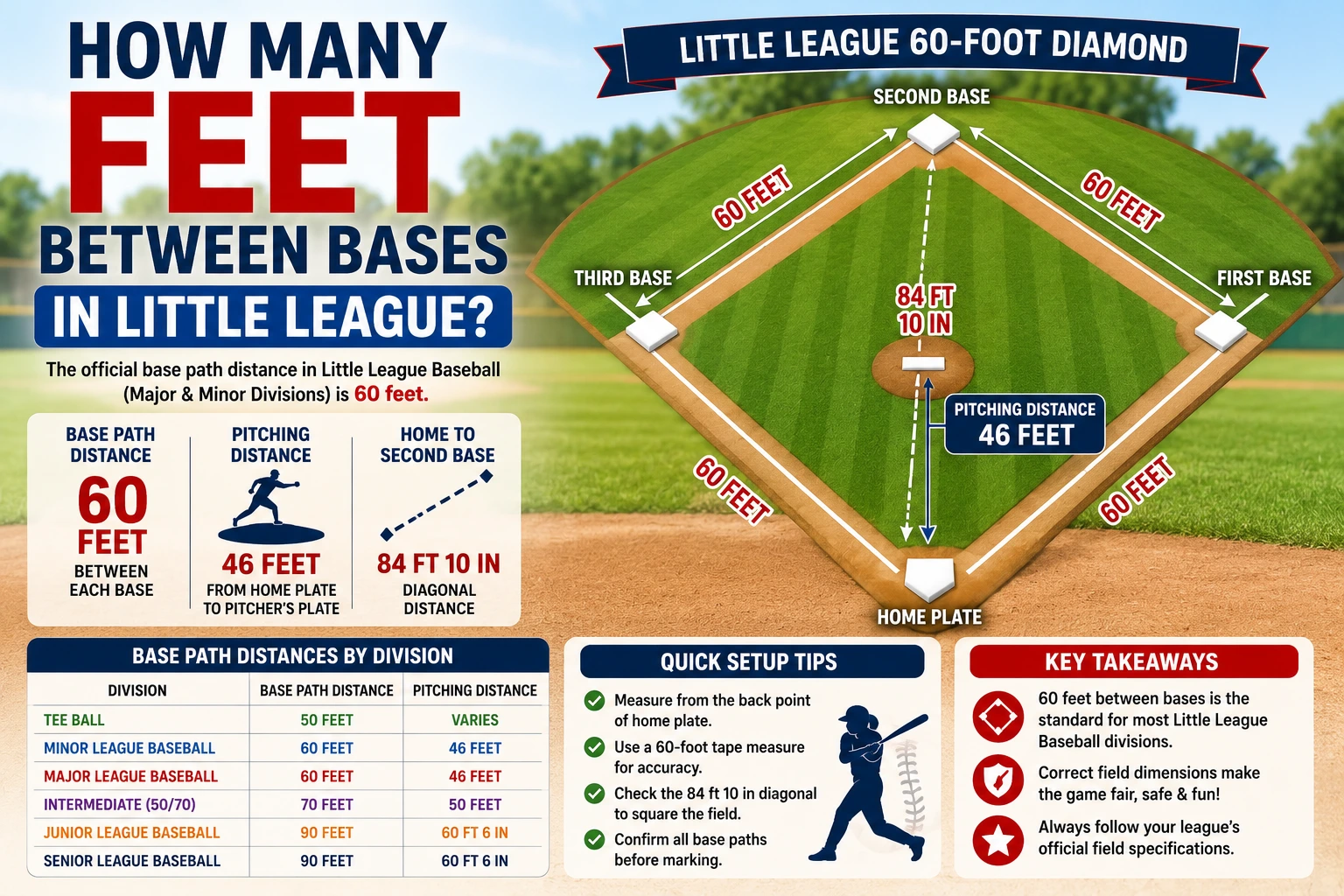
If you are asking how many feet between bases in Little League, the standard answer for most Little League Baseball divisions is:
60 feet between each base
This means the distance from home plate to first base is 60 feet. The same 60-foot distance applies from first base to second base, second base to third base, and third base back to home plate.
A standard Little League Baseball field for players age 12 and under uses a 60-foot diamond. The pitching distance is usually 46 feet, measured from the back point of home plate to the front edge of the pitcher’s plate.
However, not every Little League division uses the same base-path distance. Tee Ball may use a smaller diamond, while Intermediate, Junior, and Senior League Baseball can use larger base paths. This guide explains the official measurements, field layout, pitching distance, and simple setup steps.
Quick Answer: How Many Feet Between Bases in Little League?
For standard Little League Baseball:
| Field Measurement | Distance |
|---|---|
| Home plate to first base | 60 feet |
| First base to second base | 60 feet |
| Second base to third base | 60 feet |
| Third base to home plate | 60 feet |
| Home plate to second base | About 84 feet 10 inches |
| Pitching distance | 46 feet |
So, the answer is simple:
There are 60 feet between bases in Little League Baseball.
For baseball divisions serving players age 12 and below, Little League generally uses 60-foot base paths. Local leagues may use a 50-foot diamond in Tee Ball.
Understanding the Little League 60-Foot Diamond
A baseball diamond is a square. Each corner of the square is marked by a base:
- Home plate
- First base
- Second base
- Third base
Each side of that square is called a base path.
What Is a Base Path?
A base path is the distance between two bases.
On a standard Little League diamond:
1 base path = 60 feet
Since there are four sides around the diamond:
60 + 60 + 60 + 60 = 240 feet
That means a runner who completes a home run travels 240 feet around the base paths.
Why the Distance Matters
Correct base distances help keep youth baseball fair and safe.
A 60-foot diamond is designed to suit younger players because it:
- Makes running distances manageable
- Gives fielders a fair chance to make plays
- Matches pitching and hitting development
- Helps reduce unsafe throws over long distances
- Keeps games moving at an age-appropriate pace
A larger diamond can make it too difficult for younger players. A smaller diamond can make the game too easy for older or more advanced players.
How Many Feet Between Bases in Little League Baseball by Division
The phrase “Little League” can refer to several divisions. The base distance changes as players get older.
Tee Ball
Tee Ball is designed for young players who are learning the basics of hitting, throwing, and running.
Many Tee Ball fields use:
- 50-foot base paths, depending on local league rules
- Smaller outfields
- Simplified field layouts
A local Little League board may choose a 50-foot diamond for Tee Ball.
Minor League and Major Division
Minor League and Major Division Baseball commonly use:
- 60 feet between bases
- 46 feet from home plate to the pitcher’s plate
This is the standard 60/46 Little League field layout.
Intermediate 50/70 Division
Intermediate Baseball helps players transition toward a full-size baseball field.
It uses:
- 70-foot base paths
- 50-foot pitching distance for regular-season play options in some cases
The name “50/70” refers to the 50-foot pitching distance and 70-foot base paths used in this division.
Junior and Senior League Baseball
Junior and Senior League Baseball generally use a conventional baseball field with:
- 90 feet between bases
- 60 feet 6 inches pitching distance
These divisions serve older players and use dimensions closer to high school, college, and professional baseball.
Little League Field Dimensions Chart
| Division | Distance Between Bases | Pitching Distance | Typical Use |
|---|---|---|---|
| Tee Ball | 50 or 60 ft | Varies locally | Beginning players |
| Minor League Baseball | 60 ft | 46 ft | Youth baseball |
| Little League Major Division | 60 ft | 46 ft | Ages 9–12 |
| Intermediate 50/70 | 70 ft | 50 ft | Transition division |
| Junior League Baseball | 90 ft | 60 ft 6 in | Ages 12–14 |
| Senior League Baseball | 90 ft | 60 ft 6 in | Ages 13–16 |
For softball, base paths are generally 60 feet across Little League divisions, although pitching distance changes by division.
Distance From Home Plate to Each Base
On a 60-foot diamond, each side of the infield square measures 60 feet.
Home Plate to First Base
The distance from the back point of home plate to the back edge of first base is:
60 feet
This is the path a batter-runner takes after hitting the ball.
First Base to Second Base
The distance from first base to second base is:
60 feet
This is the base path used during steals, double plays, and runners advancing.
Second Base to Third Base
Second base to third base is also:
60 feet
Third Base to Home Plate
The distance from third base back to home plate is:
60 feet
This completes the diamond.
Little League Pitching Distance Explained
Base-path distance and pitching distance are different measurements.
For standard Little League Baseball Major and Minor Divisions:
- Bases are 60 feet apart
- The pitcher’s plate is 46 feet from home plate
The pitching distance is measured from the back point of home plate to the front edge of the pitcher’s plate.
This shorter pitching distance gives young pitchers a realistic chance to reach the plate while helping batters see and react to pitches.
Do not measure the pitching distance from the center of home plate or the center of the mound. That creates an incorrect setup.
How to Set Up a 60-Foot Little League Diamond
You can set up a youth baseball diamond with a tape measure, string, marking paint, and base anchors.
Tools You Need
Gather:
- 100-foot measuring tape
- Stakes or cones
- String line
- Marking paint or chalk
- Hammer or mallet
- Base anchors
- Field layout diagram
Step 1: Mark Home Plate
Choose the back point of home plate as your starting point.
This point is important because official field measurements begin there.
Step 2: Measure to First and Third Base
From the back point of home plate:
- Measure 60 feet toward first base
- Measure 60 feet toward third base
Place temporary stakes at both points.
Step 3: Find Second Base
Second base should be exactly 60 feet from first base and 60 feet from third base.
A simple method is to use two 60-foot strings:
- One from first base
- One from third base
Where the strings meet is the center location for second base.
Step 4: Check the Home-to-Second Diagonal
On a 60-foot square, the distance from home plate to second base is approximately:
84 feet 10 inches
This diagonal check helps confirm that the diamond is square.
The exact calculation is:
60 × 1.414 = 84.84 feet
That is about:
84 feet 10 inches
Step 5: Set the Pitcher’s Plate
Measure 46 feet from the back point of home plate toward second base.
Place the front edge of the pitcher’s plate at that 46-foot mark.
Why Some Little League Fields Use Different Base Distances
Not every youth field uses 60 feet between bases because players develop at different speeds and skill levels.
A league may use different measurements because of:
- Player age
- Skill level
- Division rules
- Available field space
- Local league options
- Tournament requirements
- Whether the game is baseball or softball
Always confirm the correct division rules before setting up a field for a game or tournament.
For example, a 12-year-old may play in either a 60-foot Major Division setting or a larger Intermediate 50/70 setting, depending on league structure and eligibility.
Little League vs High School vs Major League Baseball
| Level | Base Path Distance | Pitching Distance |
|---|---|---|
| Tee Ball | 50–60 ft | Varies |
| Little League Major | 60 ft | 46 ft |
| Intermediate 50/70 | 70 ft | 50 ft |
| High school baseball | 90 ft | 60 ft 6 in |
| College baseball | 90 ft | 60 ft 6 in |
| Professional baseball | 90 ft | 60 ft 6 in |
The move from 60 feet to 90 feet is a major step for developing players. It adds 30 feet to every base path and increases the total distance around the diamond from 240 feet to 360 feet.
Common Field Setup Mistakes
Measuring From the Wrong Part of Home Plate
Use the back point of home plate, not the front edge.
Measuring to the Wrong Part of a Base
For accurate setup, measurements generally run to the proper base edge or anchor position based on the field layout.
Forgetting to Square the Diamond
If the home-to-second measurement is wrong, the field can look normal but still be uneven.
Using a 90-Foot Layout for Younger Players
A full-size baseball diamond is not suitable for standard Little League Major Division play.
Mixing Pitching and Base Measurements
Remember:
- Standard Little League bases: 60 feet
- Standard Little League pitching distance: 46 feet
Expert Tips for Accurate Little League Field Measurements
- Use a long tape measure instead of guessing with steps.
- Measure from the back point of home plate every time.
- Confirm the 84-foot-10-inch home-to-second diagonal.
- Check each base path before anchoring bases.
- Use temporary stakes before painting lines.
- Review the league’s division rules before game day.
- Recheck the pitching rubber after dragging or repairing the infield.
- Keep a field layout guide with the equipment.
FAQs
1. How many feet are between bases in Little League?
For standard Little League Baseball, the distance between bases is 60 feet.
2. How far is home plate to second base in Little League?
On a 60-foot Little League diamond, home plate to second base is approximately 84 feet 10 inches.
3. How far is the Little League pitcher’s mound from home plate?
For Major and Minor League Baseball, the pitcher’s plate is 46 feet from the back point of home plate.
4. Are all Little League fields 60 feet between bases?
No. Most standard divisions for players age 12 and under use 60-foot base paths, but Tee Ball may use 50 feet, Intermediate uses 70 feet, and Junior/Senior League Baseball uses 90 feet.
5. How many feet does a player run for a Little League home run?
A player runs 60 feet between each of four bases, for a total of 240 feet around the base paths.
Conclusion
The answer to how many feet between bases in Little League is usually 60 feet. Standard Little League Baseball uses a 60-foot diamond for most players age 12 and under, with a pitching distance of 46 feet.
However, it is important to check the division before setting up a field. Tee Ball can use 50-foot base paths, Intermediate Baseball uses 70 feet, and Junior and Senior League Baseball use the standard 90-foot diamond. Using the right measurements creates a safer, fairer, and more enjoyable game for every young player.
Discover more