

If you’re planning a sealing or renovation project, one of the first questions you’ll likely ask is how many feet does a tube of caulk cover. Whether you’re sealing a bathtub, installing windows, weatherproofing doors, or filling expansion joints, knowing the coverage of a tube of caulk helps prevent waste and ensures you buy the correct amount.
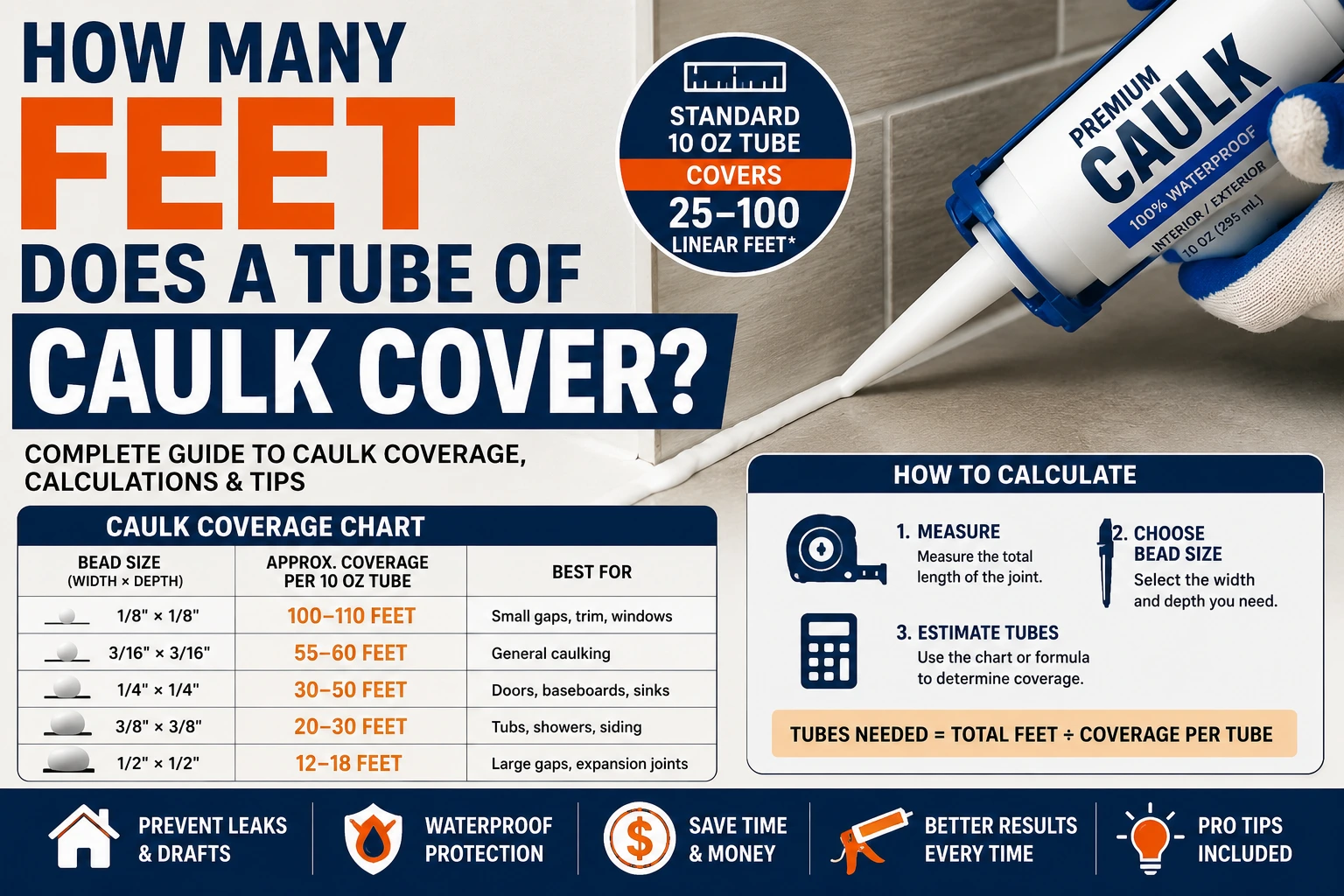
The answer depends largely on the size of the bead you apply. A standard 10-ounce tube of caulk can cover anywhere from 25 to 100 linear feet, depending on the width and depth of the joint.
For example:
- A small 1/8-inch bead may cover over 100 feet.
- A 1/4-inch bead often covers around 50 feet.
- A larger 3/8-inch bead may cover closer to 25 feet.
This guide explains coverage calculations, practical examples, charts, and professional tips so you can estimate caulk needs accurately.
Quick Answer
For a standard 10-ounce tube:
| Bead Size | Approximate Coverage |
|---|---|
| 1/8″ × 1/8″ | 100–110 feet |
| 3/16″ × 3/16″ | 55–60 feet |
| 1/4″ × 1/4″ | 30–50 feet |
| 3/8″ × 3/8″ | 20–30 feet |
| 1/2″ × 1/2″ | 12–18 feet |
Most household projects use a 1/4-inch bead, making 40–50 linear feet per tube a common estimate.
Understanding Caulk Coverage
Before calculating coverage, it’s important to understand what affects it.
What Determines Coverage?
Several factors influence how many feet a tube of caulk can cover:
- Joint width
- Joint depth
- Type of caulk
- Application technique
- Surface condition
- Amount of waste
The larger the bead, the less distance a tube can cover.
Why Bead Size Matters
A bead is the line of caulk applied to a joint or gap.
Think of squeezing toothpaste from a tube.
A thin line stretches farther than a thick line.
The same principle applies to caulk.
Example
A tube applied at:
- 1/8-inch width may cover over 100 feet.
The same tube applied at:
- 1/2-inch width may cover only 15 feet.
This is why bead dimensions are critical for accurate estimates.
How Many Feet Does a Tube of Caulk Cover?
Most manufacturers base coverage on a standard 10-ounce tube.
The average coverage ranges include:
| Joint Size | Linear Feet |
|---|---|
| 1/8″ × 1/8″ | 104 feet |
| 3/16″ × 3/16″ | 58 feet |
| 1/4″ × 1/4″ | 31 feet |
| 3/8″ × 3/8″ | 14 feet |
| 1/2″ × 1/2″ | 8 feet |
As bead size increases, coverage decreases significantly.
Coverage Formula
Professionals often estimate caulk coverage using manufacturer charts.
A simplified approach is:
Tube Coverage = Tube Volume ÷ Joint Volume
Since most homeowners don’t calculate cubic inches manually, using coverage charts is typically easier and more accurate.
Caulk Coverage Chart by Bead Size
The following chart provides quick estimates for a standard 10-ounce tube.
| Width | Depth | Approximate Coverage |
|---|---|---|
| 1/8″ | 1/8″ | 104 feet |
| 3/16″ | 3/16″ | 58 feet |
| 1/4″ | 1/4″ | 31 feet |
| 1/4″ | 3/8″ | 21 feet |
| 3/8″ | 3/8″ | 14 feet |
| 1/2″ | 1/2″ | 8 feet |
This chart can help estimate how many tubes you’ll need before starting a project.
How to Calculate Caulk Coverage for Any Project
Calculating caulk requirements is easier than many people think.
Step 1: Measure the Joint Length
Use a tape measure to determine the total length requiring caulk.
Example:
- Window perimeter = 20 feet
- Door frame = 18 feet
Total:
38 feet
Step 2: Determine Joint Size
Measure:
- Width
- Depth
Example:
- Width = 1/4 inch
- Depth = 1/4 inch
Step 3: Compare to Coverage Chart
A 1/4″ × 1/4″ bead covers roughly:
31 feet per tube
For a 38-foot project:
38 ÷ 31 = 1.23
You’ll need:
2 tubes
Always round up.
Common Caulking Projects and Coverage Examples
Different projects require different amounts of caulk.
Bathtub Installation
Typical tub perimeter:
15–20 feet
Coverage needed:
Less than one tube of standard silicone caulk.
Window Sealing
Average window:
12–20 feet of perimeter
One tube can often seal two to three windows.
Door Frames
Most doors require:
15–18 feet of caulking
One tube usually handles multiple doors.
Kitchen Backsplash
Average backsplash:
20–30 feet of joints
One tube is generally sufficient.
Expansion Joints
Larger construction joints consume significantly more material.
These projects often require several tubes.
Silicone vs Acrylic Caulk Coverage
Many homeowners wonder whether coverage changes by caulk type.
Silicone Caulk
Advantages:
- Waterproof
- Flexible
- Durable
- Ideal for bathrooms and kitchens
Coverage:
Similar to acrylic caulk when applied at the same bead size.
Acrylic Latex Caulk
Advantages:
- Easy cleanup
- Paintable
- Affordable
Coverage:
Comparable to silicone.
The primary difference is performance, not coverage.
Factors That Affect Caulk Usage
Coverage estimates are only guidelines.
Several real-world factors may increase or decrease usage.
Uneven Surfaces
Rough materials absorb more caulk.
Examples:
- Brick
- Stone
- Textured siding
Wasted Material
Beginners often waste caulk through:
- Over-application
- Excess smoothing
- Incorrect nozzle cuts
Joint Depth
Deep joints require significantly more product.
Backer rods can reduce caulk usage in larger gaps.
Temperature
Very cold temperatures can affect flow and application consistency.
Benefits of Accurate Coverage Estimates
Knowing coverage before shopping provides several advantages.
Saves Money
Avoid buying unnecessary tubes.
Prevents Delays
Running out of caulk mid-project can slow progress.
Reduces Waste
Unused tubes often dry out before future use.
Improves Planning
Accurate estimates create smoother project timelines.
Common Mistakes When Estimating Caulk
Many DIYers underestimate how much caulk they need.
Ignoring Joint Depth
Depth affects volume just as much as width.
Buying Exactly the Required Amount
Always purchase one extra tube for unexpected needs.
Cutting the Nozzle Too Large
A larger opening produces thicker beads and wastes material.
Not Measuring First
Guessing coverage often results in material shortages.
Expert Tips for Maximizing Caulk Coverage
Professionals use several strategies to increase efficiency.
Use Backer Rods
For gaps wider than 1/4 inch:
- Install backer rods first.
- Reduce caulk consumption.
- Improve flexibility.
Cut the Nozzle Carefully
Start with a small opening.
You can always enlarge it later.
Apply Consistent Pressure
Uneven pressure causes wasted material.
Smooth, controlled application improves coverage.
Practice on Scrap Material
Beginners can improve bead consistency before starting the actual project.
Keep Extra Tubes
Unused sealed tubes can be stored for future repairs.
Real-World Coverage Examples
Example 1: Bathroom Caulking
Tub perimeter:
18 feet
Bead size:
1/4″ × 1/4″
Coverage:
31 feet per tube
Result:
1 tube sufficient
Example 2: Three Windows
Total perimeter:
54 feet
Coverage:
58 feet per tube at 3/16″
Result:
1 tube may be enough
Buying 2 tubes is safer.
Example 3: Garage Expansion Joint
Length:
40 feet
Joint:
3/8″ × 3/8″
Coverage:
14 feet per tube
Result:
3 tubes required
Frequently Asked Questions
1. How many feet does a standard 10 oz tube of caulk cover?
A standard tube typically covers between 25 and 100 linear feet, depending on bead size.
2. How many feet does a tube of caulk cover with a 1/4-inch bead?
Most 10-ounce tubes cover approximately 30–50 linear feet when applying a 1/4-inch bead.
3. Does silicone caulk cover more than acrylic caulk?
Coverage is generally similar. Bead dimensions affect coverage more than caulk type.
4. How many tubes of caulk do I need for a bathtub?
Most bathtub installations require less than one tube, though purchasing two tubes is recommended.
5. Can I reduce caulk usage in large joints?
Yes. Using a backer rod reduces the amount of caulk needed and improves performance.
Conclusion
If you’re wondering how many feet does a tube of caulk cover, the answer depends primarily on bead width and depth. A standard 10-ounce tube can cover anywhere from 25 to over 100 linear feet, with most common household applications averaging 30 to 50 feet per tube.
Understanding how many feet does a tube of caulk cover allows you to estimate projects accurately, reduce waste, save money, and avoid interruptions during installation. By measuring joints carefully, using coverage charts, and applying professional techniques, you can ensure a clean, durable, and efficient caulking job every time.
Discover more