
If you’re planning a construction project, one of the most common questions is: how many square feet is 1000 bricks?
Whether you’re building a garden wall, house facade, garage, or decorative structure, knowing the coverage area of 1,000 bricks helps you estimate materials, labor, and project costs more accurately.
The short answer is that 1,000 standard modular bricks typically cover about 250 to 300 square feet of wall area, depending on the brick size, mortar joints, and wall design.
However, the exact number can vary. In this guide, we’ll explain how brick coverage works, show the formulas used by professionals, and provide practical examples you can use for your own project.
Quick Answer
For standard modular bricks used in the United States:
| Brick Quantity | Approximate Coverage |
|---|---|
| 100 bricks | 25–30 sq ft |
| 500 bricks | 125–150 sq ft |
| 1,000 bricks | 250–300 sq ft |
| 1,500 bricks | 375–450 sq ft |
| 2,000 bricks | 500–600 sq ft |
As a general rule:
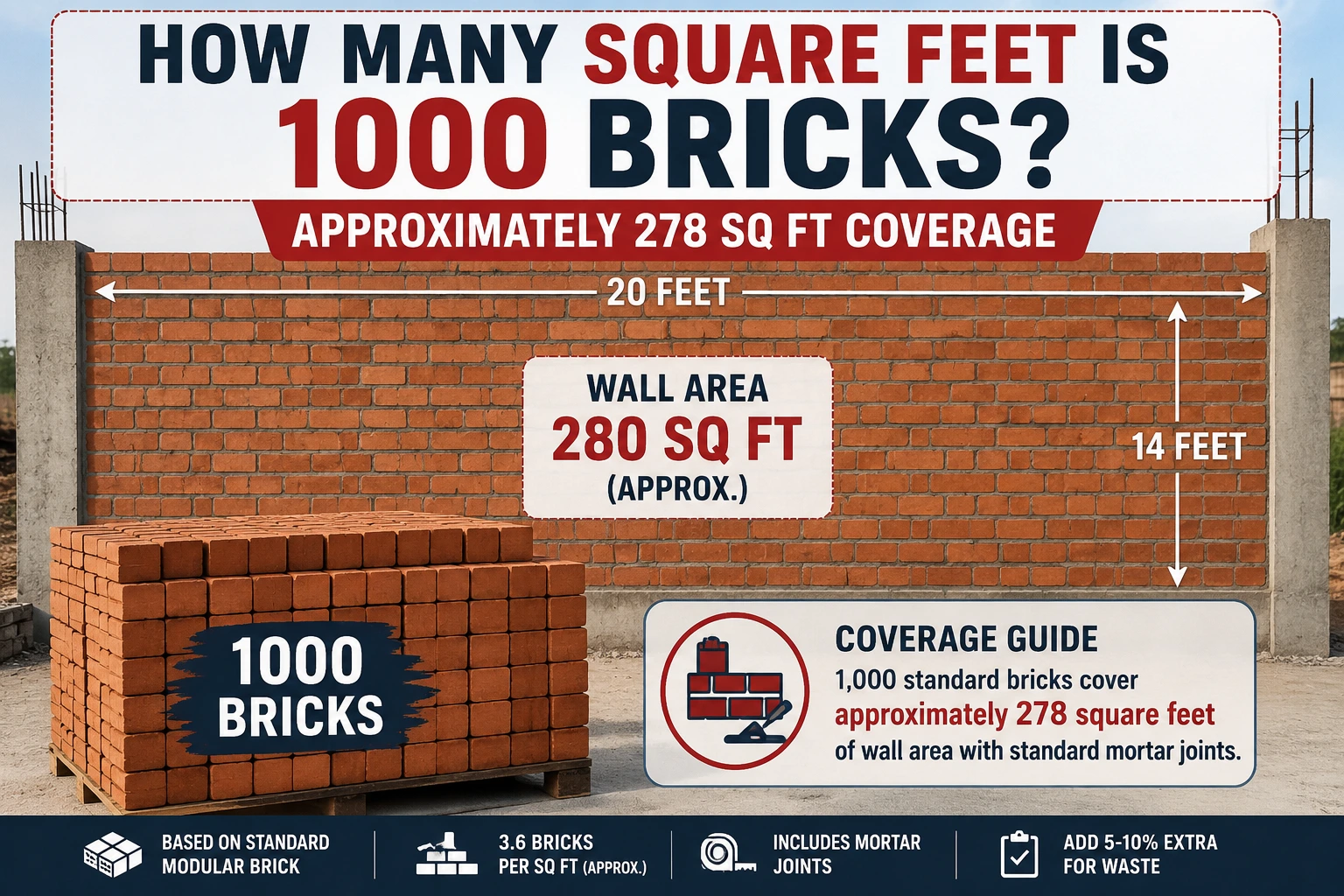
1,000 standard bricks cover approximately 278 square feet of single-layer wall area.
This estimate assumes standard brick dimensions and typical mortar joints.
Understanding Brick Coverage
Before calculating wall area, it’s important to understand how brick coverage is measured.
Brick coverage refers to the visible wall surface that a specific number of bricks can cover after installation.
Builders usually estimate brick quantities based on:
- Brick dimensions
- Mortar joint thickness
- Wall thickness
- Construction method
- Waste allowance
Standard Brick Dimensions
A common modular brick measures approximately:
- Length: 7.625 inches
- Height: 2.25 inches
- Width: 3.625 inches
When mortar joints are included, the installed dimensions become larger.
Most calculations assume:
- 3/8-inch mortar joints
- Standard running bond pattern
- Single-wythe wall construction
Why Mortar Matters
Many people calculate using brick dimensions alone and forget mortar joints.
Mortar creates spacing between bricks, which increases the total area each brick covers.
As a result:
- Fewer bricks may be required
- Total wall coverage increases slightly
- Material estimates become more accurate
How Many Square Feet Is 1000 Bricks for Different Brick Sizes?
Not all bricks are identical. Different brick sizes can significantly change coverage.
Standard Modular Bricks
Most residential projects use modular bricks.
Coverage estimate:
- Approximately 3.6 bricks per square foot
Calculation:
1000 ÷ 3.6 = 277.8 square feet
Coverage: About 278 square feet
Queen Bricks
Queen bricks are slightly longer.
Coverage estimate:
- Around 3.1 bricks per square foot
Calculation:
1000 ÷ 3.1 = 322.6 square feet
Coverage: About 323 square feet
King Bricks
King bricks are larger and cover more area.
Coverage estimate:
- Around 2.7 bricks per square foot
Calculation:
1000 ÷ 2.7 = 370.4 square feet
Coverage: About 370 square feet
Comparison Table
| Brick Type | Bricks per Sq Ft | Coverage of 1000 Bricks |
|---|---|---|
| Modular | 3.6 | 278 sq ft |
| Queen | 3.1 | 323 sq ft |
| King | 2.7 | 370 sq ft |
Formula for Calculating Brick Coverage
Professionals use a simple formula:
Coverage Area = Number of Bricks ÷ Bricks Per Square Foot
For standard modular bricks:
Coverage Area = 1000 ÷ 3.6
Result:
Coverage Area = 277.8 square feet
Step-by-Step Calculation
Let’s walk through it.
Step 1: Determine Brick Type
Assume standard modular brick.
Step 2: Find Coverage Rate
Standard brick requirement:
3.6 bricks per square foot.
Step 3: Divide Total Bricks
1000 ÷ 3.6 = 277.8
Step 4: Round for Practical Use
Most contractors round to:
275–280 square feet
Step 5: Add Waste Factor
Include 5–10% extra bricks for:
- Breakage
- Cutting
- Transportation damage
- Future repairs
Coverage Chart for Common Brick Quantities
This chart helps estimate wall area quickly.
| Number of Bricks | Approximate Coverage |
|---|---|
| 100 | 28 sq ft |
| 250 | 69 sq ft |
| 500 | 139 sq ft |
| 750 | 208 sq ft |
| 1000 | 278 sq ft |
| 1250 | 347 sq ft |
| 1500 | 417 sq ft |
| 2000 | 556 sq ft |
| 3000 | 833 sq ft |
These figures assume standard modular bricks.
Real-World Examples
Understanding actual construction scenarios makes calculations easier.
Garden Wall
Suppose you want to build a garden wall:
- Length: 40 feet
- Height: 7 feet
Wall area:
40 × 7 = 280 square feet
You would need approximately:
1,000 standard bricks
This is one of the most common examples when asking how many square feet is 1000 bricks.
House Exterior Wall
Imagine a house wall measuring:
- Width: 35 feet
- Height: 8 feet
Calculation:
35 × 8 = 280 square feet
Again, approximately 1,000 bricks would be required.
Garage Wall
A detached garage wall:
- Width: 28 feet
- Height: 10 feet
Area:
28 × 10 = 280 square feet
Estimated requirement:
Around 1,000 modular bricks
Factors That Affect How Many Square Feet Is 1000 Bricks
Several variables can change coverage significantly.
Mortar Joint Thickness
Thicker joints increase coverage.
Common mortar sizes:
- 1/4 inch
- 3/8 inch
- 1/2 inch
Larger joints reduce the total number of bricks needed per square foot.
Brick Size Variations
Brick sizes vary between manufacturers and regions.
Examples include:
- Modular bricks
- Utility bricks
- Queen bricks
- King bricks
Larger bricks cover more area.
Waste and Breakage
Professional estimators always include waste.
Typical allowances:
| Project Type | Waste Factor |
|---|---|
| Small DIY Projects | 10% |
| Residential Construction | 5–10% |
| Commercial Projects | 3–5% |
For 1,000 required bricks, ordering 1,050–1,100 bricks is often recommended.
Wall Openings
Doors and windows reduce brick requirements.
For example:
Wall area = 300 sq ft
Window area = 20 sq ft
Actual brick area:
300 − 20 = 280 sq ft
This adjustment prevents overordering materials.
Common Mistakes When Estimating Brick Coverage
Many people make estimation errors that lead to higher costs.
Ignoring Mortar Joints
Bricks are rarely installed edge-to-edge.
Always account for mortar spacing.
Using Wrong Brick Dimensions
Not all bricks are standard modular bricks.
Verify measurements before calculating.
Forgetting Waste Allowance
Damaged bricks are common on construction sites.
Always order extras.
Ignoring Openings
Doors, windows, and vents reduce brick quantity requirements.
Mixing Measurement Units
Using inches for one measurement and feet for another often causes inaccurate estimates.
Keep units consistent.
Expert Tips for Accurate Brick Estimation
Professional masons use several best practices.
Measure Twice
Double-check wall dimensions before ordering materials.
Know Your Brick Type
Request exact specifications from suppliers.
Add a Safety Margin
Order at least 5–10% extra bricks.
Consider Future Repairs
Keeping spare matching bricks can save money later.
Use Professional Estimation Software
Large projects benefit from digital quantity takeoff tools.
How Many Square Feet Is 1000 Bricks Compared to Other Quantities?
Here’s a quick comparison.
| Bricks | Approximate Coverage |
|---|---|
| 250 | 69 sq ft |
| 500 | 139 sq ft |
| 750 | 208 sq ft |
| 1000 | 278 sq ft |
| 1250 | 347 sq ft |
| 1500 | 417 sq ft |
| 2000 | 556 sq ft |
This table is useful when scaling construction projects up or down.
FAQs
1. How many square feet will 1000 standard bricks cover?
Approximately 278 square feet when using standard modular bricks and typical mortar joints.
2. How many bricks are needed for 100 square feet?
Most projects require around 360 standard bricks for 100 square feet of wall area.
3. Does brick size affect coverage?
Yes. Larger bricks such as queen or king bricks cover more area and reduce the number of bricks needed per square foot.
4. Should I order extra bricks?
Yes. Most contractors recommend ordering 5–10% extra to account for breakage, cutting, and future repairs.
5. How do I calculate brick coverage for my wall?
Measure wall area in square feet and divide by the brick coverage rate. For standard bricks, use approximately 3.6 bricks per square foot.
Conclusion
So, how many square feet is 1000 bricks? For most construction projects using standard modular bricks, 1,000 bricks will cover approximately 275 to 280 square feet of wall area, with 278 square feet being a commonly accepted estimate.
The exact coverage depends on brick size, mortar joint thickness, wall openings, and waste allowances. By understanding these factors and using proper calculations, you can estimate materials more accurately, avoid costly mistakes, and plan your masonry project with confidence. Whether you’re building a garden wall, home exterior, or garage, knowing how many square feet 1,000 bricks can cover is an essential step in successful project planning
discover more
cubic yard equals how many cubic feet