

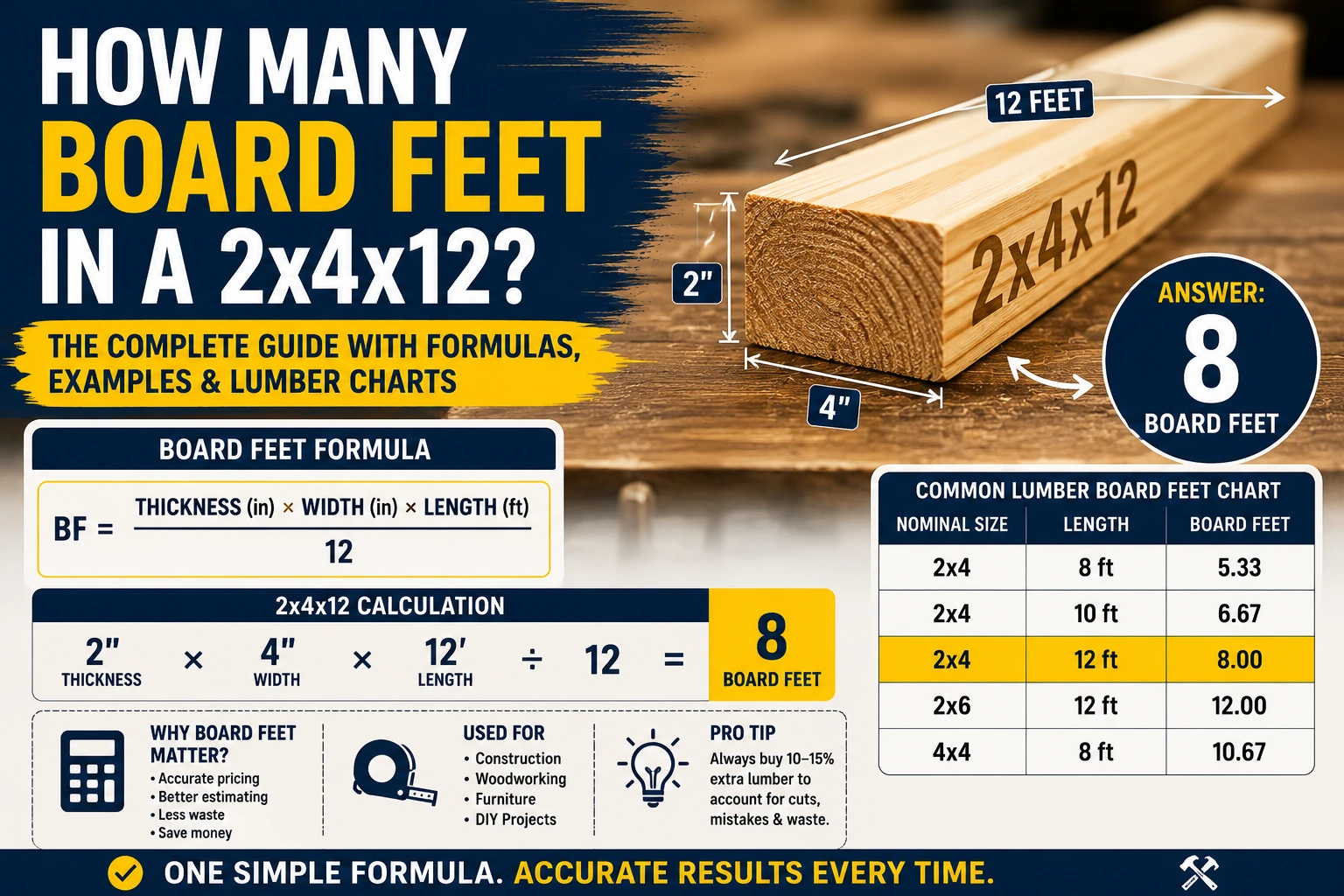
If you work with lumber, construction materials, or woodworking projects, you may ask: “How many board feet in a 2x4x12?”
The answer is:
2×4×12÷12=8 board feet
So:
- A 2x4x12 contains 8 board feet.
Understanding board foot calculations is important for:
- Estimating lumber costs
- Planning woodworking projects
- Buying the correct amount of wood
- Reducing material waste
In this complete guide, you will learn how board feet work, how to calculate lumber volume, common mistakes, real-world examples, and expert woodworking tips.
Understanding Board Feet
Before solving “how many board feet in a 2x4x12,” it helps to understand what a board foot actually means.
What Is a Board Foot?
A board foot is a unit of wood measurement used in:
- Lumber yards
- Carpentry
- Construction
- Sawmills
- Woodworking shops
One board foot equals:
1 inch thick×12 inches wide×12 inches long
In simpler terms:
- 144 cubic inches of wood = 1 board foot
Why Board Feet Matter
Board feet help standardize lumber measurements.
This allows:
- Accurate pricing
- Easier estimating
- Consistent project planning
Instead of guessing wood volume, professionals use board feet for precision.
How Many Board Feet in a 2x4x12?
The standard formula for board feet is:
Board Feet=12Thickness×Width×Length
Using a 2x4x12:
- Thickness = 2 inches
- Width = 4 inches
- Length = 12 feet
Calculation:
122×4×12=8
Answer:
- 8 board feet
Board Foot Formula Explained
Understanding the formula makes lumber estimating much easier.
Standard Formula
Use:
Board Feet=12T×W×L
Where:
- T = thickness in inches
- W = width in inches
- L = length in feet
Why Divide by 12?
Board feet are based on:
- 12-inch width
- 12-inch length
- 1-inch thickness
Dividing by 12 converts the lumber volume into standard board foot units.
Step-by-Step 2x4x12 Example
Let’s break down the process clearly.
Step 1: Identify Thickness
Thickness:
- 2 inches
Step 2: Identify Width
Width:
- 4 inches
Step 3: Identify Length
Length:
- 12 feet
Step 4: Apply Formula
2×4×12=96
Then divide by 12:
96÷12=8
Final answer:
- 8 board feet
Actual vs Nominal Lumber Size
One confusing topic for beginners is nominal lumber dimensions.
What Is Nominal Size?
A “2×4” does not actually measure:
- 2 inches by 4 inches
The stated size is called the:
- Nominal size
Actual 2×4 Dimensions
A standard 2×4 usually measures about:
1.5 inches×3.5 inches
This happens because lumber is:
- Dried
- Planed
- Finished after cutting
Why Board Foot Calculations Still Use Nominal Size
Traditionally, board feet are calculated using nominal dimensions for standard lumber estimation.
However, fine woodworking projects may use actual dimensions for precision.
Common Lumber Board Foot Chart
Here is a quick-reference board foot chart.
| Lumber Size | Length | Board Feet |
|---|---|---|
| 2×4 | 8 ft | 5.33 |
| 2×4 | 10 ft | 6.67 |
| 2×4 | 12 ft | 8 |
| 2×6 | 12 ft | 12 |
| 4×4 | 8 ft | 10.67 |
| 1×12 | 10 ft | 10 |
This chart helps builders estimate material faster.
Why Board Foot Calculations Matter
Understanding board feet offers several benefits.
Lumber Pricing
Many hardwood suppliers charge by:
- Board foot
- Not by individual board
Knowing calculations prevents overpaying.
Project Estimating
Board feet help estimate:
- Framing lumber
- Furniture projects
- Cabinetry
- Deck construction
Reducing Waste
Accurate estimates reduce:
- Scrap wood
- Overspending
- Extra storage needs
How to Calculate Board Feet for Any Board
The same formula works for nearly all lumber.
Example: 1x6x10
Calculation:
121×6×10=5
Answer:
- 5 board feet
Example: 4x4x8
Calculation:
124×4×8=10.67
Answer:
- About 10.67 board feet
Common Board Foot Mistakes
Many beginners make calculation errors.
Forgetting Length Uses Feet
Thickness and width use:
- Inches
Length uses:
- Feet
Mixing units creates inaccurate results.
Using Actual Dimensions Incorrectly
Sometimes people accidentally use:
- Actual dimensions
instead of: - Nominal dimensions
Know which measurement your project requires.
Forgetting Waste Material
Most projects need extra wood for:
- Cuts
- Mistakes
- Defects
- Warping
Professionals often add:
- 10–15% extra lumber
Board Feet vs Square Feet
These measurements are very different.
| Measurement Type | What It Measures |
|---|---|
| Board feet | Volume of lumber |
| Square feet | Surface area |
Board feet consider:
- Thickness
- Width
- Length
Square feet only measure:
- Length × width
Real-World Uses of Board Foot Calculations
Board feet are important in many industries.
Home Construction
Builders estimate:
- Framing lumber
- Roof structures
- Wall studs
Furniture Making
Woodworkers calculate board feet for:
- Tables
- Cabinets
- Shelves
- Desks
Hardwood Sales
Hardwood suppliers commonly price exotic woods by board foot.
Examples:
- Oak
- Walnut
- Cherry
- Maple
Expert Lumber Estimating Tips
Professionals follow several best practices.
Buy Extra Lumber
Wood defects and mistakes happen frequently.
Extra lumber prevents:
- Project delays
- Mismatched boards
Check Lumber Grade
Higher-grade wood:
- Costs more
- Has fewer defects
- Produces cleaner finishes
Store Lumber Properly
Incorrect storage can cause:
- Warping
- Cracking
- Moisture damage
Keep lumber:
- Dry
- Flat
- Elevated
Benefits of Understanding Board Feet
Learning board feet improves:
- Budget accuracy
- Project planning
- Material efficiency
- Construction confidence
It also helps homeowners communicate better with contractors and lumber suppliers.
FAQs
1. How many board feet in a 2x4x12?
A 2x4x12 contains 8 board feet.
2. What is the formula for board feet?
Use:
Board Feet=12T×W×L
3. Why is it called a board foot?
It represents a wood volume equal to:
- 1 inch thick
- 12 inches wide
- 12 inches long
4. Do lumber yards use board feet?
Yes. Many lumber suppliers price hardwoods by board foot.
5. Is a 2×4 actually 2 inches by 4 inches?
No. A standard 2×4 typically measures about 1.5 × 3.5 inches after finishing.
Conclusion
If you are asking “how many board feet in a 2x4x12,” the answer is:
8 board feet
Understanding board foot calculations is essential for woodworking, construction, furniture building, and lumber estimating. By learning the board foot formula and recognizing the difference between nominal and actual lumber sizes, you can estimate materials more accurately and reduce waste.
Whether you are building a deck, framing a wall, or crafting furniture, mastering board foot calculations helps save money, improve efficiency, and make your projects more successful.
Discover more
how many dog breeds have webbed feet