
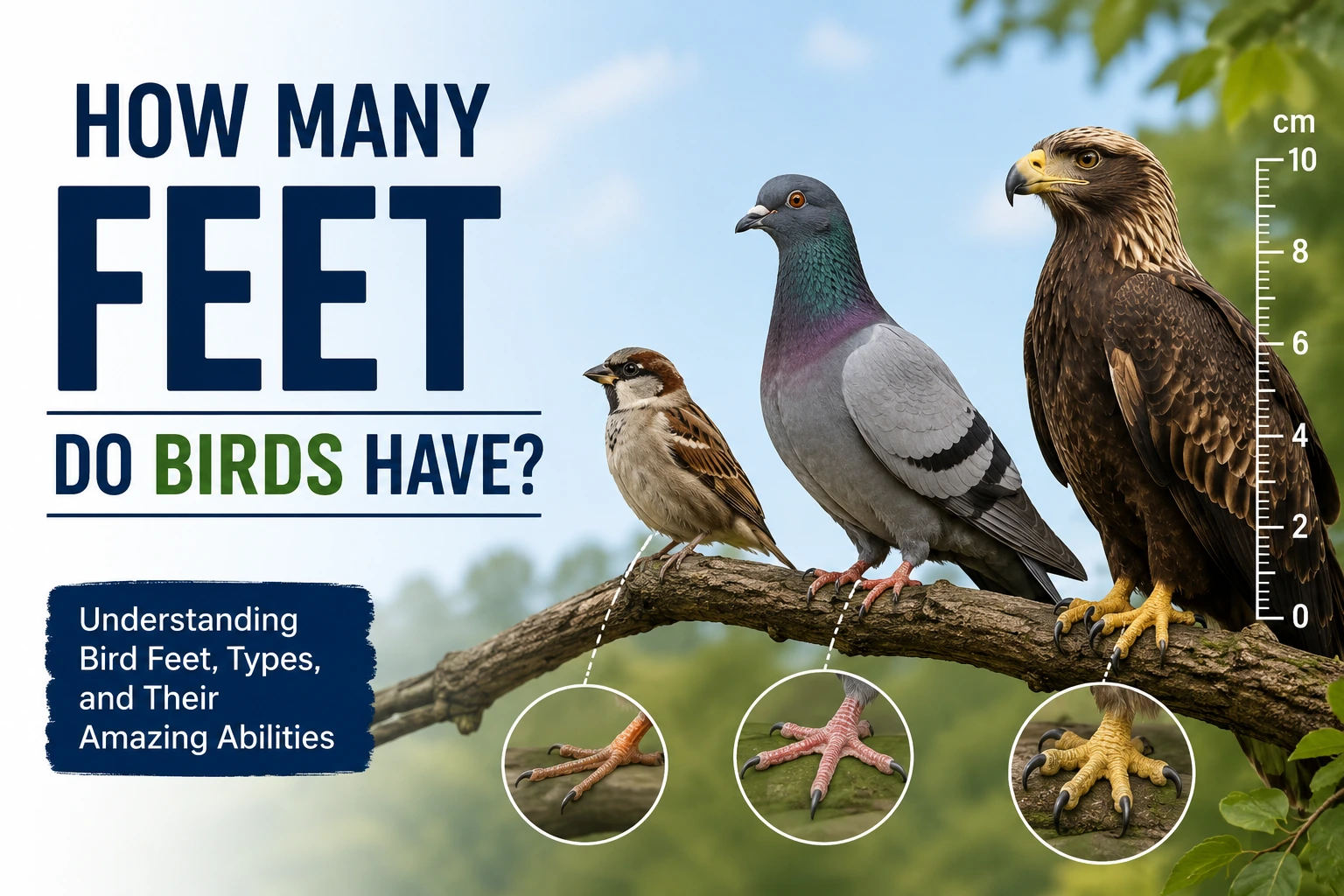
If you’ve ever watched birds walking across your lawn, perched on a tree branch, or swimming across a pond, you may have wondered, how many feet do birds have?
The answer is simple: all birds have two feet. Whether it’s a tiny hummingbird, a soaring eagle, a waddling penguin, or a large ostrich, every bird has two feet connected to two legs. However, while the number of feet is the same across nearly all bird species, the size, shape, and structure of those feet vary greatly depending on where the bird lives and how it survives.
Bird feet are remarkable examples of adaptation. They help birds perch, swim, climb, hunt, scratch for food, carry prey, and even regulate body temperature. From the powerful talons of an eagle to the webbed feet of a duck, each design serves a specific purpose.
In this guide, you’ll learn everything about bird feet, including their anatomy, toe arrangements, different foot types, and the fascinating ways they help birds thrive in diverse environments.
The Simple Answer
To answer the question directly:
Birds have two feet.
This is true for virtually every bird species on Earth, from backyard sparrows to giant flightless birds.
Each foot is attached to one leg and usually contains several toes equipped with strong claws. Although birds share the same basic body structure, evolution has shaped their feet differently to match their lifestyles.
For example:
- Ducks have webbed feet for swimming.
- Eagles have sharp talons for catching prey.
- Woodpeckers have climbing feet.
- Chickens have scratching feet.
- Owls have powerful gripping feet.
- Ostriches have only two toes for fast running.
So, while every bird has two feet, not every bird has the same type of feet.
Understanding Bird Anatomy
To appreciate how bird feet function, it’s helpful to understand the basic anatomy of a bird’s lower body.
Bird Legs
A bird’s legs are much longer than they appear.
Many parts of their legs are hidden beneath feathers, making them seem shorter than they actually are.
The visible backward-bending joint that many people think is a bird’s knee is actually its ankle. The real knee is tucked high beneath the feathers.
This unique leg structure allows birds to:
- Walk efficiently
- Land safely
- Take off into flight
- Balance while perching
- Absorb impact when landing
Bird Feet
Bird feet are made of:
- Bones
- Tendons
- Muscles
- Tough skin
- Scales
- Claws
Unlike human feet, bird feet have evolved for specific tasks instead of simply walking.
Some are designed for gripping branches, while others are built for swimming, digging, climbing, or hunting.
Bird Toes
Most birds have four toes, although not all species do.
A typical bird foot includes:
- One rear toe
- Three front toes
This arrangement provides excellent balance and gripping ability.
The toes end in claws, which help birds:
- Hold branches
- Catch prey
- Dig soil
- Defend themselves
- Climb tree trunks
How Many Toes Do Birds Have?
Although birds all have two feet, the number of toes varies between species.
Most birds have:
| Bird Type | Number of Toes |
|---|---|
| Songbirds | 4 |
| Ducks | 4 |
| Eagles | 4 |
| Pigeons | 4 |
| Chickens | 4 |
| Woodpeckers | 4 |
| Ostriches | 2 |
| Emus | 3 |
| Cassowaries | 3 |
The number of toes reflects each bird’s habitat and movement.
For example:
- Ostriches evolved fewer toes to improve running speed.
- Ducks retain four toes, with three connected by webbing.
- Raptors have four strong toes ending in powerful talons.
Types of Bird Feet
Bird scientists classify bird feet based on the arrangement of their toes. These arrangements are called toe configurations.
Each configuration helps birds perform specific tasks in nature.
Anisodactyl Feet
This is the most common type of bird foot.
Characteristics:
- Three toes point forward.
- One toe points backward.
Birds with anisodactyl feet include:
- Robins
- Sparrows
- Crows
- Pigeons
- Blackbirds
Advantages:
- Excellent grip on branches
- Comfortable perching
- Stable walking
- Good balance
Around 90% of bird species use this toe arrangement.
Zygodactyl Feet
These feet have:
- Two toes facing forward
- Two toes facing backward
This design provides a powerful grip for climbing.
Birds with zygodactyl feet include:
- Woodpeckers
- Parrots
- Cockatoos
- Macaws
Benefits include:
- Easier climbing
- Better grip on tree trunks
- Ability to hold food while eating
Many parrots can even use one foot almost like a human hand.
Pamprodactyl Feet
Pamprodactyl feet are less common.
Their unique feature is that all four toes can rotate forward when needed.
Birds with this toe arrangement include:
- Swifts
These flexible feet help birds cling to vertical surfaces such as cliffs and walls.
Syndactyl Feet
In syndactyl feet:
- Two front toes are partially joined together.
This arrangement strengthens the foot while still allowing flexibility.
Birds with syndactyl feet include:
- Kingfishers
- Bee-eaters
- Hornbills
These birds often perch on branches while scanning for prey or insects.
Didactyl Feet
Didactyl feet have only two toes.
This rare toe arrangement is found in:
- Ostriches
Having only two large toes allows ostriches to:
- Run at remarkable speeds
- Cover long distances
- Maintain balance on open grasslands
They are the fastest-running birds in the world, reaching speeds of up to 45 miles (72 kilometers) per hour.
Why Bird Feet Are So Important
Bird feet are much more than simple walking tools. They play a vital role in almost every aspect of a bird’s daily life.
Depending on the species, bird feet help with:
- Walking
- Running
- Swimming
- Perching
- Hunting
- Climbing
- Digging
- Carrying food
- Building nests
- Defending against predators
Without specialized feet, many bird species would struggle to survive in their natural habitats.
For example, an eagle’s sharp talons allow it to catch fish and small mammals, while a duck’s webbed feet help it paddle efficiently through water. Likewise, a woodpecker’s climbing feet enable it to move vertically along tree trunks in search of insects.
How Bird Feet Help Birds Survive
Although every bird has two feet, those feet are adapted for different environments and lifestyles. The shape, size, and strength of a bird’s feet determine how it moves, finds food, escapes predators, and raises its young.
Let’s look at the many ways bird feet help them survive.
Perching
Perching is one of the most common uses of bird feet.
Songbirds spend much of their lives resting on branches. Their feet contain a unique tendon-locking mechanism that automatically tightens when they land on a perch. This allows them to grip branches securely without using much energy.
Benefits include:
- Prevents falling while sleeping
- Conserves energy
- Provides stability in windy conditions
- Allows quick takeoff when danger appears
This natural locking system explains why birds can sleep on tree branches without falling.
Swimming
Water birds have specially adapted feet for moving through lakes, rivers, ponds, and oceans.
Common swimming birds include:
- Ducks
- Geese
- Swans
- Pelicans
- Loons
Most swimming birds have webbed feet. The webbing stretches between the toes, creating a larger surface area that pushes against water like a paddle.
Advantages include:
- Faster swimming
- Better steering
- Improved balance in water
- Efficient diving
Some birds, such as grebes and coots, have lobed toes instead of fully webbed feet. These help them swim while making walking on land easier.
Hunting
Birds of prey rely on their feet to catch and hold food.
Examples include:
- Eagles
- Hawks
- Falcons
- Owls
Their feet feature:
- Powerful muscles
- Long curved talons
- Strong gripping force
An eagle can grab fish directly from the water, while an owl silently catches mice in complete darkness using its sharp talons.
Without these specialized feet, hunting would be much more difficult.
Climbing
Some birds spend most of their time climbing trees instead of walking on the ground.
Woodpeckers are excellent climbers because of their zygodactyl feet.
Their toe arrangement allows them to:
- Grip bark securely
- Climb vertically
- Stay balanced while pecking
- Search for insects beneath tree bark
Parrots also use their climbing feet to move through trees and even hold food while eating.
Running
Not all birds fly. Some rely on running to survive.
Examples include:
- Ostriches
- Emus
- Rheas
These birds have long, powerful legs and fewer toes, reducing weight and improving speed.
Ostriches can run at speeds of up to 45 miles (72 kilometers) per hour, making them the fastest-running birds on Earth.
Digging and Scratching
Ground-dwelling birds often use their feet to uncover food.
Examples include:
- Chickens
- Turkeys
- Quail
- Pheasants
Their strong claws allow them to scratch through:
- Soil
- Leaves
- Grass
- Sand
This helps them find:
- Seeds
- Worms
- Insects
- Small roots
Bird Feet Comparison Table
Different birds have evolved feet that match their habitats and feeding habits.
| Bird | Number of Feet | Number of Toes | Foot Type | Main Purpose |
|---|---|---|---|---|
| Sparrow | 2 | 4 | Anisodactyl | Perching |
| Robin | 2 | 4 | Anisodactyl | Walking and perching |
| Duck | 2 | 4 | Webbed | Swimming |
| Goose | 2 | 4 | Webbed | Swimming |
| Eagle | 2 | 4 | Talons | Hunting |
| Owl | 2 | 4 | Talons | Catching prey |
| Woodpecker | 2 | 4 | Zygodactyl | Climbing |
| Parrot | 2 | 4 | Zygodactyl | Climbing and gripping |
| Ostrich | 2 | 2 | Didactyl | Running |
| Emu | 2 | 3 | Running feet | Speed and balance |
This comparison highlights that while all birds have two feet, their toe arrangements and foot structures vary to suit their environment and lifestyle.
Interesting Facts About Bird Feet
Bird feet are full of fascinating adaptations that many people don’t know about.
Here are some interesting facts:
- Every bird species has two feet, regardless of its size or habitat.
- Most birds have four toes, but ostriches have only two.
- A bird’s scales are made of keratin, the same material found in human fingernails.
- Birds do not wear out their claws evenly because different species use them in different ways.
- Some parrots use one foot to hold food while eating, much like humans use their hands.
- Flamingos often stand on one leg for long periods to conserve body heat and reduce muscle fatigue.
- Raptors have some of the strongest gripping feet in the animal kingdom.
- Penguins have webbed feet that help them swim efficiently, even though they cannot fly.
- Many birds can identify suitable perches by feel using sensitive nerves in their feet.
Common Myths About Bird Feet
Many misconceptions exist about bird anatomy. Let’s separate fact from fiction.
Myth 1: Birds Have Four Feet
Fact: All birds have only two feet.
Myth 2: Every Bird Has Four Toes
Fact: Most do, but species like ostriches have only two toes, while emus and cassowaries have three.
Myth 3: Bird Feet Are Weak
Fact: Many birds have incredibly strong feet. Eagles and hawks can grip prey with tremendous force, while woodpeckers cling securely to vertical tree trunks.
Myth 4: Bird Feet Only Help Them Walk
Fact: Bird feet serve many purposes, including swimming, climbing, hunting, scratching, perching, balancing, and even handling food.
Myth 5: All Bird Feet Look the Same
Fact: Bird feet vary greatly in shape, size, and structure depending on each species’ habitat and survival needs.
How to Identify Bird Feet in Nature
If you enjoy birdwatching, observing a bird’s feet can help identify the species.
Look for these features:
- Number of toes
- Presence of webbing
- Length of claws
- Toe arrangement
- Foot size
- Leg length
- Color of the legs and feet
For example:
- Webbed feet usually indicate a water bird.
- Sharp talons suggest a bird of prey.
- Two forward and two backward toes often belong to a woodpecker or parrot.
- Two large toes are a clear sign of an ostrich.
Watching how birds use their feet can also provide clues about their behavior and habitat.
Expert Tips for Learning About Bird Feet
If you’re interested in birds or teaching children about wildlife, these tips can make learning more engaging:
- Observe local birds in parks or gardens.
- Compare the feet of different bird species using field guides or reputable websites.
- Notice how birds perch, walk, or swim.
- Look for footprints in mud, sand, or snow.
- Use binoculars to safely observe birds without disturbing them.
- Encourage children to draw different types of bird feet to understand their adaptations.
These simple activities can help you appreciate the diversity and function of bird feet in the natural world.
FAQs
How many feet do birds have?
All birds have two feet. This is true for nearly every bird species, from tiny hummingbirds to large ostriches.
How many toes do most birds have?
Most birds have four toes—three pointing forward and one pointing backward. However, some species, such as ostriches, have only two toes.
Why do birds have different types of feet?
Bird feet have evolved to match different habitats and lifestyles. Some are designed for swimming, others for climbing, hunting, running, or perching.
Do all birds have claws?
Yes. Most birds have claws at the ends of their toes. Birds of prey have especially large, curved claws known as talons for catching and holding prey.
Which bird has only two toes?
The ostrich is the only living bird with two toes on each foot. This unique adaptation helps it run quickly across open grasslands.
Conclusion
Understanding how many feet do birds have is straightforward: every bird has two feet. However, those two feet are far from ordinary. They are highly specialized tools that help birds perch on branches, swim through water, climb trees, hunt prey, scratch for food, and run across open landscapes.
While most birds have four toes, some species, like ostriches, have evolved fewer toes to improve speed and efficiency. From the webbed feet of ducks to the powerful talons of eagles and the climbing feet of woodpeckers, each design reflects millions of years of adaptation to different environments.
The next time you watch a bird, take a closer look at its feet. Their shape, toe arrangement, and movement reveal fascinating clues about how that bird lives, feeds, and survives in the wild. Understanding these remarkable adaptations not only answers the question “how many feet do birds have” but also offers a deeper appreciation for the incredible diversity of the avian world.
Discover more