

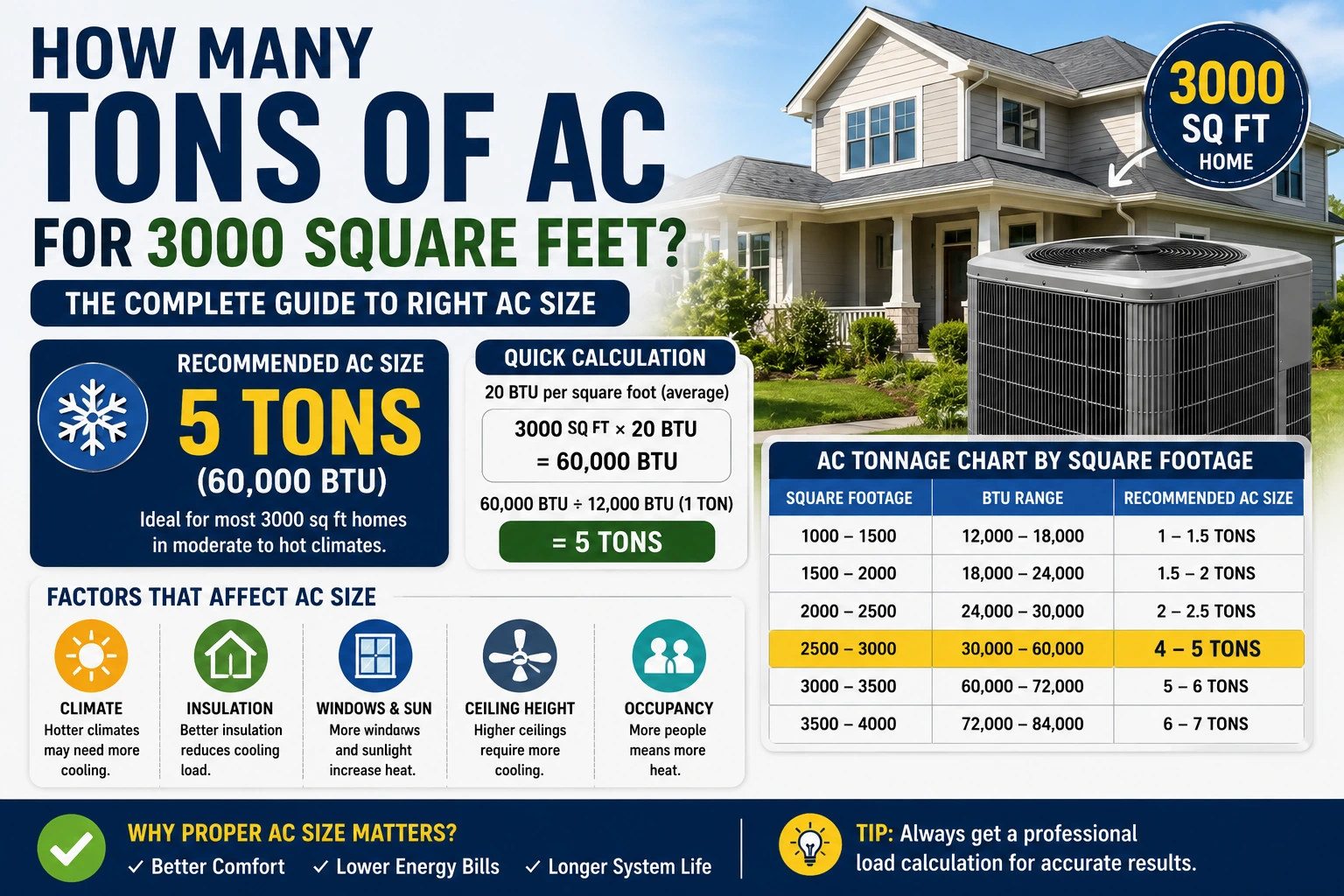
If you are building, renovating, or upgrading a large home, one of the most common questions is: “How many tons of AC for 3000 square feet?”
In most cases, a:
- 5-ton AC unit is commonly recommended for a 3000 square foot home.
However, the exact AC size depends on several important factors such as:
- Climate
- Insulation
- Ceiling height
- Sun exposure
- Number of occupants
- Energy efficiency
Choosing the correct air conditioner size is critical because an oversized or undersized system can lead to:
- Higher energy bills
- Poor cooling performance
- Humidity problems
- Increased wear on HVAC equipment
In this complete guide, you will learn how AC tonnage works, how to calculate cooling needs, factors affecting sizing, expert HVAC tips, and common mistakes homeowners make.
Understanding AC Tonnage
Before choosing the right system, it helps to understand what “tons” mean in air conditioning.
What Does AC Tonnage Mean?
In HVAC systems, “tonnage” measures cooling capacity rather than weight.
One ton of air conditioning equals:
12,000 BTUs per hour
BTU stands for:
- British Thermal Unit
It measures how much heat an AC system can remove from a home each hour.
Why Is It Called a Ton?
The term comes from the days when cooling systems used ice.
One ton of cooling represented:
- The amount of heat required to melt one ton of ice in 24 hours.
Today, HVAC systems still use this measurement standard.
How Many Tons of AC for 3000 Square Feet?
For most homes, HVAC professionals estimate:
| Home Size | Recommended AC Size |
|---|---|
| 2,000 sq ft | 3–4 tons |
| 2,500 sq ft | 4–5 tons |
| 3,000 sq ft | 5 tons |
| 3,500 sq ft | 5–6 tons |
So for a typical 3000 sq ft home:
3000 sq ft≈5-ton AC unit
This is only a general estimate. Some homes may need:
- 4.5 tons
- 5.5 tons
- Multiple systems
depending on conditions.
AC Size Formula Explained
HVAC sizing usually begins with BTU calculations.
Basic BTU Formula
A common estimate is:
20 BTUs per square foot
For 3000 square feet:
3000×20=60,000 BTUs
Converting BTUs Into Tons
Since:
- 1 ton = 12,000 BTUs
The formula becomes:
60,000÷12,000=5
Answer:
- 5 tons
AC Tonnage Chart by Square Footage
This chart provides general sizing guidance.
| Square Footage | Estimated AC Size |
|---|---|
| 600–1,000 sq ft | 1.5–2 tons |
| 1,000–1,500 sq ft | 2–3 tons |
| 1,500–2,000 sq ft | 3–4 tons |
| 2,000–2,500 sq ft | 4–5 tons |
| 2,500–3,000 sq ft | 5 tons |
| 3,000–3,500 sq ft | 5–6 tons |
Remember:
- These are general estimates only.
Factors That Affect AC Size
Not every 3000 sq ft home requires the same system.
Climate Zone
Hot climates require larger systems.
Homes in:
- Arizona
- Texas
- Florida
usually need more cooling capacity than homes in cooler regions.
Insulation Quality
Well-insulated homes retain cool air better.
Good insulation reduces:
- Heat transfer
- Energy usage
- Cooling demand
Poor insulation increases AC requirements.
Ceiling Height
Higher ceilings create more air volume.
A home with:
- 10-foot ceilings
may require more cooling than one with:
- Standard 8-foot ceilings
even if square footage is identical.
Windows and Sunlight
Large windows increase solar heat gain.
South-facing windows especially raise indoor temperatures during summer.
Homes with:
- Large glass areas
- Skylights
- Poor window insulation
may need larger AC systems.
Number of Occupants
People generate heat naturally.
More occupants mean:
- More body heat
- More appliance use
- Greater cooling demand
What Happens If Your AC Is Too Small?
Undersized systems create several problems.
Constant Running
A small AC may run continuously trying to cool the home.
This increases:
- Electricity bills
- System wear
- Noise levels
Uneven Cooling
Some rooms may remain:
- Hot
- Humid
- Uncomfortable
especially during peak summer temperatures.
Shorter Equipment Lifespan
Overworking an AC system often leads to:
- More repairs
- Compressor strain
- Earlier replacement
What Happens If Your AC Is Too Large?
Oversized systems also cause issues.
Short Cycling
A large unit cools too quickly and shuts off repeatedly.
This is called:
- Short cycling
Poor Humidity Control
Fast cooling cycles may not remove enough humidity.
The house can feel:
- Damp
- Sticky
- Uncomfortable
even when temperatures look correct.
Higher Energy Costs
Oversized systems:
- Cost more upfront
- Use more electricity
- Require larger ductwork
How HVAC Professionals Calculate AC Size
Professional sizing is much more detailed than simple square footage estimates.
Manual J Load Calculation
HVAC experts often use:
- Manual J calculations
This method evaluates:
- Climate
- Insulation
- Windows
- Air leaks
- Occupancy
- Building orientation
It provides the most accurate system size.
Ductwork Inspection
Poor ductwork affects cooling performance.
Professionals inspect:
- Airflow
- Duct size
- Leakage
- Vent placement
Central AC vs Multiple Units for 3000 Sq Ft
Large homes may use different cooling setups.
Single Central AC System
Benefits
- Simpler setup
- One thermostat
- Lower installation complexity
Drawbacks
- Uneven cooling possible in large homes
Zoned HVAC Systems
Zoning allows different temperatures in separate areas.
Benefits
- Better efficiency
- Customized comfort
- Reduced energy waste
Drawbacks
- Higher installation cost
Multiple Smaller Units
Some large homes use:
- Two smaller systems
instead of one oversized unit.
This often improves:
- Efficiency
- Comfort
- Redundancy
Energy Efficiency Tips for Large Homes
Large homes can consume significant energy during summer.
Upgrade Insulation
Better insulation lowers cooling demand dramatically.
Use Ceiling Fans
Fans improve airflow and reduce AC workload.
Install Smart Thermostats
Smart thermostats optimize:
- Temperature schedules
- Energy savings
- System efficiency
Seal Air Leaks
Leaks around:
- Doors
- Windows
- Attics
allow cool air to escape.
Common AC Sizing Mistakes
Homeowners often make costly sizing errors.
Choosing Based Only on Square Footage
Square footage alone is not enough.
Many other factors affect cooling needs.
Ignoring Humidity
Humidity greatly impacts indoor comfort.
Proper dehumidification is essential.
Buying the Largest Unit Available
Bigger is not always better.
Oversized systems often perform worse.
Benefits of Correct AC Sizing
Proper HVAC sizing improves:
- Comfort
- Energy efficiency
- Air quality
- Equipment lifespan
- Utility costs
It also creates more consistent indoor temperatures.
FAQs
1. How many tons of AC for 3000 square feet?
Most homes around 3000 sq ft typically require a 5-ton AC unit.
2. Can a 4-ton AC cool a 3000 sq ft house?
Possibly in mild climates with excellent insulation, but many homes will require closer to 5 tons.
3. What does 1 ton of AC equal?
One ton equals:
12,000 BTUs per hour
4. Is a bigger AC unit better?
No. Oversized units may short cycle and fail to control humidity properly.
5. How do HVAC professionals size AC systems?
Professionals often use Manual J load calculations to determine accurate cooling requirements.
Conclusion
If you are asking “how many tons of AC for 3000 square feet,” the general recommendation is:
5-ton AC system for most 3000 sq ft homes
However, proper HVAC sizing depends on much more than square footage alone. Climate, insulation, ceiling height, sunlight exposure, windows, and occupancy all influence cooling needs.
Choosing the correct AC size helps improve comfort, reduce energy bills, control humidity, and extend equipment lifespan. Before purchasing a system, it is always best to consult an HVAC professional for a detailed load calculation and accurate sizing recommendation.
Discover more
how many board feet in a 2x4x12