
If you’re planning a backyard basketball court, a school sports area, or a recreational facility, you may be wondering how many square feet in a half court basketball court. Knowing the exact square footage helps you estimate construction costs, choose the right flooring, and determine whether your available land is large enough.
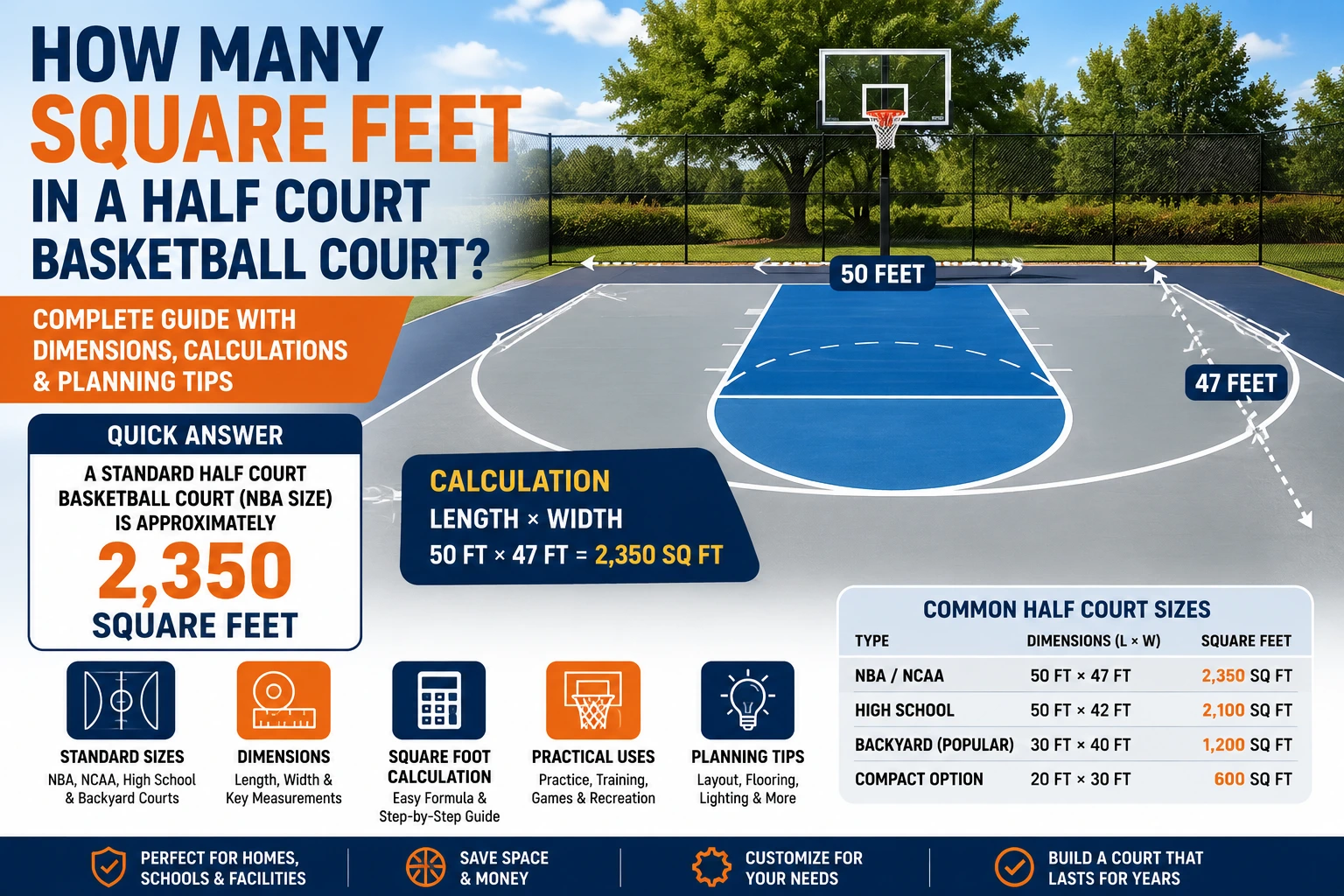
A standard half court basketball court is approximately 2,350 square feet when based on official NBA dimensions. However, the actual square footage varies depending on whether you’re building an NBA, NCAA, high school, or backyard court.
In this guide, you’ll learn how to calculate half-court square footage, compare different court sizes, and understand how much space you need for a practical and enjoyable basketball court.
Quick Answer
The square footage of a half basketball court depends on the court standard.
| Court Type | Approximate Size | Square Feet |
|---|---|---|
| NBA Half Court | 50 ft × 47 ft | 2,350 sq ft |
| NCAA Half Court | 47 ft × 47 ft | 2,209 sq ft |
| High School Half Court | 42 ft × 42 ft | 1,764 sq ft |
| Backyard Half Court | Varies | 900–2,000 sq ft |
For most residential installations, homeowners build a court between 1,000 and 2,000 square feet.
How to Calculate the Square Footage of a Half Court Basketball Court
Calculating square footage is simple once you know the dimensions.
Formula
The formula is:
Square Feet = Length × Width
Multiply both measurements in feet.
Step-by-Step Calculation
For an NBA half court:
- Length = 50 feet
- Width = 47 feet
Calculation:
50 × 47 = 2,350 square feet
The same formula applies to every rectangular basketball court.
Standard Half Court Basketball Dimensions
Different organizations use different court sizes.
Understanding these standards helps you choose the right design.
NBA Half Court
A full NBA basketball court measures:
- Length: 94 feet
- Width: 50 feet
Half of the playing surface measures:
| Dimension | Size |
|---|---|
| Length | 47 feet |
| Width | 50 feet |
| Square Feet | 2,350 sq ft |
This is the most commonly referenced size when discussing professional basketball courts.
NCAA Half Court
College basketball courts are also:
- 94 feet long
- 50 feet wide
A regulation NCAA half court provides approximately 2,350 square feet of playing space, although some planning guides round usable practice areas slightly differently depending on boundary allowances.
High School Half Court
Most high school courts measure:
- 84 feet long
- 50 feet wide
Half court dimensions become:
- 42 feet × 50 feet
Calculation:
42 × 50 = 2,100 square feet
This size works well for school gyms and community recreation centers.
Backyard Half Court
Backyard courts have no official dimensions.
Popular residential sizes include:
| Dimensions | Square Feet |
|---|---|
| 20 × 30 | 600 sq ft |
| 25 × 35 | 875 sq ft |
| 30 × 30 | 900 sq ft |
| 30 × 40 | 1,200 sq ft |
| 35 × 40 | 1,400 sq ft |
| 40 × 40 | 1,600 sq ft |
| 47 × 50 | 2,350 sq ft |
Most homeowners customize the court based on:
- Available yard space
- Budget
- Number of players
- Intended use
Comparison Table of Half Court Basketball Sizes
Here’s a quick comparison of common half-court dimensions.
| Court Standard | Dimensions | Square Feet | Best For |
|---|---|---|---|
| NBA | 47 × 50 ft | 2,350 | Professional practice |
| NCAA | 47 × 50 ft | 2,350 | College training |
| High School | 42 × 50 ft | 2,100 | Schools |
| Residential | 30 × 40 ft | 1,200 | Home use |
| Compact Backyard | 30 × 30 ft | 900 | Small yards |
This table shows that the ideal size depends on your available space and intended level of play.
What Can Fit on a Half Court?
A half court offers enough space for many basketball activities without requiring the land needed for a full-size court.
You can comfortably enjoy:
- One-on-one games
- Two-on-two games
- Three-on-three games
- Shooting practice
- Dribbling drills
- Defensive drills
- Youth basketball training
- Free-throw practice
- Skill development sessions
Many schools, parks, and homeowners prefer a half court because it provides an excellent playing experience while using significantly less space than a full court.
Why Choose a Half Court Instead of a Full Court?
A half basketball court is often the most practical option for residential properties and community recreation areas.
Some of the biggest advantages include:
Requires Less Land
A full-size basketball court occupies approximately 4,700 square feet, while a standard half court requires about 2,350 square feet. This makes it much easier to fit into a backyard or small recreational area.
Lower Construction Costs
Because the playing surface is smaller, you’ll typically spend less on:
- Concrete
- Asphalt
- Court tiles
- Acrylic coatings
- Fencing
- Lighting
- Labor
Reducing the overall footprint can significantly lower installation costs without sacrificing the quality of play for casual games and practice.
Indoor vs. Outdoor Half Court Basketball Courts
When planning a half basketball court, one of the first decisions is whether it will be built indoors or outdoors. Both options provide excellent playing experiences, but they differ in cost, maintenance, and construction requirements.
| Feature | Indoor Court | Outdoor Court |
|---|---|---|
| Playing Surface | Hardwood or sports flooring | Concrete, asphalt, or modular tiles |
| Weather Exposure | None | Rain, sun, wind, and snow |
| Maintenance | Moderate | Moderate to High |
| Installation Cost | Higher | Lower |
| Year-Round Play | Yes | Depends on climate |
Indoor Half Court
Indoor courts provide the highest quality playing experience. They are commonly found in:
- Schools
- Universities
- Recreation centers
- Professional training facilities
- Large residential properties
Advantages include:
- Smooth playing surface
- Better ball bounce
- Protection from weather
- Longer flooring lifespan
However, indoor courts require a building, lighting, ventilation, and a larger construction budget.
Outdoor Half Court
Outdoor courts are the most popular option for homeowners because they are more affordable and easier to install.
Common outdoor surfaces include:
- Concrete
- Asphalt
- Modular sports tiles
An outdoor half court is ideal for:
- Family recreation
- Youth practice
- Community parks
- Backyard basketball
Adding fencing and proper drainage can improve safety and reduce maintenance.
Flooring Options for a Half Basketball Court
Choosing the right flooring affects performance, durability, and long-term maintenance.
Concrete
Concrete is one of the most common outdoor court materials.
Pros:
- Durable
- Long-lasting
- Low maintenance
- Affordable
Cons:
- Hard on joints
- Requires periodic sealing
- Can develop cracks over time
Asphalt
Asphalt provides a slightly softer playing surface than concrete.
Benefits include:
- Lower initial cost
- Smooth finish
- Good traction
It may require resurfacing after several years of heavy use.
Modular Sports Tiles
Many homeowners now prefer interlocking sports tiles.
Advantages include:
- Excellent drainage
- Comfortable underfoot
- Easy replacement of damaged sections
- Available in various colors
Although they cost more upfront than concrete, modular tiles often provide better shock absorption and player comfort.
Hardwood Flooring
Hardwood remains the standard for indoor basketball courts.
Benefits:
- Professional playing experience
- Excellent ball response
- Attractive appearance
Because hardwood requires climate control and regular maintenance, it is generally used only for indoor facilities.
Space Planning Tips
Before building a half basketball court, think beyond the playing surface. Extra clearance around the court improves safety and allows players to move comfortably.
Leave Safety Margins
Experts recommend adding several feet of open space around the court to reduce the risk of collisions with fences, walls, or landscaping.
This additional space also makes maintenance easier.
Consider the Basketball Hoop
The hoop should be installed on a stable support system with enough clearance behind the backboard.
Choose between:
- In-ground hoops
- Wall-mounted hoops (indoor)
- Adjustable residential hoops
Plan for Lighting
If you plan to play in the evening, install LED sports lighting that provides even illumination across the entire court.
Proper lighting:
- Improves visibility
- Reduces shadows
- Enhances safety
Think About Drainage
Outdoor courts should be built with a slight slope to prevent water from pooling after rain.
Proper drainage helps:
- Protect the playing surface
- Extend the court’s lifespan
- Reduce maintenance costs
Estimated Construction Costs
Many people researching how many square feet in a half court basketball court also want to estimate the cost of building one.
The final cost depends on factors such as:
- Surface material
- Site preparation
- Labor
- Fencing
- Lighting
- Basketball equipment
- Location
Below are general estimates.
| Court Surface | Estimated Cost per Sq Ft |
|---|---|
| Concrete | $8–$15 |
| Asphalt | $7–$14 |
| Modular Sports Tiles | $12–$25 |
| Indoor Hardwood | $20–$50+ |
Example Cost Estimates
For a standard 2,350-square-foot half court:
| Surface | Approximate Cost Range |
|---|---|
| Concrete | $18,800–$35,250 |
| Asphalt | $16,450–$32,900 |
| Modular Tiles | $28,200–$58,750 |
| Hardwood Indoor | $47,000–$117,500+ |
These figures are estimates and may not include site preparation, permits, fencing, lighting, or landscaping.
Benefits of a Half Court Basketball Court
A half court is an excellent investment for many homeowners, schools, and recreational facilities.
Uses Less Space
Compared to a full court, a half court fits on much smaller lots while still supporting a wide variety of basketball activities.
Lower Installation Cost
Less surface area means lower expenses for:
- Materials
- Labor
- Maintenance
- Equipment
Great for Practice
Most basketball drills focus on:
- Shooting
- Passing
- Ball handling
- Defense
- Footwork
A half court provides plenty of room for these essential skills.
Family-Friendly
A half court encourages outdoor activity for players of all ages and can become a central feature for family recreation.
Drawbacks to Consider
Although a half court offers many advantages, it may not suit every situation.
Potential limitations include:
- Not suitable for full-court games
- Limited space for larger groups
- Reduced conditioning opportunities compared to a full court
- Some advanced team drills require a full-length court
If your goal is competitive five-on-five play, a full-size court may be the better option.
Expert Tips Before Building
Proper planning helps you maximize your investment.
Measure Your Available Space
Before selecting a court size, carefully measure your property and account for safety clearances around the court.
Consider Future Needs
Think about whether you’ll want to add:
- Lighting
- Seating
- Fencing
- Scoreboards
- Additional recreational features
Planning ahead can reduce renovation costs later.
Choose Quality Equipment
Invest in:
- Durable basketball hoops
- Weather-resistant nets
- High-quality backboards
- Reliable surface materials
Quality equipment lasts longer and improves the playing experience.
Check Local Regulations
Some neighborhoods and municipalities have rules regarding:
- Setbacks
- Permits
- Noise
- Outdoor lighting
Confirm local requirements before beginning construction.
Common Mistakes to Avoid
Avoid these common planning errors.
Forgetting Extra Clearance
The playing surface alone isn’t enough. Players need additional room around the court for safe movement.
Choosing the Wrong Surface
Different surfaces suit different needs. For example:
- Hardwood is best indoors.
- Concrete works well outdoors.
- Modular tiles offer added comfort and easier maintenance.
Ignoring Drainage
Poor drainage can lead to standing water, slippery conditions, and premature surface damage.
Underestimating the Budget
Many projects cost more than expected because owners forget to include:
- Site preparation
- Hoops
- Lighting
- Fencing
- Landscaping
- Accessories
Creating a complete budget before construction helps prevent surprises.
FAQs
1. How many square feet is a standard half court basketball court?
A regulation NBA or NCAA half court measures approximately 2,350 square feet, based on dimensions of 47 feet by 50 feet.
2. What is the minimum size for a backyard half court?
Many homeowners build courts ranging from 600 to 1,200 square feet, depending on available yard space and intended use.
3. Is a half court enough for practice?
Yes. A half court is ideal for shooting drills, one-on-one games, passing, ball handling, defensive drills, and skill development.
4. How much space should I leave around a half basketball court?
It’s recommended to leave several feet of clearance around the playing surface for player safety, maintenance access, and equipment placement.
5. Is concrete or modular tile better for an outdoor basketball court?
Concrete is durable and cost-effective, while modular sports tiles provide better shock absorption, drainage, and player comfort. The best choice depends on your budget and performance preferences.
Conclusion
If you’re wondering how many square feet in a half court basketball court, the answer depends on the court standard you choose. A regulation NBA or NCAA half court measures approximately 2,350 square feet, while high school and residential courts are often smaller. Backyard courts can range from 600 to over 2,000 square feet, allowing homeowners to customize the size based on available space and budget.
Understanding the square footage is only the first step. You should also consider the court’s intended use, surface material, safety clearances, drainage, lighting, and future maintenance. Whether you’re building a simple backyard practice court or a professional-quality recreational space, careful planning ensures a court that provides years of enjoyable play and lasting value.
discover more