
If you’ve ever wondered feet in a mile how many feet in a mile, you’re not alone. This is one of the most common distance conversion questions asked by students, runners, homeowners, surveyors, and anyone working with measurements. Whether you’re calculating a walking route, planning a construction project, or solving a math problem, knowing the exact number of feet in a mile is incredibly useful.
The answer is simple:
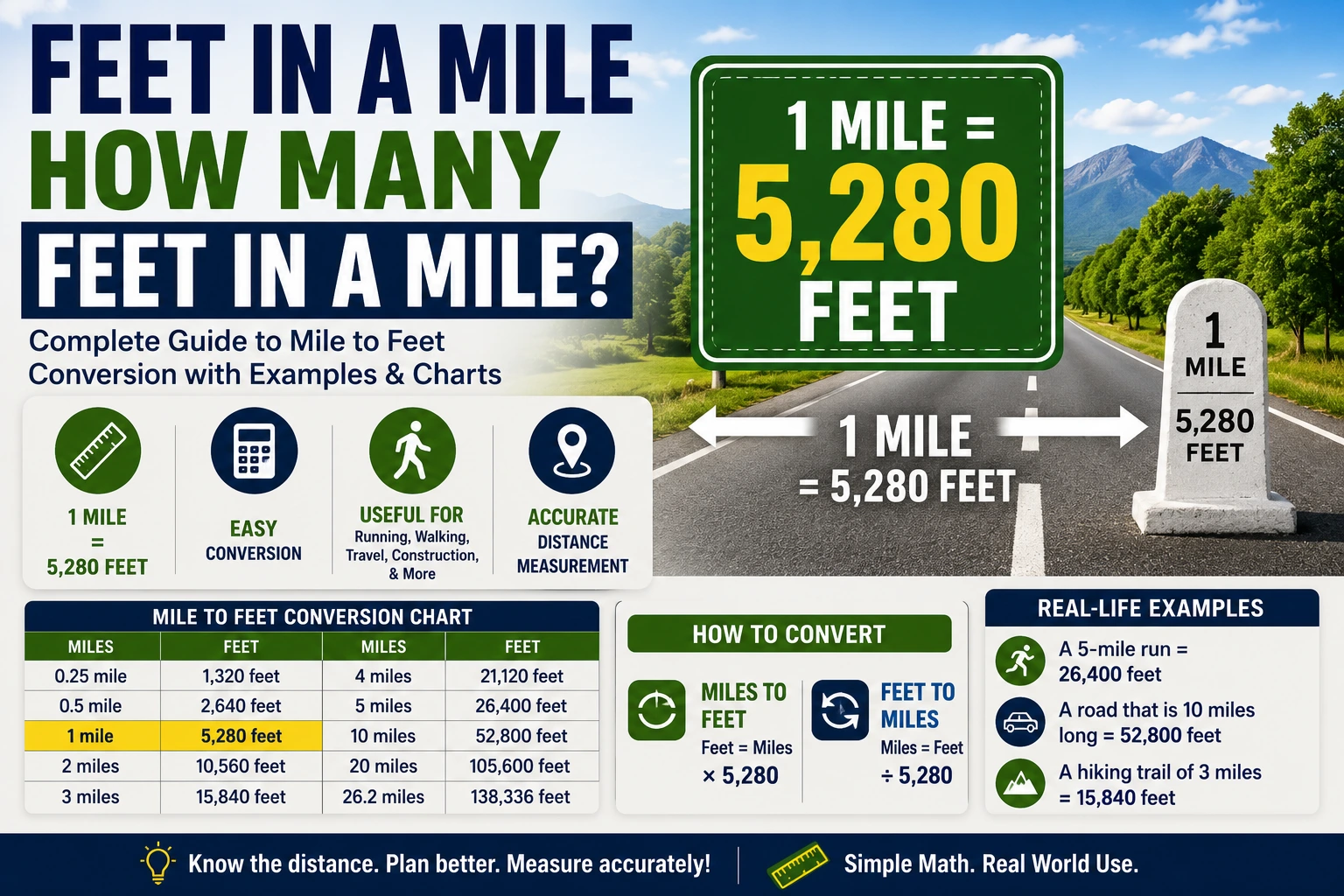
One mile equals exactly 5,280 feet.
Although it’s easy to memorize, understanding where this number comes from and how to use it in everyday situations makes conversions much easier. In this guide, you’ll learn the exact conversion, easy formulas, practical examples, conversion charts, and expert tips to confidently convert between miles and feet.
What Is a Mile?
A mile is a unit of distance used in the United States, the United Kingdom (for road distances), and a few other countries that follow the Imperial or U.S. customary measurement systems.
Historically, the mile has existed in different forms for thousands of years. The modern statute mile was officially standardized to 5,280 feet.
Today, miles are commonly used to measure:
- Highway distances
- Walking routes
- Running races
- Hiking trails
- Property boundaries
- Road trips
- Aviation and transportation
Unlike metric countries that primarily use kilometers, the United States continues to use miles for most road signs and travel distances.
Feet in a Mile: How Many Feet in a Mile?
The exact answer is:
1 Mile = 5,280 Feet
This conversion never changes.
Whether you’re measuring a hiking trail or calculating the distance between two locations, every statute mile contains exactly 5,280 feet.
Quick Conversion Table
| Miles | Feet |
|---|---|
| 0.25 | 1,320 ft |
| 0.50 | 2,640 ft |
| 0.75 | 3,960 ft |
| 1 Mile | 5,280 ft |
| 2 Miles | 10,560 ft |
| 3 Miles | 15,840 ft |
| 5 Miles | 26,400 ft |
| 10 Miles | 52,800 ft |
This table provides a quick reference for the most common mile-to-feet conversions.
Why Are Miles and Feet Still Used?
Even though many countries use the metric system, miles and feet remain important in several industries.
They are commonly used for:
- Road signs
- Construction
- Surveying
- Real estate
- Sports
- Running events
- Engineering
- Land measurement
For shorter distances, feet offer greater precision than miles.
For example:
Instead of saying:
- 0.15 miles
many people prefer:
- 792 feet
This makes measurements easier to understand in construction and property planning.
Mile to Feet Conversion Formula
Converting miles into feet is very simple.
Formula
Feet = Miles × 5,280
Once you know this formula, you can convert any distance quickly.
Example 1
2 Miles
2 × 5,280
= 10,560 feet
Example 2
3.5 Miles
3.5 × 5,280
= 18,480 feet
Example 3
0.75 Mile
0.75 × 5,280
= 3,960 feet
Example 4
5 Miles
5 × 5,280
= 26,400 feet
Using this formula eliminates the need for memorizing long conversion tables.
Mile to Feet Conversion Chart
The chart below includes many commonly searched conversions.
| Miles | Feet |
|---|---|
| 0.10 | 528 |
| 0.25 | 1,320 |
| 0.50 | 2,640 |
| 0.75 | 3,960 |
| 1 | 5,280 |
| 1.5 | 7,920 |
| 2 | 10,560 |
| 3 | 15,840 |
| 4 | 21,120 |
| 5 | 26,400 |
| 10 | 52,800 |
| 20 | 105,600 |
Bookmark this chart if you regularly work with distances.
Real-Life Examples
Understanding conversions becomes much easier when you apply them to everyday situations.
Walking Distance
Suppose your fitness app says you’ve walked 2 miles.
Calculation:
2 × 5,280
= 10,560 feet
Now you know you’ve walked more than ten thousand feet.
Running
A runner completes a 5-mile run.
Distance in feet:
5 × 5,280
= 26,400 feet
This helps coaches and athletes understand training distances more precisely.
Property Measurement
A private road measures 0.5 miles.
Conversion:
0.5 × 5,280
= 2,640 feet
This information is useful when estimating paving or maintenance costs.
Hiking Trail
A hiking trail is 3 miles long.
Distance:
3 × 5,280
= 15,840 feet
Knowing the total distance helps hikers estimate travel time and prepare accordingly.
Why Is One Mile Equal to 5,280 Feet?
Many people wonder why the number isn’t a simple 5,000 feet.
The answer comes from history.
The modern statute mile was established in England in 1593.
At that time:
- 1 mile = 8 furlongs
- 1 furlong = 660 feet
Therefore:
8 × 660 = 5,280 feet
Although measurement systems have evolved, this standard remains in use today.
Common Uses of Mile-to-Feet Conversions
Knowing how many feet are in a mile is helpful in many professions and daily activities.
Construction
Builders convert miles into feet when planning:
- Roads
- Utility lines
- Drainage systems
- Pipelines
Real Estate
Property developers often calculate distances between:
- Lots
- Roads
- Utilities
- Easements
using feet rather than miles.
Sports
Running events, marathons, and cross-country races often require converting distances into feet for course planning.
Surveying
Land surveyors frequently convert miles into feet for accurate property measurements.
Education
Students regularly solve conversion problems involving miles and feet in math and science classes.
How to Convert Feet Back to Miles
Sometimes you’ll know the number of feet and need to determine the equivalent distance in miles.
Fortunately, this calculation is just as simple.
Formula
Miles = Feet ÷ 5,280
Example
10,560 feet
10,560 ÷ 5,280
= 2 miles
This reverse formula is commonly used in engineering, surveying, mapping, and athletics.
Miles vs Kilometers
While miles are widely used in the United States and a few other countries, most of the world measures distance in kilometers. Understanding the difference between these units makes international travel, map reading, and distance conversions much easier.
| Unit | Equivalent |
|---|---|
| 1 Mile | 5,280 feet |
| 1 Mile | 1.609 kilometers |
| 1 Kilometer | 3,280.84 feet |
| 1 Kilometer | 0.621 miles |
When Are Miles Used?
Miles are commonly used for:
- Highway distances
- Running races (such as 1-mile races)
- Property measurements
- Hiking trails
- Road trip planning
When Are Kilometers Used?
Kilometers are commonly used for:
- International travel
- Scientific calculations
- GPS mapping
- Most countries outside the United States
Knowing both systems helps when reading maps or converting distances for travel.
Feet to Mile Conversion Chart
Sometimes you know the number of feet and want to convert it back into miles.
Use this quick reference chart.
| Feet | Miles |
|---|---|
| 528 | 0.10 |
| 1,320 | 0.25 |
| 2,640 | 0.50 |
| 3,960 | 0.75 |
| 5,280 | 1 |
| 10,560 | 2 |
| 15,840 | 3 |
| 21,120 | 4 |
| 26,400 | 5 |
| 52,800 | 10 |
This table is useful for students, surveyors, runners, and engineers.
Practical Uses of Mile-to-Feet Conversions
Knowing feet in a mile how many feet in a mile has many practical applications.
Road Construction
Engineers convert miles into feet when designing:
- Highways
- Bridges
- Sidewalks
- Utility lines
Using feet allows for more precise planning and measurements.
Real Estate
Property professionals often calculate distances between:
- Property boundaries
- Access roads
- Utility easements
- Driveways
Since real estate measurements are usually more detailed, feet are often preferred over miles.
Fitness and Running
Many fitness trackers display distances in miles.
Converting them into feet helps runners better understand:
- Stride length
- Workout distances
- Training goals
Hiking and Outdoor Activities
Trail maps may show distances in miles, while campsite layouts and park measurements are often given in feet.
Being comfortable with both units makes outdoor planning easier.
Education
Students frequently solve mile-to-feet conversion problems in:
- Mathematics
- Science
- Geography
- Engineering courses
Learning the conversion formula helps improve problem-solving skills.
Common Mile-to-Feet Conversion Examples
Here are some everyday calculations.
| Distance | Feet |
|---|---|
| 1 mile | 5,280 feet |
| 2 miles | 10,560 feet |
| 3 miles | 15,840 feet |
| 4 miles | 21,120 feet |
| 5 miles | 26,400 feet |
| 8 miles | 42,240 feet |
| 10 miles | 52,800 feet |
| 15 miles | 79,200 feet |
| 20 miles | 105,600 feet |
| 50 miles | 264,000 feet |
These conversions are especially useful for road trips, athletic events, and construction planning.
Expert Tips for Easy Conversions
Converting between miles and feet becomes much easier with a few simple strategies.
Here are some expert tips:
- Memorize the key number: 5,280 feet = 1 mile.
- Multiply by 5,280 to convert miles into feet.
- Divide by 5,280 to convert feet into miles.
- Keep a conversion chart for quick reference.
- Use a calculator for decimal mile conversions.
- Double-check decimal placement to avoid large calculation errors.
- Estimate your answer first to catch obvious mistakes.
These habits improve speed and accuracy, especially when working with measurements regularly.
Common Conversion Mistakes
Even simple conversions can lead to errors if you’re not careful.
Forgetting the Exact Number
Some people mistakenly believe one mile equals 5,000 feet.
The correct value is always:
1 mile = 5,280 feet
Multiplying Instead of Dividing
Remember:
- Miles → Feet = Multiply
- Feet → Miles = Divide
Mixing up these operations leads to incorrect answers.
Ignoring Decimal Values
For example:
0.5 mile
is not 5,280 feet.
Instead:
0.5 × 5,280 = 2,640 feet
Always include decimal values in your calculations.
Confusing Miles with Kilometers
One mile is not the same as one kilometer.
- 1 mile = 1.609 kilometers
- 1 kilometer = 0.621 miles
Using the wrong unit can significantly affect measurements.
Skipping Unit Labels
Always write the unit after your answer.
For example:
- 10,560 feet
- 2 miles
This helps prevent confusion when reading calculations later.
Why Understanding Mile-to-Feet Conversions Matters
Knowing how to convert miles into feet isn’t just useful for school—it has practical value in everyday life.
Understanding this conversion helps you:
- Measure property more accurately.
- Plan walking and running routes.
- Estimate construction materials.
- Read maps with confidence.
- Compare travel distances.
- Complete math and engineering calculations.
- Interpret land survey reports.
Whether you’re a student, homeowner, contractor, or athlete, knowing that one mile equals 5,280 feet is a valuable piece of knowledge you’ll use repeatedly.
FAQs
How many feet are in one mile?
One mile contains exactly 5,280 feet. This is the standard conversion used in the United States and other countries that follow the Imperial measurement system.
How do I convert miles into feet?
Multiply the number of miles by 5,280.
Example:
3 miles × 5,280 = 15,840 feet.
How do I convert feet into miles?
Divide the number of feet by 5,280.
Example:
10,560 feet ÷ 5,280 = 2 miles.
Why does one mile equal 5,280 feet?
The modern statute mile was standardized in England in 1593 and defined as 8 furlongs, with each furlong measuring 660 feet. Multiplying 8 by 660 gives 5,280 feet.
Are miles and kilometers the same?
No. One mile equals approximately 1.609 kilometers, while one kilometer equals about 0.621 miles.
Conclusion
If you’ve been searching for feet in a mile how many feet in a mile, the answer is simple and exact: one mile equals 5,280 feet. This standard measurement is used for road distances, construction projects, land surveying, athletics, and many everyday calculations. Once you memorize this key conversion, switching between miles and feet becomes quick and straightforward.
Understanding the relationship between miles and feet goes beyond remembering a single number. By learning the conversion formulas, using reference charts, and practicing with real-world examples, you can confidently solve measurement problems in school, work, or daily life. Whether you’re planning a road trip, measuring property, training for a race, or completing a math assignment, knowing that 1 mile = 5,280 feet will help you make accurate calculations every time.
Discover more