

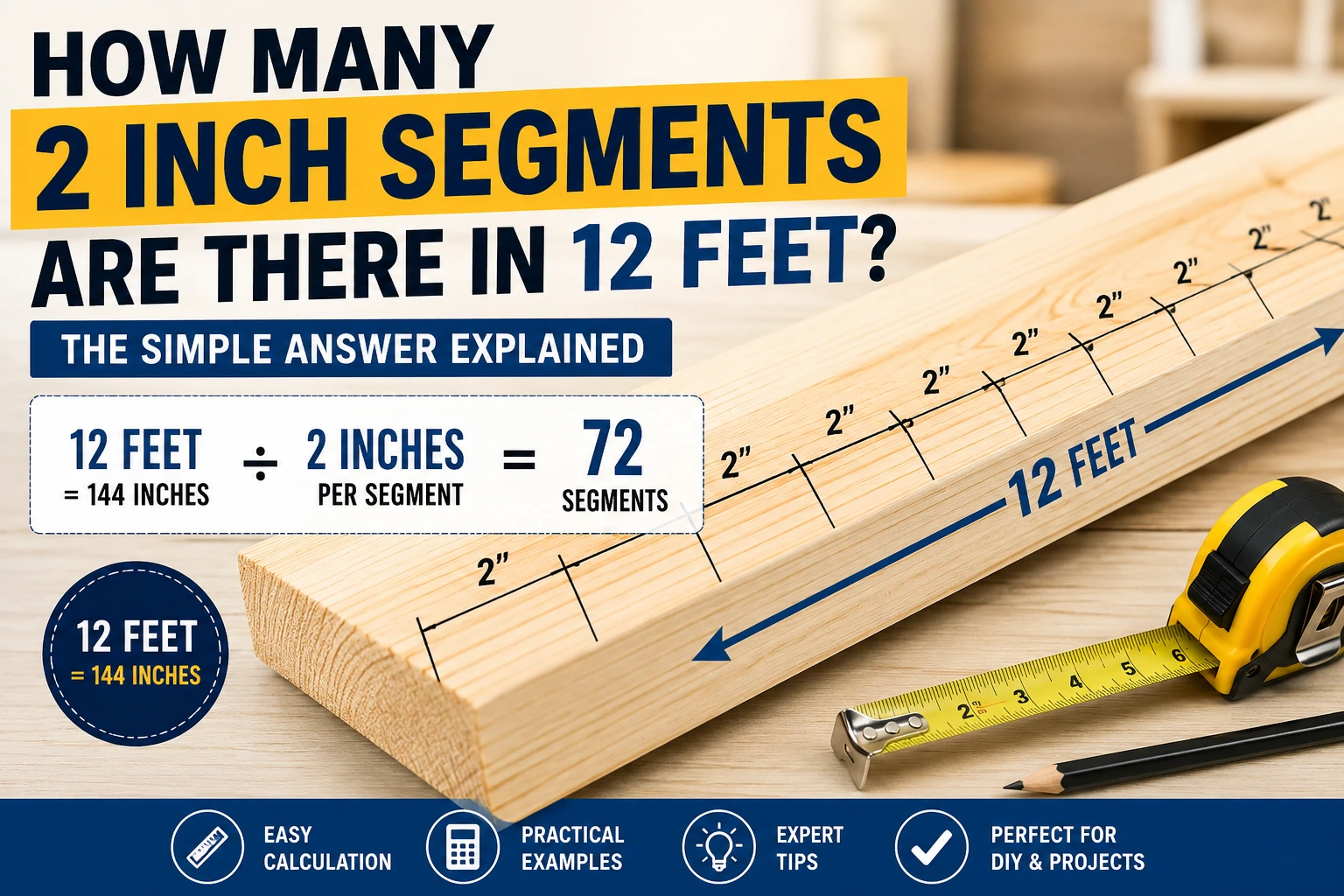
If you’ve ever wondered how many 2 inch segments are there in 12 feet, the answer is surprisingly simple once you convert the units correctly. Whether you’re cutting lumber, measuring pipes, planning a DIY project, or solving a school math problem, knowing how to convert feet into inches makes these calculations fast and accurate.
The key is remembering that one foot equals 12 inches. Once everything is in the same unit, you simply divide the total length by the length of each segment.
In this guide, you’ll learn the exact calculation, understand why it works, explore practical examples, avoid common mistakes, and discover a handy conversion chart for similar measurements.
The Quick Answer
There are 72 segments of 2 inches in 12 feet.
Here’s the calculation:
- 12 feet = 144 inches
- 144 ÷ 2 = 72
Answer: 72 two-inch segments
How Many 2 Inch Segments Are There in 12 Feet? (Step-by-Step)
Let’s solve the problem one step at a time.
Convert 12 Feet into Inches
Since:
- 1 foot = 12 inches
Multiply:
12 × 12 = 144 inches
Now you know that twelve feet contains 144 inches.
Divide by the Segment Length
Each segment measures 2 inches.
Now divide:
144 ÷ 2 = 72
That means a twelve-foot length can be divided into 72 equal segments, each measuring two inches.
Understanding Feet and Inches
Before solving measurement questions, it’s important to understand how these units relate.
The imperial measurement system uses:
| Unit | Equivalent |
|---|---|
| 1 foot | 12 inches |
| 2 feet | 24 inches |
| 3 feet | 36 inches |
| 6 feet | 72 inches |
| 12 feet | 144 inches |
Whenever you’re dividing a length into smaller pieces, always convert everything into the same unit first.
This avoids calculation errors and makes the math much easier.
How Many 2 Inch Segments Are There in 12 Feet? Using the Formula
You don’t need to memorize every answer.
Instead, use a simple formula.
Formula
Number of Segments = Total Length ÷ Segment Length
If the original length is measured in feet:
Segments = (Feet × 12) ÷ Segment Length in Inches
Example
Length = 12 feet
Segment size = 2 inches
Calculation:
(12 × 12) ÷ 2
144 ÷ 2
= 72 segments
This formula works for almost any cutting or measuring project.
Conversion Table for Common Lengths
The table below helps you quickly determine how many 2-inch segments fit into different lengths.
| Length (Feet) | Inches | 2-Inch Segments |
|---|---|---|
| 1 | 12 | 6 |
| 2 | 24 | 12 |
| 3 | 36 | 18 |
| 4 | 48 | 24 |
| 5 | 60 | 30 |
| 6 | 72 | 36 |
| 7 | 84 | 42 |
| 8 | 96 | 48 |
| 9 | 108 | 54 |
| 10 | 120 | 60 |
| 11 | 132 | 66 |
| 12 | 144 | 72 |
| 15 | 180 | 90 |
| 20 | 240 | 120 |
This chart is especially useful for contractors, teachers, and DIY enthusiasts.
Why Convert Feet into Inches First?
Many people try to divide feet directly by inches, which leads to incorrect answers.
For example:
12 ÷ 2 = 6
This is wrong because the units are different.
You cannot divide feet by inches without converting.
Correct process:
- Convert feet into inches
- Divide by inches
That produces the correct answer of 72 segments.
Real-World Examples of 2 Inch Segments
Woodworking
Suppose you have a 12-foot wooden board.
If every piece must be exactly 2 inches long:
- Total length = 144 inches
- Pieces = 72
This helps estimate material usage before making cuts.
Pipe Cutting
A plumber needs short 2-inch PVC connectors from a 12-foot pipe.
Ignoring blade thickness, they can produce:
- 72 equal pieces
This makes planning much easier.
Metal Fabrication
Metal shops often divide long steel rods into identical sections.
Knowing the total number of pieces helps estimate labor, production time, and material costs.
School Math Problems
Teachers frequently use problems involving feet and inches to teach:
- Unit conversions
- Division
- Measurement skills
- Word problems
This example is a classic exercise because it combines multiple math concepts.
Craft Projects
Crafters often cut:
- Ribbon
- Leather strips
- Foam
- Plastic tubing
- Decorative trim
Using the same conversion method ensures every piece is identical.
Practical Uses for This Calculation
Knowing how to calculate segment counts is valuable in many industries.
Common applications include:
- Construction
- Carpentry
- Cabinet making
- Interior design
- Landscaping
- Manufacturing
- Plumbing
- Electrical installations
- Engineering
- Furniture making
Even homeowners performing simple repairs can benefit from understanding this basic measurement.
Segment Comparison Chart
Here’s how many pieces you can cut from a 12-foot length using different segment sizes.
| Segment Size | Number of Pieces |
|---|---|
| 1 inch | 144 |
| 2 inches | 72 |
| 3 inches | 48 |
| 4 inches | 36 |
| 6 inches | 24 |
| 8 inches | 18 |
| 12 inches | 12 |
| 24 inches | 6 |
This comparison helps when deciding the ideal size for your project.
Accounting for Saw Blade Width (Kerf)
In real cutting projects, each saw cut removes a small amount of material known as the kerf.
For example:
- Blade thickness = 1/8 inch
If you’re making dozens of cuts, the total material lost adds up.
So while the mathematical answer is 72 segments, the actual number of finished pieces may be slightly lower depending on:
- Blade thickness
- Cutting accuracy
- Material waste
- Damaged ends
Professional woodworkers always include kerf in their cutting plans.
Common Mistakes to Avoid
Avoid these errors when working with measurements.
Forgetting the Conversion
Always convert feet into inches first.
Mixing Units
Never divide feet directly by inches.
Both values must use the same unit.
Ignoring Material Loss
When cutting physical materials, account for:
- Saw blade width
- Waste
- Trim cuts
Rounding Too Early
Complete the calculation before rounding any numbers.
This improves accuracy.
Misreading the Measuring Tape
Double-check measurements before making cuts.
A small mistake early can affect every remaining segment.
Expert Tips for Accurate Measurements
Professionals follow several best practices to reduce mistakes.
- Measure twice before cutting.
- Convert everything into one unit.
- Use a quality measuring tape.
- Mark cut lines carefully.
- Include blade thickness in planning.
- Label pieces after cutting.
- Double-check calculations before starting.
These habits save time, reduce waste, and improve project accuracy.
Why This Calculation Matters
Although the math is simple, accurate conversions have a big impact.
They help you:
- Reduce material waste
- Improve project planning
- Estimate supplies
- Save money
- Increase cutting accuracy
- Complete projects faster
- Prevent expensive mistakes
Whether you’re building furniture or solving homework, understanding measurement conversions is an essential skill.
FAQs
1. How many 2 inch segments are there in 12 feet?
There are 72 segments because 12 feet equals 144 inches, and 144 divided by 2 equals 72.
2. How many inches are in 12 feet?
There are 144 inches in 12 feet.
3. What formula is used to calculate the number of segments?
Use:
Segments = Total Length ÷ Segment Length
If using feet:
Segments = (Feet × 12) ÷ Segment Length
4. Does saw blade thickness affect the final number of pieces?
Yes. In practical cutting projects, the blade removes a small amount of material during each cut, so you may end up with slightly fewer usable pieces than the theoretical calculation.
5. Can I use the same method for other segment sizes?
Absolutely. Simply convert the total length into inches and divide by your desired segment length.
Conclusion
If you’re asking how many 2 inch segments are there in 12 feet, the correct answer is 72. The process is straightforward: convert 12 feet into 144 inches, then divide by 2. This simple calculation is useful in woodworking, construction, plumbing, crafting, manufacturing, and everyday measurement tasks.
By understanding the relationship between feet and inches, using the correct formula, and accounting for practical factors like saw blade width, you can plan projects with greater confidence and accuracy. Whether you’re solving a math problem or preparing materials for your next DIY project, this conversion method ensures precise results every time.
Discover more