

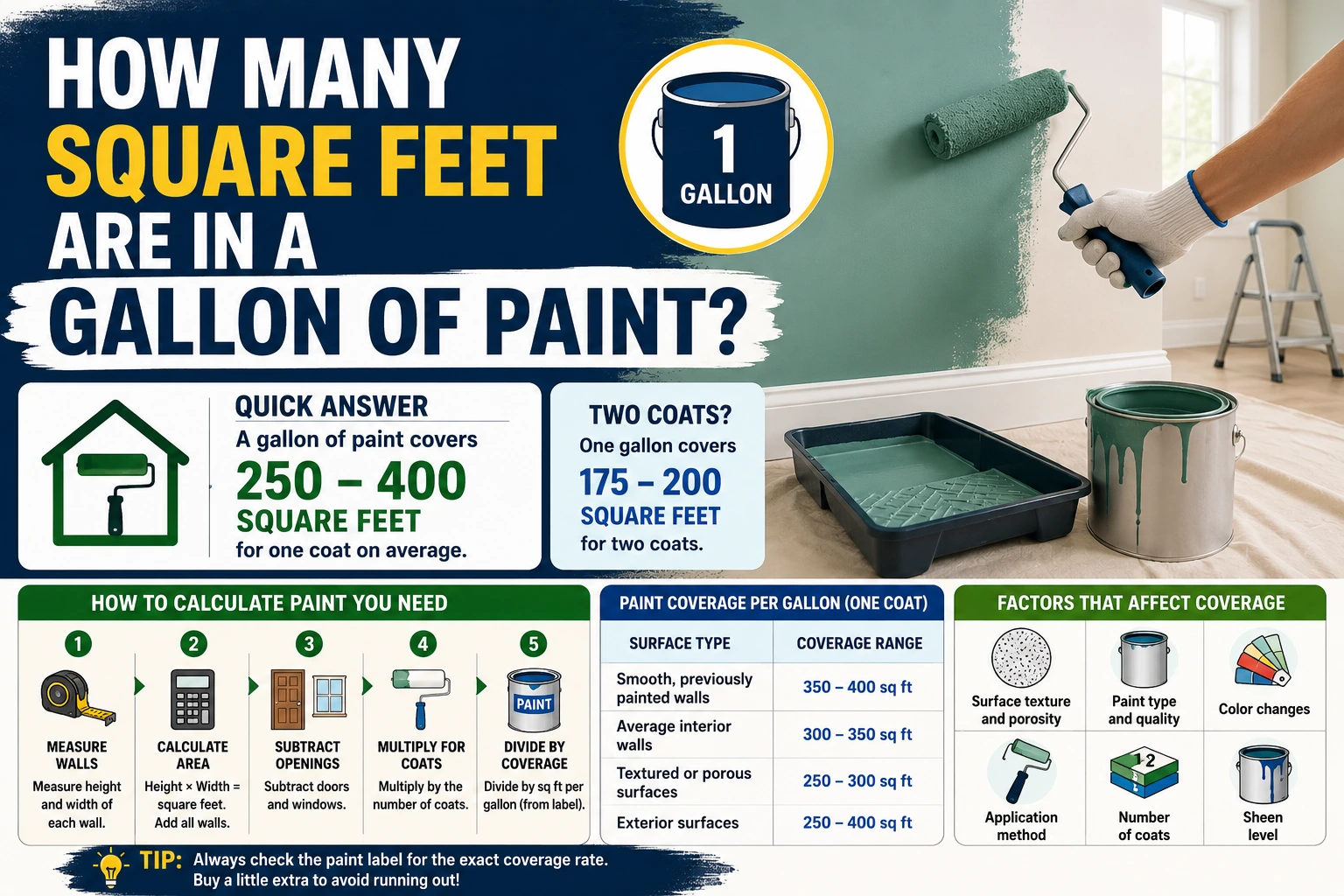
If you are asking how many square feet are in a gallon of paint, the usual answer is between 250 and 400 square feet for one coat.
Many interior paints cover close to 350 to 400 square feet per gallon on smooth, previously painted walls. However, rough, porous, dark, damaged, or textured surfaces can reduce coverage. Some paint brands list coverage ranges of 250 to 400 square feet per gallon, while selected premium paints may list coverage of about 400 to 450 square feet per gallon.
The exact amount depends on the paint type, surface condition, number of coats, color change, and application method. That is why the best estimate always starts with the coverage rate printed on your paint can.
This guide explains paint coverage per gallon, how to measure your walls, how many gallons you may need for common rooms, and how to avoid buying too much or too little paint.
Quick Answer: How Many Square Feet Are in a Gallon of Paint?
A gallon of paint typically covers:
| Paint Situation | Estimated Coverage Per Gallon |
|---|---|
| Smooth interior wall, one coat | 350–400 sq ft |
| Average wall, one coat | 300–350 sq ft |
| Textured or porous wall, one coat | 250–300 sq ft |
| Exterior siding, one coat | 250–400 sq ft |
| Two coats on a smooth wall | 175–200 sq ft |
A simple planning rule is:
One gallon of paint covers about 350 square feet for one coat.
However, do not treat this as a guarantee. Paint makers note that product needs can change based on surface condition and application method, so a calculator provides an estimate rather than an exact promise.
How Many Square Feet Are in a Gallon of Paint for One Coat?
For one coat, a gallon usually covers 250 to 400 square feet.
This range is wide because not every wall absorbs paint in the same way. A smooth, clean drywall surface may need much less paint than raw wood, brick, stucco, textured plaster, or an old wall with repairs.
Average Coverage Range
Most homeowners can use these simple estimates:
- 400 square feet: smooth wall, similar color, quality paint
- 350 square feet: average painted wall
- 300 square feet: light texture or moderate color change
- 250 square feet: rough, porous, unpainted, or exterior surface
For example, some interior paint products are rated for 250 to 400 square feet per gallon, while Benjamin Moore’s ben interior acrylic paint lists 400 to 450 square feet per gallon.
Why Paint Labels Matter
The label on the can is more useful than a general rule because each formula is different.
Coverage can change based on:
- Paint thickness
- Sheen
- Pigment level
- Surface type
- Whether primer is needed
- Brush, roller, or spray application
- Temperature and humidity
Always read the manufacturer’s coverage range before buying. If the label says 350 square feet per gallon, use that number in your calculation instead of assuming 400 square feet.
How Many Square Feet Are in a Gallon of Paint for Two Coats?
If you need two coats, one gallon covers about half the area.
For example:
- At 400 square feet per gallon for one coat, it covers about 200 square feet for two coats.
- At 350 square feet per gallon for one coat, it covers about 175 square feet for two coats.
- At 300 square feet per gallon for one coat, it covers about 150 square feet for two coats.
This is one of the most common paint-estimating mistakes. People calculate wall area for one coat, then forget to double the area for a second coat.
Two coats are often a good idea when:
- Painting a light color over a dark color
- Painting a dark color over a light color
- Covering stains or patched areas
- Using a lower-coverage paint
- Painting new drywall
- Painting a rough surface
- Creating a more even finish
Some paints advertise one-coat coverage in specific colors or conditions. Still, a second coat may be needed for the best durability and uniform appearance.
Paint Coverage Per Gallon Chart
Use this chart as a quick guide when planning a painting project.
| Wall Area | One Coat at 350 Sq Ft/Gallon | Two Coats at 350 Sq Ft/Gallon |
| 100 sq ft | 1 quart may be enough | 1 gallon |
| 200 sq ft | 1 gallon | 2 gallons |
| 350 sq ft | 1 gallon | 2 gallons |
| 500 sq ft | 2 gallons | 3 gallons |
| 700 sq ft | 2 gallons | 4 gallons |
| 1,000 sq ft | 3 gallons | 6 gallons |
| 1,500 sq ft | 5 gallons | 9 gallons |
These are rounded purchase estimates. Paint is commonly sold in quarts, one-gallon cans, and five-gallon buckets. Buying slightly more than the exact calculation can help you avoid running out before the project is complete.
How to Calculate How Much Paint You Need
You can estimate paint needs with a tape measure and a calculator.
Step 1: Measure Each Wall
Measure the width and height of each wall in feet.
For example:
- Wall width: 12 feet
- Wall height: 8 feet
12 × 8 = 96 square feet
That wall has 96 square feet of paintable area.
Step 2: Find Total Wall Square Footage
Add the area of every wall.
For a 12-foot by 12-foot room with 8-foot ceilings:
- Four walls
- Each wall is 12 feet wide and 8 feet high
- One wall area: 96 square feet
- Four walls: 96 × 4 = 384 square feet
The total wall area is 384 square feet.
Step 3: Subtract Doors and Windows
You can subtract large openings for a more accurate estimate.
A common estimate is:
- Standard door: about 20 square feet
- Average window: about 15 square feet
For example, if the room has one door and two windows:
384 – 20 – 30 = 334 square feet
Your paintable wall area is about 334 square feet.
Step 4: Multiply for Extra Coats
If you need two coats:
334 × 2 = 668 square feet of coverage needed
Step 5: Divide by Paint Coverage
If your paint covers 350 square feet per gallon:
668 ÷ 350 = 1.91 gallons
You should buy 2 gallons of paint.
How Many Square Feet Does a Gallon of Paint Cover in Common Rooms?
Room size alone does not tell you the exact paint amount. Ceiling height, doors, windows, closets, and trim all change the result. Still, these examples provide a useful starting point.
Small Bedroom
A 10-foot by 10-foot room with 8-foot ceilings has:
- Wall perimeter: 40 feet
- Wall area: 40 × 8 = 320 square feet
- Less one door and one window: about 285 square feet
For one coat, one gallon may be enough. For two coats, plan on two gallons.
Medium Bedroom
A 12-foot by 12-foot room with 8-foot ceilings has about 384 square feet of wall area before subtracting openings.
For two coats, most people should plan for 2 gallons of paint.
Living Room
A 15-foot by 20-foot living room with 8-foot ceilings has:
- Perimeter: 70 feet
- Wall area: 70 × 8 = 560 square feet
After subtracting doors and windows, the paintable area may be around 480 to 520 square feet.
For two coats, you may need 3 gallons.
Bathroom
A small bathroom may have only 150 to 250 square feet of paintable wall area after subtracting the door, window, tile, vanity, and shower area.
A quart may work for a small touch-up project, but one gallon is usually safer for a full bathroom repaint.
Ceiling
To paint a ceiling, multiply the room length by its width.
For a 12-foot by 12-foot ceiling:
12 × 12 = 144 square feet
One gallon can usually cover a standard bedroom ceiling with one or two coats, depending on the paint and surface.
What Affects Paint Coverage Per Gallon?
Paint coverage is not fixed. Several factors can make one gallon go farther or run out sooner.
Surface Texture and Porosity
Textured, rough, or porous surfaces absorb more paint.
Examples include:
- Stucco
- Brick
- Raw drywall
- Bare wood
- Concrete
- Heavily textured plaster
- Popcorn ceilings
These surfaces have more tiny gaps and surface area than smooth drywall. They often need primer and extra paint.
Paint Type and Quality
Higher-quality paint may offer better hiding power and a more consistent finish. However, every product has its own stated coverage rate.
Do not assume expensive paint always covers more area. Compare the label, finish, recommended coats, and surface instructions.
Color Changes
Painting white over beige may need less paint than painting white over deep red, navy, black, or bright yellow.
Dramatic color changes often need:
- A tinted primer
- A second coat
- Sometimes a third coat
Application Method
A roller is usually efficient for walls. Brushes are best for edges and trim. Sprayers are fast but can create more overspray and waste if used incorrectly.
Roller nap also matters. A thicker roller holds more paint and works well on texture, but it may use more paint than a smooth-wall roller.
Number of Coats
Every additional coat increases the amount of paint needed.
If your project requires two coats, double the coverage area in your calculation before dividing by the gallon coverage rate.
Interior vs Exterior Paint Coverage
Interior and exterior projects may use similar coverage ranges, but exterior surfaces often need more paint.
Exterior walls can include:
- Siding
- Brick
- Stucco
- Trim
- Fascia
- Shutters
- Gutters
- Gables
Outdoor surfaces may be rough, weathered, porous, or uneven. As a result, coverage can be closer to 250 square feet per gallon than 400 square feet per gallon. Behr’s exterior guidance also lists 250 to 400 square feet per gallon and notes that porous, rough, textured, unpainted surfaces and major color changes may require more paint.
For exterior work, measure carefully and include all trim, gables, and hard-to-reach areas.
How Much Paint Do You Need for 1,000 Square Feet?
For 1,000 square feet of paintable surface:
| Number of Coats | Coverage Rate | Gallons Needed |
| One coat | 400 sq ft/gallon | 3 gallons |
| One coat | 350 sq ft/gallon | 3 gallons |
| One coat | 250 sq ft/gallon | 4 gallons |
| Two coats | 400 sq ft/gallon | 5 gallons |
| Two coats | 350 sq ft/gallon | 6 gallons |
| Two coats | 250 sq ft/gallon | 8 gallons |
For a two-coat project with average paint, 6 gallons is a practical estimate for 1,000 square feet.
If you need five or more gallons, compare the cost of individual cans with a five-gallon pail. A larger container can also help keep the color more consistent across a big project.
Common Mistakes When Estimating Paint
Avoid these common errors before you start painting.
Forgetting the Second Coat
Always multiply the paintable area by the number of coats.
Measuring Floor Area Instead of Wall Area
A 12-foot by 12-foot room has 144 square feet of floor space, but its walls have much more paintable area.
Ignoring Ceiling Height
Rooms with 9-foot, 10-foot, or vaulted ceilings need more paint than rooms with standard 8-foot ceilings.
Skipping Primer on Problem Surfaces
Primer can improve adhesion and reduce uneven absorption. It is especially helpful on bare drywall, stained walls, repaired areas, and dramatic color changes.
Buying Exactly the Minimum Amount
Paint can be lost in trays, rollers, brushes, spills, cut-in work, and touch-ups. A small extra amount is often worth having.
Expert Tips to Make One Gallon of Paint Go Further
Use these tips for a smoother job and more accurate coverage.
- Clean dust, grease, and dirt from walls before painting.
- Repair holes and sand rough patches.
- Prime bare or stained areas when needed.
- Use the roller nap recommended for your wall texture.
- Stir paint thoroughly before and during use.
- Apply even coats instead of overly thick coats.
- Keep a small amount for future touch-ups.
- Mix multiple gallons together in one large bucket for consistent color on large jobs.
- Buy paint from the same batch when possible.
- Use the paint maker’s calculator as a final check before purchasing.
Frequently Asked Questions About Paint Coverage
Does one gallon of paint cover 400 square feet?
It can. One gallon may cover about 400 square feet on a smooth surface with one coat. However, many paints list a range of 250 to 400 square feet, and rough or porous surfaces may reduce coverage.
How much paint do I need for a 12×12 room?
A 12×12 room with 8-foot ceilings has about 384 square feet of wall area before subtracting doors and windows. For two coats, two gallons are usually a safe estimate.
How many gallons of paint do I need for 1,000 square feet?
For one coat, you may need 3 to 4 gallons depending on the paint’s coverage rate. For two coats, expect about 5 to 8 gallons. At 350 square feet per gallon, plan for 6 gallons for two coats.
Does a second coat double the amount of paint needed?
Usually, yes. If you need two full coats, you should double the total paintable square footage in your calculation. Some second coats may use slightly less paint, but planning for two full coats is safer.
Should I buy extra paint for touch-ups?
Yes. Keep a small sealed amount of leftover paint for future repairs, scuffs, nail holes, and touch-ups. Store it in a cool, dry place and label it with the room name and paint color.
Conclusion: How Many Square Feet Are in a Gallon of Paint?
So, how many square feet are in a gallon of paint? Most gallons cover about 250 to 400 square feet for one coat, with around 350 square feet being a useful average for planning.
Smooth, previously painted walls may get closer to the high end of the range. Textured, porous, damaged, or unpainted surfaces may need more paint. If you plan to apply two coats, remember that one gallon will effectively cover only about half as much wall area.
For the best estimate, measure your paintable surfaces, subtract large doors and windows, multiply for the number of coats, and divide by the coverage rate printed on the can. This simple method helps you buy enough paint, control costs, and finish your project without an unexpected trip back to the store.
Discover more