

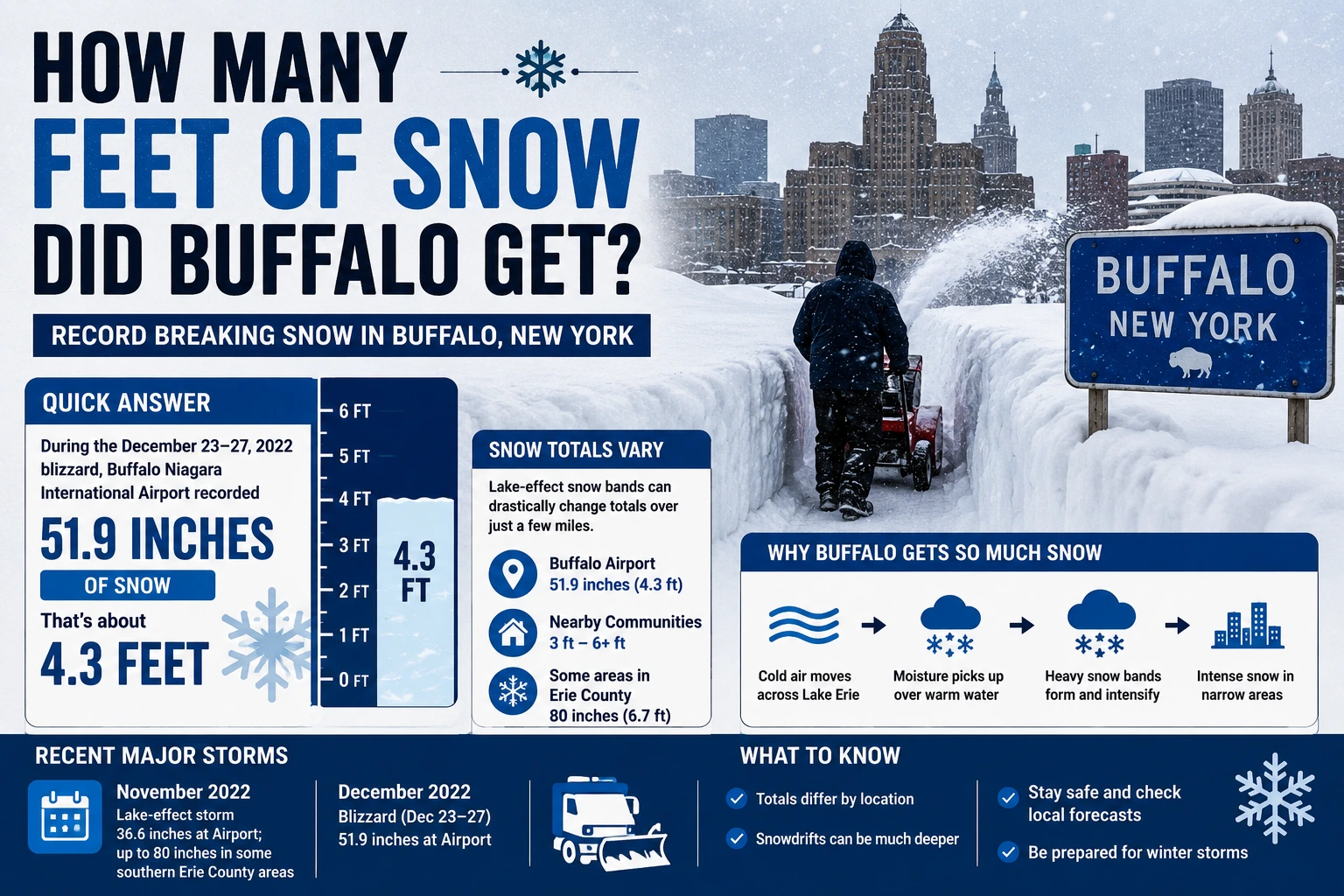
If you are asking how many feet of snow did Buffalo get, the answer depends on the storm, the year, and the exact location in the Buffalo area.
During the December 2022 blizzard, Buffalo Niagara International Airport recorded 51.9 inches of snow, which equals about 4.3 feet. However, some locations in the wider Buffalo and Western New York region received much higher lake-effect snowfall totals during major events. In some storms, communities south of Buffalo have measured more than 6 feet of snow.
Buffalo is famous for heavy winter weather because it sits near Lake Erie. When cold air moves over the warmer lake water, it can create narrow but intense snow bands. One neighborhood may get a few inches, while another area only a short drive away may get several feet.
This guide explains Buffalo snow totals, the 2022 blizzard, lake-effect snow, historic storms, snowfall measurements, and why totals can change so much across the region.
Quick Answer: How Many Feet of Snow Did Buffalo Get?
The most widely discussed recent answer comes from the December 2022 blizzard.
Buffalo Niagara International Airport received 51.9 inches, or about:
4 feet and 3.9 inches of snow
To convert inches to feet:
51.9 ÷ 12 = 4.325 feet
So, Buffalo received a little more than 4.3 feet of snow at the airport during that storm.
However, the Buffalo area is not one single snowfall point. Lake-effect snow bands can create very different totals across Erie County and nearby communities. The National Weather Service reported a maximum Lake Erie snowfall total of 51.9 inches at Buffalo Airport during the December 23–27, 2022 event.
How Many Feet of Snow Did Buffalo Get in the 2022 Blizzard?
When people search how many feet of snow did Buffalo get, they are often referring to the deadly December 2022 blizzard.
The storm affected Western New York from December 23 through December 27. It combined heavy lake-effect snow, dangerous wind, bitter cold, whiteout conditions, and major travel disruption.
Buffalo Airport Snowfall Total
Buffalo Niagara International Airport recorded 51.9 inches of snow during the event.
That is equal to:
| Snowfall Measurement | Amount |
|---|---|
| Inches | 51.9 inches |
| Feet | 4.325 feet |
| Feet and inches | 4 feet, 3.9 inches |
| Centimeters | About 132 cm |
The airport total is often used as the official Buffalo reference point. It is important to remember that airport measurements may not match snowfall in every neighborhood or suburb.
Snowfall Totals in Nearby Communities
During major lake-effect events, snowfall can vary sharply over short distances.
For example, during the November 2022 lake-effect storm, Buffalo Airport measured 36.6 inches, while areas such as Hamburg and Orchard Park received much higher totals. Reports from the wider storm area included around 80 inches in parts of southern Erie County.
This means one place may receive about 3 feet of snow while another nearby community gets more than 6 feet.
Why the Blizzard Felt Worse Than the Snow Total Alone
The December 2022 storm was not dangerous only because of snowfall.
It also brought:
- Whiteout conditions
- Strong wind gusts
- Snowdrifts that buried vehicles
- Extremely poor visibility
- Road closures and travel bans
- Power outages
- Emergency response delays
- Very cold wind chills
Wind can move snow into deep drifts. Even if the measured snowfall is around 4 feet, a drift near a house, driveway, or parked car can be much deeper.
Buffalo Snowfall Totals in Inches and Feet
This chart makes it easier to understand common Buffalo snowfall totals.
| Inches of Snow | Feet of Snow |
| 12 inches | 1 foot |
| 24 inches | 2 feet |
| 36 inches | 3 feet |
| 48 inches | 4 feet |
| 51.9 inches | 4.3 feet |
| 60 inches | 5 feet |
| 72 inches | 6 feet |
| 80 inches | 6.7 feet |
A snowfall total of 51.9 inches is just over 4 feet. A total of 80 inches is about 6 feet and 8 inches.
Why Buffalo Gets So Much Snow
Buffalo’s heavy snow is strongly connected to its location near Lake Erie.
What Is Lake-Effect Snow?
Lake-effect snow happens when cold air moves across relatively warmer lake water.
The lake adds heat and moisture to the cold air. As that air moves inland, it rises, cools, and forms snow clouds. If the wind direction stays steady, the snow can fall in a narrow band for many hours.
This is why lake-effect snow can produce extreme totals in a small area.
How Lake Erie Creates Heavy Snow Bands
Lake Erie is shallow compared with some other Great Lakes. It can cool and freeze more quickly later in winter, but before it freezes, it can supply large amounts of moisture to the atmosphere.
A strong lake-effect event usually needs:
- Cold air moving over warmer lake water
- Enough moisture from the lake
- A steady wind direction
- An unstable atmosphere
- A snow band that stays over one location
- Temperatures cold enough for snow
When these conditions line up, snowfall rates can become intense.
Why Some Buffalo Suburbs Get More Snow Than the City
The heaviest lake-effect snow often falls south and east of Buffalo, depending on wind direction.
Areas closer to the usual snow bands may receive much higher totals than the city center or airport.
Snowfall can differ because of:
- Wind direction
- Distance from Lake Erie
- Elevation
- Local terrain
- Band movement
- How long the snow band remains in place
That is why a single “Buffalo snow total” should always be read with the measurement location in mind.
Buffalo’s Biggest Recent Snowstorms
Buffalo has experienced many major snow events, but 2022 was especially memorable because two major lake-effect storms occurred within weeks of each other.
November 2022 Lake-Effect Snowstorm
In November 2022, Buffalo Airport recorded 36.6 inches of snow during a lake-effect event. The Northeast Regional Climate Center noted that this ranked as Buffalo’s seventh-largest three-day snowfall total at the airport, with records dating back to 1884.
However, the highest totals were not at the airport. Parts of southern Erie County received far more snow, with reports around 80 inches in some locations.
December 2022 Blizzard
The December 2022 blizzard brought 51.9 inches to Buffalo Airport over several days. It also brought strong winds that made the storm especially dangerous.
The National Weather Service’s event archive lists 51.9 inches as the maximum Lake Erie total at Buffalo Airport for the December 23–27 storm.
Historic Snowfall in Southern Erie County
Southern Erie County is often in the path of heavy lake-effect bands. In the November 2022 event, some communities received more than 6 feet of snow.
This does not mean every part of Buffalo gets 6 feet during every storm. Instead, it shows how localized lake-effect snow can be.
How Buffalo Snowfall Is Measured
Official snowfall measurements are usually taken on a flat, open surface away from buildings, trees, and drifting snow.
Weather observers measure fresh snow using a ruler or snow board. They often clear the board at set times so the snow does not compact too much before being measured.
Snowfall totals are different from snow depth.
- Snowfall total means all snow that fell during a period.
- Snow depth means how much snow is sitting on the ground at one time.
- Snowdrift depth means wind-blown snow piled into one area.
For example, a storm may produce 4 feet of snowfall, but the snow depth on the ground may be lower because snow settles and compacts. A drift may be much higher because wind pushes snow into one location.
Buffalo Snow Totals Can Vary Greatly by Location
One of the biggest mistakes people make is assuming every location in Buffalo receives the same snowfall.
Lake-effect snow can create a sharp boundary. One neighborhood may have light snow, while another gets intense snowfall only a few miles away.
Here is a simple example:
| Location Type | Possible Snowfall During One Event |
| North of the main snow band | A few inches |
| Buffalo Airport area | Several inches to several feet |
| Southtowns in a persistent band | Several feet |
| Higher-elevation locations | Potentially even higher totals |
The exact numbers change with every storm. The key point is that Buffalo snowfall is highly local.
How Much Snow Is 51.9 Inches in Feet?
To convert inches to feet, divide by 12.
51.9 ÷ 12 = 4.325
So, 51.9 inches equals:
- 4.325 feet
- About 4.3 feet
- 4 feet and nearly 4 inches
For quick weather conversions:
- 24 inches = 2 feet
- 36 inches = 3 feet
- 48 inches = 4 feet
- 60 inches = 5 feet
- 72 inches = 6 feet
Real-Life Comparisons: What Does 4 to 6 Feet of Snow Look Like?
Four feet of snow is taller than many young children. It can cover car wheels, block sidewalks, and make driveways hard to clear.
Six feet of snow is close to the height of an average adult. In areas with deep drifts, snow can cover vehicles, block doors, and make travel impossible without heavy equipment.
Here is how major snow totals may look:
| Snow Depth | Everyday Comparison |
| 1 foot | Around knee height for many adults |
| 2 feet | Near waist height for a small child |
| 4 feet | Around chest height for a child |
| 5 feet | Taller than many adults when drifted |
| 6 feet | Near the height of an average adult |
These comparisons are only visual guides. Fresh snow, packed snow, and wind-blown drifts can look very different.
Why Wind and Snowdrifts Matter as Much as Snowfall Totals
A snowfall total does not show the full danger of a blizzard.
Strong winds can:
- Blow snow across roads
- Reduce visibility to near zero
- Create deep drifts
- Cover freshly cleared driveways
- Make roads look clear in one place and blocked in another
- Cause dangerous wind chills
- Trap vehicles or block emergency access
During the December 2022 storm, the National Weather Service and other reports documented severe wind conditions along with the heavy snow. The airport recorded 51.9 inches, while wind made travel and emergency response far more difficult.
Common Mistakes When Reading Buffalo Snow Totals
Avoid these common misunderstandings.
Confusing Buffalo Airport With Every Part of Buffalo
Airport totals are official and useful, but they do not represent every neighborhood.
Mixing Snowfall With Snow Depth
A storm total tells you how much snow fell. It does not always show how much remains on the ground later.
Treating Drifts as Official Snowfall
A 10-foot drift does not mean 10 feet of snow fell. Wind may have moved snow from a wide area into one spot.
Comparing Different Time Periods
A 24-hour total, three-day total, monthly total, and seasonal total are not directly comparable.
Ignoring Lake-Effect Snow Bands
Lake-effect snow is highly localized. Always check the exact location and measurement period.
Winter Preparation Tips for Heavy Buffalo Snow
Heavy snow is a normal winter risk in the Buffalo region. Preparation can reduce stress and improve safety.
- Follow local weather alerts and travel advisories.
- Keep a snow shovel, ice melt, flashlight, batteries, and warm blankets ready.
- Avoid driving during whiteout conditions.
- Keep your vehicle fuel tank reasonably full.
- Clear snow away from furnace and dryer vents.
- Do not run a vehicle in an enclosed garage.
- Check on older neighbors, family members, and people with limited mobility.
- Keep phones charged before a major storm.
- Use caution when shoveling heavy, wet snow.
- Watch for roof snow loads after repeated storms.
For current weather, warnings, and local snowfall reports, use the official National Weather Service Buffalo office.
Frequently Asked Questions About Buffalo Snowfall
How many feet of snow did Buffalo get in the 2022 blizzard?
Buffalo Niagara International Airport recorded 51.9 inches during the December 2022 blizzard. That equals about 4.3 feet of snow.
Did Buffalo get 6 feet of snow?
Some communities in the wider Buffalo and southern Erie County region received more than 6 feet during major lake-effect events, especially in November 2022. Buffalo Airport itself recorded 36.6 inches during that November event, while some nearby locations reported much higher totals.
What is Buffalo’s highest snowfall total?
The answer depends on the measurement location and time period. Buffalo Airport has official records, while nearby lake-effect zones can receive much higher totals during individual storms. Always compare the same location and duration when reviewing snowfall records.
Why does Buffalo get more snow than other cities?
Buffalo is near Lake Erie. Cold air moving over the relatively warmer lake picks up moisture and can create intense lake-effect snow bands. These bands can stay over one area for hours and produce heavy snowfall.
How much snow does Buffalo get in an average winter?
Average snowfall depends on the official weather station and the climate period used. The most reliable way to check long-term averages is through NOAA climate normals, which provide standardized 30-year climate data for weather stations.
Conclusion: How Many Feet of Snow Did Buffalo Get?
So, how many feet of snow did Buffalo get? During the December 2022 blizzard, Buffalo Niagara International Airport recorded 51.9 inches, which equals about 4.3 feet of snow.
Yet Buffalo-area snowfall is not uniform. Lake-effect snow can cause one community to receive a few inches while another nearby area gets several feet. During major storms, some parts of southern Erie County have received more than 6 feet.
When checking Buffalo snow totals, always look at the exact location, storm dates, and whether the number refers to snowfall, snow depth, or drifting. That context gives a much clearer picture of Buffalo’s famous winter weather.
Discover more