
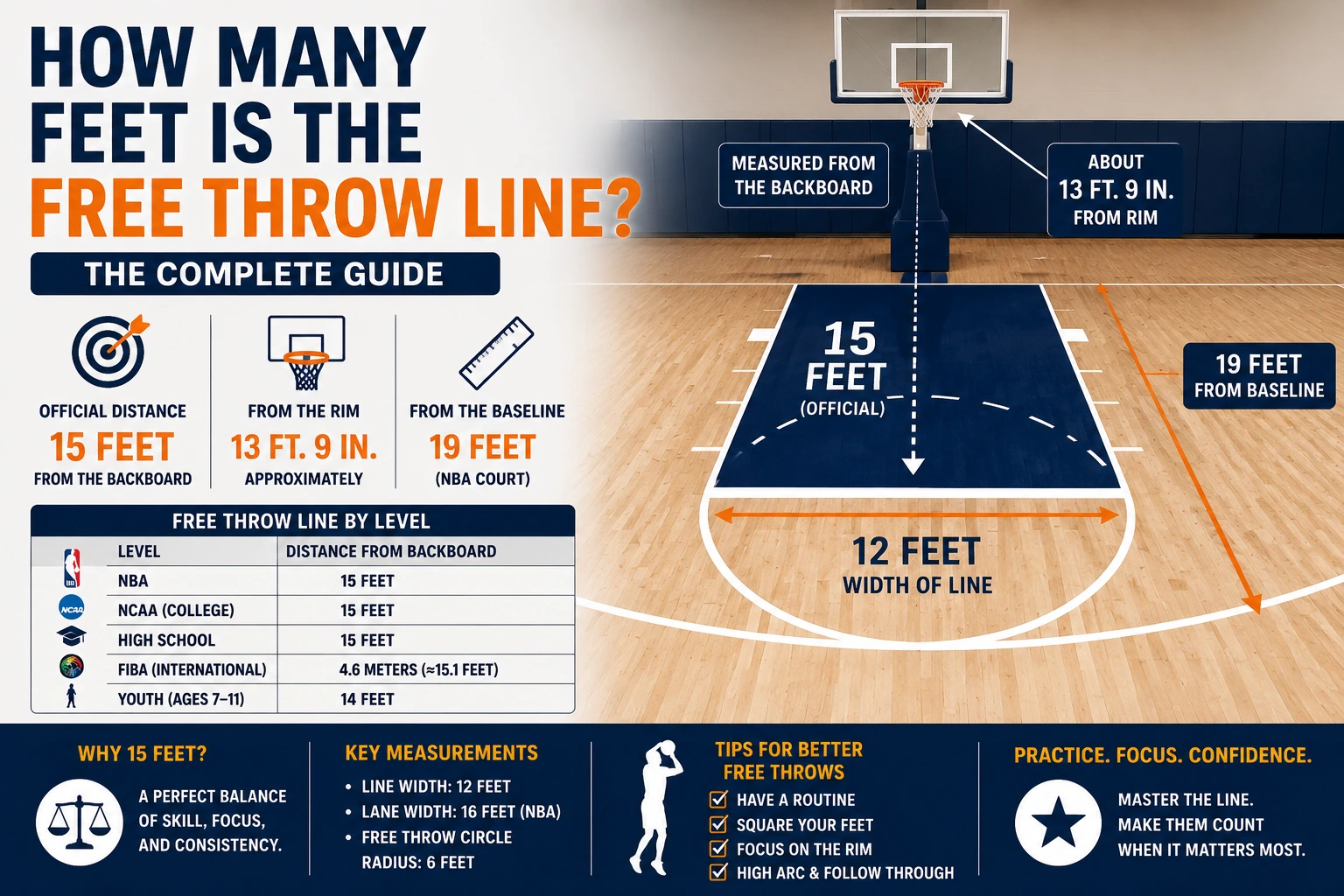
If you are asking how many feet free throw line distance is, the official answer is simple: the free throw line is 15 feet from the plane of the front of the backboard.
This measurement is used on regulation NBA, NCAA, and most high school basketball courts. The line is also known as the foul line because players shoot from it after certain fouls.
However, people sometimes say the free throw line is about 13 feet 9 inches from the rim. That can also be correct, depending on where the measurement begins. The official court measurement starts at the front face of the backboard, not at the rim.
Understanding this difference is useful when building a home court, marking a driveway hoop area, coaching young players, or simply learning basketball court dimensions.
Quick Answer: How Many Feet Is the Free Throw Line?
The standard basketball free throw line is:
15 feet from the front plane of the backboard.
It is also:
- About 13 feet 9 inches from the front of the rim
- 19 feet from the baseline on a standard court
- 12 feet wide across the lane area
- Part of the free throw lane, also called the key or paint
The NBA rulebook states that the free throw line is drawn parallel to the end line and is 15 feet from the plane of the face of the backboard.
Official Free Throw Line Distance
The official measurement is not taken from the basket itself. It is measured from the vertical plane of the backboard’s front face.
That means you start at the front of the backboard and measure straight out onto the court for 15 feet.
This keeps court measurements consistent because basketball rims extend forward from the backboard.
Distance From the Rim vs. Backboard
A regulation rim extends 18 inches from the backboard. Because of that, the free throw line is closer to the rim than it is to the backboard.
Here is the simple calculation:
[
15 \text{ feet} – 1.5 \text{ feet} = 13.5 \text{ feet}
]
However, measurements are commonly described as about 13 feet 9 inches from the front of the rim, depending on the exact reference point used for the basket and court diagram.
For court marking, use the official 15-foot measurement from the backboard plane rather than guessing from the rim.
How Many Feet Free Throw Line Is From the Basket?
Many players ask how far the free throw line is from the basket because they naturally look at the rim while shooting.
The best answer is:
The free throw line is approximately 13 feet 9 inches from the front of the rim, but the official measurement is 15 feet from the backboard.
Why People Get Different Answers
Different answers happen because people may measure from:
- The front of the backboard
- The center of the rim
- The front edge of the rim
- The back edge of the rim
- The center of the basket support
Only one measurement is used for official court marking: 15 feet from the front face of the backboard.
For players, the rim distance can be useful as a visual reference. For builders and coaches, the backboard measurement is the one that matters.
The 13 Feet 9 Inches Measurement
A common basketball court reference describes the foul line as 13 feet 9 inches from the basket area, while the official line remains 15 feet from the backboard.
This is why you may see both numbers online. They are not necessarily conflicting; they use different starting points.
How Many Feet Free Throw Line Is From the Backboard?
The free throw line is exactly:
15 feet from the front of the backboard.
This is the correct number to use when painting or taping a court.
Official 15-Foot Measurement
To mark the line correctly:
- Find the front plane of the backboard.
- Measure 15 feet straight toward the center of the court.
- Mark a straight line parallel to the baseline.
- Make the line 12 feet wide across the free throw lane.
The NBA also identifies the free throw line as 19 feet from the baseline, which is helpful when you are marking a full court.
Where to Start Measuring
Do not measure from:
- The pole behind the hoop
- The center of the backboard
- The front edge of the rim
- The wall behind the hoop
- The baseline alone, unless your baseline and backboard are already set correctly
Start from the front face of the backboard and measure outward on the floor.
Free Throw Line Distance by Basketball Level
For most standard basketball games, the free throw distance is the same.
NBA Free Throw Line
In the NBA, the free throw line is 15 feet from the plane of the backboard. The NBA free throw lane is 16 feet wide.
NCAA and High School Free Throw Line
College and high school basketball also use a 15-foot free throw line from the backboard. The lane width may differ by level, but the shooting distance stays the same.
The NCAA and NBA have different three-point lines and lane dimensions, yet the free throw line measurement remains consistent.
FIBA Free Throw Line
FIBA courts use metric measurements. The free throw line is 4.6 meters from the point on the floor directly below the backboard, which is about 15.1 feet.
The small difference comes from metric conversion and court-specification methods.
Youth Basketball Free Throw Line
Younger players may use a shorter free throw distance to help them learn proper shooting form.
For players ages 7–8 and 9–11, USA Basketball recommends free throws from 14 feet from the basket.
This shorter distance helps young players avoid forcing the ball toward the rim with poor mechanics.
Free Throw Line Distance Chart
| Basketball Level | Free Throw Distance | Measurement Reference |
|---|---|---|
| NBA | 15 feet | Front plane of backboard |
| NCAA | 15 feet | Front plane of backboard |
| High school | 15 feet | Front plane of backboard |
| FIBA | 4.6 meters / about 15.1 feet | Point below backboard |
| Youth ages 7–11 | 14 feet | Basket reference |
| Front of rim reference | About 13 ft. 9 in. | Front edge of rim |
The key point is that regulation adult basketball uses a 15-foot free throw line.
Understanding the Free Throw Lane and Key
The free throw line is part of a larger marked area called the free throw lane. Players often call it the key, lane, or paint.
Free Throw Line Width
The free throw line is 12 feet wide. It connects the two sides of the free throw lane.
The shooter stands behind this line during a free throw attempt. Players lining up for rebounds stand in marked lane spaces along the sides.
Lane Width
Lane width changes by league.
| League | Lane Width |
| NBA | 16 feet |
| NCAA | 12 feet |
| High school | Usually 12 feet |
| FIBA | About 16.1 feet |
Even though the lane can be wider or narrower, the free throw line distance remains close to 15 feet.
Free Throw Circle
The free throw circle sits around the free throw line. It has a 6-foot radius, making the full circle 12 feet across.
Part of the circle is inside the lane and part extends outside it. Players use the area for positioning and movement during play.
Baseline to Free Throw Line
On a standard NBA court, the free throw line is 19 feet from the baseline. This includes the 4 feet from the baseline to the backboard plane plus the 15-foot distance from the backboard to the free throw line.
This is useful when setting up court lines on a driveway or gym floor.
How to Measure and Mark a Free Throw Line
You can mark a practice free throw line at home with a tape measure, chalk, paint, or floor tape.
Step 1: Find the Backboard Plane
Identify the front surface of the backboard. Imagine a straight vertical line dropping from its front edge to the floor.
This is your official starting point.
Step 2: Measure 15 Feet Onto the Court
Measure 15 feet straight out from the backboard toward the court.
Use a long tape measure and keep it centered with the hoop.
Step 3: Mark the Line and Lane
Mark a line that is 12 feet wide. It should run parallel to the baseline.
If you are creating a full practice key:
- Mark the lane sides
- Add the free throw circle
- Add lane spaces if needed
- Check that the hoop is centered
Step 4: Check Your Measurements
Measure from both sides of the backboard to make sure the line is straight.
A crooked free throw line can make a home court look uneven and may affect player alignment during practice.
Why the Free Throw Line Is 15 Feet Away
The 15-foot distance has been part of basketball for generations. It creates a shot that rewards balance, focus, and repeatable form.
Balance Between Skill and Consistency
A free throw is an uncontested shot. The distance must be challenging enough to require skill but close enough for players to develop consistency.
At 15 feet, players need:
- Proper leg drive
- A stable shooting base
- Good wrist action
- Soft touch
- Consistent follow-through
- Focus under pressure
A Standard Across Major Levels
Keeping the same adult free throw distance across major leagues helps players move from school basketball to college and professional play without relearning the basic shot distance.
The three-point line changes by league, but the free throw line stays familiar.
Free Throw Shooting Tips From the Line
Knowing the distance is helpful, but good shooting habits matter more.
Build a Repeatable Routine
Use the same routine every time.
For example:
- Set your feet.
- Take one or two dribbles.
- Look at your target.
- Bend your knees.
- Shoot smoothly.
- Hold your follow-through.
A routine helps you stay calm in close games.
Use Proper Foot Placement
Place your feet about shoulder-width apart. Keep your shooting-side foot slightly ahead if that feels natural.
Do not step on the line. During a free throw, the shooter must remain behind the line until the ball touches the rim.
Focus on Arc and Follow-Through
A high, soft arc gives the ball a better chance to drop through the hoop.
Finish with your shooting hand pointed toward the basket. Keep your elbow under the ball and avoid pushing the shot from the shoulder.
Practice Under Pressure
Free throws often decide games because they happen when players are tired or nervous.
Practice after running drills, while teammates create noise, or after doing short sprints. This helps you build confidence in game-like situations.
Common Mistakes About Free Throw Line Distance
Measuring From the Rim Instead of the Backboard
The most common mistake is measuring 15 feet from the rim. That makes the line too far away.
Measure 15 feet from the front plane of the backboard.
Confusing the Free Throw Line With the Three-Point Line
The free throw line is inside the key. The three-point line is much farther from the basket and curves around the court.
Using Adult Distance for Young Beginners
A full 15-foot line may encourage younger children to throw the ball with two hands or use poor form. A 14-foot youth line can be more appropriate for younger age groups.
Marking the Line From the Baseline Incorrectly
The line is 19 feet from the baseline on an NBA court, but backyard hoops may not have the same backboard placement. Measure from the backboard first for the most accurate result.
Frequently Asked Questions
How many feet is the free throw line?
The regulation free throw line is 15 feet from the front plane of the backboard.
Is the free throw line 15 feet from the rim?
No. The official 15-foot measurement is from the backboard, not the rim. The line is roughly 13 feet 9 inches from the front of the rim.
How far is the free throw line from the baseline?
On a standard NBA court, the free throw line is 19 feet from the baseline.
Is the free throw line the same in the NBA and high school?
Yes. The standard adult free throw line is 15 feet from the backboard in the NBA, NCAA, and high school basketball.
How far do younger players shoot free throws?
USA Basketball recommends a 14-foot free throw distance for players ages 7–8 and 9–11.
Conclusion: How Many Feet Free Throw Line?
So, how many feet free throw line distance is used in basketball? The regulation answer is 15 feet from the front plane of the backboard.
It is about 13 feet 9 inches from the front of the rim and 19 feet from the baseline on a standard NBA court. While youth programs may use a shorter distance, adult regulation basketball uses the 15-foot measurement.
If you are marking a home court, measure from the backboard, not the rim. Then create a straight 12-foot-wide line parallel to the baseline. With the correct court setup and regular practice, players can build confidence and improve their free throw percentage.
Discover more