
If you’re planning a woodworking project, building a deck, installing a fence, or estimating lumber for wall paneling, you may be wondering how many square feet does a 1x6x16 cover. Knowing this measurement helps you purchase the right amount of lumber while avoiding unnecessary waste or expensive extra trips to the lumber yard.
Although a board labeled 1×6×16 sounds straightforward, there’s an important detail many beginners overlook: dimensional lumber uses nominal sizes, not actual finished dimensions. This difference affects the final coverage calculation.
In this guide, you’ll learn exactly how much area a 1×6×16 board covers, how the calculation works, why actual dimensions matter, and how to estimate the number of boards needed for your next project.
Quick Answer
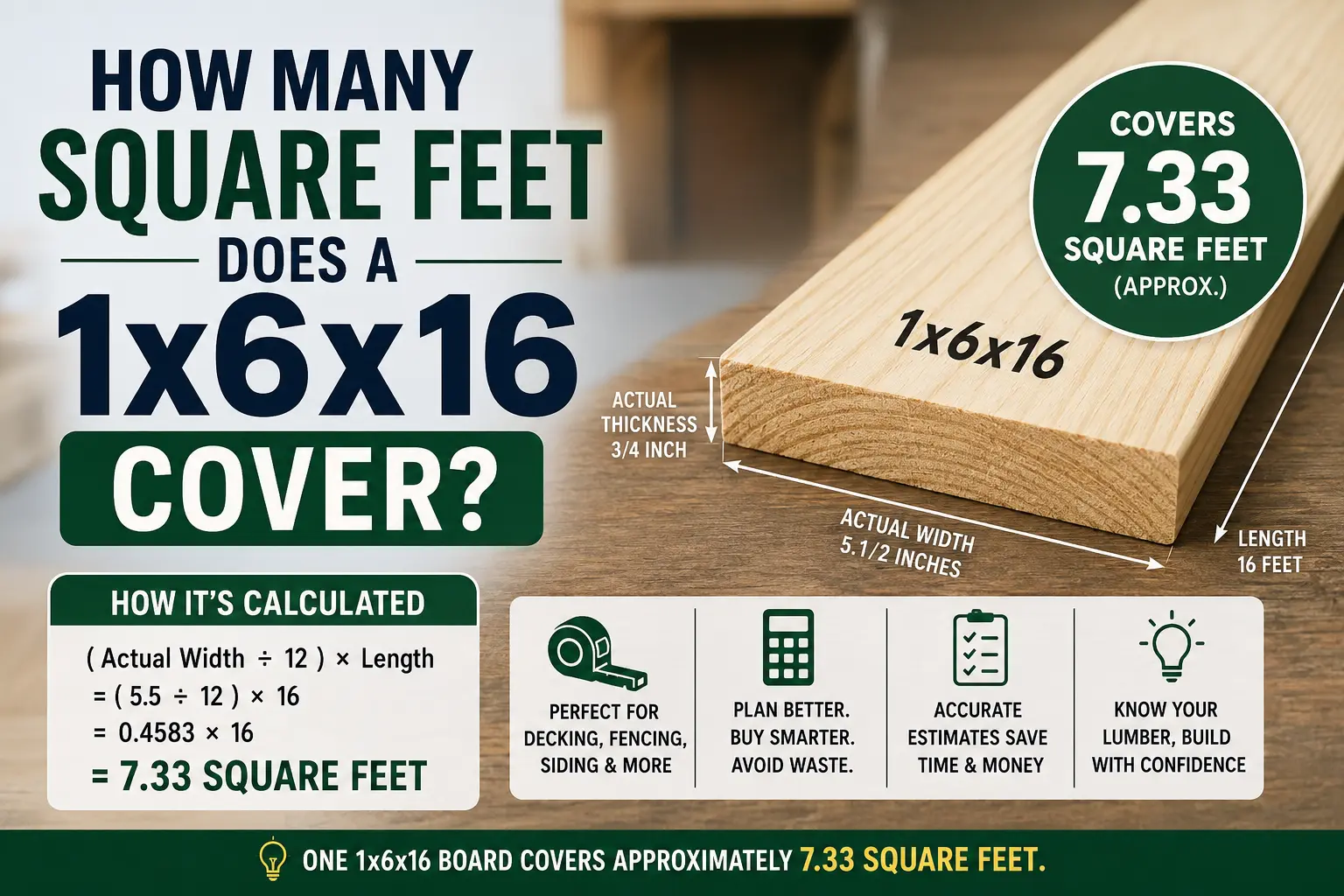
A standard 1×6×16 board covers approximately:
| Board Size | Actual Width | Length | Approximate Coverage |
|---|---|---|---|
| 1×6×16 | 5.5 inches | 16 feet | 7.33 square feet |
Quick Formula
Square Feet = (Width in Inches ÷ 12) × Length in Feet
For a 1×6×16:
- Actual width = 5.5 inches
- Width in feet = 5.5 ÷ 12 = 0.4583 ft
- Length = 16 ft
Coverage:
0.4583 × 16 = 7.33 square feet
Understanding the Actual Size of a 1×6×16 Board
Many people assume a 1×6 board measures exactly 1 inch thick and 6 inches wide. It doesn’t.
Lumber is sold using nominal dimensions, which refer to the board’s size before it is dried and planed.
The finished dimensions are slightly smaller.
| Nominal Size | Actual Size |
|---|---|
| 1×4 | ¾ × 3½ inches |
| 1×6 | ¾ × 5½ inches |
| 1×8 | ¾ × 7¼ inches |
| 1×10 | ¾ × 9¼ inches |
| 1×12 | ¾ × 11¼ inches |
Because the actual width is 5.5 inches, that’s the measurement used when calculating square footage.
How Many Square Feet Does a 1x6x16 Cover?
The board covers approximately 7.33 square feet.
Let’s break down the calculation.
Step 1: Convert Width to Feet
5.5 inches ÷ 12
= 0.4583 feet
Step 2: Multiply by Length
0.4583 × 16
= 7.33 square feet
This is the total surface area of one side of the board.
Formula Explained
The basic formula is:
Square Feet = Width (feet) × Length (feet)
Always use the actual board width, not the nominal width.
Coverage Chart for Common Board Sizes
Here’s a quick comparison of popular lumber sizes.
| Board Size | Length | Coverage |
|---|---|---|
| 1×4×8 | 8 ft | 2.33 sq ft |
| 1×4×12 | 12 ft | 3.5 sq ft |
| 1×6×8 | 8 ft | 3.67 sq ft |
| 1×6×10 | 10 ft | 4.58 sq ft |
| 1×6×12 | 12 ft | 5.5 sq ft |
| 1×6×14 | 14 ft | 6.42 sq ft |
| 1×6×16 | 16 ft | 7.33 sq ft |
| 1×8×16 | 16 ft | 9.67 sq ft |
| 1×10×16 | 16 ft | 12.33 sq ft |
| 1×12×16 | 16 ft | 15 sq ft |
This table is helpful when estimating materials for larger projects.
Board Feet vs Square Feet
Many people confuse board feet with square feet, but they measure different things.
| Square Feet | Board Feet |
|---|---|
| Measures surface area | Measures volume |
| Used for flooring and siding | Used for lumber purchasing |
| Length × Width | Thickness × Width × Length ÷ 12 |
For a 1×6×16 board:
Board Feet =
1 × 6 × 16 ÷ 12
= 8 board feet
Meanwhile, its surface coverage is 7.33 square feet.
Practical Examples
Knowing the coverage helps you estimate materials more accurately.
Decking
Suppose your deck measures:
12 × 16 feet
Total area:
192 square feet
Each board covers:
7.33 square feet
Boards needed:
192 ÷ 7.33
≈ 27 boards
Add 10% extra for cuts and waste.
Final purchase:
30 boards
Fence
Imagine building a decorative privacy fence covering:
220 square feet
Each board:
7.33 sq ft
220 ÷ 7.33
≈ 30 boards
With waste included:
Approximately 33 boards
Wall Paneling
Accent wall size:
10 × 8 feet
Total:
80 square feet
80 ÷ 7.33
≈ 11 boards
Buying 12 boards allows room for trimming.
Shelving
Building long storage shelves?
One 16-foot board can often be cut into:
- Two 8-foot shelves
- Four 4-foot shelves
- Eight 2-foot shelves
Always account for saw blade thickness (kerf), which slightly reduces usable length.
Factors That Affect Coverage
Although the mathematical coverage is 7.33 square feet, actual installed coverage may be lower.
Several factors influence this.
Board Gaps
Deck boards usually have spacing between them.
Common gaps include:
- ⅛ inch
- 3⁄16 inch
- ¼ inch
These gaps reduce the overall covered surface.
Waste
Cuts around corners, windows, or obstacles create waste.
Professionals typically add:
- 5% for simple layouts
- 10% for average projects
- 15–20% for complex designs
Defective Boards
Some boards may contain:
- Large knots
- Warping
- Splits
- Cracks
- Twisting
These defects reduce usable material.
Expansion and Contraction
Wood naturally expands and contracts with changing humidity.
Proper spacing prevents future buckling and ensures long-term durability.
How Many Boards Do You Need?
Here’s a quick reference.
| Project Size | Boards Needed |
|---|---|
| 50 sq ft | 7 boards |
| 100 sq ft | 14 boards |
| 150 sq ft | 21 boards |
| 200 sq ft | 28 boards |
| 250 sq ft | 35 boards |
| 300 sq ft | 41 boards |
| 400 sq ft | 55 boards |
| 500 sq ft | 69 boards |
These estimates assume no waste.
Always purchase extra lumber.
Common Mistakes to Avoid
Many DIY builders make simple estimating errors.
Using Nominal Dimensions
Always calculate with actual measurements.
Ignoring Waste
Every project requires trimming.
Buying the exact number of boards usually isn’t enough.
Forgetting Expansion Gaps
Outdoor projects need spacing to allow wood movement.
Mixing Units
Convert inches into feet before calculating square footage.
Buying Without a Plan
Sketch your layout before purchasing lumber.
A detailed plan reduces waste and saves money.
Expert Tips for Accurate Lumber Estimates
Experienced builders follow a few simple practices.
- Measure twice before ordering.
- Purchase 10–15% extra lumber.
- Check each board for warping before buying.
- Group boards by quality and appearance.
- Use a lumber calculator for large projects.
- Keep leftover boards for future repairs.
- Consider grain direction if appearance matters.
- Store lumber flat before installation to prevent twisting.
These habits improve both project quality and budget accuracy.
FAQs
How many square feet does a 1x6x16 cover?
A standard 1×6×16 board covers approximately 7.33 square feet using its actual width of 5.5 inches.
Why isn’t a 1×6 board actually 6 inches wide?
Lumber dimensions are nominal. After drying and planing, a 1×6 board measures approximately 5.5 inches wide.
How many board feet are in a 1×6×16?
A 1×6×16 contains 8 board feet, which measures lumber volume rather than surface coverage.
How many 1×6×16 boards cover 100 square feet?
You’ll need about 14 boards (100 ÷ 7.33 = 13.64). It’s wise to purchase one or two extra boards for waste.
Should I include extra lumber for waste?
Yes. Most professionals recommend buying 5–15% more lumber depending on the complexity of your project and the amount of cutting required.
Conclusion
Understanding how many square feet does a 1x6x16 cover makes it much easier to estimate materials for decks, fences, siding, shelving, and countless DIY woodworking projects. Since a standard 1×6 board has an actual width of 5.5 inches, a 16-foot board covers approximately 7.33 square feet.
Remember to use actual board dimensions rather than nominal sizes when calculating coverage, and always account for spacing, trimming, defects, and waste. By planning carefully and adding a small percentage of extra material, you’ll avoid shortages, reduce costs, and complete your project with confidence. Whether you’re a first-time DIYer or an experienced contractor, accurate square-foot calculations are the foundation of successful lumber planning.
Discover more