

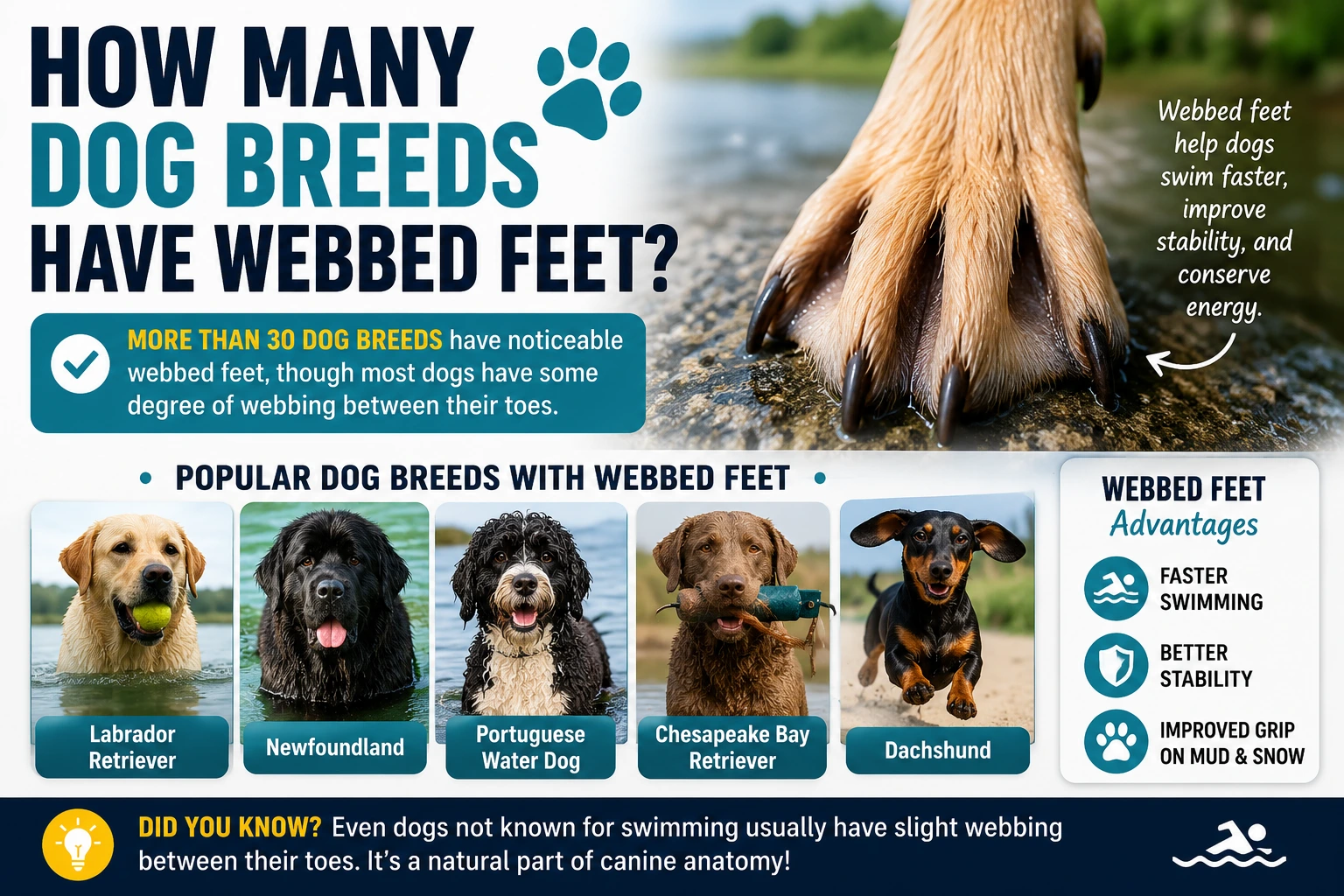
Many dog owners are surprised to learn that several dog breeds naturally have webbed feet. If you are wondering “how many dog breeds have webbed feet,” the answer is larger than most people expect.
Experts estimate that:
- Dozens of dog breeds have some degree of webbing between their toes.
In fact, nearly all dogs have slight webbing, but certain breeds were specifically developed to have stronger, more noticeable webbed feet for swimming, hunting, and working in water environments.
Webbed paws help dogs:
- Swim more efficiently
- Walk through mud and snow
- Improve balance
- Retrieve objects from water
In this complete guide, you will learn which dog breeds have webbed feet, why dogs evolved this feature, how webbing helps them, and how to care for dogs with webbed paws.
What Are Webbed Feet in Dogs?
Webbed feet refer to skin that connects a dog’s toes more than usual.
This extra skin acts similarly to:
- Swim fins
- Paddles
- Water propulsion tools
The webbing can range from:
- Very slight
- Moderately visible
- Highly developed
Some dog breeds have stronger webbing because they were bred for water-related tasks.
How Webbing Works
When a dog swims, webbing:
- Increases surface area
- Pushes more water backward
- Improves movement efficiency
This allows dogs to:
- Swim faster
- Conserve energy
- Stay stable in water
Webbed feet also help distribute weight on soft surfaces like:
- Mud
- Snow
- Marshland
How Many Dog Breeds Have Webbed Feet?
There is no exact official number because many breeds have at least partial webbing.
However:
- More than 30 well-known dog breeds are recognized for having noticeable webbed feet.
These breeds are often:
- Retrievers
- Water dogs
- Hunting dogs
- Arctic breeds
- Working dogs
Many were originally bred for:
- Fishing assistance
- Water rescue
- Duck retrieval
- Marsh hunting
Why Many Dogs Have Partial Webbing
Even dogs not known for swimming usually have slight webbing.
This is because:
- Dogs evolved from animals that benefited from improved terrain movement.
However, in specialized breeds, humans selectively bred dogs with stronger webbing for better performance.
Why Do Dogs Have Webbed Feet?
Webbed feet serve several practical purposes.
Swimming Advantages
The biggest benefit is improved swimming ability.
Webbed paws:
- Act like paddles
- Increase propulsion
- Reduce energy use
This is why many water dogs are excellent swimmers.
Hunting and Retrieval
Hunters historically used dogs to:
- Retrieve ducks
- Swim through marshes
- Recover game from lakes
Webbed feet improved efficiency during these tasks.
Walking on Snow and Mud
Webbing also helps distribute weight more evenly.
This prevents dogs from:
- Sinking into mud
- Sliding on wet surfaces
- Struggling in snow
Breeds from cold climates often benefit from this feature.
Dog Breeds Known for Webbed Feet
Several popular dog breeds are famous for their webbed paws.
Labrador Retriever
The Labrador Retriever is one of the best-known web-footed breeds.
Why Labs Have Webbed Feet
Labs were bred to:
- Retrieve fishing nets
- Recover waterfowl
- Swim long distances
Traits
- Strong swimmers
- Water-resistant coat
- Athletic body
Newfoundland
Newfoundlands are famous rescue dogs with powerful swimming abilities.
Benefits of Their Webbed Feet
Their large webbed paws help them:
- Pull people through water
- Swim in rough conditions
- Perform water rescues
They are among the strongest canine swimmers.
Portuguese Water Dog
Originally used by fishermen, these dogs worked on boats and in the ocean.
Common Jobs
- Carrying messages
- Herding fish
- Retrieving gear
Their webbed paws helped them maneuver through water efficiently.
Chesapeake Bay Retriever
This breed was developed for retrieving ducks in icy water.
Key Features
- Thick coat
- Endurance
- Strong webbed feet
These dogs are excellent working retrievers.
German Shorthaired Pointer
Although known primarily as hunting dogs, they also possess partially webbed feet.
This helps them:
- Cross wetlands
- Retrieve waterfowl
- Swim efficiently
Dachshund
Surprisingly, Dachshunds have mild webbing too.
Their paws were originally designed for:
- Digging
- Navigating rough terrain
Full vs Partial Webbing in Dogs
Not all webbed feet are identical.
Full Webbing
Some breeds have highly visible webbing.
Examples:
- Newfoundland
- Portuguese Water Dog
These dogs excel in water sports and rescue work.
Partial Webbing
Many breeds only have mild webbing between toes.
Examples:
- Labrador Retriever
- Dachshund
- Spaniels
This still improves mobility and swimming.
How Webbed Feet Help Dogs
Webbed paws offer multiple advantages.
Faster Swimming
Dogs with webbed feet move more water with each paddle.
This improves:
- Speed
- Efficiency
- Endurance
Better Stability
Webbing helps dogs maintain balance on:
- Wet docks
- Boats
- Slippery surfaces
Improved Endurance
Efficient movement reduces fatigue during:
- Long swims
- Hunting trips
- Outdoor work
How to Check if Your Dog Has Webbed Feet
You can inspect your dog’s paws safely at home.
Step-by-Step Inspection
- Gently spread the toes apart
- Look for skin connecting the toes
- Compare front and back paws
- Check for symmetrical webbing
Do not force the toes open aggressively.
What Is Normal?
Slight webbing is normal in most dogs.
More pronounced webbing is common in:
- Water breeds
- Hunting breeds
- Sporting breeds
Common Myths About Webbed Feet in Dogs
Several misconceptions exist about webbed paws.
Myth: Only Water Dogs Have Webbed Feet
False.
Many non-swimming breeds also have mild webbing.
Myth: Webbed Feet Mean Mixed Breed Genetics
False.
Many purebred dogs naturally have webbed feet.
Myth: Webbing Causes Problems
Healthy webbing is completely normal and beneficial.
Caring for Dogs With Webbed Feet
Proper paw care keeps webbed feet healthy.
Keep Paws Clean
Dirt and moisture can collect between toes.
After swimming:
- Rinse paws
- Dry thoroughly
Watch for Infections
Moist environments may increase risk of:
- Fungal infections
- Irritation
- Redness
Check paws regularly.
Trim Nails Carefully
Long nails affect:
- Balance
- Walking posture
- Swimming efficiency
Routine grooming is important.
Best Activities for Dogs With Webbed Feet
These breeds often enjoy active outdoor lifestyles.
Swimming
Many web-footed dogs naturally love water.
Swimming provides:
- Exercise
- Joint support
- Mental stimulation
Dock Diving
Dock diving competitions are popular for:
- Retrievers
- Water dogs
- Sporting breeds
Water Retrieval Games
Fetching floating toys helps satisfy natural instincts.
Benefits of Webbed Feet in Modern Dogs
Even though many dogs no longer work as hunters or rescue animals, webbed feet still provide advantages.
These include:
- Better athletic ability
- Easier swimming
- Improved outdoor mobility
FAQs
1. How many dog breeds have webbed feet?
More than 30 recognized dog breeds are known for noticeable webbed feet, although most dogs have slight webbing naturally.
2. Why do dogs have webbed feet?
Webbed feet help dogs swim, walk on soft terrain, and retrieve objects from water more efficiently.
3. Which dog breed has the strongest webbed feet?
The Newfoundland is often considered one of the strongest web-footed swimming breeds.
4. Are webbed feet normal in dogs?
Yes. Mild webbing is common and natural in many dog breeds.
5. Can dogs with webbed feet swim better?
Generally, yes. Webbed paws improve propulsion and swimming efficiency.
Conclusion
If you are asking “how many dog breeds have webbed feet,” the answer is surprisingly large. More than 30 popular breeds are known for noticeable webbed paws, while many other dogs have partial webbing naturally.
Webbed feet evolved to help dogs:
- Swim efficiently
- Retrieve game
- Navigate mud and snow
- Improve stability outdoors
From the Labrador Retriever to the Newfoundland, these breeds showcase how specialized anatomy supports working abilities and athletic performance.
Whether you own a swimming breed or are simply curious about canine anatomy, understanding webbed feet offers fascinating insight into how dogs evolved and adapted to different environments.
Discover more
how many linear feet is 1 acre