

How Many Cubic Feet of Dirt in a Dump Truck?
If you’re planning a landscaping, excavation, grading, or construction project, one of the first questions you’ll ask is: how many cubic feet of dirt in a dump truck?
The answer depends on the size of the truck, the type of dirt being hauled, and weight restrictions. While many people focus on truck size, understanding both volume and weight is essential when estimating dirt deliveries.
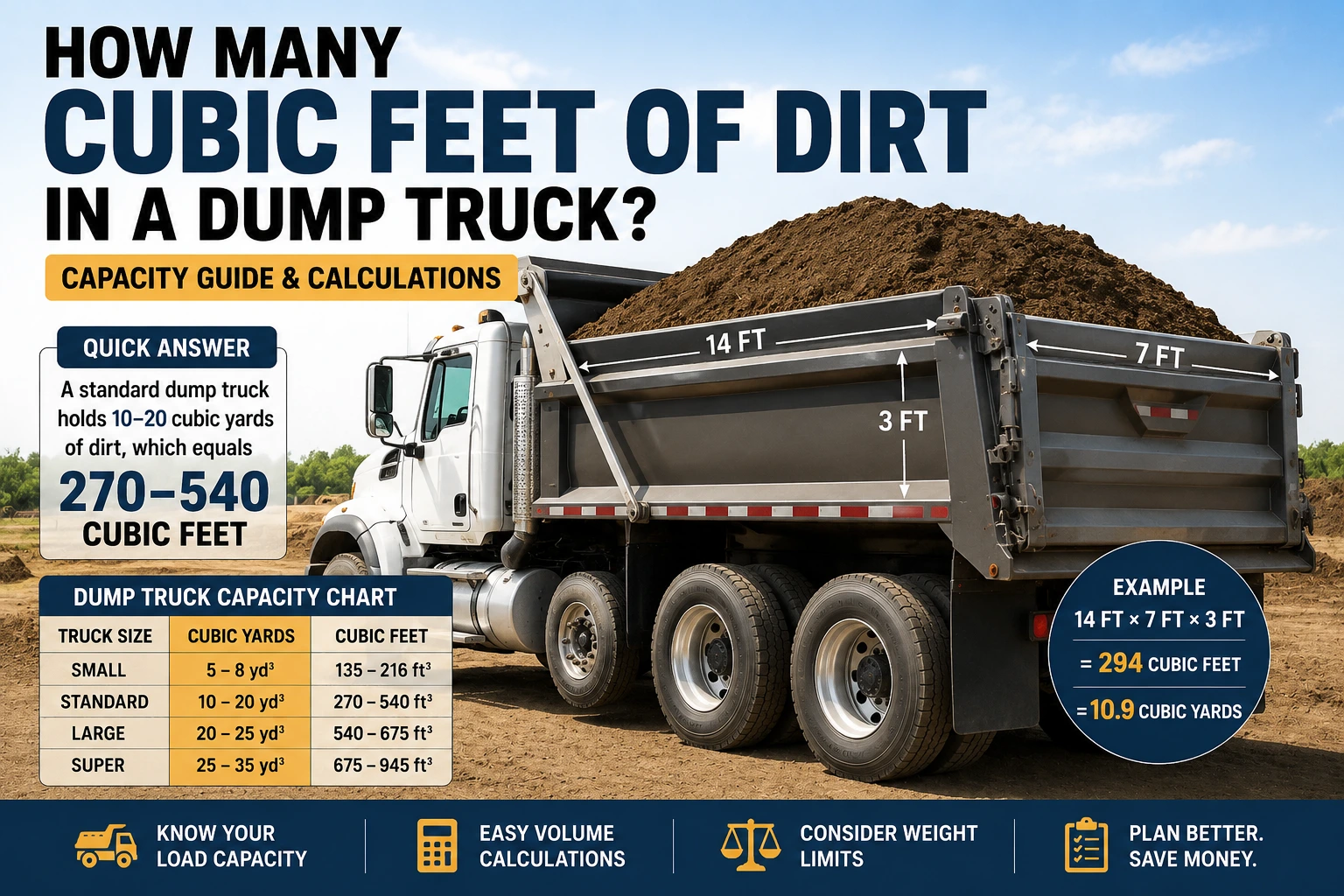
In general, a standard dump truck can hold between 270 and 540 cubic feet of dirt, while larger trucks can carry much more. Knowing these numbers helps you order the right amount of soil, avoid extra delivery charges, and keep your project on schedule.
This guide explains dump truck capacities, cubic-foot calculations, conversion charts, and practical examples to help you estimate dirt volumes accurately.
Quick Answer
Most standard dump trucks carry:
| Dump Truck Size | Cubic Yards | Cubic Feet |
|---|---|---|
| Small Dump Truck | 5–8 yd³ | 135–216 ft³ |
| Standard Dump Truck | 10–20 yd³ | 270–540 ft³ |
| Large Dump Truck | 20–25 yd³ | 540–675 ft³ |
| Super Dump Truck | 25–35 yd³ | 675–945 ft³ |
A common contractor dump truck typically holds 10 to 16 cubic yards, which equals approximately 270 to 432 cubic feet of dirt.
Understanding Dump Truck Capacity
Dump truck capacity is usually measured in cubic yards, not cubic feet.
However, homeowners and DIY users often estimate projects in cubic feet because landscaping measurements are frequently given in feet.
Since:
1 cubic yard=27 cubic feet
Converting between the two units is simple.
For example:
- 10 cubic yards = 270 cubic feet
- 15 cubic yards = 405 cubic feet
- 20 cubic yards = 540 cubic feet
This conversion helps when ordering soil, topsoil, fill dirt, mulch, gravel, or sand.
How Many Cubic Feet of Dirt in a Dump Truck by Size
Different trucks have different capacities.
Small Dump Trucks
Small dump trucks are commonly used for residential projects.
Typical capacity:
- 5–8 cubic yards
- 135–216 cubic feet
These trucks are ideal for:
- Small landscaping jobs
- Garden projects
- Backyard leveling
- Residential deliveries
Standard Dump Trucks
These are the most common trucks used by contractors.
Typical capacity:
- 10–20 cubic yards
- 270–540 cubic feet
Applications include:
- Foundation work
- Driveway preparation
- Site grading
- Construction projects
Large Dump Trucks
Large trucks are often used for commercial projects.
Capacity:
- 20–25 cubic yards
- 540–675 cubic feet
These trucks reduce delivery trips and improve efficiency on larger jobs.
Super Dump Trucks
Super dump trucks can carry enormous volumes.
Capacity:
- 25–35 cubic yards
- 675–945 cubic feet
These vehicles are commonly seen on:
- Highway projects
- Large-scale excavation
- Industrial construction
Cubic Feet vs Cubic Yards Explained
Many people confuse cubic feet and cubic yards.
Here’s the relationship:
| Unit | Equivalent |
|---|---|
| 1 Cubic Yard | 27 Cubic Feet |
| 5 Cubic Yards | 135 Cubic Feet |
| 10 Cubic Yards | 270 Cubic Feet |
| 15 Cubic Yards | 405 Cubic Feet |
| 20 Cubic Yards | 540 Cubic Feet |
Because dump truck suppliers generally quote capacity in cubic yards, understanding this conversion prevents ordering errors.
How to Calculate Dirt Volume in a Dump Truck
You can estimate a truck’s dirt volume using basic measurements.
Volume Formula
Volume=Length×Width×Height
Example Calculation
Suppose a truck bed measures:
- Length = 14 feet
- Width = 7 feet
- Height = 3 feet
Calculation:
14 × 7 × 3 = 294 cubic feet
To convert to cubic yards:
294 ÷ 27 = 10.89 cubic yards
This truck can hold approximately 11 cubic yards of loose dirt.
Dump Truck Capacity Chart
The following chart provides common capacities.
| Cubic Yards | Cubic Feet |
|---|---|
| 5 | 135 |
| 6 | 162 |
| 8 | 216 |
| 10 | 270 |
| 12 | 324 |
| 15 | 405 |
| 18 | 486 |
| 20 | 540 |
| 25 | 675 |
| 30 | 810 |
| 35 | 945 |
This chart is useful when comparing truck sizes and estimating material requirements.
Weight vs Volume of Dirt
Volume is only part of the equation.
Dirt is heavy, and truck operators must follow legal weight limits.
Typical dirt weights:
| Material | Weight per Cubic Yard |
|---|---|
| Dry Topsoil | 2,000–2,400 lbs |
| Fill Dirt | 2,000–2,700 lbs |
| Moist Soil | 2,400–3,000 lbs |
| Wet Clay Soil | 3,000+ lbs |
For example:
A truck with a capacity of 20 cubic yards may not always carry 20 cubic yards if the soil is particularly wet or dense.
Weight restrictions often reduce the usable volume.
How Many Wheelbarrows Equal a Dump Truck Load?
Many homeowners prefer comparing truckloads to wheelbarrows.
A standard wheelbarrow holds roughly:
- 2 to 3 cubic feet
Let’s compare.
| Dump Truck Capacity | Equivalent Wheelbarrows |
|---|---|
| 135 cubic feet | 45–68 |
| 270 cubic feet | 90–135 |
| 405 cubic feet | 135–203 |
| 540 cubic feet | 180–270 |
Moving a dump truck’s worth of dirt by wheelbarrow can require hundreds of trips.
Real-World Examples
Backyard Leveling Project
Suppose you need to level a backyard measuring:
- 40 feet × 30 feet
- Fill depth = 6 inches (0.5 feet)
Calculation:
40 × 30 × 0.5 = 600 cubic feet
600 cubic feet ÷ 27 = 22.2 cubic yards
You would likely need:
- One large dump truck
- Or two smaller truckloads
Garden Bed Installation
Garden dimensions:
- 20 feet × 10 feet
- Depth = 1 foot
Calculation:
20 × 10 × 1 = 200 cubic feet
200 ÷ 27 = 7.4 cubic yards
A small dump truck can easily handle this amount.
Common Uses for Dump Truck Loads of Dirt
Dump trucks deliver dirt for many projects.
Landscaping
Uses include:
- Lawn grading
- Garden beds
- Tree planting
- Yard leveling
Construction
Applications include:
- Building pads
- Foundation preparation
- Site development
- Backfilling
Road Projects
Large trucks transport dirt for:
- Highway construction
- Drainage improvements
- Embankment creation
Agricultural Work
Farmers often order truckloads of soil for:
- Field improvements
- Drainage correction
- Land leveling
Factors That Affect Dirt Capacity
Several factors influence how much dirt fits into a truck.
Soil Moisture
Wet dirt weighs significantly more than dry dirt.
Soil Type
Clay is denser than sandy soil.
Truck Design
Some trucks have:
- Higher sidewalls
- Larger beds
- Enhanced load capacities
Legal Weight Limits
Road regulations restrict total vehicle weight.
Even if more volume could physically fit, operators may need to carry less material.
Common Mistakes When Ordering Dirt
Avoid these costly errors.
Ordering by Weight Instead of Volume
Many projects require volume estimates rather than tonnage.
Ignoring Compaction
Loose dirt settles over time.
You may need additional material.
Forgetting Delivery Access
Ensure trucks can safely reach your property.
Not Accounting for Waste
Extra material is often needed for grading and leveling.
Miscalculating Dimensions
Always measure length, width, and depth accurately before ordering.
Expert Tips for Estimating Dirt Needs
Professionals recommend:
- Measure twice before ordering.
- Add 5–10% extra material.
- Confirm truck capacity with suppliers.
- Ask whether pricing is by yard or ton.
- Consider soil compaction.
- Verify site accessibility.
- Compare delivery costs from multiple providers.
These steps help prevent delays and unnecessary expenses.
9. FAQs
1. How many cubic feet of dirt are in a standard dump truck?
A standard dump truck typically carries between 270 and 540 cubic feet of dirt, depending on truck size and weight limits.
2. How many cubic yards are in a dump truck?
Most dump trucks hold between 10 and 20 cubic yards, though larger trucks may carry 25 to 35 cubic yards.
3. How do I convert cubic yards to cubic feet?
Multiply cubic yards by 27.
For example:
10 cubic yards × 27 = 270 cubic feet.
4. Can a dump truck carry 1,000 cubic feet of dirt?
Most standard dump trucks cannot. Very large or specialized trucks may approach that capacity, but weight restrictions often limit loads.
5. How much does a dump truck load of dirt weigh?
A full load typically weighs between 10,000 and 30,000 pounds depending on soil type, moisture content, and truck size.
10. Conclusion
If you’re wondering how many cubic feet of dirt in a dump truck, the answer depends largely on truck size and soil weight. Most standard dump trucks carry between 270 and 540 cubic feet of dirt, while larger trucks can transport 675 cubic feet or more. Understanding cubic feet, cubic yards, and weight limitations helps you order the correct amount of material for landscaping, construction, excavation, and grading projects. By using the formulas, charts, and examples in this guide, you can confidently estimate your dirt requirements and avoid costly ordering mistakes.
Discover More:
1How Many Cubic Feet in a Pickup Truck Bed?