
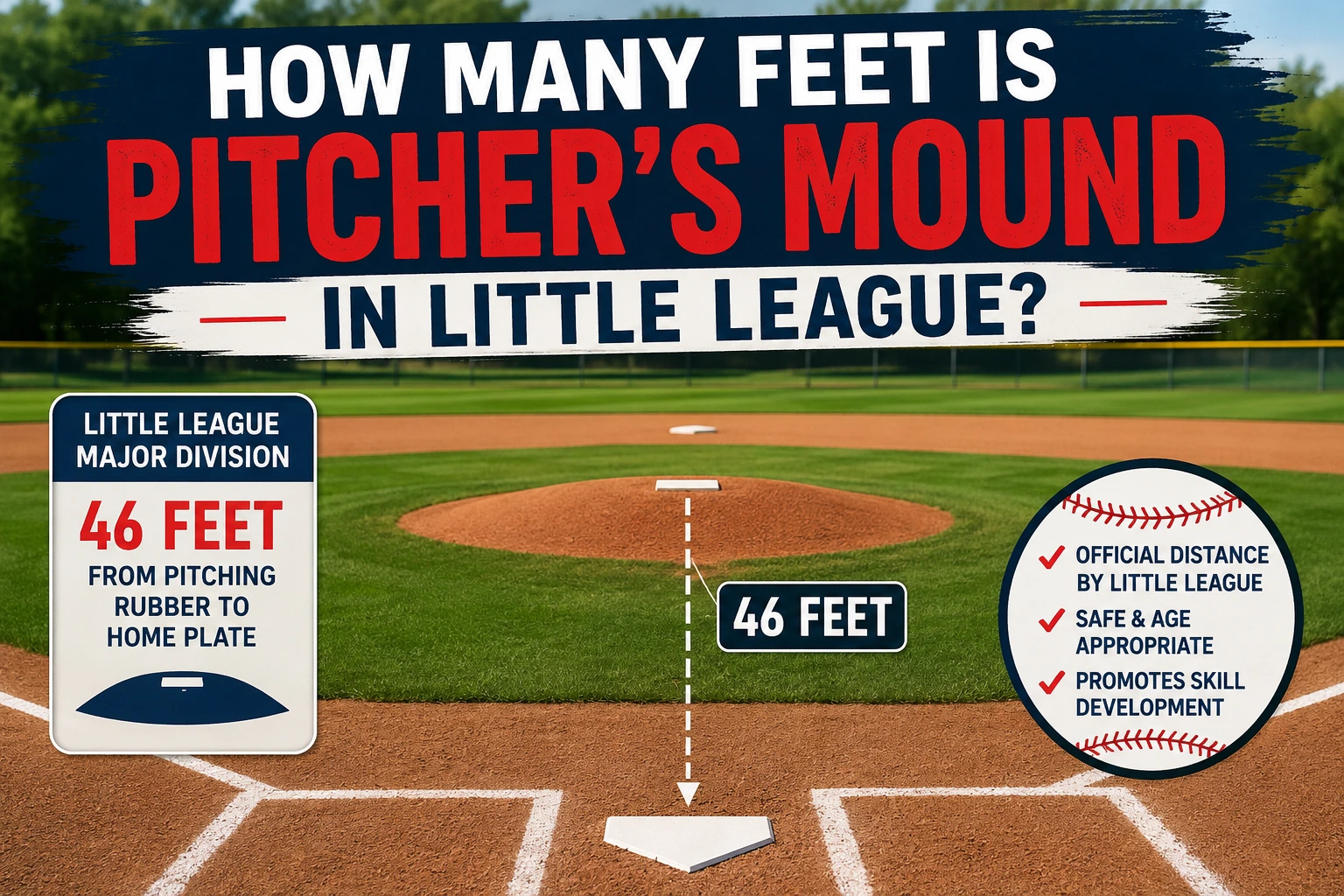
If you are setting up a youth baseball field or helping your child learn the game, you may wonder: how many feet is pitcher’s mound in Little League?
The official Little League pitcher’s mound distance for the Major Division is 46 feet from the front edge of the pitching rubber to the back point of home plate.
This distance is shorter than professional baseball because Little League players are younger and still developing their strength, pitching mechanics, and control.
Understanding the correct mound distance is important for:
- Player safety
- Fair competition
- Proper skill development
- Following official Little League rules
- Building a regulation baseball field
In this guide, you will learn everything about Little League pitching distances, field dimensions, age-based measurements, and setup tips.
Understanding the Little League Pitcher’s Mound Distance
The answer to how many feet is pitcher’s mound in little league depends on the division and age group.
For the standard Little League Major Division:
46 feet
The measurement is taken from:
- The front edge of the pitching rubber
to - The back tip of home plate
This is the official regulation used in most Little League games for players ages 9–12.
The shorter distance compared to Major League Baseball allows young pitchers to throw safely while still learning accuracy and mechanics.
Official Little League Pitching Distances by Division
Different Little League divisions use different pitching distances based on player age and skill level.
Little League Pitching Distance Chart
| Division | Typical Age | Pitching Distance |
|---|---|---|
| Tee Ball | 4–7 | No official mound |
| Coach Pitch | 5–8 | Varies |
| Minor League | 7–11 | 46 feet |
| Little League Major | 9–12 | 46 feet |
| Intermediate (50/70) | 11–13 | 50 feet |
| Junior League | 12–14 | 54 feet |
| Senior League | 13–16 | 60 feet 6 inches |
This chart helps coaches and parents understand how the game evolves as players get older.
Distance From Home Plate to Pitching Rubber
Many people confuse the mound itself with the pitching rubber.
The official measurement refers specifically to the distance between:
- Home plate
- Pitching rubber
In Little League Major Division:
46 ft
In Major League Baseball:
60 ft 6 in
That means Little League pitchers throw from a much closer distance than professional players.
Why Pitching Distance Changes by Age Group
Youth baseball uses shorter distances for several important reasons.
1. Player Safety
Young arms are still developing. A shorter pitching distance reduces stress on:
- Shoulders
- Elbows
- Wrists
This helps prevent injuries.
2. Better Skill Development
Younger players need time to learn:
- Throwing mechanics
- Pitch control
- Accuracy
- Timing
Shorter distances make learning easier and more fun.
3. Balanced Competition
If the mound were too far away, younger pitchers would struggle to reach home plate consistently.
Proper distances help keep games competitive and enjoyable.
Difference Between Little League and MLB Pitching Distance
One of the biggest differences between youth baseball and professional baseball is field size.
Comparison Table
| Feature | Little League Major | MLB |
|---|---|---|
| Pitching Distance | 46 feet | 60 ft 6 in |
| Base Paths | 60 feet | 90 feet |
| Fence Distance | 200–225 feet | 325–400+ feet |
| Player Age | 9–12 | Adults |
The shorter dimensions help children develop skills gradually before moving to larger fields later in their baseball journey.
How to Measure a Little League Pitcher’s Mound
If you are building or marking a field, accurate measurements are essential.
Step-by-Step Guide
Step 1: Locate Home Plate
Place home plate firmly in the ground.
Step 2: Find the Back Point
Use the back tip of home plate as the starting point.
Step 3: Measure Toward Center Field
Use a measuring tape and extend it straight toward second base.
Step 4: Mark 46 Feet
Measure exactly:
46 feet
This marks the front edge of the pitching rubber.
Step 5: Install the Pitching Rubber
Center the rubber properly on the mound.
Helpful Measurement Tips
- Use a long field tape measure
- Double-check measurements
- Mark chalk lines carefully
- Ensure the mound is level
Even small errors can affect gameplay.
Important Little League Field Dimensions
The pitcher’s mound is only one part of a Little League field.
Here are other important dimensions.
Base Paths
The distance between bases is:
60 feet
Outfield Fence
Most Little League fences range between:
200–225 feet
Mound Diameter
A Little League mound is usually around:
10 feet
in diameter.
Little League Field Layout Basics
A standard Little League field includes:
- Home plate
- Pitcher’s mound
- First base
- Second base
- Third base
- Foul lines
- Batter’s boxes
- Dugouts
- Outfield fence
All measurements should follow official regulations for league play.
Common Mistakes When Setting Up a Little League Field
Incorrect field measurements are very common.
Here are mistakes to avoid.
Measuring From the Wrong Spot
Always measure from:
- Back tip of home plate
to - Front edge of pitching rubber
Not the center of the mound.
Using MLB Measurements
Many beginners mistakenly use professional dimensions.
Remember:
Little League Major Division = 46 feet
NOT 60 feet 6 inches.
Uneven Mound Surface
A poorly leveled mound affects:
- Pitch accuracy
- Balance
- Player safety
Incorrect Base Distances
Little League uses 60-foot base paths, not 90 feet like MLB.
Tips for Coaches and Parents
Helping young players succeed starts with the right environment.
Focus on Mechanics First
Teach:
- Proper grip
- Arm motion
- Balance
- Follow-through
before focusing on pitch speed.
Avoid Overpitching
Young pitchers should avoid excessive throwing.
Rest days are extremely important.
Use Regulation Distances
Practicing on the correct field size helps players build confidence and consistency.
Encourage Fun and Learning
Little League is about:
- Teamwork
- Skill building
- Sportsmanship
- Confidence
Avoid putting too much pressure on young athletes.
How Pitching Distance Affects the Game
The mound distance changes many aspects of baseball.
Pitch Speed Perception
A shorter distance makes pitches appear faster to hitters.
Reaction Time
Batters have less time to react at 46 feet compared to professional distances.
Fielding Strategy
Coaches often adjust defensive positioning based on player age and field size.
Transitioning to Larger Fields
As players get older, they gradually move to larger fields.
Typical Progression
| Level | Pitching Distance |
|---|---|
| Little League | 46 feet |
| Intermediate | 50 feet |
| Junior League | 54 feet |
| High School / MLB | 60 ft 6 in |
This gradual increase helps players safely adapt over time.
Expert Advice for Building a Backyard Little League Field
Many parents create practice spaces at home.
Recommended Backyard Setup
- Portable pitching rubber
- Flat dirt mound
- Net or backstop
- Chalk lines
- 46-foot measurement tape
Even a small practice area can improve skills dramatically.
Why Accurate Measurements Matter
Using correct Little League dimensions helps players:
- Learn proper timing
- Develop realistic pitching mechanics
- Improve hitting skills
- Prepare for competitive games
Incorrect distances can create bad habits that are difficult to fix later.
Frequently Asked Questions
1. How many feet is pitcher’s mound in Little League Major Division?
The official pitching distance is 46 feet from the pitching rubber to home plate.
2. Is Little League pitching distance the same for all ages?
No. Different divisions use different mound distances depending on player age and skill level.
3. How far is the pitcher’s mound in MLB?
Major League Baseball uses a pitching distance of 60 feet 6 inches.
4. How many feet are the base paths in Little League?
Little League Major Division uses 60-foot base paths.
5. Can backyard practice fields use official measurements?
Yes. Using official Little League dimensions helps players practice more effectively.
Conclusion
So, how many feet is pitcher’s mound in little league? The official distance for Little League Major Division baseball is 46 feet from the pitching rubber to home plate.
This shorter distance is designed specifically for young athletes to promote:
- Safety
- Skill development
- Better gameplay
- Confidence building
Understanding Little League field dimensions helps coaches, parents, and players create the best possible baseball experience. Whether you are setting up a backyard field, coaching a youth team, or simply learning the rules, accurate measurements are essential for fair and enjoyable play.
Discover more
how many feet is 32 square feet