
If you’re buying an air conditioner, one of the most common questions is how many BTU for square feet. Choosing the correct BTU rating is essential because an undersized AC won’t cool your space efficiently, while an oversized unit can waste energy, cycle too frequently, and reduce humidity control.
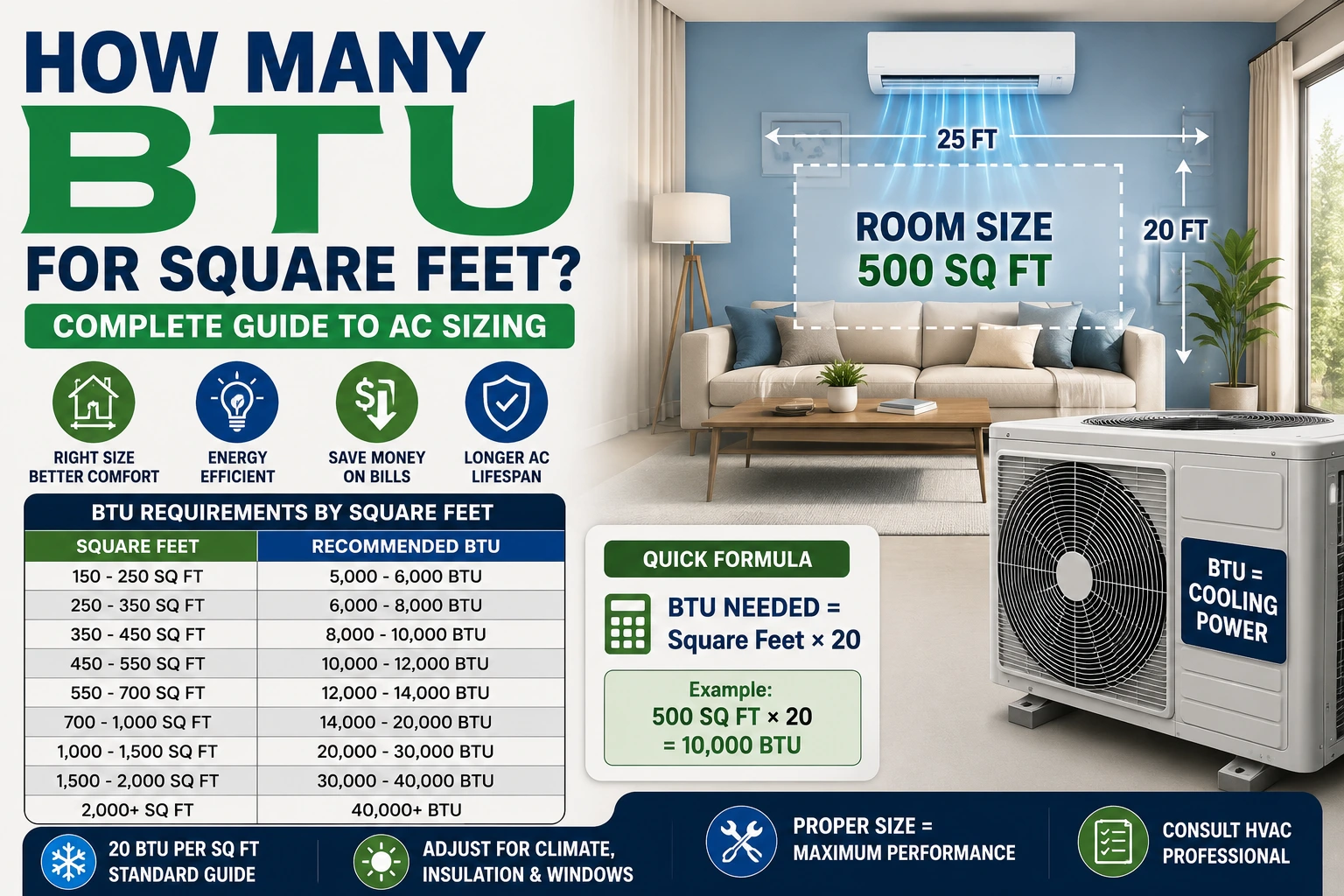
As a general rule, most homes require about 20 BTUs per square foot under average conditions. However, the exact number depends on several factors, including climate, insulation, ceiling height, windows, room occupancy, and sun exposure.
This comprehensive guide explains how BTUs work, how to calculate the right cooling capacity, provides easy-to-use charts, real-life examples, and expert tips to help you choose the right air conditioner for your home.
Quick Answer
Most HVAC professionals use this basic guideline:
20 BTUs per square foot
Here’s a quick reference chart.
| Room Size | Recommended BTU |
|---|---|
| 150 sq ft | 5,000 BTU |
| 250 sq ft | 6,000 BTU |
| 350 sq ft | 8,000 BTU |
| 450 sq ft | 10,000 BTU |
| 550 sq ft | 12,000 BTU |
| 700 sq ft | 14,000 BTU |
| 1,000 sq ft | 20,000 BTU |
| 2,000 sq ft | 40,000 BTU |
These values are general estimates. A professional HVAC load calculation provides the most accurate sizing.
What Is a BTU?
BTU stands for British Thermal Unit.
It measures the amount of heat an air conditioner can remove from a room in one hour.
The higher the BTU rating, the greater the cooling capacity.
For example:
- 5,000 BTU cools a small room.
- 12,000 BTU cools a larger room.
- 48,000 BTU (4-ton system) cools an entire home.
Understanding BTUs helps you match your air conditioner to your space.
How Many BTU for Square Feet?
A simple rule used by many professionals is:
BTUs Needed = Square Feet × 20
Example:
Room size:
500 sq ft
Calculation:
500 × 20
= 10,000 BTUs
This works well for average homes with:
- Standard 8-foot ceilings
- Average insulation
- Moderate climate
- Typical occupancy
Adjustments may be needed if your home has unique characteristics.
BTU Sizing Chart
The following chart provides recommended BTU ratings for common room sizes.
| Square Feet | Recommended BTU |
|---|---|
| 100 | 5,000 |
| 150 | 5,000 |
| 200 | 6,000 |
| 250 | 6,000 |
| 300 | 7,000 |
| 350 | 8,000 |
| 400 | 9,000 |
| 450 | 10,000 |
| 500 | 10,000 |
| 550 | 12,000 |
| 700 | 14,000 |
| 1,000 | 20,000 |
| 1,500 | 30,000 |
| 2,000 | 40,000 |
| 2,400 | 48,000 |
How to Calculate BTU Requirements
Calculating BTUs is straightforward.
Step 1: Measure the Room
Multiply:
Length × Width
Example:
20 ft × 15 ft
= 300 square feet
Step 2: Multiply by 20
300 × 20
= 6,000 BTUs
This is your starting estimate.
Step 3: Adjust for Special Conditions
Increase BTUs if the room:
- Gets direct afternoon sunlight
- Has high ceilings
- Contains many windows
- Houses several people
- Includes heat-producing appliances
Reduce BTUs slightly if the room is heavily shaded or exceptionally well insulated.
Factors That Affect BTU Needs
Square footage alone does not determine cooling requirements.
Climate
Homes in hotter regions generally require more BTUs than homes in cooler climates.
Insulation
Well-insulated homes retain cool air better, reducing the required cooling capacity.
Poor insulation increases heat gain.
Ceiling Height
Most sizing charts assume 8-foot ceilings.
Rooms with vaulted or higher ceilings require additional BTUs because there is more air to cool.
Windows
Large windows increase solar heat gain.
Energy-efficient windows help reduce cooling requirements.
Sun Exposure
South- and west-facing rooms often require more cooling due to increased sunlight.
Occupancy
Each additional person contributes body heat.
Rooms with many occupants may need extra cooling capacity.
Appliances
Kitchens and laundry rooms generate heat from ovens, stoves, dryers, and other appliances.
These spaces usually require higher BTU ratings.
BTU Examples for Different Rooms
Small Bedroom
Size:
150 sq ft
Recommended cooling:
5,000 BTUs
Home Office
Size:
250 sq ft
Recommended cooling:
6,000 BTUs
Living Room
Size:
450 sq ft
Recommended cooling:
10,000 BTUs
Master Bedroom
Size:
550 sq ft
Recommended cooling:
12,000 BTUs
Open Living Area
Size:
1,000 sq ft
Recommended cooling:
20,000 BTUs
AC Tons and BTUs
Large central air systems are often measured in tons.
Here’s how they compare.
| AC Size | BTUs |
|---|---|
| 1 Ton | 12,000 BTU |
| 1.5 Ton | 18,000 BTU |
| 2 Ton | 24,000 BTU |
| 2.5 Ton | 30,000 BTU |
| 3 Ton | 36,000 BTU |
| 3.5 Ton | 42,000 BTU |
| 4 Ton | 48,000 BTU |
| 5 Ton | 60,000 BTU |
Understanding this conversion makes it easier to compare window units and central HVAC systems.
Choosing the Right Air Conditioner Size
Proper sizing improves both comfort and efficiency.
Undersized AC
Problems include:
- Constant operation
- Poor cooling
- Higher electricity bills
- Increased wear on the system
Oversized AC
A unit that’s too large can:
- Short cycle
- Waste energy
- Leave humidity levels too high
- Reduce indoor comfort
Properly Sized AC
A correctly sized unit:
- Maintains consistent temperatures
- Removes humidity effectively
- Operates efficiently
- Extends equipment lifespan
Common BTU Sizing Mistakes
Avoid these common errors.
Using Square Footage Alone
Many people ignore insulation, climate, and ceiling height.
Forgetting Window Heat Gain
Rooms with large windows often require additional cooling.
Ignoring Occupancy
Extra people increase cooling demand.
Not Considering Ceiling Height
High ceilings significantly increase room volume.
Buying Based on Price Alone
A cheaper unit may cost more to operate if it’s the wrong size.
Expert Tips for Accurate AC Sizing
Professionals recommend:
- Measure every room carefully.
- Consider local climate conditions.
- Upgrade insulation before replacing an AC unit.
- Seal air leaks around windows and doors.
- Use energy-efficient windows when possible.
- Schedule a Manual J load calculation for whole-home HVAC systems.
- Choose an AC with an appropriate SEER rating for long-term energy savings.
Why Proper BTU Sizing Matters
Choosing the right BTU rating provides several benefits.
Lower Energy Bills
Efficient cooling reduces electricity consumption.
Better Comfort
Proper sizing keeps temperatures stable throughout the day.
Longer Equipment Life
Correctly sized systems experience less strain and fewer repairs.
Improved Humidity Control
An appropriately sized air conditioner removes moisture more effectively, making indoor spaces feel cooler and more comfortable.
Better Indoor Air Quality
Longer, balanced cooling cycles help improve air circulation and filtration.
FAQs
1: How many BTUs do I need per square foot?
A common guideline is 20 BTUs per square foot for average residential spaces. However, insulation, climate, windows, and occupancy can change the required cooling capacity.
2: Is 20 BTUs per square foot always accurate?
No. It’s a helpful starting point, but factors such as ceiling height, direct sunlight, and local climate may require higher or lower BTU ratings.
3: How many BTUs are needed for a 500-square-foot room?
Using the standard estimate:
500 × 20 = 10,000 BTUs
This is appropriate for most average rooms.
4: What happens if I choose an oversized AC?
An oversized AC cools the room too quickly, causing short cycling, poor humidity control, and unnecessary energy use.
5: What is the most accurate way to determine BTU requirements?
For an entire home, the best method is a Manual J load calculation, which evaluates insulation, windows, climate, orientation, occupancy, ceiling height, and other factors.
Conclusion
Understanding how many BTU for square feet is one of the most important steps when choosing an air conditioner. While the general guideline of 20 BTUs per square foot works well for many homes, factors such as insulation, climate, ceiling height, windows, and occupancy all influence the final cooling requirement.
By using the BTU sizing charts, calculation formulas, and expert recommendations in this guide, you can select an air conditioner that delivers efficient cooling, lower energy bills, and long-lasting comfort. For whole-home HVAC systems, consider a professional load calculation to ensure the most accurate sizing for your specific home.
Discover more
4 ton ac unit covers how many square feet