

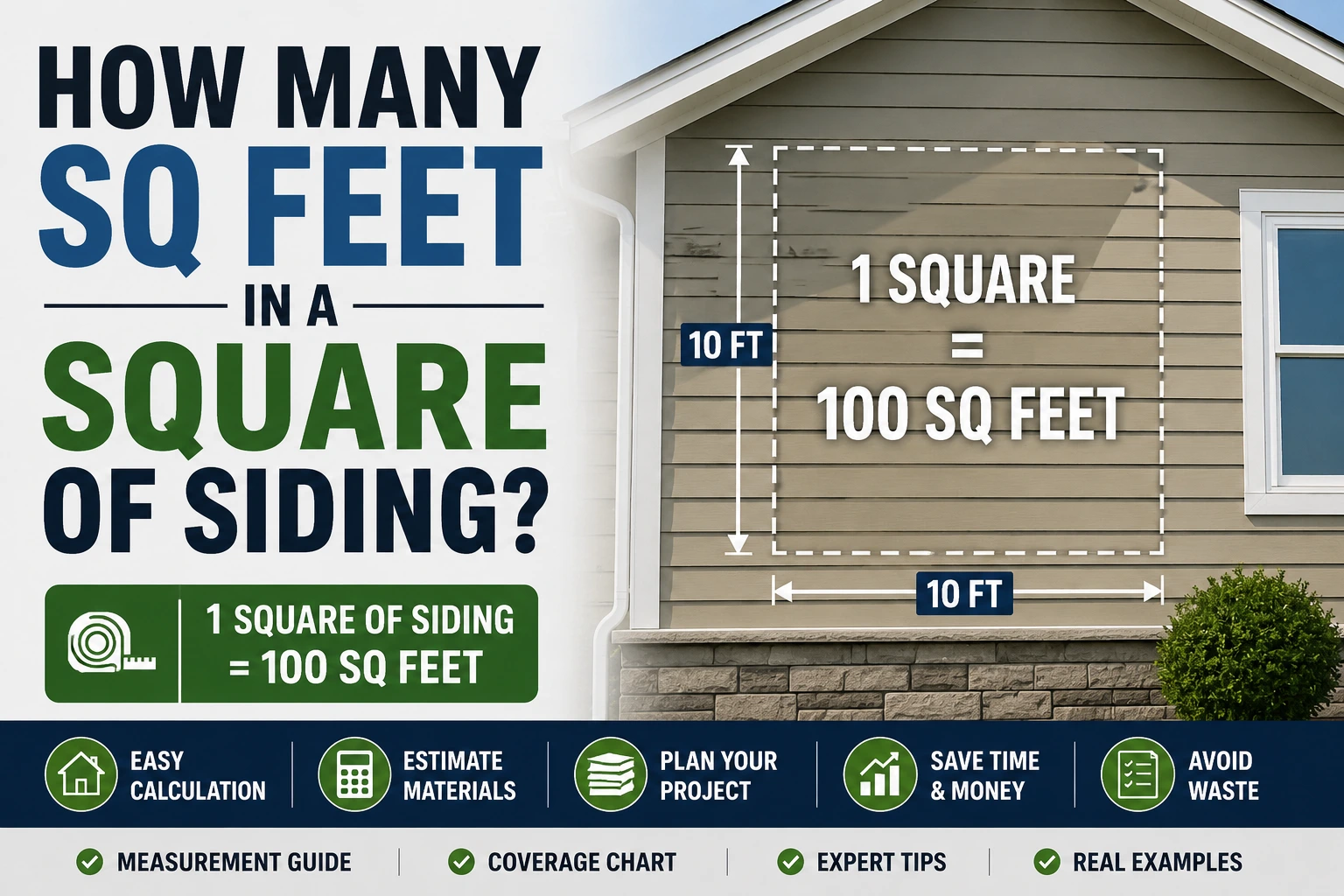
If you’re planning to replace or install siding, one of the first questions you’ll likely ask is how many sq feet in a square of siding. Understanding this measurement is essential for estimating material costs, reducing waste, and ensuring you order the right amount of siding for your project.
The simple answer is:
One square of siding covers 100 square feet.
While this seems straightforward, there are several factors to consider when calculating siding requirements. Home shape, wall height, windows, doors, and waste allowances all affect the total amount of siding you’ll need.
This guide explains everything you need to know, from basic definitions and formulas to real-world examples, conversion charts, and expert estimation tips.
Quick Answer
Here’s the industry standard:
| Measurement | Coverage |
|---|---|
| 1 Square of Siding | 100 Square Feet |
| 5 Squares | 500 Square Feet |
| 10 Squares | 1,000 Square Feet |
| 20 Squares | 2,000 Square Feet |
Answer:
One square of siding equals 100 square feet of wall coverage.
What Is a Square of Siding?
A square is a standard unit used in the siding and roofing industries.
Instead of measuring siding by individual panels, contractors estimate projects using “squares.”
Definition
1 Square = 100 Square Feet
This measurement makes estimating faster and simplifies ordering materials.
For example:
- A wall measuring 10 ft × 10 ft
- Total area = 100 square feet
- Required siding = 1 square
Why Contractors Use Siding Squares
Using squares instead of individual panels offers several advantages.
Easier Estimating
Large homes may require thousands of square feet of siding.
It’s much easier to say:
- 18 squares
than
- 1,800 square feet
Simplified Ordering
Manufacturers often package siding based on square coverage.
This helps suppliers and contractors communicate clearly.
Faster Cost Estimates
Most siding quotes are calculated by the square.
For example:
- Material cost per square
- Labor cost per square
- Installation time per square
How Many Sq Feet in a Square of Siding?
The industry standard never changes.
1 square = 100 square feet
Regardless of the siding material, the measurement remains the same.
Examples include:
- Vinyl siding
- Fiber cement siding
- Engineered wood siding
- Metal siding
- Composite siding
Although the coverage is always 100 square feet, the number of individual panels in a square varies depending on the panel size.
Formula for Calculating Siding Squares
Calculating siding requirements is simple.
Step 1: Measure Wall Area
Multiply:
Length × Height
Example:
30 ft × 12 ft
= 360 square feet
Step 2: Repeat for Every Exterior Wall
Suppose your walls measure:
| Wall | Area |
|---|---|
| Front | 360 sq ft |
| Back | 360 sq ft |
| Left | 240 sq ft |
| Right | 240 sq ft |
Total wall area:
360 + 360 + 240 + 240
= 1,200 square feet
Step 3: Subtract Openings
Remove areas occupied by:
- Windows
- Doors
- Garage doors
Suppose total openings equal:
150 square feet
Then:
1,200 − 150
= 1,050 square feet
Step 4: Divide by 100
Formula:
Siding Squares = Total Square Feet ÷ 100
1,050 ÷ 100
= 10.5 squares
Always round up when ordering materials.
Siding Coverage Conversion Chart
Use this chart for quick estimates.
| Square Feet | Siding Squares |
|---|---|
| 100 | 1 |
| 200 | 2 |
| 300 | 3 |
| 500 | 5 |
| 800 | 8 |
| 1,000 | 10 |
| 1,500 | 15 |
| 2,000 | 20 |
| 2,500 | 25 |
| 3,000 | 30 |
Real-Life Examples
Example 1: Small Home
Exterior wall area:
900 square feet
Calculation:
900 ÷ 100
= 9 squares
Example 2: Medium Home
Wall area:
1,650 square feet
Calculation:
1,650 ÷ 100
= 16.5 squares
Round up:
17 squares
Example 3: Large Two-Story House
Wall area:
2,750 square feet
Calculation:
2,750 ÷ 100
= 27.5 squares
Round up:
28 squares
Estimating Siding for Different Home Sizes
The following estimates are general guidelines.
| Home Size | Approximate Siding Needed |
|---|---|
| Small Cottage | 8–12 Squares |
| Ranch Home | 12–18 Squares |
| Medium Two-Story | 18–24 Squares |
| Large Family Home | 24–35 Squares |
| Luxury Home | 35+ Squares |
Actual requirements depend on:
- Roof design
- Gables
- Dormers
- Wall height
- Architectural details
Waste Allowance for Siding Projects
Never order the exact amount.
Cutting panels creates waste.
Professionals recommend adding:
| Project Type | Waste Factor |
|---|---|
| Simple Design | 5% |
| Moderate Design | 7–10% |
| Complex Home | 10–15% |
Example:
Needed:
20 squares
With 10% waste:
20 × 1.10
= 22 squares
Factors That Affect Siding Requirements
Several features influence how much siding you’ll need.
Windows and Doors
Large openings reduce siding coverage.
Gables
Triangular wall sections require separate calculations.
Multiple Stories
Taller homes naturally require more siding.
Architectural Features
Bay windows, chimneys, and decorative trim increase cutting and waste.
Panel Orientation
Horizontal and vertical siding layouts may affect installation efficiency.
Common Siding Materials
Although all are measured in squares, each material has unique characteristics.
| Material | Benefits |
|---|---|
| Vinyl | Affordable, low maintenance |
| Fiber Cement | Durable, fire resistant |
| Engineered Wood | Natural appearance |
| Metal | Long lifespan |
| Composite | Moisture resistant |
Regardless of the material, one square always covers 100 square feet.
Common Mistakes to Avoid
Many homeowners underestimate siding needs.
Avoid these common errors.
Forgetting Waste
Always order extra material.
Ignoring Gables
Triangular areas are often missed during calculations.
Measuring Incorrectly
Double-check wall dimensions before placing an order.
Not Subtracting Openings
Doors and windows reduce siding coverage.
Ordering Exact Quantities
Extra panels are useful for future repairs and replacements.
Expert Tips for Accurate Siding Estimates
Professionals recommend the following practices:
- Measure every wall individually.
- Use a laser distance measurer for better accuracy.
- Add 5–10% for waste.
- Round up to the nearest full square.
- Purchase all siding at once to avoid color differences between batches.
- Keep leftover panels for future repairs.
- Confirm manufacturer packaging before ordering.
Why Understanding Siding Squares Matters
Knowing how many square feet are in a square of siding helps you:
- Estimate project costs accurately.
- Compare contractor quotes.
- Prevent material shortages.
- Reduce unnecessary waste.
- Plan renovations more efficiently.
Whether you’re replacing damaged siding or building a new home, understanding this simple measurement saves time and money.
FAQ 1: How many sq feet are in one square of siding?
One square of siding covers 100 square feet of exterior wall area.
FAQ 2: Does every siding material use the same square measurement?
Yes. Vinyl, fiber cement, engineered wood, metal, and composite siding all use the same standard of 100 square feet per square.
FAQ 3: How do I calculate how many siding squares I need?
Measure the total exterior wall area, subtract windows and doors, then divide the remaining square footage by 100. Add an additional 5–10% for waste.
FAQ 4: How much waste should I allow when ordering siding?
Most professionals recommend adding 5–10% for simple projects and 10–15% for complex home designs with many cuts and angles.
FAQ 5: Why do contractors estimate siding by the square instead of square feet?
Using squares simplifies estimating, pricing, ordering, and installation. Since one square always equals 100 square feet, it provides a consistent industry standard.
10. ## Conclusion
If you’ve been wondering how many sq feet in a square of siding, the answer is simple: one square of siding equals 100 square feet. This standard measurement is used across the siding industry, regardless of whether you’re installing vinyl, fiber cement, engineered wood, or metal siding.
Understanding this conversion makes it easier to estimate materials, compare contractor quotes, and budget for your project. By accurately measuring your home’s exterior, subtracting openings, and adding a reasonable waste allowance, you can order the right amount of siding with confidence. Whether you’re tackling a DIY renovation or hiring a professional installer, knowing how many sq feet in a square of siding is the first step toward a successful siding project.
Discover more