

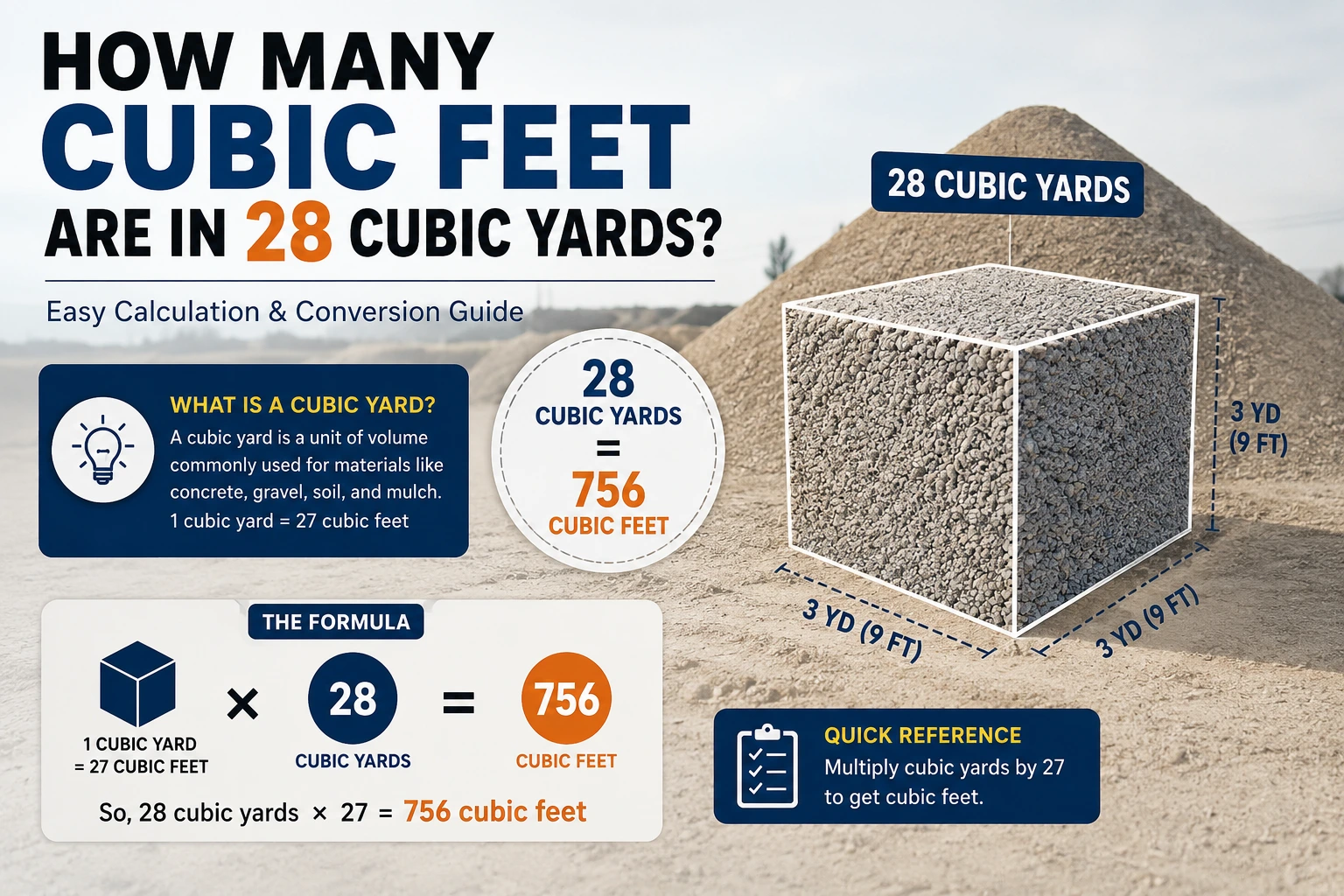
If you are working on a construction project, landscaping job, or even a simple DIY home improvement task, you might ask: how many cubic feet are in 28 cubic yards? This is a common measurement conversion problem that shows up when dealing with bulk materials like concrete, soil, gravel, or sand.
Understanding this conversion is important because suppliers often use cubic yards, while smaller calculations and planning are done in cubic feet. In this guide, you’ll learn the exact answer, the formula behind it, and how to confidently convert any cubic yard measurement into cubic feet.
Understanding Cubic Yards and Cubic Feet
Before solving how many cubic feet are in 28 cubic yards, it is important to understand what these units mean.
What is a cubic yard?
A cubic yard is a unit of volume used mainly in construction and landscaping. It represents a cube that measures:
- 3 feet in length
- 3 feet in width
- 3 feet in height
So, 1 cubic yard = 27 cubic feet.
What is a cubic foot?
A cubic foot is a smaller unit of volume used for measuring space or materials. It represents a cube that is:
- 1 foot × 1 foot × 1 foot
It is commonly used in:
- Construction estimates
- Soil and mulch calculations
- Storage volume
Why these units matter
Different industries use different measurement systems. Cubic yards are preferred for bulk delivery, while cubic feet are used for precise calculations. Knowing how to convert between them helps avoid over-ordering or under-ordering materials.
The Exact Conversion Formula Explained
To understand how many cubic feet are in 28 cubic yards, we need the basic formula:
Basic conversion rule
1 cubic yard = 27 cubic feet
So the formula becomes:
Cubic feet = Cubic yards × 27
Step-by-step calculation for 28 cubic yards
Now apply the formula:
- 28 cubic yards × 27 cubic feet
- = 756 cubic feet
So the calculation is simple but powerful when applied correctly.
How Many Cubic Feet Are in 28 Cubic Yards?
The final answer is:
28 cubic yards = 756 cubic feet
This means that a volume of 28 cubic yards is equal to 756 cubic feet of space or material.
Quick mental math trick
If you want to estimate quickly:
- Multiply 28 × 30 = 840
- Subtract 28 × 3 = 84
- 840 − 84 = 756 cubic feet
This trick helps you calculate without a calculator.
Real-World Examples of 28 Cubic Yards
Understanding the number is useful, but seeing it in real life makes it more meaningful.
Concrete for construction
If you are pouring a driveway or foundation, 28 cubic yards of concrete is a large amount. At 756 cubic feet, it could cover:
- A medium-sized driveway
- A small building slab
- Multiple structural footings
Landscaping soil or mulch
For landscaping projects, 28 cubic yards equals a massive volume of material. It could fill:
- Large garden beds
- Multiple yards of topsoil
- Full landscape redesign projects
Gravel and sand applications
In roadwork or drainage projects, this volume could be used for:
- Driveway base layers
- Drainage trenches
- Pool foundation filling
Conversion Table for Quick Reference
Here is a quick guide for cubic yard to cubic feet conversions:
| Cubic Yards | Cubic Feet |
|---|---|
| 1 | 27 |
| 5 | 135 |
| 10 | 270 |
| 20 | 540 |
| 25 | 675 |
| 28 | 756 |
| 30 | 810 |
| 50 | 1350 |
This table helps you quickly estimate volumes without recalculating each time.
Why Accurate Volume Conversion Matters
Getting volume conversions right is not just about math—it directly affects cost and efficiency.
Cost estimation
Construction materials are expensive. Miscalculating can lead to:
- Overspending on materials
- Wasting unused stock
- Budget misalignment
Material ordering
Suppliers often deliver in cubic yards. If your calculations are in cubic feet, incorrect conversion can lead to shortages.
Project efficiency
Correct measurements ensure smooth workflow on site. You avoid delays caused by material shortages or excess handling.
Common Mistakes in Cubic Yard Conversions
Even simple conversions can go wrong if you’re not careful.
Confusing square feet vs cubic feet
A common mistake is mixing area and volume:
- Square feet = area
- Cubic feet = volume
Always remember: cubic measurements involve length × width × height.
Miscalculating dimensions
People sometimes forget that a cubic yard is 3 feet × 3 feet × 3 feet, not just 3 feet total.
Rounding errors
Rounding too early in calculations can lead to inaccurate estimates, especially for large projects.
Expert Tips for Fast Conversion
Here are practical tips to improve speed and accuracy:
Use multiplication shortcuts
Always remember:
- Multiply cubic yards by 27
This is the key conversion rule.
Memorize key values
Knowing these helps:
- 1 yard = 27 ft³
- 10 yards = 270 ft³
- 20 yards = 540 ft³
Use calculators wisely
For large projects, always double-check your math using a calculator or digital converter to avoid costly mistakes.
Practical Applications in Daily Life
This conversion is not just for professionals—it has everyday uses too.
Home improvement projects
If you’re filling a backyard or installing a patio, understanding cubic feet helps you:
- Estimate soil or gravel needed
- Plan costs accurately
- Avoid multiple supplier trips
Construction site planning
Contractors rely on this conversion for:
- Foundation planning
- Concrete pouring
- Material logistics
Landscaping design
Landscapers use cubic yard conversions to:
- Design garden layouts
- Plan soil distribution
- Estimate mulch coverage
5 FAQs
1. How many cubic feet are in 28 cubic yards?
28 cubic yards equals 756 cubic feet.
2. What is the formula to convert cubic yards to cubic feet?
Multiply cubic yards by 27.
3. Why is 1 cubic yard equal to 27 cubic feet?
Because 1 yard equals 3 feet, and volume is 3 × 3 × 3 = 27 cubic feet.
4. Is cubic yard bigger than cubic foot?
Yes, one cubic yard is much larger than one cubic foot.
5. Where is this conversion used?
It is widely used in construction, landscaping, excavation, and material estimation.
Conclusion
Understanding how many cubic feet are in 28 cubic yards is essential for accurate measurement in construction, landscaping, and DIY projects. The simple conversion rule—multiplying by 27—gives a clear answer:
28 cubic yards = 756 cubic feet
By mastering this conversion, you can plan materials more efficiently, avoid costly mistakes, and improve project accuracy. Whether you’re working on concrete, soil, or gravel, this knowledge ensures better decision-making and smoother project execution.
discover more