
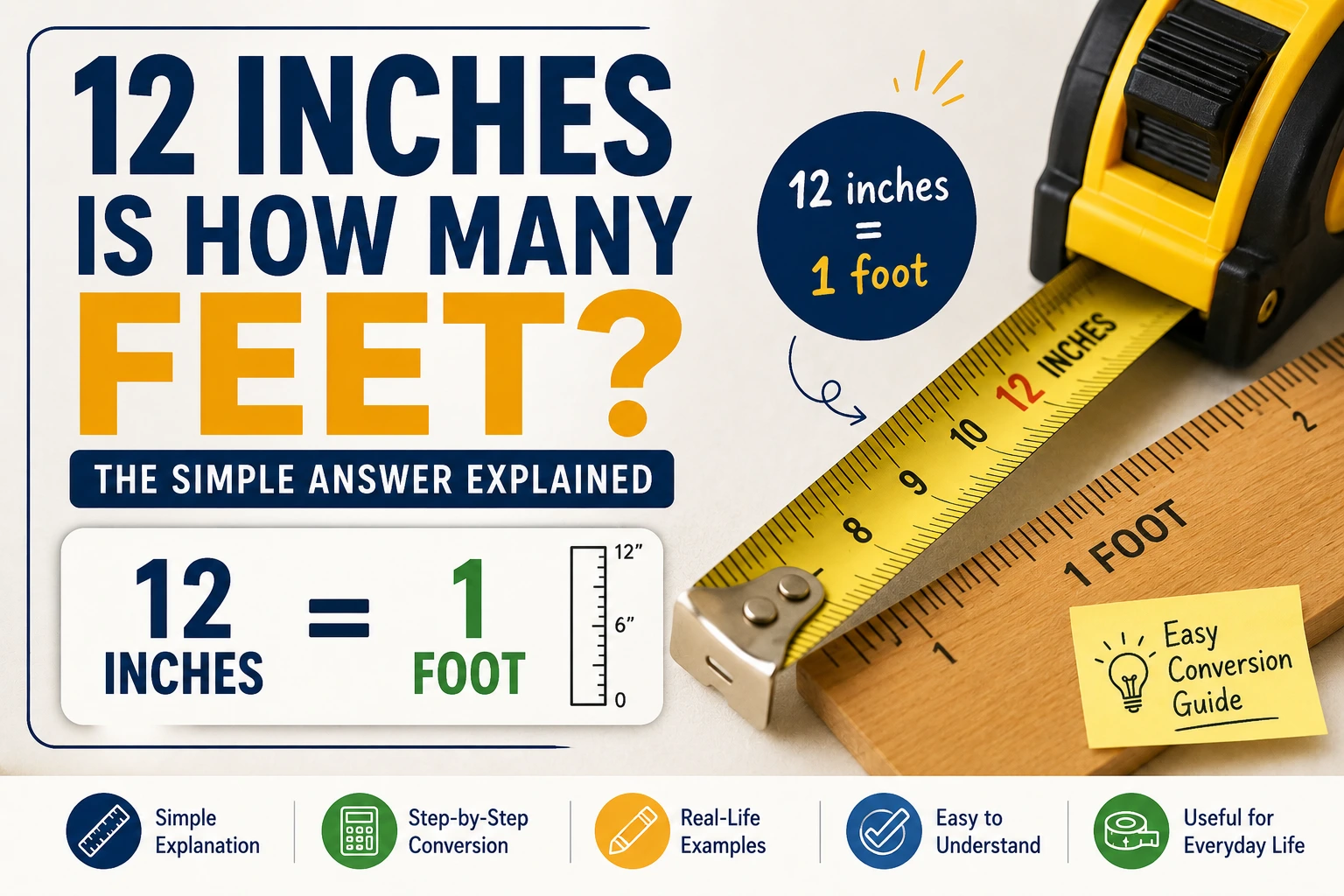
If you have ever asked 12 inches is how many feet, the answer is very simple. Twelve inches equals exactly one foot. This is one of the most basic and important conversions in the imperial measurement system.
Understanding this relationship makes it easier to measure furniture, room dimensions, building materials, and even a person’s height. Since many countries still use feet and inches for everyday measurements, learning this conversion is a useful skill.
In this guide, you will learn why 12 inches equals 1 foot, how to convert inches into feet, practical examples, conversion charts, common mistakes to avoid, and expert tips for accurate measurements.
12 Inches Is How Many Feet Exactly?
The exact answer is:
12 inches = 1 foot
Unlike many other conversions that result in decimal values, this conversion is exact.
The calculation is simple.
12 ÷ 12 = 1 foot
Because one foot always contains twelve inches, converting twelve inches into feet gives an answer of exactly one.
| Inches | Feet |
|---|---|
| 12 | 1 |
| Exact Answer | 1 foot |
This relationship forms the basis of every inch to feet conversion.
Understanding Inches and Feet
Both inches and feet belong to the imperial measurement system, which is widely used in the United States and several other countries.
An inch is a smaller unit of length. It is commonly used for measuring:
- Books
- Mobile phones
- Laptops
- Furniture
- Clothing
- Television screens
A foot is a larger unit that contains twelve inches.
Feet are commonly used for measuring:
- Room dimensions
- Building heights
- Doors
- Windows
- Walls
- Human height
Understanding the relationship between these units makes measurement conversions much easier.
How to Convert Inches to Feet
The conversion formula is very simple.
Feet = Inches ÷ 12
Let’s apply it to 12 inches.
Step 1
Write the measurement.
12 inches
Step 2
Divide by 12.
12 ÷ 12 = 1
Step 3
Write the answer.
12 inches = 1 foot
This same formula works for every inch measurement.
For example:
- 24 inches = 2 feet
- 36 inches = 3 feet
- 48 inches = 4 feet
- 60 inches = 5 feet
Once you know the formula, you can convert any measurement quickly.
Why 12 Inches Equals 1 Foot
The relationship between inches and feet dates back hundreds of years and has become a standard part of the imperial measurement system.
Today, every measuring tape, ruler, and construction plan follows this standard.
One foot is always divided into twelve equal parts called inches.
This consistency makes measuring objects easier and ensures everyone uses the same units.
Because of this fixed relationship, converting inches into feet only requires dividing by twelve.
Examples of Inches to Feet Conversions
Understanding a few common conversions makes estimating measurements much easier.
| Inches | Feet |
|---|---|
| 6 | 0.5 |
| 12 | 1 |
| 18 | 1.5 |
| 24 | 2 |
| 30 | 2.5 |
| 36 | 3 |
| 48 | 4 |
| 60 | 5 |
| 72 | 6 |
These examples show how every additional twelve inches adds one more foot.
Quick Inches to Feet Conversion Chart
This quick reference chart can help you convert common measurements without using a calculator.
| Inches | Feet |
|---|---|
| 1 | 0.08 |
| 2 | 0.17 |
| 3 | 0.25 |
| 4 | 0.33 |
| 5 | 0.42 |
| 6 | 0.50 |
| 8 | 0.67 |
| 10 | 0.83 |
| 12 | 1 |
| 24 | 2 |
| 36 | 3 |
| 48 | 4 |
Everyday Uses for This Conversion
Knowing that 12 inches is how many feet may seem basic, but it is one of the most useful measurement conversions in daily life. Whether you are measuring objects at home, completing school assignments, or working on a construction project, understanding that 12 inches equals 1 foot helps you measure with confidence.
Measuring Furniture
Furniture dimensions are often provided in inches, while room sizes are measured in feet. Knowing how to convert between the two helps you determine whether a piece of furniture will fit in your available space.
Examples include:
- Coffee tables
- Sofas
- Dining tables
- Bookshelves
- Office desks
Home Improvement Projects
DIY projects often require accurate measurements. Understanding inches and feet helps when installing:
- Shelves
- Cabinets
- Curtains
- Flooring
- Wall panels
A simple mistake in measurement can lead to wasted materials and additional costs.
Construction and Carpentry
Builders, carpenters, and contractors constantly switch between inches and feet while reading plans and measuring materials.
Knowing that every 12 inches equals 1 foot allows for quick mental calculations and more accurate measurements.
Education
Students frequently learn measurement conversions in mathematics and science classes.
Understanding this conversion builds a strong foundation for solving more advanced measurement problems later.
Sports and Fitness
Height measurements are often expressed in feet and inches.
For example:
- 5 feet = 60 inches
- 6 feet = 72 inches
Learning these relationships makes it easier to understand height measurements in sports and health records.
Benefits of Understanding Inches to Feet Conversions
Learning simple measurement conversions offers several advantages.
Better Accuracy
Knowing the correct relationship between inches and feet reduces measurement errors.
Faster Calculations
Once you remember that 12 inches equals 1 foot, many conversions can be completed mentally without using a calculator.
Improved Communication
Construction workers, designers, teachers, and homeowners often use both units. Understanding both makes communication much easier.
More Confidence During DIY Projects
Whether you are assembling furniture or measuring a room, knowing basic conversions helps you work more efficiently.
Easier Shopping
Many products list dimensions in inches. Understanding the equivalent in feet helps you choose the right product for your space.
Common Mistakes When Converting Inches to Feet
Although the conversion is straightforward, several common mistakes can lead to incorrect measurements.
Dividing by the Wrong Number
The biggest mistake is forgetting that one foot equals 12 inches.
Some people mistakenly divide by 10.
Always remember:
Feet = Inches ÷ 12
Mixing Inches With Feet
Another common error is treating inches and feet as interchangeable units.
For example:
12 inches is not 12 feet.
Instead:
12 inches = 1 foot.
Rounding Too Soon
When converting larger measurements, complete the calculation before rounding your answer.
This helps maintain accuracy, especially in construction and engineering.
Confusing Imperial and Metric Units
Inches and feet belong to the imperial system.
Centimetres and metres belong to the metric system.
Avoid mixing these systems unless you are intentionally converting between them.
Expert Tips for Accurate Measurements
Professionals rely on a few simple habits to improve measurement accuracy.
Use a Quality Measuring Tape
Choose a measuring tape with clearly marked inches and feet.
A high quality tape reduces reading errors.
Double Check Every Measurement
Measure twice before cutting materials.
This simple habit saves time, money, and frustration.
Learn Common Conversions
Memorising a few common conversions makes estimating measurements much easier.
Examples include:
- 12 inches = 1 foot
- 24 inches = 2 feet
- 36 inches = 3 feet
- 48 inches = 4 feet
- 60 inches = 5 feet
- 72 inches = 6 feet
Keep a Conversion Chart Nearby
A printed conversion chart can be very helpful during home improvement or construction projects.
Understand Both Formats
Some situations use decimal feet, while others use feet and inches.
Knowing both formats improves communication and prevents mistakes.
Practical Examples
Here are a few examples using the conversion formula.
Example 1
12 inches ÷ 12 = 1 foot
Example 2
30 inches ÷ 12 = 2.5 feet
Example 3
48 inches ÷ 12 = 4 feet
Example 4
72 inches ÷ 12 = 6 feet
Example 5
96 inches ÷ 12 = 8 feet
These examples demonstrate how easy it becomes once you understand the basic formula.
Why This Conversion Matters
Many people rely on measurement conversions every day without realizing it.
Understanding that 12 inches is how many feet allows you to:
- Read measuring tapes correctly
- Understand product dimensions
- Plan room layouts
- Complete school assignments
- Improve DIY projects
- Work more efficiently on construction tasks
Because the relationship between inches and feet never changes, this simple conversion remains one of the easiest and most useful to remember.
Frequently Asked Questions
12 inches is how many feet?
Twelve inches equals exactly 1 foot. Since one foot always contains 12 inches, the conversion is exact.
Why does one foot equal 12 inches?
The imperial measurement system defines one foot as exactly 12 inches. This standard has been used for centuries and is followed worldwide wherever imperial units are used.
How do I convert inches into feet?
Divide the number of inches by 12.
Formula:
Feet = Inches ÷ 12
For example:
12 ÷ 12 = 1 foot
Is 24 inches equal to 2 feet?
Yes. Since every foot contains 12 inches:
24 ÷ 12 = 2 feet
Where is this conversion commonly used?
This conversion is used in construction, carpentry, architecture, interior design, furniture shopping, education, engineering, sports, and everyday household measurements.
Conclusion
If you were wondering 12 inches is how many feet, the answer is simple and exact. Twelve inches equals one foot. This basic conversion forms the foundation of the imperial measurement system and is used every day in homes, schools, construction sites, and workplaces.
Remember the simple formula:
Feet = Inches ÷ 12
By understanding this relationship, you can quickly convert any measurement from inches to feet with confidence. Whether you are measuring furniture, planning a DIY project, reading construction plans, or helping with schoolwork, knowing that 12 inches is how many feet makes measuring easier, more accurate, and far more convenient.
Discover more