

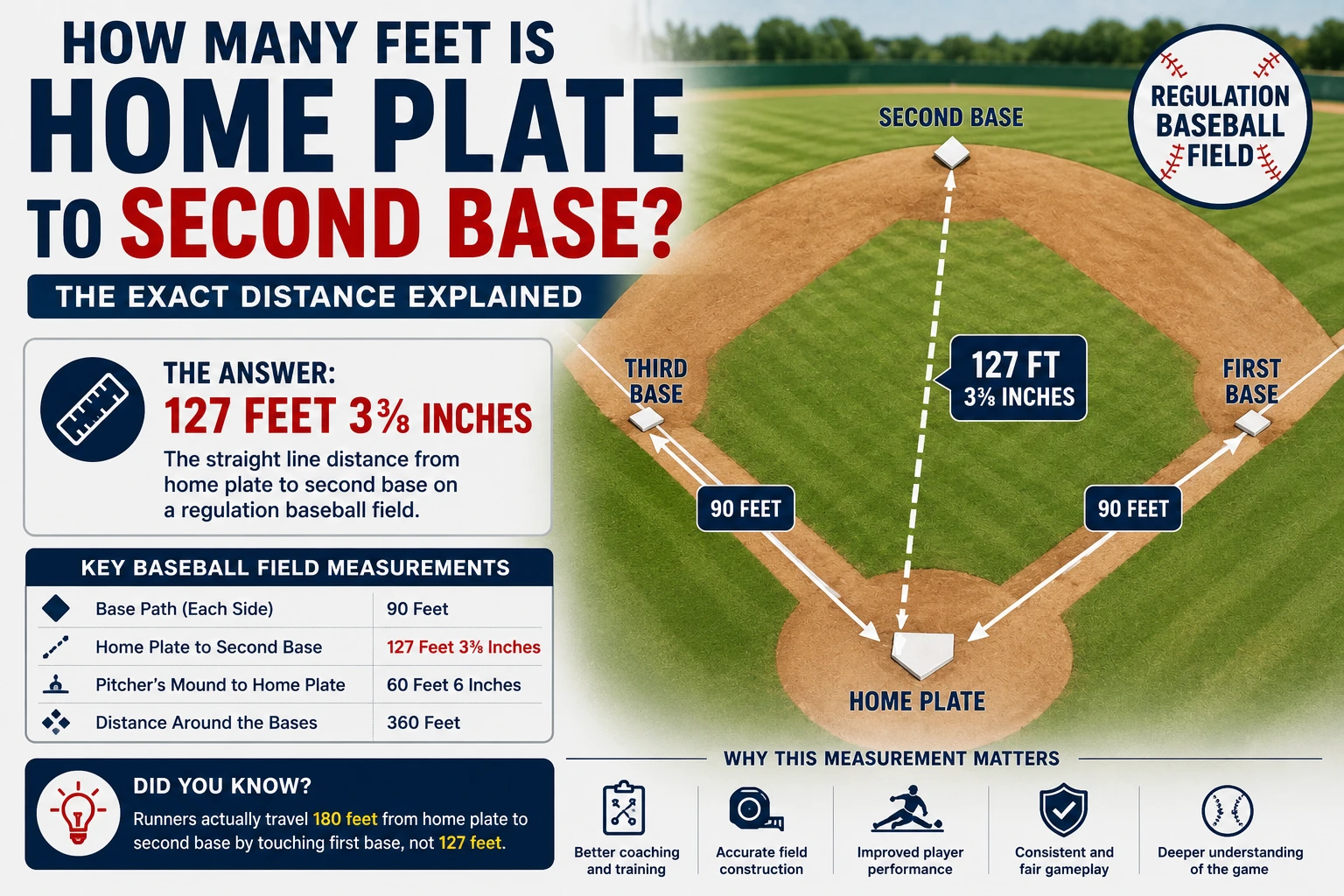
If you have ever watched or played baseball, you may have wondered how many feet is home plate to second base. Unlike the distance between individual bases, which is easy to remember, the measurement from home plate to second base requires a simple mathematical calculation because it runs diagonally across the baseball diamond.
Understanding this distance is useful for players, coaches, field builders, parents, and baseball fans. It helps explain field design, defensive positioning, throwing distances, and official baseball field measurements. Whether you are building a baseball field, studying the game, or simply satisfying your curiosity, knowing the exact distance provides a better understanding of how the sport is played.
In this guide, you’ll learn the precise measurement from home plate to second base, how it is calculated, why it matters, and how it compares with other important baseball field dimensions.
The Quick Answer
The official distance from home plate to second base is approximately 127 feet 3⅜ inches on a regulation baseball field.
This measurement is based on the standard baseball diamond where each base path measures 90 feet.
The diagonal distance is calculated using geometry rather than simple addition.
| Baseball Measurement | Distance |
|---|---|
| Home to First Base | 90 feet |
| First to Second Base | 90 feet |
| Second to Third Base | 90 feet |
| Third to Home Plate | 90 feet |
| Home Plate to Second Base | Approximately 127 feet 3⅜ inches |
Although players run 180 feet when advancing from home plate to second base by touching first base, the straight line distance across the infield is only about 127 feet.
Exact Distance
A regulation baseball diamond forms a perfect square.
Each side measures:
90 feet
The diagonal of that square, which runs from home plate to second base, measures:
127 feet 3⅜ inches
This measurement is used by field designers and grounds crews when laying out regulation baseball fields.
Understanding Baseball Field Measurements
Baseball fields follow carefully defined measurements that ensure fair play at every level of competition.
While outfield fences vary from stadium to stadium, the infield dimensions remain remarkably consistent.
Standard Base Paths
A regulation baseball field contains four bases.
These include:
- Home plate
- First base
- Second base
- Third base
Each consecutive base is exactly:
90 feet apart
This standard has been used in Major League Baseball for more than a century.
The equal spacing creates a perfectly square infield.
Why Measurements Matter
Accurate field measurements affect nearly every part of the game.
They influence:
- Base running
- Throwing distances
- Defensive positioning
- Double plays
- Pitching strategy
- Field construction
- Umpire decisions
Even small measurement errors can impact player safety and game fairness.
How Many Feet Is Home Plate to Second Base?
Many people assume the distance from home plate to second base is simply:
90 feet + 90 feet = 180 feet
That calculation represents the running distance after touching first base.
However, if you measure directly across the baseball diamond, the answer is very different.
The diagonal distance is approximately:
127 feet 3⅜ inches
This is because the baseball diamond forms a square rather than a straight line.
The Mathematical Calculation
The distance is calculated using the Pythagorean Theorem, which determines the diagonal of a square.
Since each side measures:
90 feet
The formula is:
Diagonal = √(90² + 90²)
Breaking it down:
- 90² = 8,100
- 8,100 + 8,100 = 16,200
- √16,200 ≈ 127.28 feet
Converting the decimal gives:
127 feet 3⅜ inches
This is the official straight line measurement used during field construction.
Why the Distance Is Not 180 Feet
The confusion comes from mixing two different measurements.
When a batter reaches second base during a game, they must run:
- Home to first
- First to second
That totals:
180 feet
However, if you stretched a tape measure directly from home plate to second base, you would measure only about 127 feet because the tape follows the diagonal instead of the base paths.
This difference highlights the importance of understanding geometry in sports field design.
Baseball Field Dimension Chart
Below are the most important measurements found on a regulation baseball field.
| Field Measurement | Official Distance |
|---|---|
| Home to First | 90 feet |
| First to Second | 90 feet |
| Second to Third | 90 feet |
| Third to Home | 90 feet |
| Home to Second | 127 feet 3⅜ inches |
| Pitcher’s Mound to Home Plate | 60 feet 6 inches |
| Home Plate to Center Field | Varies by stadium |
| Home Plate to Backstop | Varies by league |
Only the infield measurements remain standardized across professional baseball.
Outfield fence distances often vary depending on stadium design.
Home Plate to Second Base Compared With Other Distances
Seeing the measurement alongside other baseball distances makes it easier to understand.
| Baseball Distance | Length |
|---|---|
| Home to First | 90 feet |
| Home to Second by Running | 180 feet |
| Home to Second Directly | 127 feet 3⅜ inches |
| Home to Third by Running | 270 feet |
| Complete Trip Around Bases | 360 feet |
This comparison shows why players must cover much greater distances than the straight line measurements used in field construction.
Understanding these differences helps coaches teach base running strategy more effectively.
Why This Measurement Is Important
The distance from home plate to second base is more than just a number.
It plays an important role in several aspects of baseball.
Field Construction
Grounds crews use this measurement to ensure every base is positioned correctly.
Even slight errors can make the entire infield uneven.
Defensive Positioning
Middle infielders often use the geometry of the diamond to improve positioning during double plays and stolen base attempts.
Coaching
Coaches explain these measurements to help young players understand the field and improve decision making.
Baseball Education
Knowing official dimensions helps students, sports writers, and fans better appreciate the game’s design and history.
Practical Examples of the Home Plate to Second Base Distance
Understanding the measurement becomes much easier when you see how it applies in real baseball situations.
Example One: Building a Baseball Field
A school plans to build a regulation baseball field.
The construction team first measures 90 feet between each base to create a perfect square. After placing home plate, first base, second base, and third base, they verify the layout by measuring the diagonal from home plate to second base.
If that diagonal measures approximately 127 feet 3⅜ inches, the infield has been laid out correctly.
Example Two: Coaching Young Players
A youth baseball coach explains why players run farther than the direct distance across the field.
Although the straight line from home plate to second base is 127 feet 3⅜ inches, runners cannot take that shortcut. They must touch first base before advancing to second, so they actually run 180 feet.
This example helps players understand both the rules of baseball and the geometry of the diamond.
Example Three: Grounds Maintenance
Before each season, grounds crews inspect the field to ensure every base remains in its proper location.
Checking the diagonal measurement is one of the easiest ways to confirm that the square infield has not shifted over time.
Baseball vs Softball Field Dimensions
Many people assume baseball and softball fields use identical measurements, but the base paths are different.
Because softball fields have shorter base paths, the distance from home plate to second base is also shorter.
| Measurement | Baseball | Fastpitch Softball |
|---|---|---|
| Base Path | 90 feet | 60 feet |
| Home to Second Base | 127 feet 3⅜ inches | Approximately 84 feet 10 inches |
| Pitching Distance | 60 feet 6 inches | 43 feet |
These differences match the pace and style of each sport while maintaining balanced gameplay.
Benefits of Understanding Baseball Field Measurements
Knowing official field dimensions offers several practical advantages.
Better Coaching
Coaches can explain defensive positioning, throwing distances, and base running more effectively.
Improved Field Construction
Accurate measurements ensure that new fields meet league standards and provide a consistent playing experience.
Enhanced Player Development
Players who understand field geometry often make better decisions when running the bases or positioning themselves on defense.
Greater Appreciation of the Game
Fans gain a deeper understanding of why certain plays are difficult, especially close throws to second base or double plays.
Easier Rule Interpretation
Many baseball rules depend on official field dimensions, making it useful for players, coaches, and umpires to understand these measurements.
Common Mistakes When Measuring the Baseball Diamond
Even experienced volunteers and coaches occasionally make measurement errors.
Avoid these common mistakes.
Assuming the Distance Is 180 Feet
The most common misunderstanding is believing that home plate to second base measures 180 feet.
That is the running distance, not the straight line measurement.
Measuring From the Wrong Part of Home Plate
Home plate has a unique five sided shape.
Official measurements begin from the rear point of home plate, not the front edge.
Forgetting the Diamond Is a Square
Every side of the baseball diamond measures 90 feet.
Changing one side slightly changes every diagonal measurement.
Ignoring Official Specifications
Professional and amateur leagues follow specific construction guidelines.
Using unofficial measurements can create an uneven field and affect gameplay.
Using Approximate Measurements
Even small errors become noticeable across an entire baseball field.
Using quality measuring equipment helps ensure accuracy.
Expert Tips for Measuring a Baseball Field
Whether you are building a new field or checking an existing one, these tips can help.
- Measure from the official reference points on each base.
- Use a high quality steel measuring tape rather than a cloth tape.
- Double check every base path before measuring the diagonal.
- Confirm the home to second base measurement after all bases are installed.
- Measure on level ground whenever possible.
- Follow official league specifications for your level of play.
- Recheck measurements before installing permanent anchors.
- Inspect field dimensions before each season if the bases are removable.
Accurate measurements improve player safety and maintain fair competition.
How many feet is home plate to second base in Major League Baseball?
The straight line distance from home plate to second base is approximately 127 feet 3⅜ inches on a regulation Major League Baseball field.
Why is home plate to second base not 180 feet?
A runner travels 180 feet by running from home plate to first base and then to second base. However, the direct diagonal distance across the baseball diamond is only 127 feet 3⅜ inches.
How is the distance from home plate to second base calculated?
The measurement is calculated using the Pythagorean Theorem because the baseball diamond forms a square with 90 foot sides.
Is the distance the same on every baseball field?
Yes. Regulation baseball fields use 90 foot base paths, making the distance from home plate to second base approximately 127 feet 3⅜ inches. While outfield fence distances may vary, the infield measurements remain standardized.
Is the distance different in softball?
Yes. Softball fields use shorter base paths, typically 60 feet, so the distance from home plate to second base is approximately 84 feet 10 inches, depending on the level of play.
Conclusion
Understanding how many feet is home plate to second base helps players, coaches, field builders, and baseball fans appreciate the precision behind the game. On a regulation baseball field, the direct distance from home plate to second base is approximately 127 feet 3⅜ inches, calculated from a square infield with 90 foot base paths. Although a runner must travel 180 feet by touching first base, the straight line measurement across the diamond is significantly shorter because it follows the diagonal.
Knowing this official measurement is useful for field construction, coaching, player development, and understanding baseball strategy. Whether you are setting up a new baseball field, studying the rules, or simply expanding your knowledge of the sport, recognizing the difference between running distance and direct field measurements provides a clearer understanding of how baseball is designed and played.
Discover more