
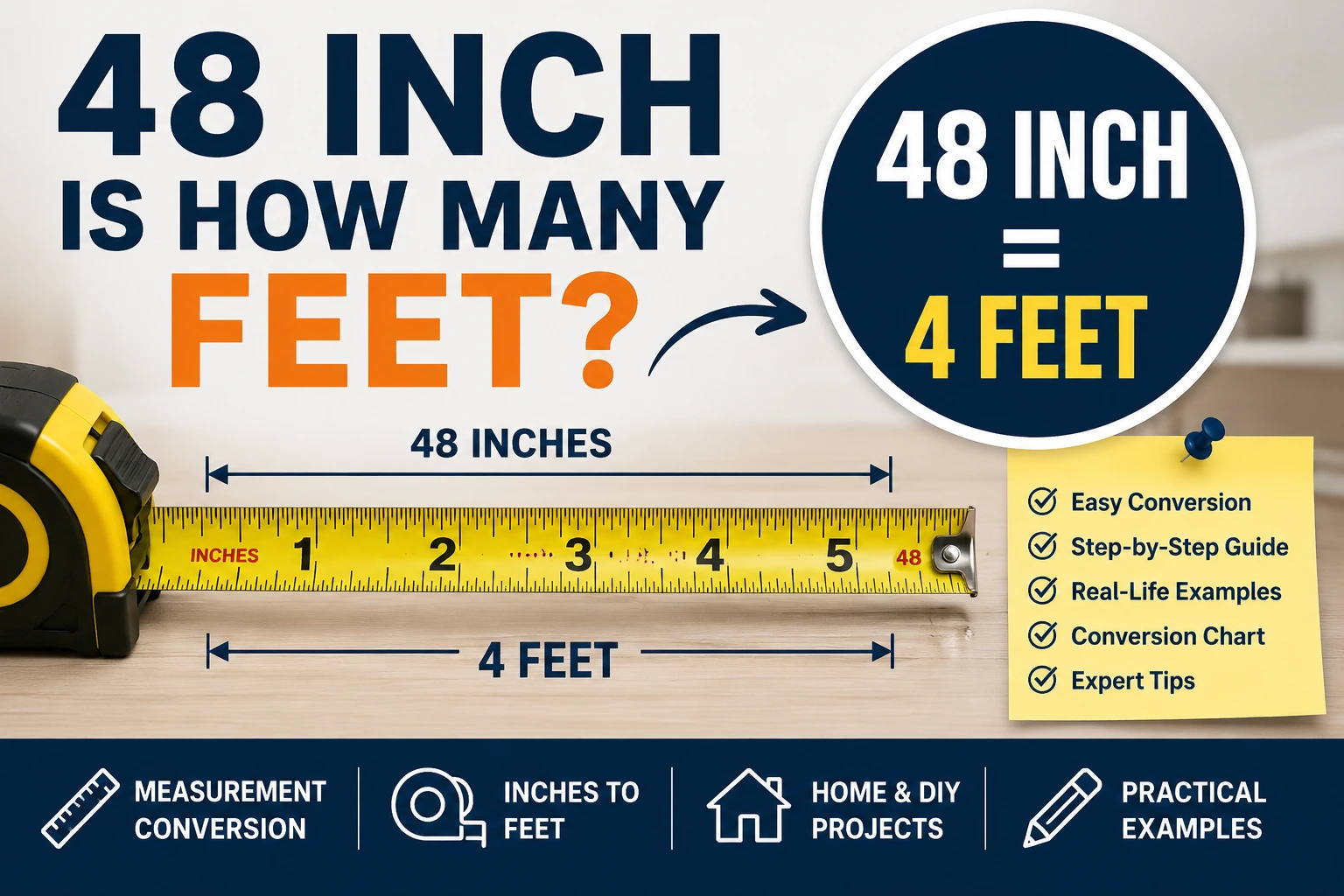
If you’re wondering 48 inch is how many feet, the answer is simple:
48 inches = 4 feet.
Whether you’re measuring furniture, planning a home renovation, buying a television stand, installing shelves, or working on a DIY project, converting inches into feet is a useful skill. Since many products are measured in inches while room dimensions are often given in feet, understanding this conversion can help you avoid mistakes and make better decisions.
In this guide, you’ll learn the exact conversion, the formula behind it, practical examples, conversion charts, and tips for measuring accurately.
The Quick Answer
The conversion is straightforward.
| Inches | Feet |
|---|---|
| 48 inches | 4 feet |
Since 1 foot equals 12 inches, divide the number of inches by 12.
48 ÷ 12 = 4 feet
Answer: 48 inches is equal to 4 feet.
Understanding Inches and Feet
Both inches and feet are units of length in the Imperial and U.S. customary measurement systems.
What Is an Inch?
An inch is a small unit commonly used for measuring:
- Furniture
- Electronics
- Clothing
- Screens
- Small household items
- Construction materials
One inch is represented as in or with the double quotation mark (“).
Example:
- 24 inches
- 36 inches
- 48 inches
What Is a Foot?
A foot is a larger unit of measurement represented as ft or by the single quotation mark (‘).
It is commonly used for measuring:
- Room dimensions
- Ceiling height
- Building materials
- Doors
- Windows
- Walls
- Property dimensions
Since one foot contains 12 inches, converting between the two units is easy.
How to Convert 48 Inches to Feet
The conversion requires only one simple calculation.
Formula
Feet = Inches ÷ 12
Insert the measurement:
Feet = 48 ÷ 12
Feet = 4
Therefore,
48 inches = 4 feet
This formula works for every inch-to-feet conversion.
Inches to Feet Conversion Formula
Whenever you need to convert inches into feet, remember this equation:
Feet = Inches ÷ 12
Here are a few examples:
| Inches | Calculation | Feet |
|---|---|---|
| 12 | 12 ÷ 12 | 1 ft |
| 24 | 24 ÷ 12 | 2 ft |
| 36 | 36 ÷ 12 | 3 ft |
| 48 | 48 ÷ 12 | 4 ft |
| 60 | 60 ÷ 12 | 5 ft |
| 72 | 72 ÷ 12 | 6 ft |
| 84 | 84 ÷ 12 | 7 ft |
| 96 | 96 ÷ 12 | 8 ft |
Learning this pattern makes mental calculations much faster.
Why Do We Divide by 12?
The reason is simple:
1 foot = 12 inches
To determine how many feet are contained in a given number of inches, divide the total inches by 12.
For example:
- 24 inches ÷ 12 = 2 feet
- 36 inches ÷ 12 = 3 feet
- 48 inches ÷ 12 = 4 feet
- 120 inches ÷ 12 = 10 feet
This conversion is used daily by builders, architects, designers, and homeowners.
Conversion Chart for Common Inch Values
The following chart helps you quickly convert inches into feet.
| Inches | Feet |
|---|---|
| 6 | 0.5 ft |
| 12 | 1 ft |
| 18 | 1.5 ft |
| 24 | 2 ft |
| 30 | 2.5 ft |
| 36 | 3 ft |
| 42 | 3.5 ft |
| 48 | 4 ft |
| 54 | 4.5 ft |
| 60 | 5 ft |
| 66 | 5.5 ft |
| 72 | 6 ft |
| 84 | 7 ft |
| 96 | 8 ft |
| 120 | 10 ft |
Bookmarking or printing this table can save time during home improvement projects.
Real-Life Examples of 48 Inches
It is easier to understand a measurement when you relate it to everyday objects.
Dining Table Width
Many rectangular dining tables measure about 48 inches, or 4 feet, across one side. This provides comfortable seating for families while fitting well in most dining rooms.
Office Desk
A standard office desk is often around 48 inches (4 feet) wide, giving enough room for a computer, keyboard, and workspace without taking up excessive floor space.
TV Stand
TV stands designed for medium-sized televisions are commonly 48 inches long, making them suitable for living rooms, bedrooms, or apartments.
Bookshelf
Many freestanding bookshelves are approximately 48 inches tall, providing several shelves for books, decorations, or storage while remaining easy to reach.
Kitchen Counter Section
In modular kitchens, a 48-inch countertop section is a common size for food preparation or appliance placement. Converting this to 4 feet helps when planning cabinet layouts and measuring available space.
Why This Conversion Matters
Knowing that 48 inches equals 4 feet is useful in many situations.
Home Improvement
Whether you’re installing shelves, replacing flooring, or hanging curtains, understanding measurements helps you purchase the correct materials and avoid costly mistakes.
Furniture Shopping
Retailers often list furniture dimensions in inches, while room sizes are measured in feet. Being able to convert quickly makes it easier to determine whether a piece will fit your space.
Construction Projects
Builders and contractors regularly switch between inches and feet when reading blueprints, cutting materials, or checking dimensions. Accurate conversions improve efficiency and reduce waste.
Education
Students studying mathematics or practical geometry frequently encounter unit conversions. Learning the inch-to-feet formula builds confidence and strengthens measurement skills.
*Continue with Part 2, which will cover practical uses, comparisons with other units, common conversion mistakes, expert tips, a complete FAQs section (with only one FAQs heading), and the H2 Conclusion.
Practical Uses of a 48-Inch Measurement
A measurement of 48 inches (4 feet) appears in many everyday situations. Understanding this conversion makes it easier to plan projects, compare product sizes, and communicate measurements accurately.
Home Renovation
When remodeling a home, measurements are often listed in both inches and feet.
Examples include:
- Kitchen cabinets
- Bathroom vanities
- Countertops
- Shelving
- Doors
Knowing that 48 inches equals 4 feet allows you to compare dimensions quickly without reaching for a calculator.
Interior Design
Interior designers frequently work with measurements in inches while floor plans are drawn in feet.
For example:
- A coffee table may be 48 inches long.
- A feature wall may be 12 feet wide.
- A sofa may measure 84 inches.
Converting inches to feet helps designers create balanced room layouts.
Carpentry and Woodworking
Woodworkers regularly measure lumber in feet while cutting pieces in inches.
For example, if a board needs to be cut to 48 inches, it can also be measured as 4 feet, making layout and cutting more efficient.
Gardening and Landscaping
Garden beds, fences, and pathways are often measured in feet, while individual materials are sold in inches.
Examples include:
- Fence panels
- Wooden stakes
- Garden edging
- Decorative borders
Understanding both units helps reduce material waste.
Construction Projects
Builders constantly convert between inches and feet when measuring:
- Wall framing
- Ceiling heights
- Windows
- Doors
- Roofing materials
Quick conversions improve communication among contractors and reduce errors.
Comparing 48 Inches to Other Common Measurements
It helps to compare 48 inches with other familiar lengths.
| Measurement | Equivalent |
|---|---|
| 48 inches | 4 feet |
| 1.33 yards | Approximately 1⅓ yards |
| 121.92 centimeters | 121.92 cm |
| 1.2192 meters | 1.22 m |
| 0.0012 kilometers | 0.0012 km |
These conversions are especially useful when working with international products or metric-based plans.
Inches to Feet Conversion Chart
The table below provides quick conversions for commonly used measurements.
| Inches | Feet |
|---|---|
| 12 | 1 ft |
| 18 | 1.5 ft |
| 24 | 2 ft |
| 30 | 2.5 ft |
| 36 | 3 ft |
| 42 | 3.5 ft |
| 48 | 4 ft |
| 54 | 4.5 ft |
| 60 | 5 ft |
| 72 | 6 ft |
| 84 | 7 ft |
| 96 | 8 ft |
| 108 | 9 ft |
| 120 | 10 ft |
Keeping this chart nearby can save time during measuring tasks.
Step-by-Step Conversion Examples
Here are a few examples using the same formula.
Example 1
Convert 48 inches to feet.
Formula:
Feet = Inches ÷ 12
Calculation:
48 ÷ 12 = 4 feet
Example 2
Convert 90 inches to feet.
90 ÷ 12 = 7.5 feet
Example 3
Convert 144 inches to feet.
144 ÷ 12 = 12 feet
Example 4
Convert 30 inches to feet.
30 ÷ 12 = 2.5 feet
Example 5
Convert 18 inches to feet.
18 ÷ 12 = 1.5 feet
These examples show that the same formula works every time.
Practical Scenarios Where You’ll Use This Conversion
Understanding inch-to-feet conversions is valuable in many real-world situations.
Buying Furniture
Suppose a product description says a table is 48 inches long.
Instead of picturing 48 individual inches, you immediately know it measures 4 feet, making it easier to decide whether it fits your room.
Installing Curtains
Curtain rods are commonly measured in inches, while window spacing is often discussed in feet.
Converting between the two ensures a proper fit.
Planning Storage
If you’re purchasing shelving units that measure 48 inches, you’ll know they require 4 feet of wall space.
Choosing a Television Stand
Many TV stands are exactly 48 inches wide.
Knowing that this equals 4 feet helps you determine if there’s enough space between walls or other furniture.
DIY Projects
Whether you’re building a bench, bookshelf, or workbench, converting inches into feet helps when reading plans and cutting materials accurately.
Common Mistakes When Converting Inches to Feet
Although the calculation is simple, mistakes still happen.
Forgetting to Divide by 12
Some people mistakenly multiply instead of dividing.
Always remember:
Feet = Inches ÷ 12
Confusing Feet with Square Feet
Feet measure length.
Square feet measure area.
For example:
- 48 inches = 4 feet
- 4 square feet is an area measurement and is not the same thing.
Mixing Measurement Systems
Don’t mix:
- Inches
- Feet
- Centimeters
- Meters
Convert everything into one measurement system before starting your calculations.
Rounding Too Early
When measurements aren’t exact multiples of 12, avoid rounding until the final answer.
Example:
50 inches = 4.1667 feet
Rounding too soon may lead to inaccurate material estimates.
Reading the Tape Measure Incorrectly
Many tape measures display both inches and feet.
Take your time to identify the correct markings before recording measurements.
Expert Tips for Accurate Measurements
Professionals rely on these simple habits to ensure precise results.
- Measure twice before cutting.
- Use a quality tape measure or laser distance measurer.
- Write measurements immediately.
- Convert units before ordering materials.
- Keep a conversion chart nearby.
- Double-check calculations for expensive projects.
- Use consistent measurement units throughout your project.
These practices reduce waste, save time, and improve accuracy.
Why Learning Measurement Conversions Is Useful
Knowing basic measurement conversions offers several benefits.
- Speeds up home improvement projects.
- Makes online shopping easier.
- Helps compare product dimensions.
- Improves communication with contractors.
- Builds confidence in DIY work.
- Strengthens math and measurement skills.
- Reduces costly purchasing mistakes.
A simple conversion like 48 inches to 4 feet may seem small, but it becomes useful in many everyday situations.
FAQs
What is 48 inch in feet?
Forty-eight inches is equal to 4 feet because one foot contains 12 inches.
How do you convert 48 inches into feet?
Divide the number of inches by 12.
48 ÷ 12 = 4 feet.
Is 48 inches exactly 4 feet?
Yes. Since 12 inches make one foot, 48 inches equals exactly 4 feet.
How many centimeters are 48 inches?
Forty-eight inches equals 121.92 centimeters.
Can I use the same formula for any inch-to-feet conversion?
Yes. Divide any measurement in inches by 12 to convert it into feet.
Conclusion
If you’ve been wondering 48 inch is how many feet, the answer is straightforward: 48 inches equals 4 feet. The conversion is based on the standard relationship that 1 foot equals 12 inches, so dividing 48 by 12 gives you 4 feet.
Understanding this simple conversion is useful for everyday tasks such as buying furniture, planning renovations, measuring rooms, working on DIY projects, or reading construction plans. By remembering the formula Feet = Inches ÷ 12, using conversion charts, and measuring carefully, you can confidently convert inches to feet whenever you need accurate and reliable measurements.
Discover more