

If you’re shopping for a space heater, furnace, or HVAC system, one of the first questions you’ll likely ask is how many BTUs to heat 200 square feet. Choosing the correct BTU rating is essential because a heater that’s too small may struggle to keep the room warm, while an oversized unit can waste energy, increase operating costs, and create uncomfortable temperature swings.
Although a general guideline recommends around 20 to 30 BTUs per square foot, the exact heating requirement depends on several important factors, including your climate, insulation quality, ceiling height, and the number of windows in the room.
In this guide, you’ll learn how to calculate the right BTU requirement for a 200 square foot room, compare heating recommendations by climate, explore real-world examples, and discover expert tips for selecting an efficient heating system.
What Is a BTU?
BTU stands for British Thermal Unit.
It measures the amount of heat needed to raise the temperature of one pound of water by one degree Fahrenheit.
In heating systems, BTUs indicate how much heat a heater can produce in one hour.
The higher the BTU rating:
- The greater the heating capacity
- The larger the space it can warm
- The more fuel or electricity it may consume
Manufacturers use BTU ratings to help buyers choose equipment that matches the size of their room.
Why BTUs Matter
Selecting the proper BTU output offers several benefits.
It helps:
- Maintain comfortable temperatures
- Improve energy efficiency
- Reduce utility bills
- Extend heater lifespan
- Prevent unnecessary wear on equipment
- Increase indoor comfort
An accurately sized heater performs better than one that is either too large or too small.
How Many BTUs to Heat 200 Square Feet?
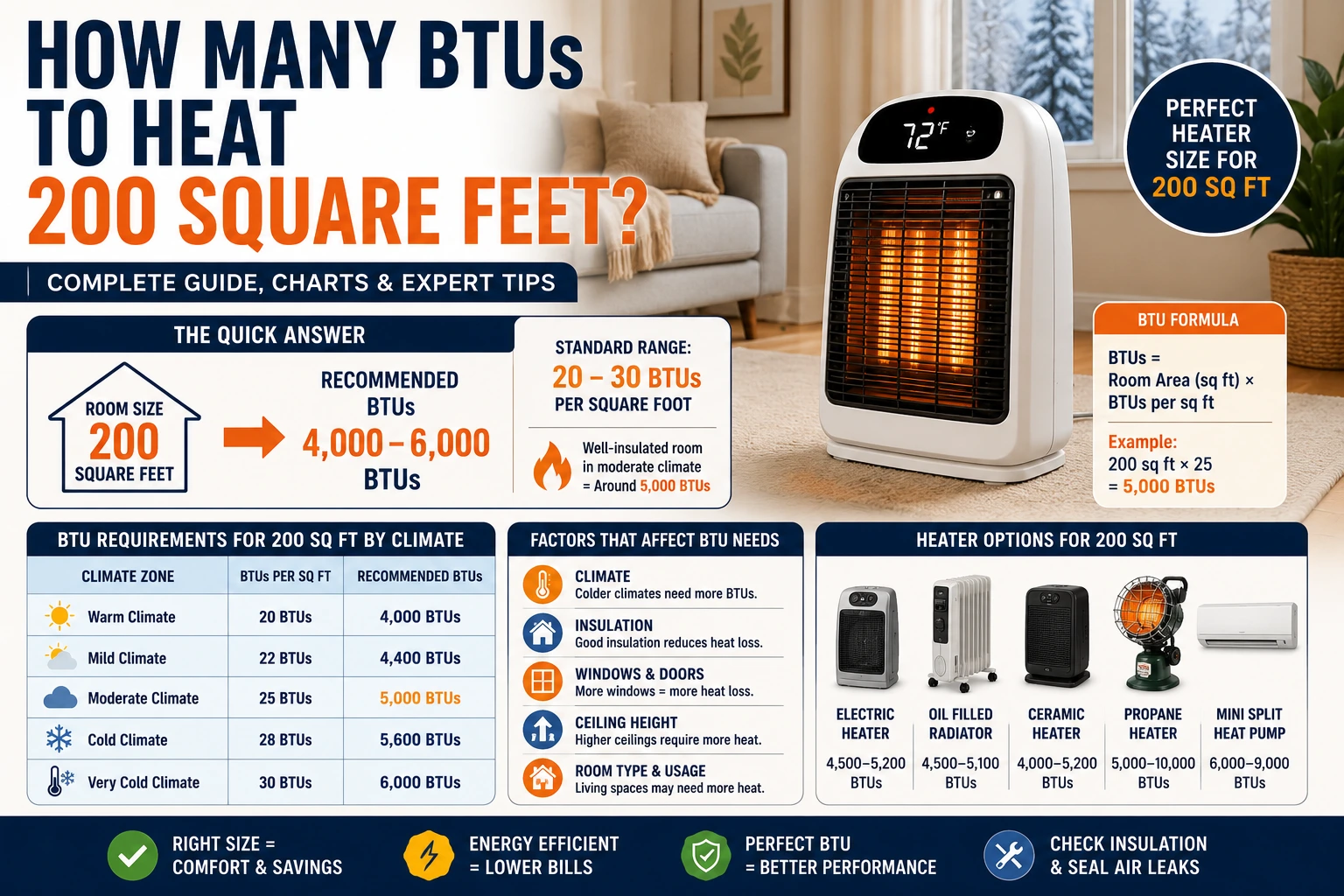
For most homes, a 200 square foot room requires approximately 4,000 to 6,000 BTUs.
A common recommendation is to use 20 to 30 BTUs per square foot.
Using this guideline:
- 200 × 20 = 4,000 BTUs
- 200 × 25 = 5,000 BTUs
- 200 × 30 = 6,000 BTUs
The appropriate size depends on your climate and room conditions.
| Room Size | Recommended BTUs |
|---|---|
| 150 sq ft | 3,000–4,500 BTUs |
| 200 sq ft | 4,000–6,000 BTUs |
| 250 sq ft | 5,000–7,500 BTUs |
| 300 sq ft | 6,000–9,000 BTUs |
For a well-insulated room in a moderate climate, 5,000 BTUs is often an excellent starting point.
Standard BTU Recommendation
Most HVAC professionals use the following general guideline.
| Condition | BTUs per Square Foot |
|---|---|
| Warm Climate | 20 BTUs |
| Moderate Climate | 25 BTUs |
| Cold Climate | 30 BTUs |
Using these recommendations:
| Climate | BTUs for 200 sq ft |
|---|---|
| Warm | 4,000 BTUs |
| Moderate | 5,000 BTUs |
| Cold | 6,000 BTUs |
These estimates assume average ceiling heights and typical insulation.
BTU Calculation Formula
The simplest way to estimate heating requirements is:
BTUs = Room Area × BTUs per Square Foot
For example:
Room Size:
200 square feet
Moderate climate:
25 BTUs per square foot
Calculation:
200 × 25 = 5,000 BTUs
This formula provides a reliable starting estimate before considering other factors.
BTU Chart by Climate Zone
Outdoor temperatures significantly influence heating needs.
The colder your climate, the more BTUs are required to maintain comfortable indoor temperatures.
| Climate Zone | BTUs per Sq Ft | BTUs for 200 Sq Ft |
|---|---|---|
| Hot Southern Regions | 20 | 4,000 |
| Mild Climate | 22 | 4,400 |
| Moderate Climate | 25 | 5,000 |
| Cold Northern Areas | 28 | 5,600 |
| Very Cold Climate | 30 | 6,000 |
These values provide a general guide for residential heating.
Factors That Affect Heating Requirements
Room size is only one part of the calculation.
Several other factors determine the actual BTUs you’ll need.
Climate
Climate has the greatest impact on heating demand.
For example:
Warm regions generally require fewer BTUs because outdoor temperatures remain relatively mild.
Cold regions require larger heating systems to compensate for greater heat loss.
Insulation
Well-insulated homes retain heat more effectively.
Good insulation in:
- Walls
- Ceilings
- Floors
- Attics
reduces the amount of heat your system must produce.
Poor insulation can increase heating requirements by 15 to 30 percent.
Ceiling Height
Most BTU recommendations assume ceilings are approximately 8 feet high.
If your ceilings measure:
- 9 feet
- 10 feet
- Cathedral height
the room contains more air volume and therefore requires additional heating capacity.
Higher ceilings often require increasing BTU output by 10 to 25 percent.
Windows and Doors
Glass allows heat to escape much faster than insulated walls.
Rooms with:
- Large windows
- Sliding glass doors
- Older windows
- Drafty entrances
may require additional BTUs to maintain comfortable temperatures.
Energy-efficient windows reduce heat loss significantly.
Heater Types for 200 Square Feet
Several heating options work well for a room of this size.
Electric Space Heaters
Electric heaters are ideal for:
- Bedrooms
- Home offices
- Apartments
- Small living rooms
Many models designed for 200 square feet produce approximately 5,000 BTUs or around 1,500 watts, making them suitable for supplemental heating.
Gas Heaters
Gas heaters can efficiently heat medium-sized spaces and often provide higher BTU outputs than electric models.
They are commonly used in garages, workshops, cabins, and larger living areas where natural gas or propane is available.
Mini Split Heat Pumps
Mini split systems offer both heating and cooling while maintaining excellent energy efficiency.
For a 200 square foot room, many entry-level mini split units provide sufficient heating capacity and allow precise temperature control throughout the year.
Choosing the Right Heater for 200 Square Feet
Selecting the right heater involves more than simply matching the BTU rating. You should also consider the room’s purpose, insulation, energy efficiency, and heating costs.
Here are some common heating options.
| Heater Type | Typical BTU Output | Best For |
|---|---|---|
| Electric Space Heater | 4,500–5,200 BTUs | Bedrooms, offices |
| Oil Filled Radiator | 4,500–5,100 BTUs | Quiet, long-lasting heat |
| Ceramic Heater | 4,000–5,200 BTUs | Fast heating |
| Propane Heater | 5,000–10,000 BTUs | Garages, workshops |
| Mini Split Heat Pump | 6,000–9,000 BTUs | Whole-room heating |
| Small Gas Wall Heater | 5,000–8,000 BTUs | Cabins, living rooms |
The ideal heater depends on your climate, room usage, and whether you need primary or supplemental heat.
Real World Examples
Understanding practical scenarios helps estimate the right heating capacity.
Example 1
Bedroom
- Room Size: 200 square feet
- Good insulation
- Eight-foot ceiling
- Moderate climate
Recommended heating capacity:
Approximately 5,000 BTUs
Example 2
Home Office
- 200 square feet
- Two exterior walls
- Large window
- Cold climate
Recommended heating capacity:
5,500 to 6,000 BTUs
The additional windows increase heat loss.
Example 3
Finished Basement
- 200 square feet
- Excellent insulation
- Few windows
Recommended heating capacity:
Around 4,500 BTUs
The surrounding earth naturally helps retain heat.
Example 4
Garage Workshop
- 200 square feet
- Minimal insulation
- Frequent door opening
Recommended heating capacity:
6,000 to 7,000 BTUs
Poor insulation increases heating demand.
Benefits of Choosing the Correct BTU Rating
Proper heater sizing offers several important advantages.
Better Energy Efficiency
A correctly sized heater operates more efficiently, reducing energy consumption and lowering utility bills.
Consistent Comfort
The room reaches and maintains a comfortable temperature without large fluctuations.
Longer Equipment Life
Heating systems that are properly sized experience less wear and often last longer.
Lower Operating Costs
Efficient operation reduces electricity, natural gas, or propane usage over time.
Improved Indoor Comfort
Proper heating helps eliminate cold spots and creates a more comfortable living environment.
Common BTU Sizing Mistakes
Many homeowners unknowingly choose the wrong heater size.
Avoid these common mistakes.
Choosing Based Only on Room Size
Square footage is important, but insulation, ceiling height, and climate also affect heating requirements.
Ignoring Ceiling Height
Rooms with high ceilings require additional BTUs because they contain more air volume.
Overlooking Insulation Quality
Poor insulation can significantly increase heating needs.
Buying the Largest Heater Available
A heater that’s too large may cycle on and off frequently, reducing efficiency and comfort.
Forgetting About Windows
Large windows and exterior doors increase heat loss and should be considered when sizing a heater.
Expert Tips for Heating a 200 Square Foot Room
HVAC professionals recommend these best practices.
- Improve insulation before purchasing a larger heater.
- Seal air leaks around windows and doors.
- Use programmable thermostats to reduce energy costs.
- Keep furniture away from heating vents.
- Clean heater filters regularly.
- Close curtains at night to reduce heat loss.
- Choose ENERGY STAR® certified equipment whenever possible.
- Consider heat pumps for year-round efficiency.
- Perform annual heater maintenance.
- Compare both BTU output and energy efficiency ratings before buying.
These simple steps can improve comfort while reducing heating expenses.
BTU Comparison by Room Size
The following chart helps compare common heating requirements.
| Room Size | Warm Climate | Moderate Climate | Cold Climate |
|---|---|---|---|
| 100 sq ft | 2,000 | 2,500 | 3,000 |
| 150 sq ft | 3,000 | 3,750 | 4,500 |
| 200 sq ft | 4,000 | 5,000 | 6,000 |
| 250 sq ft | 5,000 | 6,250 | 7,500 |
| 300 sq ft | 6,000 | 7,500 | 9,000 |
| 400 sq ft | 8,000 | 10,000 | 12,000 |
This table serves as a useful starting point for selecting heating equipment.
FAQs
How many BTUs do I need to heat 200 square feet?
Most 200 square foot rooms require 4,000 to 6,000 BTUs, depending on climate, insulation, ceiling height, and window placement.
Is a 5,000 BTU heater enough for 200 square feet?
Yes. In a well-insulated room with an average ceiling height and a moderate climate, 5,000 BTUs is generally sufficient.
Can a 1,500-watt electric heater heat 200 square feet?
Yes. A standard 1,500-watt electric heater produces approximately 5,100 BTUs, making it suitable for many 200 square foot rooms.
Do I need more BTUs in colder climates?
Yes. Homes in colder regions often require 28 to 30 BTUs per square foot, increasing the recommended heating capacity to around 6,000 BTUs for a 200 square foot room.
What happens if my heater has too many BTUs?
An oversized heater may heat the room too quickly, cycle on and off frequently, waste energy, and reduce overall comfort.
Conclusion
Understanding how many BTUs to heat 200 square feet helps you choose a heating system that delivers comfort, efficiency, and reliable performance. In most cases, a room of this size requires 4,000 to 6,000 BTUs, with 5,000 BTUs being an excellent choice for average conditions. However, factors such as climate, insulation, ceiling height, and window placement can affect the ideal BTU rating. By calculating your heating needs accurately and selecting the appropriate heater, you can reduce energy costs, improve indoor comfort, and enjoy consistent warmth throughout the colder months.
Discover more